Showing posts with label recycleskip. Show all posts
Showing posts with label recycleskip. Show all posts
Fox Spirits
I wanted to share this website: Fox Spirits in Asia and Asian Fox Spirits in the West. The website has not been updated in a long time, but that's fine: it is full of wonderful information.


Wikipedia: From Death to Joss Paper
I'm having so much fun reading the Wikipedia Trails that people do for class that I've decided to start doing Wikipedia Trails of my own!
I came across this article because a student is working on a project on Death and she mentioned the Grim Reaper: Death (Personification). This is an incredibly detailed article which looks at personifications of death by regions and by different religious traditions. Here is an image of Death as a skeleton with a scythe:

There were so many links to go from there, and I decided to go to King Yan and the other representation of Yama in East Asia. Here is an image of the Japanese version, Enma.

And from that article I went to hell-money. This was fascinating! It is faux money that is burnt in religious rituals. These hell bank notes have the signature of the Jade Emperor and King Yan, and they can feature images of religious and mythological figures and even modern celebrities.

And that led me to joss paper, a term that is new to me! Also known as ghost money. This is a picture of joss paper that has pictures on it of things the dead might need in the afterlife like clothes, shoes, etc. This is all so fascinating, and I had never heard of it before!

And Wikipedia did not give me the origin of this word "joss," so I looked it up at etymonline.com, and I could not believe it: from Latin Deus!
I came across this article because a student is working on a project on Death and she mentioned the Grim Reaper: Death (Personification). This is an incredibly detailed article which looks at personifications of death by regions and by different religious traditions. Here is an image of Death as a skeleton with a scythe:


And from that article I went to hell-money. This was fascinating! It is faux money that is burnt in religious rituals. These hell bank notes have the signature of the Jade Emperor and King Yan, and they can feature images of religious and mythological figures and even modern celebrities.


joss (n.) "Chinese figure of a deity," 1711, from Chinese Pidgin English, from Javanese dejos, a word formed 16c. from Portuguese deus "god," from Latin deus (see Zeus). Colloquially, it came to mean "luck." Joss-stick "Chinese incense" first recorded 1831.
Roma Story: Death the Sweetheart
I just added a new book to the Freebookapalooza blog, Gypsy Folk Tales by Francis Hindes Groome, and I wanted to share this marvelous story from that collection. Meanwhile, you can read more about the Romani people at Wikipedia.
For more examples of this type of story, see the entry for Death Takes a Holiday at TVTropes.

Death the Sweetheart
There was once a pretty young girl with no husband, no father, no mother, no brothers, no kinsfolk; they were all dead and gone. She lived alone in a hut at the end of the village, and no one came near her, and she never went near any one.
One evening a goodly wanderer came to her, opened the door, and cried, "I am a wanderer and have been far in the world. Here will I rest; I can no further go."
The maiden said, "Stay here; I will give thee a mattress to sleep on and, if thou wilt, victuals and drink too."
The goodly wanderer soon lay down and said, "Now once again I sleep; it is long since I slept last."
"How long?" asked the girl.
And he answered, "Dear maid, I sleep but one week in a thousand years."
The girl laughed and said, "Thou jestest, surely? Thou art a roguish fellow." But the wanderer was sound asleep.
Early next morning he arose and said, "Thou art a pretty young girl. If thou wilt, I will tarry here a whole week longer." She gladly agreed, for already she loved the goodly wanderer.
So once they were sleeping, and she roused him and said, "Dear man, I dreamt such an evil dream. I dreamt thou hadst grown cold and white, and we drove in a beautiful carriage, drawn by six white birds. Thou didst blow on a mighty horn; then dead folk came up and went with us —thou wert their king."
Then answered the goodly wanderer, " That was an evil dream." Straightway he arose and said, "Beloved, I must go, for not a soul has died this long while in all the world. I must off, let me go."
But the girl wept and said, "Go not away; bide with me."
"I must go," he answered. "God keep thee."
But, as he reached her his hand, she said sobbing, "Tell me, dear man, who thou art then."
"Who knows that dies," said the wanderer. "Thou askest vainly; I tell thee not who I am."
Then the girl wept and said, "I will suffer everything, only do tell me who thou art."
"Good," said the man," "then thou comest with me. I am Death."
The girl shuddered and died.
For more examples of this type of story, see the entry for Death Takes a Holiday at TVTropes.
Gypsy with a Mandolin
Death the Sweetheart
There was once a pretty young girl with no husband, no father, no mother, no brothers, no kinsfolk; they were all dead and gone. She lived alone in a hut at the end of the village, and no one came near her, and she never went near any one.
One evening a goodly wanderer came to her, opened the door, and cried, "I am a wanderer and have been far in the world. Here will I rest; I can no further go."
The maiden said, "Stay here; I will give thee a mattress to sleep on and, if thou wilt, victuals and drink too."
The goodly wanderer soon lay down and said, "Now once again I sleep; it is long since I slept last."
"How long?" asked the girl.
And he answered, "Dear maid, I sleep but one week in a thousand years."
The girl laughed and said, "Thou jestest, surely? Thou art a roguish fellow." But the wanderer was sound asleep.
Early next morning he arose and said, "Thou art a pretty young girl. If thou wilt, I will tarry here a whole week longer." She gladly agreed, for already she loved the goodly wanderer.
So once they were sleeping, and she roused him and said, "Dear man, I dreamt such an evil dream. I dreamt thou hadst grown cold and white, and we drove in a beautiful carriage, drawn by six white birds. Thou didst blow on a mighty horn; then dead folk came up and went with us —thou wert their king."
Then answered the goodly wanderer, " That was an evil dream." Straightway he arose and said, "Beloved, I must go, for not a soul has died this long while in all the world. I must off, let me go."
But the girl wept and said, "Go not away; bide with me."
"I must go," he answered. "God keep thee."
But, as he reached her his hand, she said sobbing, "Tell me, dear man, who thou art then."
"Who knows that dies," said the wanderer. "Thou askest vainly; I tell thee not who I am."
Then the girl wept and said, "I will suffer everything, only do tell me who thou art."
"Good," said the man," "then thou comest with me. I am Death."
The girl shuddered and died.
Game of Thrones: Seats of Power
I found this delightful graphic thanks to C. B. Watson in OU's Classics Department, who is TheRealDrWatson at Twitter. Game of Thrones is definitely a great frame of reference for pondering mythological themes!
The source is Lapham's Quarterly; click the image for a larger view, and you can see the text below:


The source is Lapham's Quarterly; click the image for a larger view, and you can see the text below:

You can also click on this image for a larger view:

Curule Chair
Used by: Consuls of the Roman Senate, Julius Caesar, Augustus
Features: Folding stool, typically made of ivory, armless, curved legs; named after chariot (currus) used to drive magistrates to place of judgment
Stone of Scone
Used by: Every English monarch (except Mary I) at coronation
Features: 336 pounds of yellow sandstone, rectangular shape, Latin cross, iron rings for transport; stolen in 1950 by Scottish nationalists and never returned
Global Concorde Presidential Office Chair
Used by: George W. Bush, Barack Obama
Features: Push-button controls, ergonomic adjustment, available in range of colors, height and depth adjustment, tilt-tension control (with 3-year warranty)
Ivory Throne
Used by: Queen Victoria
Features: Ivory carvings of plants and animals, green velvet cushions sewn with gold and silver threads, matching footstool
Gunlocke Executive Chair
Used by: John F. Kennedy, Gerald Ford
Features: Ergonomic (designed for JFK’s back pain), black leather upholstery, padded arms, spring suspension, brass-capped cherry wood base, 2-inch rubber wheels (with 12-year warranty)
Popemobile
Used by: Pope Benedict XVI
Features: Mercedes-Benz M-Class SUV with bulletproof glass room, hydraulic lift, armored side panels, Vatican coat of arms, personalized license plates
Oz Books: Free to Read, plus Free Audiobooks
This post from Open Culture provides links to free online versions of all the Oz books, plus free audiobook versions. Visit the Open Culture post for all those links: The Complete Wizard of Oz Series, Available as Free eBooks and Free Audio Books.
Meanwhile, I've listed below the titles in the Oz series, linking each one to its Wikipedia article. If you only know the old Wizard of Oz movie from 1939, you are in for a treat with these books:
The Wonderful Wizard of Oz (1)
The Marvelous Land of Oz (2)
Ozma of Oz (3)
Dorothy and the Wizard of Oz (4)
The Road to Oz (5)
The Emerald City of Oz (6)
The Patchwork Girl of Oz (7)
Tik Tok of Oz (8)
The Scarecrow of Oz (9)
Rinkitink in Oz (10)
The Lost Princess of Oz (11)
The Tin Woodman of Oz (12)
The Magic of Oz (13)
Glinda of Oz (14)

Meanwhile, I've listed below the titles in the Oz series, linking each one to its Wikipedia article. If you only know the old Wizard of Oz movie from 1939, you are in for a treat with these books:
The Wonderful Wizard of Oz (1)
The Marvelous Land of Oz (2)
Ozma of Oz (3)
Dorothy and the Wizard of Oz (4)
The Road to Oz (5)
The Emerald City of Oz (6)
The Patchwork Girl of Oz (7)
Tik Tok of Oz (8)
The Scarecrow of Oz (9)
Rinkitink in Oz (10)
The Lost Princess of Oz (11)
The Tin Woodman of Oz (12)
The Magic of Oz (13)
Glinda of Oz (14)
Limericks
May 12 is National Limerick Day! Why May 12? It is the birthday of the poet Edward Lear, who is famous for his limericks as well as other poems. Here is a video with some limericks from his Book of Nonsense:

You can read more about limericks at Wikipedia, and you can find some wonderful examples in the UnTextbook too.
The Aesop's Fables unit has the fables in limerick form, along with illustrations by Walter Crane. So, for example, here is the famous story of the "sour grapes" and the fox:
This Fox has a longing for grapes:
He jumps, but the bunch still escapes.
So he goes away sour,
And, 'tis said, to this hour
Declares that he's no taste for grapes.
There are also some limericks in the Nursery Rhymes unit, like the Old Man of Bombay:
THERE was a fat man of Bombay,
Who was smoking one sunshiny day,
When a bird, called a snipe,
Flew away with his pipe,


Dorothy's Silver Shoes
One of my goals for the summer is to build up a list of more extra credit reading options, above and beyond what's in the UnTextbook now, and one of the books I want to include is Baum's The Wonderful Wizard of Oz. There are so many differences from the movie, and one of the most notable is that the shoes in the book are silver, not red. Here's an illustration by W. W. Denslow; you can read more at Wikipedia: Silver Shoes.

As for the red shoes from the movie, they are in the Smithsonian!


Baring-Gould: Fetches
One of my favorite folklorists is Sabine Baring-Gould; you can see some of his books here: free books by Baring-Gould online, and you can learn more about him at Wikipedia: Sabine Baring-Gould.
In his Book of Folklore, there is a chapter entitled Fetches, which is about spirit doubles. You can read more about fetches at Wikipedia: Fetches.
Here is one of the stories he tells about spirit doubles that give a warning about impending danger:

In his Book of Folklore, there is a chapter entitled Fetches, which is about spirit doubles. You can read more about fetches at Wikipedia: Fetches.
Here is one of the stories he tells about spirit doubles that give a warning about impending danger:
The musician Glück was staying in Ghent. While there he was spending an evening with some friends. He returned to his lodgings one moonlight evening, when he observed going before him a figure that closely resembled himself. It took every turn through the streets which he was accustomed to take, and finally, on reaching the door, drew out a key, opened it, and entered. On this the musician turned round, went back to his friends, and earnestly entreated to be taken in for the night. Next morning they accompanied him to his lodgings, and found that the heavy wooden beams of the ceiling of Glück's sleeping-room had fallen down in the night and crushed the bed. It was obvious that had he passed the night there he must have been killed.Baring-Gould also tells a series of stories from England:
In Yorkshire the wraith or double is called a waft. There is one night in the year in which the wafts of those who are about to die proceed to the church and may be seen. This is St Mark's Eve, and anyone who is curious to know about the death of his fellow-parishioners must keep watch in the church porch on that eve for an hour on each side of midnight for three successive years. Mr Henderson says in his Northern Folklore:
On the third year they will see the forms of those doomed to die within the twelvemonth passing, one by one, into the church. If the watcher fall asleep during his vigil he will die himself during the year. I have heard, however, of one case in which the intimation was given by the sight of the watcher's own form and features. It is that of an old woman at Scarborough, who kept St Mark's vigil in the porch of St Mary's in that town about eighty years ago. Figure after figure glided into the church, turning round to her as they went in, so that she recognised their familiar faces. At last a figure turned and gazed at her; she knew herself, screamed, and fell senseless to the ground. Her neighbours found her there in the morning, and carried her home, but she did not long survive the shock.
I know of a case far more recent, at Monkokehampton, in North Devon, when a stalwart young carpenter resolved on keeping watch. He saw two pass him, and then his own wraith, that looked hard at him. He fled and took to his bed. The rector visited him and did all in his power to convince the man that he had been victim to hallucination or a dream. The doctor visited him and could find nothing really the matter with him. Nevertheless he died within a fortnight.

Pictures of England:
The Stolen Statue of Manannan Mac Lir
This is a statue of Manannan Mac Lir, a Celtic sea god:

In January 2015, the statue was stolen from its location on Binevenagh Mountain near Limavady in Ireland, and the thieves left behind a cross along with a sign that read "You Shall Have No Other God But Me." The Limavady Borough Council paid for a replacement statue, duplicating the original (the original was recovered, but was too badly damaged to be put back on display), and the replacement statue was installed in December 2015.
You can read more about this case in the Belfast Telegraph (the source for this image). This article at the BBC appeared when the statue was first stolen, and this BBC article appeared when the damaged original was found.
Curious? You can read more about Manannán mac Lir at Wikipedia.
You can read more about this case in the Belfast Telegraph (the source for this image). This article at the BBC appeared when the statue was first stolen, and this BBC article appeared when the damaged original was found.
Curious? You can read more about Manannán mac Lir at Wikipedia.
Mermaid Legends From Around the World
Here is a fun resource from Mental Floss: 9 Mermaid Legends From Around the World
1. JAPAN // NINGYO
2. SCOTLAND AND ORKNEY ISLANDS // SELKIE
3. AFRICA // MAMI WATA
4. BRAZIL // IARA
5. NEW ZEALAND // MARAKIHAU
6. FRANCE // MELUSINE
7. IRELAND // MERROW
8. RUSSIA // RUSALKA
9. NORWAY AND ORKNEY ISLANDS // FINFOLK
And here is the image of Melusine:

1. JAPAN // NINGYO
2. SCOTLAND AND ORKNEY ISLANDS // SELKIE
3. AFRICA // MAMI WATA
4. BRAZIL // IARA
5. NEW ZEALAND // MARAKIHAU
6. FRANCE // MELUSINE
7. IRELAND // MERROW
8. RUSSIA // RUSALKA
9. NORWAY AND ORKNEY ISLANDS // FINFOLK
And here is the image of Melusine:

The Water-Sprite
This fairy tale comes from Mother's Nursery Tales by Katharine Pyle. The story will probably remind you of Hansel and Grethel, but this time the children are trapped by a water-sprite, and they are helped by the water-sprite's water-cat!

A little brother and sister were playing one day on the edge of a well that belonged to a water-sprite. The little girl held her brother’s hand, and leaned far over to look down into it. "It seems to me that down below there I can see green meadows and flocks of sheep moving over them," she said.
"It is only the reflection of the clouds," said the little boy. "But be careful. I fear you will fall in."
Even as he spoke the little girl slipped and fell into the well, and as she had hold of her brother’s hand she pulled him in after her. The two children went down—down—down—through the waters, and when they came to the bottom they found themselves in a country of green meadows and trees and streams, and before them stood a shining castle with domes and towers. This castle belonged to the water-sprite who owned the well.
The little brother and sister went up to the castle and knocked at the door, and at once the water-sprite opened it to them.
"Come in, come in," said she. "I saw you playing on the edge of the well, and it was I who caused you to fall in. I am lonely here, so you shall stay with me and be my servants, and whatever I bid you do that you must do." The water-sprite would have been beautiful if only she had not been so green. Her face was green and her hair was green, and her eyes were green. Only her teeth were white.
The sprite led the children into the kitchen and there she gave the little girl a bucket that had no bottom. "Go," said she, "and fetch me some water to boil the dumplings for supper. And you," said she to the boy, "must cut me some wood," and she gave him an ax that had no edge. It was as blunt as a hammer.
The little sister went out to the spring that the water-sprite showed her, and tried to dip up water, but as fast as she dipped it up it ran out again, for the bucket had no bottom.
The brother began to chop at a tree near by. He chopped and he chopped and he chopped, but he could scarcely make a dent, the ax was so blunt.
When the children came back to the castle without either wood or water, the sprite was very cross with them. "I can easily see that you are both very stupid," said she. "But sit down; sit down at the table. Even if you are stupid I suppose you must eat."
The children sat down at the table, and the water-sprite set before them a dish of dumplings, but as the dumplings had not been cooked and were only dough the children could not eat them. They slipped them into their pockets, and then, when the sprite was not looking they gave the dumplings to the water-cat that rubbed about their chairs.
After that the children went to bed and slept.
The next day it was the same thing over again. The water-sprite set them tasks that they could not possibly do, and gave them only dough to eat, so the children made up their minds to run away. They waited, however, until afternoon, when the water-sprite went up to the top of the well to look about her.
When they were about to set out, the water-cat said to them, "You do well to run away. You would not be happy here. But do not think my mistress will allow you to escape if she can help it. When she comes home and finds you gone, she will at once set out in pursuit of you. She can go very much faster than you, and she will certainly catch you unless you take with you her comb, her brush, and her mirror. These are magic things. Each time you find she is about to catch you, throw one or other of these things over your shoulder. By this means, and by this means only, can you hope to escape."
The children thanked the little cat, and did as it advised them. They took the water-sprite’s brush and comb and mirror, and carried them off with them, and ran as fast as they could along the road that led to the upper world.
Soon after they had left, the water-sprite came home. When she found them gone she only stopped long enough to scold the cat, and then she put on her shoes of swiftness and started after them.
Presently the children looked behind them and saw her coming. She came so fast on her shoes of swiftness, that it seemed as though they could not possibly escape her.
However, the children remembered what the water-cat had told them. They threw the comb behind them, and at once it spread and grew into a wall of spikes, tremendously stiff and high. It took the water-sprite a long time to climb over this wall, and the children were well on their way before they heard her behind them again.
Then the little girl threw the brush over her shoulder. At once the brush became a great thick forest, through which the water-sprite could hardly find her way.
But she got through it at last, and then it did not take her long to be at their heels again.
"And now we have only one more thing left," said the brother, and he threw the mirror behind him.
At once the mirror became a hill of glass so steep and smooth that no one could possibly climb it. The sprite tried to run up it, but no sooner had she gone a step or so than she slipped back again. At last, with a shriek of rage, she turned and fled back to her castle, and that was the last of her.
But the children went on their way, and the road led them straight to the upper world and the door of their home. After that they were always careful to keep away from the edge of the water-sprite’s well.
The Water-Sprite
[Listen to the LibriVox audio]
[Listen to the LibriVox audio]
"It is only the reflection of the clouds," said the little boy. "But be careful. I fear you will fall in."
Even as he spoke the little girl slipped and fell into the well, and as she had hold of her brother’s hand she pulled him in after her. The two children went down—down—down—through the waters, and when they came to the bottom they found themselves in a country of green meadows and trees and streams, and before them stood a shining castle with domes and towers. This castle belonged to the water-sprite who owned the well.
The little brother and sister went up to the castle and knocked at the door, and at once the water-sprite opened it to them.
"Come in, come in," said she. "I saw you playing on the edge of the well, and it was I who caused you to fall in. I am lonely here, so you shall stay with me and be my servants, and whatever I bid you do that you must do." The water-sprite would have been beautiful if only she had not been so green. Her face was green and her hair was green, and her eyes were green. Only her teeth were white.
The sprite led the children into the kitchen and there she gave the little girl a bucket that had no bottom. "Go," said she, "and fetch me some water to boil the dumplings for supper. And you," said she to the boy, "must cut me some wood," and she gave him an ax that had no edge. It was as blunt as a hammer.
The little sister went out to the spring that the water-sprite showed her, and tried to dip up water, but as fast as she dipped it up it ran out again, for the bucket had no bottom.
The brother began to chop at a tree near by. He chopped and he chopped and he chopped, but he could scarcely make a dent, the ax was so blunt.
When the children came back to the castle without either wood or water, the sprite was very cross with them. "I can easily see that you are both very stupid," said she. "But sit down; sit down at the table. Even if you are stupid I suppose you must eat."
The children sat down at the table, and the water-sprite set before them a dish of dumplings, but as the dumplings had not been cooked and were only dough the children could not eat them. They slipped them into their pockets, and then, when the sprite was not looking they gave the dumplings to the water-cat that rubbed about their chairs.
After that the children went to bed and slept.
The next day it was the same thing over again. The water-sprite set them tasks that they could not possibly do, and gave them only dough to eat, so the children made up their minds to run away. They waited, however, until afternoon, when the water-sprite went up to the top of the well to look about her.
When they were about to set out, the water-cat said to them, "You do well to run away. You would not be happy here. But do not think my mistress will allow you to escape if she can help it. When she comes home and finds you gone, she will at once set out in pursuit of you. She can go very much faster than you, and she will certainly catch you unless you take with you her comb, her brush, and her mirror. These are magic things. Each time you find she is about to catch you, throw one or other of these things over your shoulder. By this means, and by this means only, can you hope to escape."
The children thanked the little cat, and did as it advised them. They took the water-sprite’s brush and comb and mirror, and carried them off with them, and ran as fast as they could along the road that led to the upper world.
Soon after they had left, the water-sprite came home. When she found them gone she only stopped long enough to scold the cat, and then she put on her shoes of swiftness and started after them.
Presently the children looked behind them and saw her coming. She came so fast on her shoes of swiftness, that it seemed as though they could not possibly escape her.
However, the children remembered what the water-cat had told them. They threw the comb behind them, and at once it spread and grew into a wall of spikes, tremendously stiff and high. It took the water-sprite a long time to climb over this wall, and the children were well on their way before they heard her behind them again.
Then the little girl threw the brush over her shoulder. At once the brush became a great thick forest, through which the water-sprite could hardly find her way.
But she got through it at last, and then it did not take her long to be at their heels again.
"And now we have only one more thing left," said the brother, and he threw the mirror behind him.
At once the mirror became a hill of glass so steep and smooth that no one could possibly climb it. The sprite tried to run up it, but no sooner had she gone a step or so than she slipped back again. At last, with a shriek of rage, she turned and fled back to her castle, and that was the last of her.
But the children went on their way, and the road led them straight to the upper world and the door of their home. After that they were always careful to keep away from the edge of the water-sprite’s well.
Story of the Day: The Wolf and the Six Little Kids
As you read (or listen) to this story, you may notice something unusual about it: the words are really short! In fact, they are almost all just one-syllable words. This story comes from a collection of Grimm fairy tales that have been retold in words of one syllable. What do you think? After you read or listen to this version, you can compare it to a traditional version in English.
Here is the book: Grimm's Fairy Tales - Retold in One-Syllable Words.


Here is the book: Grimm's Fairy Tales - Retold in One-Syllable Words.
The Wolf and the Six Little Kids
[listen to the LIBRIVOX AUDIO]
There was once an old goat who had six kids, of whom she was as fond as a moth-er could be. One day she had to go out to get some food for them, so she called them all to her and said, "Dear young ones, I must go out and get some food for you. Be on your guard that the wolf does not come in the house, for if he does, he will eat you all up. He will try in all ways to fool you, but you can tell him with ease by his rough voice and his black feet."
"Dear moth-er," said the kids, "you need have no fear; we will take good care not to let the wolf in." So the old goat said good-bye and went off with her mind at rest.
It was not long when the kids heard a knock at the door, and some-one cried, "O-pen the door, dear young ones; your moth-er has come home and has brought some-thing nice for each one of you."
But the kids knew by the rough voice that it was the wolf, and they said, "We will not o-pen the door for you. You are not our moth-er; she has a fine, sweet voice, but yours is coarse and harsh; you must be the wolf."
So the wolf left them and went to a store where he bought a large piece of chalk. This he ate to make his voice soft, and then he came back and knocked at the door of the goat's house a-gain. "Open the door, dear young ones," he said; "your moth-er has brought some-thing nice for each one of you."
But the wolf had put his black paws on the win-dow sill, and the kids saw them. So they cried, 'We will not o-pen the door for you. You are not our moth-er; she has not big, black feet. You must be the wolf."

Then the wolf ran to a ba-ker and said, "I have hurt my foot; please put some dough on it." As soon as his foot was cov-ered with dough, he ran to the mil-ler and said, "Put some white flour on my foot."
The mil-ler thought, "The wolf wants to play a trick on some-one," and he was not go-ing to do it, but the wolf said, "If you don't, I will eat you up." This put the mil-ler in a fright, so he spread flour on the wolf's feet.
Then the bad wolf went a third time to the goat's house, knocked, and said, "O-pen the door, dear young ones; your moth-er has come home and has brought some-thing nice for each one of you."
"Show us your feet first," said the kids, "that we may know if you are our moth-er or not."
The wolf put his paw on the win-dow sill, and when they saw that it was white, they thought he must be their moth-er, and let him in. Great was their fear when they saw it was the wolf. They ran this way and that way to try to hide. One went un-der the ta-ble, an-oth-er in-to the bed, a third in-to the ov-en, a fourth in-to the cup-board, a fifth un-der the wash-tub, the sixth in-to the clock-case. But the wolf found them and ate up all but the young-est one of them — the one that was hid in the clock- case. Then the wolf went out, and lay down on the grass be-neath, and went to sleep.
In a short time the old goat came home. What a sight met her eyes! The door stood wide o-pen, and the whole house was up-set. Not a kid was to be seen; she called each one, but no one spoke till she came to the name of the young-est, when a weak voice said, "Dear moth-er, I am hid in the clock-case." She helped the young kid out, and heard how the wolf had come and eat-en up all her oth-er dear young ones. She wept and wept as if she would nev-er stop.
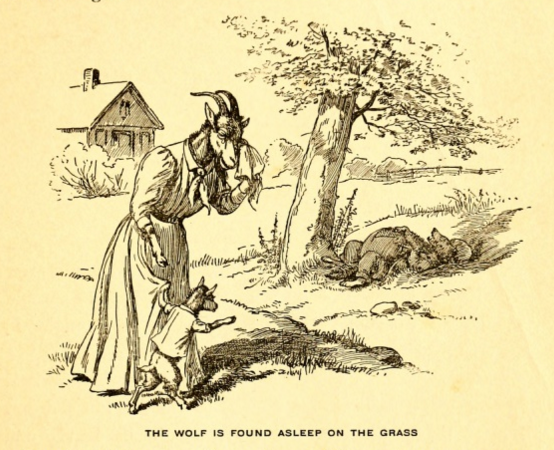
At length she and the kid went out for a walk. When they had gone a few steps, they saw the wolf, where he lay a-sleep on the grass, snor-ing so loud that he shook the leaves on the trees. The old goat looked at him with care and thought she could see some-thing move in-side of him. "Can it be, " she thought, "that my young ones whom he ate are still a-live?"
She at once sent the young kid home for the shears, and with them she cut the wolf o-pen. She had just made a small slit, when one of the kids put his head out. She cut some more, and out it sprang, and then an-oth-er, and an-oth-er, till all were out, as full of life as ever, for the wolf had been so gree-dy that he swal- lowed them whole and had not hurt them a bit. Oh, it was a time of joy! The kids danced and jumped a-bout, they were so full of glee.
But the old goat said to them, "Go and get some stones, and we will put them in-side of this scamp, and sew him up be-fore he wakes."
So the kids ran in great haste and brought large stones, which they put in-side of the wolf. Then the old goat sewed up the slit and the wolf did not wake nor move.
When the wolf's sleep was out, he got up, and as the stones gave him a great thirst, he went to a brook for a drink. As he stooped to drink, the weight of the stones made him fall in-to the wa-ter, and he was drowned.
Then the six young ones gave a shout, "The wolf is dead! The wolf is dead!" and they and their moth-er danced for joy all the way home.
Story of the Day: The Judgment of Baboon
Here is another cumulative tale which includes an elephant, this time from South Africa! The story source is South-African Folk-Tales, by James A. Honey (1910), with the thee/thou style updated to modern "you" for ease of reading.


(baboon)

The Judgment of Baboon
One day, it is said, the following story happened:
Mouse had torn the clothes of Itkler (the tailor), who then went to Baboon and accused Mouse with these words: "In this manner I come to you: Mouse has torn my clothes, but will not know anything of it and accuses Cat; Cat protests likewise her innocence, and says, 'Dog must have done it, but Dog denies it also, and declares Wood has done it; and Wood throws the blame on Fire, and says, 'Fire did it;' Fire says, 'I have not, Water did it;' Water says, 'Elephant tore the clothes;' and Elephant says, 'Ant tore them.' Thus a dispute has arisen among them. Therefore, I, Itkler, come to you with this proposition: Assemble the people and try them in order that I may get satisfaction."
Thus he spoke, and Baboon assembled them for trial. Then they made the same excuses which had been mentioned by Itkler, each one putting the blame upon the other.
So Baboon did not see any other way of punishing them, save through making them punish each other; he therefore said, "Mouse, give Itkler satisfaction."
Mouse, however, pleaded not guilty. But Baboon said,
Cat, bite Mouse.
She did so.He then put the same question to Cat, and when she exculpated herself, Baboon called to Dog,
Dog, bite Cat.
In this manner Baboon questioned them all, one after the other, but they each denied the charge. Then he addressed the following words to them, and said,
Wood, beat Dog.
Fire, burn Wood.
Water, quench Fire.
Elephant, drink Water.
Ant, bite Elephant in his most tender parts.
They did so, and since that day they cannot any longer agree with each other.
Ant enters into Elephant's most tender parts and bites him.

(elephant)

Elephant swallows Water.
Water quenches Fire.
Fire consumes Wood.
Wood beats Dog.
Dog bites Cat.
And Cat bites Mouse.
Through this judgment Itkler got satisfaction, and addressed Baboon in the following manner: "Yes! Now I am content, since I have received satisfaction, and with all my heart I thank you, Baboon, because you have exercised justice on my behalf and given me redress."
Then Baboon said, "From to-day I will not any longer be called Jan, but Baboon shall be my name."
Since that time Baboon walks on all fours, having probably lost the privilege of walking erect through this foolish judgment.
Story of the Day: The Louse and the Crow
This is another cumulative tale in which an elephant appears (by virtue of its size), and, like The Little Blackbird, this comes from Indian Folk Tales: Being Side-lights on Village Life in Bilaspore, Central Provinces by E. M. Gordon (1908).The defiant little louse may remind you of a character in another chain tale: the Gingerbread Man!
Once a louse and a crow made a covenant of friendship. The louse said to the crow, "Go friend and bring me some fire." So the crow brought his friend the louse some fire. Then said the louse, "Now, friend, I will broil and eat you."
The crow replied, "If I strike you once with my beak, you will disappear. How then can you talk of eating me?" But the louse broiled and ate his friend the crow.
Passing on, the louse came across a loaf of bread which a man was cooking on the fire. Then said the louse to the loaf of bread, "I will eat you, my friend." But the bread replied that the louse would be scorched in the fire and how could he eat the bread. But the louse ate the bread also.
Passing on, the louse met a she-goat. To the goat he said, "I am about to feast on you." The goat replied that if she would trample on the louse, he would be reduced to nothing. The louse replied that he had eaten the crow and the loaf of bread and he could eat the goat also. And he quickly finished the goat.
Passing on, the louse met a cow. To the cow he said, "I am about to eat you, O cow."
But the cow replied, "If I trample you underfoot, you will be reduced to nothing."
The louse said, "If I have eaten the crow and the bread and the goat, what then can hinder me from eating you?" So he ate the cow also.
Passing on, the louse met a buffalo. To the buffalo the louse said, "I will eat you also."
But the buffalo replied, "I have but to tread on you and you will be nowhere." Then the louse ate the buffalo also.
The louse next met five strong sepoys. To the sepoys the louse said, "I am about to eat you five men."
The sepoys replied, "You will lose yourself in the head of but one of us and here you speak of feasting on us five warriors." But true to his word the louse ate the five sepoys.

Next the louse met a wedding procession in which there were one lakh (a hundred thousand) of people. Addressing them the louse said that he would eat them. The men replied that the louse would be lost in the head of but one man and how then could he speak of eating a hundred thousand people. But the louse replied that he had eaten first the crow, then the loaf, then the goat and the cow and the buffalo and the five sepoys, and he would certainly eat the hundred thousand people in the procession and he quickly devoured the whole number.

Next the louse came upon an elephant and to the elephant the louse said, "I will eat you in no time." The elephant replied that he could blow away the louse with but one puff of breath from his trunk. The louse then related how he had eaten the crow, the loaf, etc. etc., and accordingly he ate the elephant also.
Now the louse, being thirsty, came across a huge tank of water. Said the louse to the tank, "I am about to drink in all of your water." The tank replied that the louse would be washed away with but one wave from the waters of the tank and how then could he talk of drinking in the waters of the tank. The louse again proceeded to narrate how he had eaten the crow, the loaf the goat etc. etc., and the louse then drank in all the waters of the tank.
Now it so happened that some women came as usual to fill the vessels of water at the tank and to their great astonishment they found that the waters had disappeared. While they were looking around, one of the women who had but one eye spied on the bank of the tank a small shining object which proved to be the louse. Said the woman, "This surely is the creature which has drunk the waters of our tank."
Just then a strong sepoy came along to have a drink at the tank. The women showed him the louse which had taken up all the water. This strong warrior immediately drew his sharp sword and with one stroke he cut in two the greedy louse.
Immediately the crow appeared and the loaf and the goat, the cow, the buffalo, the five men, the one lakh of people, the elephant also, and the waters of the tank. Each of these went to their respective places and the women, after thanking the brave sepoy who had befriended them, filled their water pots as usual and went to their homes.
800 words
The Louse and the Crow
Once a louse and a crow made a covenant of friendship. The louse said to the crow, "Go friend and bring me some fire." So the crow brought his friend the louse some fire. Then said the louse, "Now, friend, I will broil and eat you."
The crow replied, "If I strike you once with my beak, you will disappear. How then can you talk of eating me?" But the louse broiled and ate his friend the crow.
Passing on, the louse came across a loaf of bread which a man was cooking on the fire. Then said the louse to the loaf of bread, "I will eat you, my friend." But the bread replied that the louse would be scorched in the fire and how could he eat the bread. But the louse ate the bread also.
Passing on, the louse met a she-goat. To the goat he said, "I am about to feast on you." The goat replied that if she would trample on the louse, he would be reduced to nothing. The louse replied that he had eaten the crow and the loaf of bread and he could eat the goat also. And he quickly finished the goat.
Passing on, the louse met a cow. To the cow he said, "I am about to eat you, O cow."
But the cow replied, "If I trample you underfoot, you will be reduced to nothing."
The louse said, "If I have eaten the crow and the bread and the goat, what then can hinder me from eating you?" So he ate the cow also.
Passing on, the louse met a buffalo. To the buffalo the louse said, "I will eat you also."
But the buffalo replied, "I have but to tread on you and you will be nowhere." Then the louse ate the buffalo also.
The louse next met five strong sepoys. To the sepoys the louse said, "I am about to eat you five men."
The sepoys replied, "You will lose yourself in the head of but one of us and here you speak of feasting on us five warriors." But true to his word the louse ate the five sepoys.

(from Armies of India, 1911)
Next the louse met a wedding procession in which there were one lakh (a hundred thousand) of people. Addressing them the louse said that he would eat them. The men replied that the louse would be lost in the head of but one man and how then could he speak of eating a hundred thousand people. But the louse replied that he had eaten first the crow, then the loaf, then the goat and the cow and the buffalo and the five sepoys, and he would certainly eat the hundred thousand people in the procession and he quickly devoured the whole number.

Next the louse came upon an elephant and to the elephant the louse said, "I will eat you in no time." The elephant replied that he could blow away the louse with but one puff of breath from his trunk. The louse then related how he had eaten the crow, the loaf, etc. etc., and accordingly he ate the elephant also.
Now the louse, being thirsty, came across a huge tank of water. Said the louse to the tank, "I am about to drink in all of your water." The tank replied that the louse would be washed away with but one wave from the waters of the tank and how then could he talk of drinking in the waters of the tank. The louse again proceeded to narrate how he had eaten the crow, the loaf the goat etc. etc., and the louse then drank in all the waters of the tank.
Now it so happened that some women came as usual to fill the vessels of water at the tank and to their great astonishment they found that the waters had disappeared. While they were looking around, one of the women who had but one eye spied on the bank of the tank a small shining object which proved to be the louse. Said the woman, "This surely is the creature which has drunk the waters of our tank."
Just then a strong sepoy came along to have a drink at the tank. The women showed him the louse which had taken up all the water. This strong warrior immediately drew his sharp sword and with one stroke he cut in two the greedy louse.
Immediately the crow appeared and the loaf and the goat, the cow, the buffalo, the five men, the one lakh of people, the elephant also, and the waters of the tank. Each of these went to their respective places and the women, after thanking the brave sepoy who had befriended them, filled their water pots as usual and went to their homes.
800 words
Story of the Day: The Little Blackbird
I learned about this cumulative tale thanks to Dan Ashliman's collection of tales of Aarne-Thompson type 2034D. The source is Indian Folk Tales: Being Side-lights on Village Life in Bilaspore, Central Provinces by E. M. Gordon (1908). The elephant is just one "link" in the chain as it were, but I love chain tales, so I wanted to include this story in the Elephant unit.

There was once a little blackbird (the litia) who was the proud owner of three kauries, or shells. This bird used to come to a king and say, "O king, I have three kauries, O king."
The king was so much annoyed by the continual chirping of the little bird that he ordered his servants to take the three kauries from the bird and to drive it away. But the bird would not leave the king, and so it began to say, "My wealth has made you rich, O king. My wealth has made you rich, O king."
The king then ordered that the three kauries should be returned to the little blackbird. The bird then took the three kauries, and went to the seller of parched gram (a coarse pea), and with the three kauries she bought three grains of parched gram.
Taking these, the bird flew off and sat on a new cart which a carpenter was making, and there she started eating the gram. Having eaten two grains, she was about to eat the third, when it dropped from her beak and fell into a joint of the new cart, where she could not reach it. In great distress she appealed to the carpenter to take to pieces his cart that she might get at the grain she had lost.
"You silly little thing," said the carpenter. "Do you suppose I am going to take to pieces my new cart to get at a single grain which you have dropped into the joint of the woodwork?"
The little blackbird then went to the king, and said to him that she had lost her grain, and asked him to order the carpenter to open his cart that she might get at her grain. "You silly little thing," said the king. "Do you suppose I am going to order the carpenter to open his cart that you may get one small grain?"
The little blackbird then went to the queen, and begged of her to persuade the king to order the carpenter to open the cart to let her get at the grain. But the queen also said, "Get away, you silly thing."
Then the little blackbird went to a deer and said, "Come, O deer, graze in the queen's garden, for she will not persuade the king, and the king will not order the carpenter, and the carpenter will not open the cart, and I cannot get at my grain." But the deer would give to heed to the bird, and called her "You silly little thing."
Then said the bird, "I will go to the lathi (the strong, stout stick)." To the stick she went and said, "Come, stout stick, strike the deer, for the deer will not graze in the queen's garden, and the queen will not persuade the king, and the king will not command the carpenter, and the carpenter will not open his cart, and I cannot get at my grain."
But the stick also would give no ear to the cry of the little blackbird, so she went at once to the fire, and she begged the fire to burn the stick, for the deer would not eat the queen's garden, and the queen would not persuade the king, the king would not command the carpenter, the carpenter would not break up his cart, and she could not get at her grain. But the fire also made light of the little bird's prayer.
So she went next to the lake, and implored the lake to quench the fire, for the fire would not burn the stick, and the stick would not strike the deer, and the deer would not destroy the garden, and the queen would not persuade the king, and the king refused to command the carpenter, who also refused to open his cart, so that the bird could not get at her grain. But the lake refused to help the bird.
She then went to a place where there were thousands of rats, and to the rats she presented her prayer that they should come and fill the lake with their diggings, for the lake would not quench the fire, for the fire would not burn the stick, and the stick would not strike the deer, and the deer would not destroy the garden, and the queen would not persuade the king, and the king refused to command the carpenter, who also refused to open his cart, so that the bird could not get at her grain. But the rats also gave no attention to the wishes of the small blackbird.
Then the bird went to a cat, and of the cat she implored that she should attack the rats, for the rats would not fill in the lake, and the lake would not quench the fire, for the fire would not burn the stick, and the stick would not strike the deer, and the deer would not destroy the garden, and the queen would not persuade the king, and the king refused to command the carpenter, who also refused to open his cart, so that the bird could not get at her grain. But the cat also was deaf to the prayers of the small blackbird.
Then she went to the elephant, and of the elephant she implored that he would crush the cat, for the cat would not kill the rats, for the rats would not fill in the lake, and the lake would not quench the fire, for the fire would not burn the stick, and the stick would not strike the deer, and the deer would not destroy the garden, and the queen would not persuade the king, and the king refused to command the carpenter, who also refused to open his cart, so that the bird could not get at her grain. But the elephant treated her as did all the others.

Then she went to an ant, and begged the wee ant to crawl into the elephant's ear, for the elephant would not crush the cat, for the cat would not kill the rats, for the rats would not fill in the lake, and the lake would not quench the fire, for the fire would not burn the stick, and the stick would not strike the deer, and the deer would not destroy the garden, and the queen would not persuade the king, and the king refused to command the carpenter, who also refused to open his cart, so that the bird could not get at her grain. But the ant also gave no heed to her prayer.
Then at last she came to the crow, the most greedy of all creatures, and of the crow she begged that he should eat the ant. From sheer greed the crow consented to eat the ant, but the ant, seeing the crow about to eat it, went to crawl into the ear of the elephant, and the elephant, fearing the harm which the ant could do him, went to crush the cat, but the cat slipped away, and was about the destroy the rats, and they at once began to fill in the lake, and the lake, becoming alarmed, was about to quench the fire, when the fire began to burn the stick, and the stick began to beat the deer, so that the deer was about to destroy the queen's garden, when the queen began to persuade the king, and the king commanded the carpenter, and the carpenter opened his new cart, and the little blackbird found her grain, and happily taking it up she flew away, and quietly enjoyed her repast, and lived very happily ever after.
The Little Blackbird


The king was so much annoyed by the continual chirping of the little bird that he ordered his servants to take the three kauries from the bird and to drive it away. But the bird would not leave the king, and so it began to say, "My wealth has made you rich, O king. My wealth has made you rich, O king."
The king then ordered that the three kauries should be returned to the little blackbird. The bird then took the three kauries, and went to the seller of parched gram (a coarse pea), and with the three kauries she bought three grains of parched gram.
Taking these, the bird flew off and sat on a new cart which a carpenter was making, and there she started eating the gram. Having eaten two grains, she was about to eat the third, when it dropped from her beak and fell into a joint of the new cart, where she could not reach it. In great distress she appealed to the carpenter to take to pieces his cart that she might get at the grain she had lost.
"You silly little thing," said the carpenter. "Do you suppose I am going to take to pieces my new cart to get at a single grain which you have dropped into the joint of the woodwork?"
The little blackbird then went to the king, and said to him that she had lost her grain, and asked him to order the carpenter to open his cart that she might get at her grain. "You silly little thing," said the king. "Do you suppose I am going to order the carpenter to open his cart that you may get one small grain?"
The little blackbird then went to the queen, and begged of her to persuade the king to order the carpenter to open the cart to let her get at the grain. But the queen also said, "Get away, you silly thing."
Then the little blackbird went to a deer and said, "Come, O deer, graze in the queen's garden, for she will not persuade the king, and the king will not order the carpenter, and the carpenter will not open the cart, and I cannot get at my grain." But the deer would give to heed to the bird, and called her "You silly little thing."
Then said the bird, "I will go to the lathi (the strong, stout stick)." To the stick she went and said, "Come, stout stick, strike the deer, for the deer will not graze in the queen's garden, and the queen will not persuade the king, and the king will not command the carpenter, and the carpenter will not open his cart, and I cannot get at my grain."
But the stick also would give no ear to the cry of the little blackbird, so she went at once to the fire, and she begged the fire to burn the stick, for the deer would not eat the queen's garden, and the queen would not persuade the king, the king would not command the carpenter, the carpenter would not break up his cart, and she could not get at her grain. But the fire also made light of the little bird's prayer.
So she went next to the lake, and implored the lake to quench the fire, for the fire would not burn the stick, and the stick would not strike the deer, and the deer would not destroy the garden, and the queen would not persuade the king, and the king refused to command the carpenter, who also refused to open his cart, so that the bird could not get at her grain. But the lake refused to help the bird.
She then went to a place where there were thousands of rats, and to the rats she presented her prayer that they should come and fill the lake with their diggings, for the lake would not quench the fire, for the fire would not burn the stick, and the stick would not strike the deer, and the deer would not destroy the garden, and the queen would not persuade the king, and the king refused to command the carpenter, who also refused to open his cart, so that the bird could not get at her grain. But the rats also gave no attention to the wishes of the small blackbird.
Then the bird went to a cat, and of the cat she implored that she should attack the rats, for the rats would not fill in the lake, and the lake would not quench the fire, for the fire would not burn the stick, and the stick would not strike the deer, and the deer would not destroy the garden, and the queen would not persuade the king, and the king refused to command the carpenter, who also refused to open his cart, so that the bird could not get at her grain. But the cat also was deaf to the prayers of the small blackbird.
Then she went to the elephant, and of the elephant she implored that he would crush the cat, for the cat would not kill the rats, for the rats would not fill in the lake, and the lake would not quench the fire, for the fire would not burn the stick, and the stick would not strike the deer, and the deer would not destroy the garden, and the queen would not persuade the king, and the king refused to command the carpenter, who also refused to open his cart, so that the bird could not get at her grain. But the elephant treated her as did all the others.

(elephant)

Then she went to an ant, and begged the wee ant to crawl into the elephant's ear, for the elephant would not crush the cat, for the cat would not kill the rats, for the rats would not fill in the lake, and the lake would not quench the fire, for the fire would not burn the stick, and the stick would not strike the deer, and the deer would not destroy the garden, and the queen would not persuade the king, and the king refused to command the carpenter, who also refused to open his cart, so that the bird could not get at her grain. But the ant also gave no heed to her prayer.
Then at last she came to the crow, the most greedy of all creatures, and of the crow she begged that he should eat the ant. From sheer greed the crow consented to eat the ant, but the ant, seeing the crow about to eat it, went to crawl into the ear of the elephant, and the elephant, fearing the harm which the ant could do him, went to crush the cat, but the cat slipped away, and was about the destroy the rats, and they at once began to fill in the lake, and the lake, becoming alarmed, was about to quench the fire, when the fire began to burn the stick, and the stick began to beat the deer, so that the deer was about to destroy the queen's garden, when the queen began to persuade the king, and the king commanded the carpenter, and the carpenter opened his new cart, and the little blackbird found her grain, and happily taking it up she flew away, and quietly enjoyed her repast, and lived very happily ever after.
Story of the Day: The Elephant-Fighting Hare
This is another story for the Elephant unit! It's another story from India, this time from Indian Fables and Folklore by Shovona Devi (1919) — it's The Elephant-Fighting Hare. It's a wonderful story about a trickster hare who not only outwits an elephant: he outwits the whole elephant herd!

Once upon a time, a little hare saw a herd of elephants in a wood and challenged their leader to a fight, but the latter went on breaking off branches and putting these into his capacious mouth, only now and then winking at the hare out of the corner of one eye.
The hare thought the elephant was unwilling to fight, so he called him a coward. The elephant then lost his temper and went straight at the saucy little thing with trunk up, bellowing, but the hare, with the characteristic nimbleness of its race, kept dodging him about, slipping in and out, round and under him, among his legs.
All of a sudden the mighty animal flung himself down, as if to crush his puny enemy under his Juggernaut weight, but the hare slipped out by his tail and, clambering on to the elephant's back, lay down there quietly.
The elephant, no more conscious of its presence than the wheel was of the fly sitting on it, still kept pressing himself to the ground, as if to crush to pulp the impudent hare supposed to be beneath him.
The other elephants, seeing the hare lying on the back of their leader, fancied it must be keeping him down by superior physical force, so they became frightened and bolted.
The leader of the herd, finding himself thus deserted by his companions and tormented by an army of ants that his gusty breathing had drawn into his nostrils, then rose and dashed away. Thus were the elephants vanquished by the hare.
(300 words)

The Elephant-Fighting Hare
The hare thought the elephant was unwilling to fight, so he called him a coward. The elephant then lost his temper and went straight at the saucy little thing with trunk up, bellowing, but the hare, with the characteristic nimbleness of its race, kept dodging him about, slipping in and out, round and under him, among his legs.
All of a sudden the mighty animal flung himself down, as if to crush his puny enemy under his Juggernaut weight, but the hare slipped out by his tail and, clambering on to the elephant's back, lay down there quietly.
The elephant, no more conscious of its presence than the wheel was of the fly sitting on it, still kept pressing himself to the ground, as if to crush to pulp the impudent hare supposed to be beneath him.
The other elephants, seeing the hare lying on the back of their leader, fancied it must be keeping him down by superior physical force, so they became frightened and bolted.
The leader of the herd, finding himself thus deserted by his companions and tormented by an army of ants that his gusty breathing had drawn into his nostrils, then rose and dashed away. Thus were the elephants vanquished by the hare.
(300 words)
Story of the Day: The Blind Men and the Elephant
This is a story I am posting here for future inclusion in the (upcoming) Elephant unit. It is in the form of a poem by John Godfrey Saxe (The Poems of John Godfrey Saxe, 1876), and I found it online at Dan Ashliman's collection of stories of this type: The Blind Men and the Elephant (Folktales of Aarne-Thompson-Uther Type 1317). There is also an article about this famous story at Wikipedia.


(Blind Men and the Elephant, Thailand)

I.
It was six men of Indostan
To learning much inclined,
Who went to see the Elephant
(Though all of them were blind),
That each by observation
Might satisfy his mind.
II.
The First approached the Elephant,
And happening to fall
Against his broad and sturdy side, At once began to bawl:
"God bless me! -- but the Elephant
Is very like a wall!"
III.
The Second, feeling of the tusk,
Cried: "Ho! -- what have we here
So very round and smooth and sharp?
To me 't is mighty clear
This wonder of an Elephant
Is very like a spear!"
IV.
The Third approached the animal,
And happening to take
The squirming trunk within his hands,
Thus boldly up and spake:
"I see," quoth he, "the Elephant
Is very like a snake!"
V.
The Fourth reached out his eager hand,
And felt about the knee.
"What most this wondrous beast is like
Is mighty plain," quoth he; "'T is clear enough the Elephant
Is very like a tree!"
VI.
The Fifth, who chanced to touch the ear,
Said: "E'en the blindest man
Can tell what this resembles most;
Deny the fact who can,
This marvel of an Elephant
Is very like a fan!"
VII.
The Sixth no sooner had begun
About the beast to grope,
Than, seizing on the swinging tail
That fell within his scope,
"I see," quoth he, "the Elephant
Is very like a rope!"
VIII.
And so these men of Indostan
Disputed loud and long,
Each in his own opinion
Exceeding stiff and strong,
Though each was partly in the right,
And all were in the wrong.
MORAL.
So, oft in theologic wars
The disputants, I ween,
Rail on in utter ignorance
Of what each other mean,
And prate about an Elephant
Not one of them has seen!
Story of the Day: The Lion and the Elephant
This is a story I am posting here for future inclusion in the (upcoming) Elephant unit. It is an Aesop's fable, and the translation below comes from Aesop's Fables: A New Translation by V.S. Vernon Jones with illustrations by Arthur Rackham (1912). This book is available online at Project Gutenberg.

The joke of the fable depends on two ancient Greek folk beliefs about these creatures: the mighty lion was supposedly afraid of the rooster's cock-a-doodle-doo, and the mighty elephant was supposedly afraid of the gnat. The Greek version of this fable is actually about Prometheus, rather than about Jupiter. You can learn more about Prometheus and his role as a creator in this Wikipedia article.
The Lion and the Elephant
The Lion, for all his size and strength, and his sharp teeth and claws, is a coward in one thing: he can't bear the sound of a cock crowing, and runs away whenever he hears it.
He complained bitterly to Jupiter for making him like that, but Jupiter said it wasn't his fault: he had done the best he could for him, and, considering this was his only failing, he ought to be well content.
The Lion, however, wouldn't be comforted, and was so ashamed of his timidity that he wished he might die.
In this state of mind, he met the Elephant and had a talk with him. He noticed that the great beast cocked up his ears all the time, as if he were listening for something, and he asked him why he did so.
Just then a gnat came humming by, and the Elephant said, "Do you see that wretched little buzzing insect? I'm terribly afraid of its getting into my ear: if it once gets in, I'm dead and done for."
The Lion's spirits rose at once when he heard this: "For," he said to himself, "if the Elephant, huge as he is, is afraid of a gnat, I needn't be so much ashamed of being afraid of a cock, who is ten thousand times bigger than a gnat."
Story of the Day: The Crab and the Elephant
This is a story I am posting here for future inclusion in the (upcoming) Elephant unit. It is a Jataka tale from Jataka Tales, edited by H. T. Francis and E. J. Thomas (1916).
In this story, the Buddha, born as an elephant, defeats a monstrous crab, with help provided at a crucial moment by the loyal she-elephant who is his wife.
The end of the story provides an explanation of the origin of the Drum and the Drum.

Once on a time, when Brahmadatta was king of Benares, there was a great lake in Himalaya, wherein was a great golden Crab. Because he lived there, the place was known as the Crab Tarn [Crab Lake].
The Crab was very large, as big round as a threshing floor; it would catch elephants, and kill and eat them, and from fear of it the elephants durst not go down and browse there.
Now the Bodhisatta was conceived by the mate of an elephant, the leader of a herd, living hard by this Crab Lake. The mother, in order to be safe till her delivery, sought another place on a mountain, and there she was delivered of a son, who in due time grew to years of wisdom, and was great and mighty, and prospered, and he was like a purple mountain of collyrium.
He chose another elephant for his mate, and he resolved to catch this Crab. So with his mate and his mother, he sought out the elephant herd, and finding his father, proposed to go and catch the Crab.
"You will not be able to do that, my son," said he.
But he begged the father again and again to give him leave, until at last he said, "Well, you may try."
So the young Elephant collected all the elephants beside the Crab Lake, and led them close by the lake. "Does the Crab catch them when they go down, or while they are feeding, or when they come up again?"
They replied, "When the beasts come up again."
"Well then," said he, "do you all go down to the lake and eat whatever you see, and come up first; I will follow last behind you." And so they did.
Then the Crab, seeing the Bodhisatta coming up last, caught his feet tight in his claw, like a smith who seizes a lump of iron in a huge pair of tongs. The Bodhisatta's mate did not leave him, but stood there close by him.
The Bodhisatta pulled at the Crab, but could not make him budge. Then the Crab pulled, and drew him towards himself. At this in deadly fear the Elephant roared and roared; hearing which all the other elephants, in deadly terror, ran off trumpeting and dropping excrement. Even his mate could not stand, but began to make off.
Then to tell her how he was held a prisoner, he uttered the first stanza, hoping to stay her from her flight:
"Gold-clawed creature with projecting eyes,
Lake-bred, hairless, clad in bony shell,
He has caught me! Hear my woful cries!
Mate! Don't leave me — for you love me well!"
Then his mate turned round, and repeated the second stanza to his comfort:
"Leave you? Never! Never will I go —
Noble husband, with your years threescore.
All four quarters of the earth can show
None so dear as thou hast been of yore."
This way she encouraged him, and saying, "Noble sir, now I will talk to the Crab a while to make him let you go," she addressed the Crab in the third stanza:
"Of all the crabs that in the sea,
Ganges, or Nerbudda be,
You are best and chief, I know:
Hear me — let my husband go!"
As she spoke thus, the Crab's fancy was smitten with the sound of the female voice, and forgetting all fear he loosed his claws from the Elephant's leg, and suspected nothing of what he would do when he was set free.
Then the Elephant lifted his foot, and stepped upon the Crab's back; and at once his eyes started out.
The Elephant shouted the joy-cry. Up ran the other elephants all, pulled the Crab along and set him upon the ground, and trampled him to mincemeat. His two claws broken from his body lay apart.
And this Crab Lake, being near the Ganges, when there was a flood in the Ganges, was filled with Ganges water; when the water subsided it ran from the lake into the Ganges.
Then these two claws were lifted and floated along the Ganges. One of them reached the sea; the other was found by the ten royal brothers while playing in the water, and they took it and made of it the little drum called Anaka.
The Titans [Asuras] found that which reached the sea, and made it into the drum called Alambara. These afterwards being worsted in battle with Sakka [Indra, King of the Gods], ran off and left it behind. Then Sakka caused it to be kept for his own use; and it is of this they say, "There is thunder like the Alambara cloud!"
In this story, the Buddha, born as an elephant, defeats a monstrous crab, with help provided at a crucial moment by the loyal she-elephant who is his wife.
The end of the story provides an explanation of the origin of the Drum and the Drum.
(Kakkata-Jataka)
Once on a time, when Brahmadatta was king of Benares, there was a great lake in Himalaya, wherein was a great golden Crab. Because he lived there, the place was known as the Crab Tarn [Crab Lake].
The Crab was very large, as big round as a threshing floor; it would catch elephants, and kill and eat them, and from fear of it the elephants durst not go down and browse there.
Now the Bodhisatta was conceived by the mate of an elephant, the leader of a herd, living hard by this Crab Lake. The mother, in order to be safe till her delivery, sought another place on a mountain, and there she was delivered of a son, who in due time grew to years of wisdom, and was great and mighty, and prospered, and he was like a purple mountain of collyrium.
He chose another elephant for his mate, and he resolved to catch this Crab. So with his mate and his mother, he sought out the elephant herd, and finding his father, proposed to go and catch the Crab.
"You will not be able to do that, my son," said he.
But he begged the father again and again to give him leave, until at last he said, "Well, you may try."
So the young Elephant collected all the elephants beside the Crab Lake, and led them close by the lake. "Does the Crab catch them when they go down, or while they are feeding, or when they come up again?"
They replied, "When the beasts come up again."
"Well then," said he, "do you all go down to the lake and eat whatever you see, and come up first; I will follow last behind you." And so they did.
Then the Crab, seeing the Bodhisatta coming up last, caught his feet tight in his claw, like a smith who seizes a lump of iron in a huge pair of tongs. The Bodhisatta's mate did not leave him, but stood there close by him.
The Bodhisatta pulled at the Crab, but could not make him budge. Then the Crab pulled, and drew him towards himself. At this in deadly fear the Elephant roared and roared; hearing which all the other elephants, in deadly terror, ran off trumpeting and dropping excrement. Even his mate could not stand, but began to make off.
Then to tell her how he was held a prisoner, he uttered the first stanza, hoping to stay her from her flight:
"Gold-clawed creature with projecting eyes,
Lake-bred, hairless, clad in bony shell,
He has caught me! Hear my woful cries!
Mate! Don't leave me — for you love me well!"
Then his mate turned round, and repeated the second stanza to his comfort:
"Leave you? Never! Never will I go —
Noble husband, with your years threescore.
All four quarters of the earth can show
None so dear as thou hast been of yore."
This way she encouraged him, and saying, "Noble sir, now I will talk to the Crab a while to make him let you go," she addressed the Crab in the third stanza:
"Of all the crabs that in the sea,
Ganges, or Nerbudda be,
You are best and chief, I know:
Hear me — let my husband go!"
As she spoke thus, the Crab's fancy was smitten with the sound of the female voice, and forgetting all fear he loosed his claws from the Elephant's leg, and suspected nothing of what he would do when he was set free.
Then the Elephant lifted his foot, and stepped upon the Crab's back; and at once his eyes started out.
The Elephant shouted the joy-cry. Up ran the other elephants all, pulled the Crab along and set him upon the ground, and trampled him to mincemeat. His two claws broken from his body lay apart.
And this Crab Lake, being near the Ganges, when there was a flood in the Ganges, was filled with Ganges water; when the water subsided it ran from the lake into the Ganges.
Then these two claws were lifted and floated along the Ganges. One of them reached the sea; the other was found by the ten royal brothers while playing in the water, and they took it and made of it the little drum called Anaka.
The Titans [Asuras] found that which reached the sea, and made it into the drum called Alambara. These afterwards being worsted in battle with Sakka [Indra, King of the Gods], ran off and left it behind. Then Sakka caused it to be kept for his own use; and it is of this they say, "There is thunder like the Alambara cloud!"
The Story of the Seven Sleepers
I've been adding new books to the Freebookapalooza blog, and I was excited to see the story of the Seven Sleepers in Stories of the Saints by Grace Hall.
You can read more about the Seven Sleepers at Wikipedia; this is like a "Rip van Winkle" story, and it is a famous legend in both the Christian and Muslim tradition.

Now, as to the Seven Sleepers, these were seven young Christians who lived in the time of the Emperor Decius. They were Maximian, Malchus, Marcus, Dionysius, John, Serapion, and Constantine. They were accused before the ruler because they refused to offer sacrifices to the gods, but they escaped to Mount Coelion [near Ephesus] and hid in a cavern. They were, however, betrayed and discovered as they slept, and by order of the Emperor were sealed into the cave.
But two Christian men, Theodorus and Rufinus, wrote an account of their martyrdom and laid the parchment, closed with silver seals, among the stones that blocked the cave's mouth.
Two hundred and eight years later, when the Christian Emperor Theodosius was reigning, he sorrowed over the heresy which had sprung up, denying the resurrection of the dead. Daily he retired to a secret place in his palace and mourned in sackcloth and ashes. God in the following manner rewarded and justified his faith.
A certain burgess of Ephesus, in digging to make a stable on Mount Coelion, came upon the cavern; the light and air entered it, and the sleepers awoke, thinking that they had slept but over night.
One of their number, Malchus, was selected to go to the city to buy food. He set forth with fear and trembling, supposing his life and that of his companions to be in great danger.
He advanced cautiously toward the city gate and was startled at the sight of a cross placed above it. He tried another gate, there found another cross. He believed himself to be dreaming, but covering his face he entered the city and went to buy bread. Hearing everywhere the name of Christ spoken boldly and openly he was more and more puzzled.
Finally he arrived at a baker's and bought bread. In payment he offered a coin the like of which the baker had never seen; the baker therefore came to the conclusion that Malthus had found some ancient hidden treasure; he immediately accused him, and Malchus knew not what to say for dread. When the bystanders saw his confusion they put a cord round his neck and haled him before the consul and the bishop.
After much questioning, the truth was discovered, and Malchus led all the principal men of the city, followed by the multitude, to the cave in Mount Coelion. There within sat the other youths, "their visages like unto roses flowering" and shining like the sun. Also they found the letter of Theodorus and Rufinus, sealed with its seals of silver, among the displaced stones at the mouth of the cave.
The Emperor was sent for and came in haste. Entering the cave, he with tears embraced each of the seven, saying: "I see you as if I should see our Lord raising Lazarus!"
Maximian then said to him: "Believe us, O Emperor, for our Lord has raised us before the Day of Judgment to the end that thou believe firmly in the resurrection of the dead!"
After these words, they all inclined their heads to the earth, and rendered up their spirits to God.
The Emperor wished to make sepulchres of gold and silver for them, but they appeared to him that night and bade him suffer them to remain on the earth of the cave (on their right side), as they had so long lain, until the day of the final resurrection.
Here is a Russian icon that depicts the sleepers:

You can read more about the Seven Sleepers at Wikipedia; this is like a "Rip van Winkle" story, and it is a famous legend in both the Christian and Muslim tradition.


THE SEVEN SLEEPERS by Grace Hall
Now, as to the Seven Sleepers, these were seven young Christians who lived in the time of the Emperor Decius. They were Maximian, Malchus, Marcus, Dionysius, John, Serapion, and Constantine. They were accused before the ruler because they refused to offer sacrifices to the gods, but they escaped to Mount Coelion [near Ephesus] and hid in a cavern. They were, however, betrayed and discovered as they slept, and by order of the Emperor were sealed into the cave.
But two Christian men, Theodorus and Rufinus, wrote an account of their martyrdom and laid the parchment, closed with silver seals, among the stones that blocked the cave's mouth.
Two hundred and eight years later, when the Christian Emperor Theodosius was reigning, he sorrowed over the heresy which had sprung up, denying the resurrection of the dead. Daily he retired to a secret place in his palace and mourned in sackcloth and ashes. God in the following manner rewarded and justified his faith.
A certain burgess of Ephesus, in digging to make a stable on Mount Coelion, came upon the cavern; the light and air entered it, and the sleepers awoke, thinking that they had slept but over night.
One of their number, Malchus, was selected to go to the city to buy food. He set forth with fear and trembling, supposing his life and that of his companions to be in great danger.
He advanced cautiously toward the city gate and was startled at the sight of a cross placed above it. He tried another gate, there found another cross. He believed himself to be dreaming, but covering his face he entered the city and went to buy bread. Hearing everywhere the name of Christ spoken boldly and openly he was more and more puzzled.
Finally he arrived at a baker's and bought bread. In payment he offered a coin the like of which the baker had never seen; the baker therefore came to the conclusion that Malthus had found some ancient hidden treasure; he immediately accused him, and Malchus knew not what to say for dread. When the bystanders saw his confusion they put a cord round his neck and haled him before the consul and the bishop.
After much questioning, the truth was discovered, and Malchus led all the principal men of the city, followed by the multitude, to the cave in Mount Coelion. There within sat the other youths, "their visages like unto roses flowering" and shining like the sun. Also they found the letter of Theodorus and Rufinus, sealed with its seals of silver, among the displaced stones at the mouth of the cave.
The Emperor was sent for and came in haste. Entering the cave, he with tears embraced each of the seven, saying: "I see you as if I should see our Lord raising Lazarus!"
Maximian then said to him: "Believe us, O Emperor, for our Lord has raised us before the Day of Judgment to the end that thou believe firmly in the resurrection of the dead!"
After these words, they all inclined their heads to the earth, and rendered up their spirits to God.
The Emperor wished to make sepulchres of gold and silver for them, but they appeared to him that night and bade him suffer them to remain on the earth of the cave (on their right side), as they had so long lain, until the day of the final resurrection.
Here is a Russian icon that depicts the sleepers:

Subscribe to:
Posts (Atom)