Showing posts with label Unit: Aesop (Winter). Show all posts

Myth-Folklore Unit: Aesop for Children (Winter)

Overview. The story source for this unit is The Aesop for Children, a collection of Aesop's fables with artwork by Milo Winter, a well known book illustrator; the name of the English translator remains a mystery; I have not been able to find out just who prepared the English versions of the fables that appear in this book, although they are very nicely done! While most of the fables contained in this unit come from the Greek and Roman tradition, there are also some fables here that the French fabulist La Fontaine borrowed from India and blended with the Aesopic tradition, such as the story of the tortoise who went flying his friends the ducks or the story of the monkey who became the proverbial "cat's paw." This reading unit also has an audio recording available from LibriVox (the other Aesop unit does not have audio available).

Language. The language used here is very contemporary and intended for a young audience. It should not cause you any trouble at all.

Navigation. You will find the table of contents below, and you can also use this link to see the story posts displayed on two pages total: Aesop for Children. Click "Older Posts" at the bottom of that page to see the second page.

Notes. This unit does not have notes on every page yet, so please feel free to ask questions if something is not clear — and your questions will help me write better notes, too! You can ask your question by leaving a comment, just like at any other blog. You can also rate each page with the star ratings checkbox at the bottom of each post. Your feedback and questions are much appreciated!

Choosing Between Units. As you will see, there are two Aesop units available in the Classical module: this unit with illustrations by Milo Winter and the unit with Aesop's fables by Joseph Jacobs with the illustrations by Walter Crane. If you are really into Aesop's fables, you can do both units if you want; there is not any overlap between the actual fables in the unit! To create this unit, I took the Milo Winters book and simply removed all the fables that appear in Jacobs. So, if you do them both, you will be a real Aesop expert! If you are going to do Aesop for just one week, the most important difference between the two units is that the Jacobs unit does not have a free audiobook version, but this unit does have a free audiobook version available.

Connecting Units. The fables of Aesop have been both popular and influential for over 200 years! In addition to the two Aesop units in the Classical module, you will find a unit of Aesop's Fables in English Poetry and Prose in the British Isles modules, and the Fables of the French Poet La Fontaine in the European module. In addition, there are close connections between Aesop's fables and the "jataka tales" of the Buddhist tradition, and there are two jataka units in the India module: Babbitt's Jataka Tales and Shedlock's Jataka Tales.

Read More. If you enjoyed the stories selected for this unit, you might enjoy reading the whole book, which is freely available online in many convenient formats include an online book view at Hathi Trust (includes pictures) and a free Kindle ebook (fables only; no pictures).

Additional Resources. There is an Aesop Index page for all the fables in the various Aesop units in this course, and you can use this link to see the four different Aesop units listed on a single page. If you would like to see all 600 of the fables that are part of the Greek and Roman Aesop tradition, you can find a listing at Aesopica.net. For an overview of the history of Aesop's fables, see Wikipedia.


There is really no rhyme or reason to the arrangement of the fables in this book, but I have not rearranged them into related groups since that would make it impossible to link to the audio files. The LibriVox recordings are done in sets of four. In some cases, all four of those fables are part of the reading unit, but in other cases you will see that only some of the fables are included from a given audio file:


READING A

READING B


Aesop (Winter): Page 1

The second fable on this page about the flying tortoise is an unusual amalgamation of two different stories. As you will see, the fable begins with the story of how the tortoise got its shell as a punishment; you can read that fable here: Zeus and the Tortoise. Then, in the second part of the fable, you will read an adaptation of an ancient fable from India, made popular by the French writer La Fontaine, of the tortoise who wanted to fly. For the Indian version of the story, see this Buddhist jataka tale: The Turtle Who Couldn't Stop Talking.

[Notes by LKG]

These stories are part of the Aesop (Winter) unit. Story source: The Aesop for Children, with illustrations by Milo Winter (1919).


The Wolf and the Kid


There was once a little Kid whose growing horns made him think he was a grown-up Billy Goat and able to take care of himself. So one evening when the flock started home from the pasture and his mother called, the Kid paid no heed and kept right on nibbling the tender grass. A little later when he lifted his head, the flock was gone.

He was all alone. The sun was sinking. Long shadows came creeping over the ground. A chilly little wind came creeping with them making scary noises in the grass. The Kid shivered as he thought of the terrible Wolf. Then he started wildly over the field, bleating for his mother. But not half-way, near a clump of trees, there was the Wolf!

The Kid knew there was little hope for him.

"Please, Mr. Wolf," he said trembling, "I know you are going to eat me. But first please pipe me a tune, for I want to dance and be merry as long as I can."

The Wolf liked the idea of a little music before eating, so he struck up a merry tune and the Kid leaped and frisked gaily.

Meanwhile, the flock was moving slowly homeward. In the still evening air the Wolf's piping carried far. The Shepherd Dogs pricked up their ears. They recognized the song the Wolf sings before a feast, and in a moment they were racing back to the pasture.

The Wolf's song ended suddenly, and as he ran, with the Dogs at his heels, he called himself a fool for turning piper to please a Kid, when he should have stuck to his butcher's trade.

Do not let anything turn you from your purpose.


The Tortoise and the Ducks

The Tortoise, you know, carries his house on his back. No matter how hard he tries, he cannot leave home. They say that Jupiter punished him so, because he was such a lazy stay-at-home that he would not go to Jupiter's wedding, even when especially invited.

After many years, Tortoise began to wish he had gone to that wedding. When he saw how gaily the birds flew about and how the Hare and the Chipmunk and all the other animals ran nimbly by, always eager to see everything there was to be seen, the Tortoise felt very sad and discontented. He wanted to see the world too, and there he was with a house on his back and little short legs that could hardly drag him along.

One day he met a pair of Ducks and told them all his trouble.

"We can help you to see the world," said the Ducks. "Take hold of this stick with your teeth and we will carry you far up in the air where you can see the whole countryside. But keep quiet or you will be sorry."

The Tortoise was very glad indeed. He seized the stick firmly with his teeth, the two Ducks took hold of it one at each end, and away they sailed up toward the clouds.

Just then a Crow flew by. He was very much astonished at the strange sight and cried:

"This must surely be the King of Tortoises!"

"Why certainly——" began the Tortoise.

But as he opened his mouth to say these foolish words he lost his hold on the stick, and down he fell to the ground, where he was dashed to pieces on a rock.

Foolish curiosity and vanity often lead to misfortune.


(600 words)


Aesop (Winter): Page 2

These stories are part of the Aesop (Winter) unit. Story source: The Aesop for Children, with illustrations by Milo Winter (1919).


The Dog, the Cock, and the Fox


A Dog and a Cock, who were the best of friends, wished very much to see something of the world. So they decided to leave the farmyard and to set out into the world along the road that led to the woods. The two comrades traveled along in the very best of spirits and without meeting any adventure to speak of.

At nightfall the Cock, looking for a place to roost, as was his custom, spied nearby a hollow tree that he thought would do very nicely for a night's lodging. The Dog could creep inside and the Cock would fly up on one of the branches. So said, so done, and both slept very comfortably.

With the first glimmer of dawn the Cock awoke. For the moment he forgot just where he was. He thought he was still in the farmyard where it had been his duty to arouse the household at daybreak. So standing on tip-toes he flapped his wings and crowed lustily. But instead of awakening the farmer, he awakened a Fox not far off in the wood.

The Fox immediately had rosy visions of a very delicious breakfast. Hurrying to the tree where the Cock was roosting, he said very politely: "A hearty welcome to our woods, honored sir. I cannot tell you how glad I am to see you here. I am quite sure we shall become the closest of friends."

"I feel highly flattered, kind sir," replied the Cock slyly. "If you will please go around to the door of my house at the foot of the tree, my porter will let you in."

The hungry but unsuspecting Fox went around the tree as he was told, and in a twinkling the Dog had seized him.

Those who try to deceive may expect to be paid in their own coin.


The Eagle and the Jackdaw

An Eagle, swooping down on powerful wings, seized a lamb in her talons and made off with it to her nest. A Jackdaw saw the deed, and his silly head was filled with the idea that he was big and strong enough to do as the Eagle had done. So with much rustling of feathers and a fierce air, he came down swiftly on the back of a large Ram. But when he tried to rise again he found that he could not get away, for his claws were tangled in the wool. And so far was he from carrying away the Ram, that the Ram hardly noticed he was there.

The Shepherd saw the fluttering Jackdaw and at once guessed what had happened. Running up, he caught the bird and clipped its wings. That evening he gave the Jackdaw to his children.

"What a funny bird this is!" they said laughing; "what do you call it, Father?"

"That is a Jackdaw, my children. But if you should ask him, he would say he is an Eagle."

Do not let your vanity make you overestimate your powers.


The Boy and the Filberts

A Boy was given permission to put his hand into a pitcher to get some filberts. But he took such a great fistful that he could not draw his hand out again. There he stood, unwilling to give up a single filbert and yet unable to get them all out at once. Vexed and disappointed he began to cry.

"My boy," said his mother, "be satisfied with half the nuts you have taken and you will easily get your hand out. Then perhaps you may have some more filberts some other time."

Do not attempt too much at once.
(600 words)


Aesop (Winter): Page 3

These stories are part of the Aesop (Winter) unit. Story source: The Aesop for Children, with illustrations by Milo Winter (1919).


The Ass and His Driver


An Ass was being driven along a road leading down the mountain side, when he suddenly took it into his silly head to choose his own path. He could see his stall at the foot of the mountain, and to him the quickest way down seemed to be over the edge of the nearest cliff.

Just as he was about to leap over, his master caught him by the tail and tried to pull him back, but the stubborn Ass would not yield and pulled with all his might.

"Very well," said his master, "go your way, you willful beast, and see where it leads you."

With that he let go, and the foolish Ass tumbled head over heels down the mountain side.

They who will not listen to reason, but stubbornly go their own way against the friendly advice of those who are wiser than they, are on the road to misfortune.


The Oxen and the Wheels

A pair of Oxen were drawing a heavily loaded wagon along a miry country road. They had to use all their strength to pull the wagon, but they did not complain.

The Wheels of the wagon were of a different sort. Though the task they had to do was very light compared with that of the Oxen, they creaked and groaned at every turn.

The poor Oxen, pulling with all their might to draw the wagon through the deep mud, had their ears filled with the loud complaining of the Wheels. And this, you may well know, made their work so much the harder to endure.

"Silence!" the Oxen cried at last, out of patience. "What have you Wheels to complain about so loudly? We are drawing all the weight, not you, and we are keeping still about it besides."

They complain most who suffer least.


The Gnat and the Bull


A Gnat flew over the meadow with much buzzing for so small a creature and settled on the tip of one of the horns of a Bull. After he had rested a short time, he made ready to fly away. But before he left he begged the Bull's pardon for having used his horn for a resting place.

"You must be very glad to have me go now," he said.

"It's all the same to me," replied the Bull. "I did not even know you were there."

We are often of greater importance in our own eyes than in the eyes of our neighbor.

The smaller the mind the greater the conceit.


The Plane Tree

Two Travellers, walking in the noonday sun, sought the shade of a widespreading tree to rest. As they lay looking up among the pleasant leaves, they saw that it was a Plane Tree.

"How useless is the Plane!" said one of them. "It bears no fruit whatever, and only serves to litter the ground with leaves."

"Ungrateful creatures!" said a voice from the Plane Tree. "You lie here in my cooling shade, and yet you say I am useless! Thus ungratefully, O Jupiter, do men receive their blessings!"

Our best blessings are often the least appreciated.


(500 words)


Aesop (Winter): Page 4

These stories are part of the Aesop (Winter) unit. Story source: The Aesop for Children, with illustrations by Milo Winter (1919).


The Farmer and the Stork


A Stork of a very simple and trusting nature had been asked by a gay party of Cranes to visit a field that had been newly planted. But the party ended dismally with all the birds entangled in the meshes of the Farmer's net.

The Stork begged the Farmer to spare him.

"Please let me go," he pleaded. "I belong to the Stork family who you know are honest and birds of good character. Besides, I did not know the Cranes were going to steal."

"You may be a very good bird," answered the Farmer, "but I caught you with the thieving Cranes and you will have to share the same punishment with them."

You are judged by the company you keep.


The Sheep and the Pig

One day a shepherd discovered a fat Pig in the meadow where his Sheep were pastured. He very quickly captured the porker, which squealed at the top of its voice the moment the Shepherd laid his hands on it. You would have thought, to hear the loud squealing, that the Pig was being cruelly hurt. But in spite of its squeals and struggles to escape, the Shepherd tucked his prize under his arm and started off to the butcher's in the market place.

The Sheep in the pasture were much astonished and amused at the Pig's behavior, and followed the Shepherd and his charge to the pasture gate.

"What makes you squeal like that?" asked one of the Sheep. "The Shepherd often catches and carries off one of us. But we should feel very much ashamed to make such a terrible fuss about it like you do."

"That is all very well," replied the Pig, with a squeal and a frantic kick. "When he catches you he is only after your wool. But he wants my bacon! Gree-ee-ee!"

It is easy to be brave when there is no danger.


The Travelers and the Purse

Two men were traveling in company along the road when one of them picked up a well-filled purse.

"How lucky I am!" he said. "I have found a purse. Judging by its weight it must be full of gold."

"Do not say 'I have found a purse,'" said his companion. "Say rather 'we have found a purse' and 'how lucky we are.' Travelers ought to share alike the fortunes or misfortunes of the road."

"No, no," replied the other angrily. "I found it and I am going to keep it."

Just then they heard a shout of "Stop, thief!" and looking around, saw a mob of people armed with clubs coming down the road.

The man who had found the purse fell into a panic.

"We are lost if they find the purse on us," he cried.

"No, no," replied the other, "You would not say 'we' before, so now stick to your 'I.' Say 'I am lost.'"

We cannot expect any one to share our misfortunes unless we are willing to share our good fortune also.


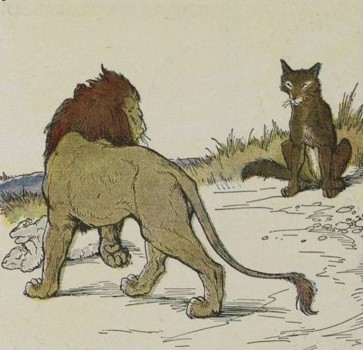
The Lion and the Ass

One day as the Lion walked proudly down a forest aisle, and the animals respectfully made way for him, an Ass brayed a scornful remark as he passed.

The Lion felt a flash of anger. But when he turned his head and saw who had spoken, he walked quietly on. He would not honor the fool with even so much as a stroke of his claws.

Do not resent the remarks of a fool. Ignore them.


(600 words)


Aesop (Winter): Page 5

These stories are part of the Aesop (Winter) unit. Story source: The Aesop for Children, with illustrations by Milo Winter (1919).


The Owl and the Grasshopper


The Owl always takes her sleep during the day. Then after sundown, when the rosy light fades from the sky and the shadows rise slowly through the wood, out she comes ruffling and blinking from the old hollow tree. Now her weird "hoo-hoo-hoo-oo-oo" echoes through the quiet wood, and she begins her hunt for the bugs and beetles, frogs and mice she likes so well to eat.

Now there was a certain old Owl who had become very cross and hard to please as she grew older, especially if anything disturbed her daily slumbers. One warm summer afternoon as she dozed away in her den in the old oak tree, a Grasshopper nearby began a joyous but very raspy song.

Out popped the old Owl's head from the opening in the tree that served her both for door and for window. "Get away from here, sir," she said to the Grasshopper. "Have you no manners? You should at least respect my age and leave me to sleep in quiet!"

But the Grasshopper answered saucily that he had as much right to his place in the sun as the Owl had to her place in the old oak. Then he struck up a louder and still more rasping tune.

The wise old Owl knew quite well that it would do no good to argue with the Grasshopper, nor with anybody else for that matter. Besides, her eyes were not sharp enough by day to permit her to punish the Grasshopper as he deserved. So she laid aside all hard words and spoke very kindly to him.

"Well sir," she said, "if I must stay awake, I am going to settle right down to enjoy your singing. Now that I think of it, I have a wonderful wine here, sent me from Olympus, of which I am told Apollo drinks before he sings to the high gods. Please come up and taste this delicious drink with me. I know it will make you sing like Apollo himself."

The foolish Grasshopper was taken in by the Owl's flattering words. Up he jumped to the Owl's den, but as soon as he was near enough so the old Owl could see him clearly, she pounced upon him and ate him up.

Flattery is not a proof of true admiration.

Do not let flattery throw you off your guard against an enemy.


The Wolf and His Shadow


A Wolf left his lair one evening in fine spirits and an excellent appetite. As he ran, the setting sun cast his shadow far out on the ground, and it looked as if the wolf were a hundred times bigger than he really was.

"Why," exclaimed the Wolf proudly, "see how big I am! Fancy me running away from a puny Lion! I'll show him who is fit to be king, he or I."

Just then an immense shadow blotted him out entirely, and the next instant a Lion struck him down with a single blow.

Do not let your fancy make you forget realities.


The Rat and the Elephant

A Rat was traveling along the King's highway. He was a very proud Rat, considering his small size and the bad reputation all Rats have. As Mr. Rat walked along—he kept mostly to the ditch—he noticed a great commotion up the road, and soon a grand procession came in view. It was the King and his retinue.

The King rode on a huge Elephant adorned with the most gorgeous trappings. With the King in his luxurious howdah were the royal Dog and Cat. A great crowd of people followed the procession. They were so taken up with admiration of the Elephant, that the Rat was not noticed. His pride was hurt.

"What fools!" he cried. "Look at me, and you will soon forget that clumsy Elephant! Is it his great size that makes your eyes pop out? Or is it his wrinkled hide? Why, I have eyes and ears and as many legs as he! I am of just as much importance, and"—

But just then the royal Cat spied him, and the next instant, the Rat knew he was not quite so important as an Elephant.

A resemblance to the great in some things does not make us great.


The Boys and the Frogs

Some Boys were playing one day at the edge of a pond in which lived a family of Frogs. The Boys amused themselves by throwing stones into the pond so as to make them skip on top of the water.

The stones were flying thick and fast and the Boys were enjoying themselves very much; but the poor Frogs in the pond were trembling with fear.

At last one of the Frogs, the oldest and bravest, put his head out of the water, and said, "Oh, please, dear children, stop your cruel play! Though it may be fun for you, it means death to us!"

Always stop to think whether your fun may not be the cause of another's unhappiness.


(800 words)


Aesop (Winter): Page 6

These stories are part of the Aesop (Winter) unit. Story source: The Aesop for Children, with illustrations by Milo Winter (1919).


The Ass Carrying the Image

A sacred Image was being carried to the temple. It was mounted on an Ass adorned with garlands and gorgeous trappings, and a grand procession of priests and pages followed it through the streets. As the Ass walked along, the people bowed their heads reverently or fell on their knees, and the Ass thought the honor was being paid to himself.

With his head full of this foolish idea, he became so puffed up with pride and vanity that he halted and started to bray loudly. But in the midst of his song, his driver guessed what the Ass had got into his head and began to beat him unmercifully with a stick.

"Go along with you, you stupid Ass," he cried. "The honor is not meant for you but for the image you are carrying."

Do not try to take the credit to yourself that is due to others.


The Two Goats


Two Goats, frisking gayly on the rocky steeps of a mountain valley, chanced to meet, one on each side of a deep chasm through which poured a mighty mountain torrent. The trunk of a fallen tree formed the only means of crossing the chasm, and on this not even two squirrels could have passed each other in safety. The narrow path would have made the bravest tremble. Not so our Goats. Their pride would not permit either to stand aside for the other.

One set her foot on the log. The other did likewise. In the middle they met horn to horn. Neither would give way, and so they both fell, to be swept away by the roaring torrent below.

It is better to yield than to come to misfortune through stubbornness.


The Ass and the Load of Salt

A Merchant, driving his Ass homeward from the seashore with a heavy load of salt, came to a river crossed by a shallow ford. They had crossed this river many times before without accident, but this time the Ass slipped and fell when halfway over. And when the Merchant at last got him to his feet, much of the salt had melted away. Delighted to find how much lighter his burden had become, the Ass finished the journey very gayly.

Next day the Merchant went for another load of salt. On the way home the Ass, remembering what had happened at the ford, purposely let himself fall into the water, and again got rid of most of his burden.

The angry Merchant immediately turned about and drove the Ass back to the seashore, where he loaded him with two great baskets of sponges. At the ford the Ass again tumbled over, but when he had scrambled to his feet, it was a very disconsolate Ass that dragged himself homeward under a load ten times heavier than before.

The same measures will not suit all circumstances.


The Lion and the Gnat

"Away with you, vile insect!" said a Lion angrily to a Gnat that was buzzing around his head. But the Gnat was not in the least disturbed.

"Do you think," he said spitefully to the Lion, "that I am afraid of you because they call you king?"

The next instant he flew at the Lion and stung him sharply on the nose. Mad with rage, the Lion struck fiercely at the Gnat, but only succeeded in tearing himself with his claws. Again and again the Gnat stung the Lion, who now was roaring terribly. At last, worn out with rage and covered with wounds that his own teeth and claws had made, the Lion gave up the fight.

The Gnat buzzed away to tell the whole world about his victory, but instead he flew straight into a spider's web. And there, he who had defeated the King of beasts came to a miserable end, the prey of a little spider.

The least of our enemies is often the most to be feared.

Pride over a success should not throw us off our guard.


The Leap at Rhodes

A certain man who visited foreign lands could talk of little when he returned to his home except the wonderful adventures he had met with and the great deeds he had done abroad.

One of the feats he told about was a leap he had made in a city called Rhodes. That leap was so great, he said, that no other man could leap anywhere near the distance. A great many persons in Rhodes had seen him do it and would prove that what he told was true.

"No need of witnesses," said one of the hearers. "Suppose this city is Rhodes. Now show us how far you can jump."

Deeds count, not boasting words.


The Monkey and the Camel

At a great celebration in honor of King Lion, the Monkey was asked to dance for the company. His dancing was very clever indeed, and the animals were all highly pleased with his grace and lightness.

The praise that was showered on the Monkey made the Camel envious. He was very sure that he could dance quite as well as the Monkey, if not better, so he pushed his way into the crowd that was gathered around the Monkey, and rising on his hind legs, began to dance. But the big hulking Camel made himself very ridiculous as he kicked out his knotty legs and twisted his long clumsy neck. Besides, the animals found it hard to keep their toes from under his heavy hoofs.

At last, when one of his huge feet came within an inch of King Lion's nose, the animals were so disgusted that they set upon the Camel in a rage and drove him out into the desert.

Shortly afterward, refreshments, consisting mostly of Camel's hump and ribs, were served to the company.

Do not try to ape your betters.


(1000 words)


Aesop (Winter): Page 7

These stories are part of the Aesop (Winter) unit. Story source: The Aesop for Children, with illustrations by Milo Winter (1919).


The Wild Boar and the Fox


A Wild Boar was sharpening his tusks busily against the stump of a tree when a Fox happened by. Now the Fox was always looking for a chance to make fun of his neighbors. So he made a great show of looking anxiously about, as if in fear of some hidden enemy. But the Boar kept right on with his work.

"Why are you doing that?" asked the Fox at last with a grin. "There isn't any danger that I can see."

"True enough," replied the Boar, "but when danger does come there will not be time for such work as this. My weapons will have to be ready for use then, or I shall suffer for it."

Preparedness for war is the best guarantee of peace.


The Ass, the Fox, and the Lion

An Ass and a Fox had become close comrades and were constantly in each other's company. While the Ass cropped a fresh bit of greens, the Fox would devour a chicken from the neighboring farmyard or a bit of cheese filched from the dairy.

One day the pair unexpectedly met a Lion. The Ass was very much frightened, but the Fox calmed his fears.

"I will talk to him," he said.

So the Fox walked boldly up to the Lion.

"Your Highness," he said in an undertone, so the Ass could not hear him, "I've got a fine scheme in my head. If you promise not to hurt me, I will lead that foolish creature yonder into a pit where he can't get out, and you can feast at your pleasure."

The Lion agreed and the Fox returned to the Ass.

"I made him promise not to hurt us," said the Fox. "But come, I know a good place to hide till he is gone."

So the Fox led the Ass into a deep pit. But when the Lion saw that the Ass was his for the taking, he first of all struck down the traitor Fox.

Traitors may expect treachery.


The Lion, the Bear, and the Fox

Just as a great Bear rushed to seize a stray kid, a Lion leaped from another direction upon the same prey. The two fought furiously for the prize until they had received so many wounds that both sank down unable to continue the battle.

Just then a Fox dashed up, and seizing the kid, made off with it as fast as he could go while the Lion and the Bear looked on in helpless rage.

"How much better it would have been," they said, "to have shared in a friendly spirit."

Those who have all the toil do not always get the profit.


The Travelers and the Sea

Two Travelers were walking along the seashore. Far out they saw something riding on the waves.

"Look," said one, "a great ship rides in from distant lands, bearing rich treasures!"

The object they saw came ever nearer the shore.

"No," said the other, "that is not a treasure ship. That is some fisherman's skiff, with the day's catch of savoury fish."

Still nearer came the object. The waves washed it up on shore.

"It is a chest of gold lost from some wreck," they cried. Both Travelers rushed to the beach, but there they found nothing but a water-soaked log.

Do not let your hopes carry you away from reality.


The Wolf and the Lion

A Wolf had stolen a Lamb and was carrying it off to his lair to eat it. But his plans were very much changed when he met a Lion, who, without making any excuses, took the Lamb away from him.

The Wolf made off to a safe distance, and then said in a much injured tone:

"You have no right to take my property like that!"

The Lion looked back, but as the Wolf was too far away to be taught a lesson without too much inconvenience, he said:

"Your property? Did you buy it, or did the Shepherd make you a gift of it? Pray tell me, how did you get it?"

What is evil won is evil lost.


(800 words)


Aesop (Winter): Page 8

These stories are part of the Aesop (Winter) unit. Story source: The Aesop for Children, with illustrations by Milo Winter (1919).


The Mice and the Weasels


The Weasels and the Mice were always up in arms against each other. In every battle the Weasels carried off the victory, as well as a large number of the Mice, which they ate for dinner next day. In despair the Mice called a council, and there it was decided that the Mouse army was always beaten because it had no leaders. So a large number of generals and commanders were appointed from among the most eminent Mice.

To distinguish themselves from the soldiers in the ranks, the new leaders proudly bound on their heads lofty crests and ornaments of feathers or straw. Then after long preparation of the Mouse army in all the arts of war, they sent a challenge to the Weasels.

The Weasels accepted the challenge with eagerness for they were always ready for a fight when a meal was in sight. They immediately attacked the Mouse army in large numbers. Soon the Mouse line gave way before the attack and the whole army fled for cover. The privates easily slipped into their holes, but the Mouse leaders could not squeeze through the narrow openings because of their head-dresses. Not one escaped the teeth of the hungry Weasels.

Greatness has its penalties.


The Wolf and the Lean Dog

A Wolf prowling near a village one evening met a Dog. It happened to be a very lean and bony Dog, and Master Wolf would have turned up his nose at such meager fare had he not been more hungry than usual. So he began to edge toward the Dog, while the Dog backed away.

"Let me remind your lordship," said the Dog, his words interrupted now and then as he dodged a snap of the Wolf's teeth, "how unpleasant it would be to eat me now. Look at my ribs. I am nothing but skin and bone. But let me tell you something in private. In a few days my master will give a wedding feast for his only daughter. You can guess how fine and fat I will grow on the scraps from the table. Then is the time to eat me."

The Wolf could not help thinking how nice it would be to have a fine fat Dog to eat instead of the scrawny object before him. So he went away pulling in his belt and promising to return.

Some days later the Wolf came back for the promised feast. He found the Dog in his master's yard and asked him to come out and be eaten.

"Sir," said the Dog, with a grin, "I shall be delighted to have you eat me. I'll be out as soon as the porter opens the door."

But the "porter" was a huge Dog whom the Wolf knew by painful experience to be very unkind toward wolves. So he decided not to wait and made off as fast as his legs could carry him.

Do not depend on the promises of those whose interest it is to deceive you.

Take what you can get when you can get it.


The Lion and the Ass

A Lion and an Ass agreed to go hunting together. In their search for game the hunters saw a number of Wild Goats run into a cave, and laid plans to catch them. The Ass was to go into the cave and drive the Goats out while the Lion would stand at the entrance to strike them down.

The plan worked beautifully. The Ass made such a frightful din in the cave, kicking and braying with all his might, that the Goats came running out in a panic of fear, only to fall victim to the Lion.

The Ass came proudly out of the cave.

"Did you see how I made them run?" he said.

"Yes, indeed," answered the Lion, "and if I had not known you and your kind I should certainly have run, too."

The loud-mouthed boaster does not impress nor frighten those who know him.


(700 words)


Aesop (Winter): Page 9

The second fable depends on a Greek geography mix-up, where the monkey in the fable mistakes the name of a Greek port, Piraeus, for the name of a person. You can just substitute some familiar feature of U.S. geography to get the same effect; it would be as if the dolphin asked the monkey about visiting Los Angeles or New York. Meanwhile, for a famous Greek legend about a dolphin who rescued a human being, Arion, from a shipwreck, you can take a look at this Wikipedia article: Arion.

[Notes by LKG]

These stories are part of the Aesop (Winter) unit. Story source: The Aesop for Children, with illustrations by Milo Winter (1919).


The Dog and His Master's Dinner

A Dog had learned to carry his master's dinner to him every day. He was very faithful to his duty, though the smell of the good things in the basket tempted him.

The Dogs in the neighborhood noticed him carrying the basket and soon discovered what was in it. They made several attempts to steal it from him. But he always guarded it faithfully.

Then one day all the Dogs in the neighborhood got together and met him on his way with the basket. The Dog tried to run away from them. But at last he stopped to argue.

That was his mistake. They soon made him feel so ridiculous that he dropped the basket and seized a large piece of roast meat intended for his master's dinner.

"Very well," he said, "you divide the rest."

Do not stop to argue with temptation.


The Monkey and the Dolphin


It happened once upon a time that a certain Greek ship bound for Athens was wrecked off the coast close to Piraeus, the port of Athens. Had it not been for the Dolphins, who at that time were very friendly toward mankind and especially toward Athenians, all would have perished. But the Dolphins took the shipwrecked people on their backs and swam with them to shore.

Now it was the custom among the Greeks to take their pet monkeys and dogs with them whenever they went on a voyage. So when one of the Dolphins saw a Monkey struggling in the water, he thought it was a man and made the Monkey climb up on his back. Then off he swam with him toward the shore.

The Monkey sat up, grave and dignified, on the Dolphin's back.

"You are a citizen of illustrious Athens, are you not?" asked the Dolphin politely.

"Yes," answered the Monkey, proudly. "My family is one of the noblest in the city."

"Indeed," said the Dolphin. "Then of course you often visit Piraeus."

"Yes, yes," replied the Monkey. "Indeed, I do. I am with him constantly. Piraeus is my very best friend."

This answer took the Dolphin by surprise, and, turning his head, he now saw what it was he was carrying. Without more ado, he dived and left the foolish Monkey to take care of himself, while he swam off in search of some human being to save.

One falsehood leads to another.


The Wolf and the Ass

An Ass was feeding in a pasture near a wood when he saw a Wolf lurking in the shadows along the hedge. He easily guessed what the Wolf had in mind, and thought of a plan to save himself. So he pretended he was lame, and began to hobble painfully.

When the Wolf came up, he asked the Ass what had made him lame, and the Ass replied that he had stepped on a sharp thorn.

"Please pull it out," he pleaded, groaning as if in pain. "If you do not, it might stick in your throat when you eat me."

The Wolf saw the wisdom of the advice, for he wanted to enjoy his meal without any danger of choking. So the Ass lifted up his foot and the Wolf began to search very closely and carefully for the thorn.

Just then the Ass kicked out with all his might, tumbling the Wolf a dozen paces away. And while the Wolf was getting very slowly and painfully to his feet, the Ass galloped away in safety.

"Serves me right," growled the Wolf as he crept into the bushes. "I'm a butcher by trade, not a doctor."

Stick to your trade.


(600 words)


Aesop (Winter): Page 10

The first fable on this page provide the origin of the phrase "cat's paw," meaning someone who is just a tool being used by someone else. You can find out more about this famous phrase at Wikipedia: Cat's Paw. Like several of the fables in this book, the story of "The Monkey and the Cat" is not an ancient Greek or Roman fable; instead, it is best known from the fables in version of the French poet La Fontaine. You can find out more in the La Fontaine unit for this class.

[Notes by LKG]

These stories are part of the Aesop (Winter) unit. Story source: The Aesop for Children, with illustrations by Milo Winter (1919).


The Monkey and the Cat


Once upon a time a Cat and a Monkey lived as pets in the same house. They were great friends and were constantly in all sorts of mischief together. What they seemed to think of more than anything else was to get something to eat, and it did not matter much to them how they got it.

One day they were sitting by the fire, watching some chestnuts roasting on the hearth. How to get them was the question.

"I would gladly get them," said the cunning Monkey, "but you are much more skillful at such things than I am. Pull them out and I'll divide them between us."

Pussy stretched out her paw very carefully, pushed aside some of the cinders, and drew back her paw very quickly. Then she tried it again, this time pulling a chestnut half out of the fire. A third time and she drew out the chestnut. This performance she went through several times, each time singeing her paw severely. As fast as she pulled the chestnuts out of the fire, the Monkey ate them up.

Now the master came in, and away scampered the rascals, Mistress Cat with a burnt paw and no chestnuts. From that time on, they say, she contented herself with mice and rats and had little to do with Sir Monkey.

The flatterer seeks some benefit at your expense.


The Dogs and the Fox

Some Dogs found the skin of a Lion and furiously began to tear it with their teeth. A Fox chanced to see them and laughed scornfully.

"If that Lion had been alive," he said, "it would have been a very different story. He would have made you feel how much sharper his claws are than your teeth."

It is easy and also contemptible to kick a man that is down.


The Dogs and the Hides

Some hungry Dogs saw a number of hides at the bottom of a stream where the Tanner had put them to soak. A fine hide makes an excellent meal for a hungry Dog, but the water was deep and the Dogs could not reach the hides from the bank. So they held a council and decided that the very best thing to do was to drink up the river.

All fell to lapping up the water as fast as they could. But though they drank and drank until, one after another, all of them had burst with drinking, still, for all their effort, the water in the river remained as high as ever.

Do not try to do impossible things.


The Rabbit, the Weasel, and the Cat

A Rabbit left his home one day for a dinner of clover. But he forgot to latch the door of his house and while he was gone a Weasel walked in and calmly made himself at home. When the Rabbit returned, there was the Weasel's nose sticking out of the Rabbit's own doorway, sniffing the fine air.

The Rabbit was quite angry—for a Rabbit— and requested the Weasel to move out. But the Weasel was perfectly content. He was settled down for good.

A wise old Cat heard the dispute and offered to settle it.

"Come close to me," said the Cat, "I am very deaf. Put your mouths close to my ears while you tell me the facts."

The unsuspecting pair did as they were told and in an instant the Cat had them both under her claws. No one could deny that the dispute had been definitely settled.

The strong are apt to settle questions to their own advantage.


(600 words)


Aesop (Winter): Page 11

These stories are part of the Aesop (Winter) unit. Story source: The Aesop for Children, with illustrations by Milo Winter (1919).


The Bear and the Bees


A Bear roaming the woods in search of berries happened on a fallen tree in which a swarm of Bees had stored their honey. The Bear began to nose around the log very carefully to find out if the Bees were at home. Just then one of the swarm came home from the clover field with a load of sweets. Guessing what the Bear was after, the Bee flew at him, stung him sharply and then disappeared into the hollow log.

The Bear lost his temper in an instant and sprang upon the log tooth and claw to destroy the nest. But this only brought out the whole swarm. The poor Bear had to take to his heels, and he was able to save himself only by diving into a pool of water.

It is wiser to bear a single injury in silence than to provoke a thousand by flying into a rage.


The Fox and the Leopard

A Fox and a Leopard, resting lazily after a generous dinner, amused themselves by disputing about their good looks. The Leopard was very proud of his glossy spotted coat and made disdainful remarks about the Fox, whose appearance he declared was quite ordinary.

The Fox prided himself on his fine bushy tail with its tip of white, but he was wise enough to see that he could not rival the Leopard in looks. Still he kept up a flow of sarcastic talk, just to exercise his wits and to have the fun of disputing. The Leopard was about to lose his temper when the Fox got up, yawning lazily.

"You may have a very smart coat," he said, "but you would be a great deal better off if you had a little more smartness inside your head and less on your ribs, the way I am. That's what I call real beauty."

A fine coat is not always an indication of an attractive mind.


The Heron

A Heron was walking sedately along the bank of a stream, his eyes on the clear water, and his long neck and pointed bill ready to snap up a likely morsel for his breakfast. The clear water swarmed with fish, but Master Heron was hard to please that morning.

"No small fry for me," he said. "Such scanty fare is not fit for a Heron."

Now a fine young Perch swam near.

"No indeed," said the Heron. "I wouldn't even trouble to open my beak for anything like that!"

As the sun rose, the fish left the shallow water near the shore and swam below into the cool depths toward the middle. The Heron saw no more fish, and very glad was he at last to breakfast on a tiny Snail.

Do not be too hard to suit or you may have to be content with the worst or with nothing at all.


The Wolf and the Goat


A hungry Wolf spied a Goat browsing at the top of a steep cliff where he could not possibly get at her.

"That is a very dangerous place for you," he called out, pretending to be very anxious about the Goat's safety. "What if you should fall! Please listen to me and come down! Here you can get all you want of the finest, tenderest grass in the country."

The Goat looked over the edge of the cliff.

"How very, very anxious you are about me," she said, "and how generous you are with your grass! But I know you! It's your own appetite you are thinking of, not mine!"

An invitation prompted by selfishness is not to be accepted.


The Ass and the Grasshoppers

One day as an Ass was walking in the pasture, he found some Grasshoppers chirping merrily in a grassy corner of the field.

He listened with a great deal of admiration to the song of the Grasshoppers. It was such a joyful song that his pleasure-loving heart was filled with a wish to sing as they did.

"What is it?" he asked very respectfully, "that has given you such beautiful voices? Is there any special food you eat, or is it some divine nectar that makes you sing so wonderfully?"

"Yes," said the Grasshoppers, who were very fond of a joke; "it is the dew we drink! Try some and see."

So thereafter the Ass would eat nothing and drink nothing but dew.

Naturally, the poor foolish Ass soon died.

The laws of nature are unchangeable.


The Mule

A Mule had had a long rest and much good feeding. He was feeling very vigorous indeed, and pranced around loftily, holding his head high.

"My father certainly was a full-blooded racer," he said. "I can feel that distinctly."

Next day he was put into harness again and that evening he was very downhearted indeed.

"I was mistaken," he said. "My father was an Ass after all."

Be sure of your pedigree before you boast of it.


Next: Aesop (Winter): Page 12

(800 words)


Aesop (Winter): Page 12

These stories are part of the Aesop (Winter) unit. Story source: The Aesop for Children, with illustrations by Milo Winter (1919).


The Cat the Cock, and the Young Mouse


A very young Mouse, who had never seen anything of the world, almost came to grief the very first time he ventured out. And this is the story he told his mother about his adventures.

"I was strolling along very peaceably when, just as I turned the corner into the next yard, I saw two strange creatures. One of them had a very kind and gracious look, but the other was the most fearful monster you can imagine. You should have seen him. On top of his head and in front of his neck hung pieces of raw red meat. He walked about restlessly, tearing up the ground with his toes, and beating his arms savagely against his sides. The moment he caught sight of me, he opened his pointed mouth as if to swallow me, and then he let out a piercing roar that frightened me almost to death."

Can you guess who it was that our young Mouse was trying to describe to his mother? It was nobody but the Barnyard Cock and the first one the little Mouse had ever seen.

"If it had not been for that terrible monster," the Mouse went on, "I should have made the acquaintance of the pretty creature, who looked so good and gentle. He had thick, velvety fur, a meek face, and a look that was very modest, though his eyes were bright and shining. As he looked at me he waved his fine long tail and smiled. I am sure he was just about to speak to me when the monster I have told you about let out a screaming yell, and I ran for my life."

"My son," said the Mother Mouse, "that gentle creature you saw was none other than the Cat. Under his kindly appearance, he bears a grudge against every one of us. The other was nothing but a bird who wouldn't harm you in the least. As for the Cat, he eats us. So be thankful, my child, that you escaped with your life, and, as long as you live, never judge people by their looks."

Do not trust alone to outward appearances.


The Wolf and the Shepherd

A Wolf had been prowling around a flock of Sheep for a long time, and the Shepherd watched very anxiously to prevent him from carrying off a Lamb. But the Wolf did not try to do any harm. Instead he seemed to be helping the Shepherd take care of the Sheep. At last the Shepherd got so used to seeing the Wolf about that he forgot how wicked he could be.

One day he even went so far as to leave his flock in the Wolf's care while he went on an errand. But when he came back and saw how many of the flock had been killed and carried off, he knew how foolish to trust a Wolf.

Once a wolf, always a wolf.


The Peacock and the Crane

A Peacock, puffed up with vanity, met a Crane one day, and to impress him spread his gorgeous tail in the Sun.

"Look," he said. "What have you to compare with this? I am dressed in all the glory of the rainbow, while your feathers are gray as dust!"

The Crane spread his broad wings and flew up toward the sun.

"Follow me if you can," he said. But the Peacock stood where he was among the birds of the barnyard, while the Crane soared in freedom far up into the blue sky.

The useful is of much more importance and value, than the ornamental.


The Farmer and the Cranes

Some Cranes saw a farmer plowing a large field. When the work of plowing was done, they patiently watched him sow the seed. It was their feast, they thought.

So, as soon as the Farmer had finished planting and had gone home, down they flew to the field, and began to eat as fast as they could.

The Farmer, of course, knew the Cranes and their ways. He had had experience with such birds before. He soon returned to the field with a sling. But he did not bring any stones with him. He expected to scare the Cranes just by swinging the sling in the air, and shouting loudly at them.

At first the Cranes flew away in great terror. But they soon began to see that none of them ever got hurt. They did not even hear the noise of stones whizzing through the air, and as for words, they would kill nobody. At last they paid no attention whatever to the Farmer.

The Farmer saw that he would have to take other measures. He wanted to save at least some of his grain. So he loaded his sling with stones and killed several of the Cranes. This had the effect the Farmer wanted, for from that day the Cranes visited his field no more.

Bluff and threatening words are of little value with rascals.

Bluff is no proof that hard fists are lacking.


The Farmer and His Sons

A rich old farmer, who felt that he had not many more days to live, called his sons to his bedside.

"My sons," he said, "heed what I have to say to you. Do not on any account part with the estate that has belonged to our family for so many generations. Somewhere on it is hidden a rich treasure. I do not know the exact spot, but it is there, and you will surely find it. Spare no energy and leave no spot unturned in your search."

The father died, and no sooner was he in his grave than the sons set to work digging with all their might, turning up every foot of ground with their spades, and going over the whole farm two or three times.

No hidden gold did they find, but at harvest time when they had settled their accounts and had pocketed a rich profit far greater than that of any of their neighbors, they understood that the treasure their father had told them about was the wealth of a bountiful crop, and that in their industry had they found the treasure.

Industry is itself a treasure.


Next: Aesop (Winter): Page 13


(1000 words)