Showing posts with label Unit: Bidpai. Show all posts

Myth-Folklore Unit: Bidpai

Overview. The collection of stories known as the Fables of Bidpai is one of the many descendants of the ancient Indian Panchatantra, with "Bidpai" being the name of a storyteller who, like Aesop, was famous for his tales of wit and wisdom. Bidpai is not well known today, but he was quite famous in early modern Europe, and many of the Bidpai stories made their way into the French fables of La Fontaine in the 17th century. In this reading unit, you will be using a modern English translation of the fables of Bidpai by Maude Dutton: The Tortoise and the Geese and Other Fables of Bidpai. Dutton's version eliminates the Panchatantra frametale in order to focus on the stories themselves, and she includes all the most famous Bidpai stories here, such as the tale of the rats who could eat iron, the flying tortoise who was unable to keep his mouth shut, the gardener who foolishly made friends with a bear, and many more.

Language. This is a modern English version of the stories intended for a young audience, so the language used should pose no problems at all.

Story Length. This unit contains only single-page stories, and some pages contain several very short stories.

Choosing Between Units. If you are not sure which of the two Panchatantra units to choose — Ryder's Panchatantra of the Tales of Bidpai — the main factor to consider is literary style. Ryder's Panchatantra conveys the story-within-a-story-within-a-story style of the original Sanskrit Panchatantra, while the Tales of Bidpai unit tells the stories individually, without the literary frametale.

Navigation. You will find the table of contents below, and you can also use this link to see the story posts displayed on two pages total: Bidpai. Click "Older Posts" at the bottom of that page to see the second page.


READING A:
  1. Introduction
  2. The Rustic and the Nightingale
  3. The King, the Falcon, and the Drinking-Cup
  4. The Two Travelers
  5. Poor Man, Rich Man, Young Man
  6. The Merchant and His Iron
  7. Gardener, Farmer, Tyrant
  8. The King, the Hermit, and the Two Princes
  9. Three Stories about Apes
  10. The Ass, the Lion, and the Fox
  11. Three Stories about Foxes
READING B:
  1. The Hare, the Fox, and the Wolf
  2. Three Stories about Snakes
  3. The Camel Driver and the Adder
  4. Two Tortoise Stories
  5. The Crane and the Crab
  6. The Lean Cat and the Fat Cat
  7. Three Stories about Birds
  8. The Partridge and the Hawk
  9. The Crow, the Jackal, the Wolf, and the Camel
  10. The Three Fish
  11. The Lion and the Hare


Bidpai: Introduction

Below you will read one account of how the wise man Bidpai created a collection of stories to satisfy the tyrannical King Dabshelim. There is another version of this same story which you might enjoy also. In this version, King Dabshelim is not a tyrant; instead, he is just overwhelmed with too much information — long before the Internet gave us TMI — but his vizier Bidpai comes to the rescue. (Story source: The Queer, The Quaint, and the Quizzical by F. Stauffer, 1882).

~ ~ ~

Dabshelim, King of India, had so numerous a library that a hundred brahmans were scarcely sufficient to keep it in order, and it required a thousand dromedaries to transport it from one place to another. As he was not able to read all these books, he proposed to the brahmans to make extracts from them of the best and most useful of their contents.

These learned personages went so heartily to work that in less than twenty years they had compiled of all these extracts a little encyclopedia of twelve thousand volumes which thirty camels could carry with ease. They presented them to the king, but what was their amazement to hear him say that it was impossible for him to read thirty camel-loads of books.

They therefore reduced their extracts to fifteen, afterwards to ten, then to four, then to two dromedaries, and at last there remained only enough to load a mule of ordinary size.

Unfortunately, Dabshelim, during this process of melting down his library, grew old and saw no probability of living long enough to exhaust its quintessence to the last volume.

"Illustrious Sultan," said his vizier, "though I have but a very imperfect knowledge of your royal library, yet I will undertake to deliver you a very brief and satisfactory abstract of it. You shall read it through in one minute, and yet you will find matter in it to reflect upon throughout the rest of your life."

Having said this, Bidpai took a palm leaf and wrote upon it with a golden style the four following paragraphs:

1. The greater part of the sciences comprise but one single word: "Perhaps." And the whole history of mankind contains no more than three: they are "born, suffer, die."

2. Love nothing but what is good, and do all that thou lovest to do; think nothing but what is true, and speak not all that thou thinkest.

3. O kings! Tame your passions, govern yourselves, and it will be only child's play to govern the world.

4. O kings! O people! It can never be often enough repeated to you, what the half-witted venture to doubt, that there is no happiness without virtue, and no virtue without God.

[Notes by LKG]

This story is part of the Bidpai unit. Story source: The Tortoise and the Geese and Other Fables of Bidpai by Maude Barrows Dutton,  with illustrations by E. Boyd Smith, 1908.

Introduction

The Fables of Bidpai are an Eastern heritage from the centuries antedating the birth of Christ and, like all the works of early literature, they have come down to us out of obscure origins, enshrouded in traditions. History forbears even to certify that the reputed author of these tales existed, but tradition has inscribed him as a sage of India who lived about the year 300 B.C.

More than this, history records him as the bravest of all the philosophers of his generation, standing silent before King Dabschélim. He was led into the august presence of his Majesty by the sincere desire to bring wisdom to a foolish ruler. The royal personage scanned his face and bade him break his silence. Bidpai fearlessly performed his task, reaping as his reward a prison cell and fettered hands.

Here he lay forgotten until one day the King, tormented by some unusual problem, bethought himself of the sage. Summoning him from his dungeon, he once again bade him share his wisdom with him. The reward this time was an elevation as high as his degradation had been low. He was given the kingdom to rule.

An era of great prosperity now set in for Dabschélim, darkened only by the thought of the briefness of mortal life. Wonted to look to Bidpai for the solution of all difficulties, he turned to him now, beseeching him to write down his words of wisdom and leave them as a lasting monument to him, Dabschélim.

Thus it was that the sage, providing himself with food and parchment ample for a year, retired with one disciple into a closed room in the far part of the palace. At the end of twelve months the philosopher and his scribe issued, pale-faced, from their retreat; a great assemblage of the savants of the Empire was called and, standing in their midst facing Dabschélim, Bidpai read his fables, in which he had ingeniously inculcated all his moral wisdom.

The King's delight was boundless. He told Bidpai to ask what he wished and it should be granted him.


Arabic Kalila-wa-Dimna)


(400 words)


Bidpai: The Rustic and the Nightingale

This story is part of the Bidpai unit. Story source: The Tortoise and the Geese and Other Fables of Bidpai by Maude Barrows Dutton,  with illustrations by E. Boyd Smith, 1908.

The Rustic and the Nightingale

A CERTAIN Rustic had a garden which was filled with beautiful plants and vines. In one corner grew a rose-tree which bore the most fragrant blossoms in the garden and was therefore the Rustic's greatest pride. Every morning, when he walked among his flowers, he brought fresh water to sprinkle this rose-tree, so that it might never be parched by the heat. And in the winter he covered it most carefully with straw lest the frost should chill its delicate roots.

One morning as he was bringing the water, he saw a nightingale perched on one of the branches of the rose-tree. The bird was hopping about and playfully pulling one of the most beautiful roses to pieces.


The angry Rustic drove the bird away, but when he came the next morning, he found that the Nightingale had returned and that the ground beneath the rose-tree was covered with torn petals. This time the Rustic was so angry that he laid a snare to catch the bird. The third morning, when he came out into his garden, the roses were unharmed for the Nightingale was caught fast in the snare. The Rustic hurried to fetch a cage and carried the captive home.

The Nightingale was very sad as she beat about the cage and finally besought the Rustic to tell her why it was that he had imprisoned her. "Was it to hear my song?" she asked. "But it cannot be for that," she added, "for do I not sing sweetly to you every evening from my nest in the garden?"

Then the Rustic replied, "Can you indeed be ignorant of the harm which you have done me? Have I not found you for two mornings tearing my beautiful roses to pieces? It is a just punishment for you now that you are shut up away from your friends for you were day by day robbing me of mine."

Then the Nightingale answered, "Is it merely for thoughtlessly plucking the petals from a few of your roses that you will imprison me for life? If you punish me so severely for this small sin, how greatly will you be punished when my heart breaks from being shut up in this cage and I die. I beg, kind sir, that you will be merciful and free me."

The Rustic's heart was touched. He carried the cage out into the garden and opened the door.

Before the Nightingale flew away, she lighted for a moment on a branch near by. "You are a good man," she said, "for you have shown pity towards me. As a token of my gratitude, I will tell you that beneath the very spot where you are standing, lies hidden a pot of gold. Take it and use it for your garden!"

And singing sweetly, the Nightingale flew away to her nest.


(500 words)


Bidpai: The King, the Falcon, and the Drinking-Cup

Compare a similar story told in Tibet about a raven: How the Raven Saved the Hunter. The story is also very similar to the "Beth Gellert"-type of story which you can see here: Llewellyn and His Dog Gellert.

[Notes by LKG]

This story is part of the Bidpai unit. Story source: The Tortoise and the Geese and Other Fables of Bidpai by Maude Barrows Dutton,  with illustrations by E. Boyd Smith, 1908.


The King, the Falcon, and the Drinking-Cup

IN bygone days there lived a King who was very fond of hunting. The King had a Falcon which he counted among his chief treasures. This Falcon the King always fed from his own hand and always carried on his own wrist when he went on the hunt.

One day, when the court was out a-hunting, a deer ran across their path and the King started in pursuit. Some of the royal party followed, but none of them could ride as well and as fast as the King. Through some accident the King did not overtake the deer and became separated from his companions.

Hot and thirsty from his long ride, he dismounted to find some water. For a long time he sought in vain, but at last came to the foot of a hill where a small stream was trickling down over the rocks. The King took a drinking-cup from his sash and held it beneath the stream, catching the water drop by drop. As soon as it was full, he raised the cup to his lips and was just about to drink when the Falcon flew up, hit the cup, and upset it.

"You awkward bird!" exclaimed the King, and began once more patiently to fill the cup from the stream. A second time the King raised it to his lips, and a second time the Falcon flew against it, knocking it from the King's hand. The thirsty King could no longer control his rage. He threw the Falcon to the ground with such force that he killed it instantly.

Just then one of the attendants rode up and, hearing that the King was thirsty, drew out his flask to give the King to drink. But the King shook his head.

"I have set my heart," he said, "on drinking from this stream which runs down the mountain-side, but it takes a long time to fill a cup drop by drop here at the bottom. Go therefore to the top of the hill and bring me down a cup of water from the source of this spring."

The attendant did as the King commanded but returned with his cup empty.

"Your Majesty," he cried, "you have been perilously near death. At the source of the spring lies a dead dragon whose poison has polluted the entire stream. Will your Majesty not drink of the water in my flask?"

He held out the cup, and as the King drank, the tears rolled down his face.

"Alas, why does the King weep?" asked the attendant, in great alarm.

The King picked up the dead bird. "This Falcon, the dearest of all my treasures," he said sadly, "saved my life twice, and I, by my own act of anger, killed it with one cruel blow!"


(500 words)


Bidpai: The Two Travelers

This story is part of the Bidpai unit. Story source: The Tortoise and the Geese and Other Fables of Bidpai by Maude Barrows Dutton,  with illustrations by E. Boyd Smith, 1908.

The Two Travelers

TWO Friends, Ganem and Salem, were journeying together, when they came to a broad stream at the foot of a hill. The woods were near at hand, and the shade was so welcome after the heat of the desert that they halted here to rest.

After they had eaten and slept, they arose to go onwhen they discovered near at hand a white stone, upon which was written in curious lettering this inscription: Travelers, we have prepared an excellent banquet for your refreshment, but you must be bold and deserve it before you can obtain it. What you are to do is this: throw yourselves bravely into the stream and swim to the other side. You will find there a lion carved from marble. This statue you must lift upon your shoulders and, with one run, carry to the top of yonder mountain, never heeding the thorns which prick your feet nor the wild beasts that may be lurking in the bushes to devour you. When once you have gained the top of the mountain, you will find yourselves in possession of great happiness.

Ganem was truly delighted when he read these words. "See, Salem," he cried, "here lies the road which will lead us to the end of all our travels and labor. Let us start at once and see if what the stone says be true."

Salem, however, was of another mind. "Perhaps," he made answer, "this writing is but the jest of some idle beggar. Perhaps the current of the stream runs too swiftly for any man to swim it. Perhaps the lion is too heavy to carry, even if it be there. It is almost impossible that any one could reach the top of yonder mountain in one run. Take my word, it is not worth while to attempt any such mad venture. I for one will have no part in it."

Nevertheless, Ganem was not to be discouraged. "My mind is fully made up to try it," he replied, "and if you will not go with me, I must go alone." So the two friends embraced, and Salem rode off on his camel.

He was scarcely out of sight before Ganem had stripped off his clothes and thrown himself into the stream. He soon found that he was in the midst of a whirlpool, but he kept bravely on, and at last reached the other side in safety.

When he had rested a few moments on the beach, he lifted the marble lion with one mighty effort, and with one run reached the top of the mountain. Here he saw to his great surprise that he was standing before the gates of a beautiful city.

He was gazing at it in admiration, when strange roars came from the inside of the lion on his shoulder. The roaring grew louder and louder until finally the turrets of the city were trembling and the mountain-sides reechoing with the tumult.

Then Ganem saw to his astonishment that great crowds of people were pouring out of the city gates. They did not seem afraid of the noise, for they all wore smiling faces. As they came nearer, Ganem saw that they were led by a group of young noblemen, who held by the rein a prancing black charger. Slowly they advanced and knelt before Ganem, saying, "Brave stranger, we beseech thee to put on these regal robes which we are bringing, and, mounted upon this charger, ride back with thy subjects to the city."

Ganem, who could scarcely believe his ears, begged them to explain to him the meaning of these honors, and the noble youths replied, "Whenever our king dies, we place upon the stone by the river the inscription which you have read. Then we wait patiently until a traveler passes by who is brave enough to undertake the bold venture. Thus we are always assured that our king is a man who is fearless of heart and dauntless of purpose. We crown you to-day as King over our city."


(700 words)


Bidpai: Poor Man, Rich Man, Young Man

This story is part of the Bidpai unit. Story source: The Tortoise and the Geese and Other Fables of Bidpai by Maude Barrows Dutton,  with illustrations by E. Boyd Smith, 1908.


The Poor Man and the Flask of Oil

THERE was once a Poor Man who lived in a house next to a wealthy Merchant who sold oil and honey. As the Merchant was a kind neighbor, he one day sent a flask of oil to the Poor Man. The Poor Man was delighted, and put it carefully away on the top shelf.

One evening, as he was gazing at it, he said half aloud,"I wonder how much oil there is in that bottle. There is a large quantity. If I should sell it, I could buy five sheep. Every year I should have lambs, and before long I should own a flock. Then I should sell some of the sheep, and be rich enough to marry a wife. Perhaps we might have a son. And what a fine boy he would be! So tall, strong, and obedient! But if he should disobey me," and he raised the staff which he held in his hand, "I should punish him thus!" and he swung the staff over his head and brought it heavily to the ground, knocking, as he did so, the flask off the shelf so that the oil ran over him from head to foot.


The Rich Man and the Bundle of Wood

THERE was once a man, who, although he was very rich, was also very stingy. In the winter when the peasants brought him wood to buy, he would give them only half their price.

One day, as he was purchasing a large bundle of wood from a Poor Man, a Priest came by. He saw the few pennies that the Rich Man had thrown at the Poor Man's feet, and he could not help saying, "My Rich Brother, can you not be more generous than this? Do you not see that this Poor Woodsman has brought you a large bundle of wood, and you are sending him away with only a penny or two? How can he buy bread enough to keep himself and his family from starving with such small wages?"

But the Rich Man was greatly vexed at the Priest's words. "What is it to me that the man is poor?" he cried, and he drove both the Poor Man and the Priest from his door.

That very night, this same bundle of sticks caught fire and the Rich Man's house and barn burned to the ground. Thus he awoke the next morning to find himself as poor as the poorest wood-chopper from whom he had ever bought wood.


The Youth, the Hawk, and the Raven

A YOUTH who was wandering through the forest saw a Hawk circling about a tree. He stood still a moment to watch what the bird was doing. He soon saw that the Hawk carried a bit of meat in his bill, which he was tearing into pieces and feeding to a young Raven that had fallen into his nest.

"Thus are the lazy always cared for," mused the Youth. "Henceforth, instead of working hard to earn my living, I will remain quietly at home. Surely someone will take care of me, for a man is of much greater importance in the world than is a Raven."

So for three days the Youth stayed within his house. Each day he grew thinner and feebler from want of food, but still no one came near him.

"Alas," he sighed at length, "how foolish I have been! I was strong and as well able to work as the Hawk. How much better it would have been to imitate him instead of the Raven!"


(600 words)


Bidpai: The Merchant and His Iron

This story is part of the Bidpai unit. Story source: The Tortoise and the Geese and Other Fables of Bidpai by Maude Barrows Dutton,  with illustrations by E. Boyd Smith, 1908.

The Merchant and His Iron

A MERCHANT, who was about to set out on a journey, went to the house of a Friend, taking with him two hundred tons of iron.

"I beg of you," he said to his Friend, "that you will kindly keep this iron for me. I am about to set out on a long journey, and it may be that ill luck will befall me. If so, then I can return home and sell this iron for a large price."

The Friend took the iron, and even as the Merchant feared, it came to pass. Misfortune overtook him on the way, and he was obliged to return home. Straightway he went to the house of his Friend and demanded the iron.

In the meantime, the Friend had sold the iron to pay his own debts, for he believed that the Merchant would never return home. However, he put on a bold face and replied: "Truly, Friend, I have sad news for you. I locked the iron in a room, thinking that it was as safe there as is my own gold. But, unknown to me, there was a rat-hole in the wall, and the rats have stolen into the room and eaten all of the iron."

The Merchant, pretending that he believed this untruth, answered promptly: "That is, indeed, sad news for me, for the iron was all that I had left. Still, I know of old that rats delight in chewing upon iron bars. I have lost much iron in this same way before, so I shall know how to bear my present ill luck."

This answer was very pleasing to the Friend, who now was sure that the Merchant believed that the rats had eaten his iron. To avoid any further suspicion, he invited the Merchant to dine with him on the morrow. The Merchant accepted and went his way. As he was passing through the city, he met one of his Friend's sons, whom he quietly took home and locked up in a room.

The next day he went to his Friend's to dine. His friend came to the door with tears streaming down his face. "You must pardon me my distress," he said to the Merchant, "but yesterday one of my children disappeared, and nothing has been heard of him since. The town-crier has been through the streets, but no trace of the child is to be found."

"I am, indeed, sorry to hear this news," replied the Merchant, "for last evening I saw a sparrow hawk flying over the city with a child in its claws. The child certainly looked very much like one of your children."

"You senseless fellow," retorted the friend, "why do you mock me in my trouble! How could a sparrow hawk carry off a child weighing fifty pounds?"

"Ah," replied the Merchant, "you must not be surprised that a sparrow hawk should carry off a child of fifty pounds in our city where rats eat up two hundred tons of iron. My friend, give me back my iron, and I will gladly restore your boy."


(500 words)


Bidpai: Gardener, Farmer, Tyrant

You will see here a reference to "Persia," the name for what we now call "Iran." Although the fables of Bidpai ultimately go back to an Indian origin, they became famous in many countries and in many languages, including versions in Persian (the language of Iran) and in Arabic. The Arabic versions were in turn translated into both Hebrew and into Latin, and from Latin into the vernacular languages of Europe. The French poet La Fontaine, for example, was a big fan of the fables of Bidpai, and combined them with the fables of Aesop in his own verse fables. La Fontaine's version of the story of the bear is part of the La Fontaine unit for this class: The Bear and the Amateur Gardener.

[Notes by LKG]

This story is part of the Bidpai unit. Story source: The Tortoise and the Geese and Other Fables of Bidpai by Maude Barrows Dutton,  with illustrations by E. Boyd Smith, 1908.


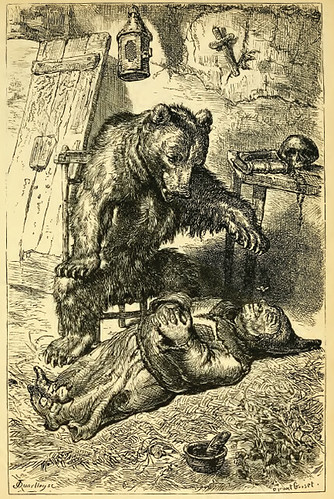
Ursus et Heremita

The Gardener and the Bear

IN the eastern part of Persia there lived at one time a Gardener whose one joy in life was his flowers and fruit trees. He had neither wife, nor children, nor friends — nothing except his garden.

At length, however, the good man wearied of having no one to talk to. He decided to go out into the world and find a friend, Scarcely was he outside the garden before he came face to face with a Bear, who, like the Gardener, was looking for a companion. Immediately a great friendship sprang up between these two.

The Gardener invited the Bear to come into his garden and fed him on quinces and melons. In return for this kindness, when the Gardener lay down to take his afternoon nap, the Bear stood by and drove off the flies.

One afternoon it happened that an unusually large fly alighted on the Gardener's nose. The Bear drove it off, but it only flew to the Gardener's chin. Again the Bear drove it away, but in a few moments it was back once more on the Gardener's nose.

The Bear now was filled with rage. With no thought beyond that of punishing the fly, he seized a huge stone and hurled it with such force at the Gardener's nose that he killed not only the fly, but the sleeping Gardener.

It is better to have a wise enemy than a foolish friend.


The Farmer, the Sheep, and the Robbers

A STUPID Farmer was coming home from a fair, leading a large Sheep which he had bought there. His way lay along a lonely mountain-side, where a band of Robbers had their den. Hidden among the bushes, the Robbers saw the Farmer and his Sheep pass by, and they determined to play a trick on him so as to win the Sheep for themselves. They therefore separated, and one after another of them met the Farmer as he passed along the road.

The first Robber doffed his cap and said, "Good-day, sir, where are you taking this dog?"

The second said, "Good-day, Sir, where did you get this dog?"

The third Robber even stopped the Farmer, and inquired where his gun was. "For surely you would not have this dog with you unless you were going hunting," he added.

And the fourth Robber, coming up from the rear, put his hand on the Sheep's head and said, "Ah, my friend, what a fine watch-dog you have!" and went on.

By this time the Farmer was very angry. "In sooth," he cried aloud, "the man who sold me this beast bewitched my eyes, for truly I thought that it was a sheep, whereas in reality it is nothing but a dog. I will hurry back at once to find the fellow and make him pay me back my money."

So saying, he tied the Sheep to a tree by the roadside and started back to the fair on a run. Thereupon the four Robbers came out of their hiding-places and carried the prize off to their den.


The Tyrant who became a Just Ruler

IN olden times there lived a King who was so cruel and unjust towards his subjects that he was always called The Tyrant. So heartless was he that his people used to pray night and day that they might have a new king.

One day, much to their surprise, he called his people together and said to them, "My dear subjects, the days of my tyranny are over. Henceforth you shall live in peace and happiness, for I have decided to try to rule henceforth justly and well."

The King kept his word so well that soon he was known throughout the land as The just King. By and by one of his favorites came to him and said, "Your Majesty, I beg of you to tell me how it was that you had this change of heart towards your people?"

And the King replied, "As I was galloping through my forests one afternoon, I caught sight of a hound chasing a fox. The fox escaped into his hole, but not until he had been bitten by the dog so badly that he would be lame for life. The hound, returning home, met a man who threw a stone at him, which broke his leg. The man had not gone far when a horse kicked him and broke his leg. And the horse, starting to run, fell into a hole and broke his leg. Here I came to my senses, and resolved to change my rule. 'For surely,' I said to myself, 'he who doeth evil will sooner or later be overtaken by evil.' "


(800 words)


Bidpai: The King, the Hermit, and the Two Princes

This story is part of the Bidpai unit. Story source: The Tortoise and the Geese and Other Fables of Bidpai by Maude Barrows Dutton,  with illustrations by E. Boyd Smith, 1908.

The King, the Hermit, and the Two Princes

IN the kingdom of Ardos there lived a wealthy old King with his two sons. Now, when the father found that he was soon to die, he was greatly troubled about his riches. He had been a wise and prudent man, and had gathered his wealth by industry and thrift. His sons, however, cared only to spend their days in making merry, and let more money slip through their fingers in a week than the King could save in a year. Therefore he feared greatly to leave his store of pearls and gold to them, and thus it was that, on his death-bed, he called to him an old friend, a Hermit, and said to him, "My good and trusted Friend, here are my riches. I beg you to take and bury them in your hermitage, for I fear to leave so much wealth to my sons. They both have a portion of their own, and when they have spent that, let them first taste of want and poverty. Then do you bring forth the treasure and give it into their hands. It may be that after they have once known a little hardship, they will live more wisely."

The Hermit did as the King bade him, and a short time afterwards the King died.

The two sons no sooner heard of their father's death than they began to quarrel over the kingdom. As the older son was the stronger, he overcame his younger brother and drove him from the city gates. The younger brother, now homeless and penniless, bethought him what to do. At last he remembered the Hermit. "He was my father's friend," the Prince said to himself, "and a good man. I will go to him and ask him to teach me to live a noble and unselfish life as he has done."

So he betook himself to the hermitage. But when he entered the hut, he found it deserted, for the Hermit had died. Thereupon the Prince resolved to make the hermitage his own and follow the example of his father's friend.

Although hitherto he had always lived as a prince, he now started to lay the fire with his own hands and then went out to fetch some water. He lowered the bucket into the well, but when he drew it up, it was empty. "Alas! The well is out of order," he sighed; "I must bring a ladder and go down and repair it."

As he reached the bottom he saw that it was not a well, but a pit, and near at hand was an entrance into a passage through the rock. The Prince quickly brought an axe and hewed upon the passage. There before his eyes lay piled his father's treasure.


In the meantime his brother, who was now King, was feasting day and night in the palace. "When my own portion is gone," he told his nobles, "there is my father's wealth. We shall have no need to do aught but eat, drink, and make merry until we die."

But when he went to the spot where his father's treasure had always been hidden, he found that it was gone. That same day a neighboring monarch declared war upon the city. The King was greatly afraid, for his soldiers needed arms, and there was no money in the royal treasury with which to buy them. The enemy drew near, and at last the King's army had to defend the city with such weapons as they had at hand. In the end the enemy was victorious, and both kings were slain in the battle.

When peace was declared, the generals gathered together to choose a new King.

"The new King must be a man of peace and not of war," said one.

"He must be prudent and not spend the wealth of the kingdom in merry-making," added another.

Then they remembered the Prince who was living as a hermit. With one accord, they proclaimed him their King. They formed a long procession, and, marching to the hermitage, led the Prince back with flying banners to his father's throne.


(700 words)


Bidpai: Three Stories about Apes

This story is part of the Bidpai unit. Story source: The Tortoise and the Geese and Other Fables of Bidpai by Maude Barrows Dutton,  with illustrations by E. Boyd Smith, 1908.


The Carpenter and the Ape

AN APE one day sat watching a Carpenter who was splitting a piece of wood with two wedges. First the Carpenter drove the smaller wedge into the crack, so as to keep it open, and then, when the crack was wide enough, he hammered in the larger wedge and pulled the first one out.

At noon the Carpenter went home to dinner, and the Ape now thought that he would try his hand at splitting boards. As he took his seat on the Carpenter's bench, his long tail slipped into the crack in the board. The Ape did not notice this, but set to work.

The first wedge he drove in exactly as he had seen the Carpenter do. But then he forgot and pulled it out before he had driven in the second one. The two sides of the board instantly sprang together and caught the Ape's tail between them.

The poor prisoner had now nothing to do but sit there groaning with pain until the Carpenter's return, when he was given a sound beating and told that he had suffered justly for meddling with other people's business.


The Apes, the Glow-Worm, and the Popinjay

A TROOP of Apes once lived on a mountain, where they fed upon fruits and herbs. When the winter came on, the cold drove them down into the valleys. As they were wandering about here, looking for food and shelter, one of them came upon a Glow-Worm in the bushes.

"Come quickly," he called to his brother Apes, "and bring a large pile of driftwood. I have found a spark of fire, and we shall soon be warm now!"

From all directions the Apes came, running and scrambling along the ground, their arms full of driftwood. A few moments later, the huge pile was heaped on top of the Glow-Worm, and the Apes, sat around in a circle waiting for the wood to catch fire.

As they were waiting, a Popinjay in a tree called out, "You silly Apes, you may sit there with your teeth chattering until Doomsday, but that pile will never catch fire. That was not a spark that you found, but only a worm with a shining light in his tail!"

"Foolish bird," retorted the Apes, "do you think that we do not know a worm from a spark of fire?"

"It is not a spark," repeated the Popinjay. "It is not a spark. It is not a spark." And she flew down into their midst, still crying, "It is not a spark."

Whereupon the foolish Apes in anger sprang upon the Popinjay and tore her to pieces, feather by feather and bone by bone, until there was nothing left of her.


The Ape and the Boar

AN Ape once took up his abode in a corner of the desert where there were many fig trees. He was a wise creature, and reasoned thus with himself: "I cannot live without food, and there is nothing here except fig trees. I must therefore eat sparingly of this fruit while it is ripe and store away a quantity for my winter food."

Accordingly, it was his custom every day to shake a fig tree, eat a few green figs, and then dry the rest. One morning when he was in the top of one of the trees, a wild Boar ran by. He had been chased by a hunter far from his home.

When the Ape saw the Boar, he trembled with fear so that the whole tree shook. The Boar, however, bowed low to the Ape, and said, "Do you want a guest?"

The Ape thereupon assumed a friendly air, and replied, "You are, indeed, most welcome. I regret only that I did not know beforehand of your coming. If I had, I would have prepared a feast in your honor. Now I have nothing to offer you but a few green figs."

The Boar again bowed humbly. "I have come a long distance," he replied, "and am hungry and weary. Anything, however simple it may be, that you will set before me, will taste as fine to me as a feast."

Thereupon the Ape shook the fig tree until not a single fig was left upon it. The Boar ate the fruit eagerly and should have been content, for the Ape had given him a generous meal. But, being a greedy creature, he remarked as he ate the last fig on the ground: "My dear host, these figs are delicious, but I am still ravenous with hunger. I pray you to shake another tree."

The Ape, who was still afraid of his guest, swung himself over into another tree and shook it. The Boar again fell to eating, nor was he satisfied when he had again swallowed the last fig.

"Make haste," he cried rudely to the Ape, at last forgetting his manners, his greediness was so great, "and find another tree as good as this last one."

But the Ape sat quietly where he was. "You have already made way with more figs than I eat in a month," he said. "If I give you any more, I myself must starve, for these figs are my only source of food."

Then the Boar growled with rage. "To pay you for your stinginess, I will bring you down from that tree and eat you alive!" he shouted.

He climbed into the tree, still growling, to bring down the Ape, but scarcely had he lodged in the first branch before it cracked beneath his weight and he fell to the ground, breaking his own neck.


(900 words)


Bidpai: The Ass, the Lion, and the Fox

This is a famous story found also in Aesop's fables (my own suspicion is that it is originally an Indian story which migrated into the world of Aesop), and in other storytelling traditions around the world. The identity of the trickster varies from one version to another. In the version below, the trickster is a fox (as also in the Aesopic version), while in the African (Swahili) version, the trickster has become a rabbit, as you can see in the illustration below. That version of the story is in the unit of Lang's tales from Africa: The Washerman's Donkey.


This story is part of the Bidpai unit. Story source: The Tortoise and the Geese and Other Fables of Bidpai by Maude Barrows Dutton,  with illustrations by E. Boyd Smith, 1908.

The Ass, the Lion, and the Fox

A LION, who had always been a great hunter, was stricken in his old age with a fever and obliged to retreat into his lair. He had not even strength enough to stand on his legs, but slept all day with his great head resting on his front paws.

Now there was a Fox who had always lived near the Lion and had followed the Lion when he went hunting in the wood. When the Lion had killed and eaten his fill of any game, the Fox always came up behind and devoured all that was left. Thus he lived for many years in this lazy fashion, and grew fat and strong.

When he heard of the Lion's illness, he was greatly distressed. "Shall I now, at this late stage of life, be obliged to kill my own meat?" he thought to himself. Then he lay down in his hole and set his wily brain to work.

Finally he arose and, putting on a very sad face, went to the Lion's lair and inquired for his health. The Lion replied mournfully that he thought he should soon die.

"But is there no cure for such a fever?" asked the Fox.

"None," replied the Lion, "unless I eat the heart and the ears of an Ass."

"Those, your Majesty, can be easily obtained, if you will but heed my advice," replied the Fox.

"Tell me, then, what trick you have devised," returned the Lion, "for I will gladly do anything to save my life."

So the Fox began: "Near here is a spring where every day a Bleacher comes to wash clothes, and an Ass, who is his beast of burden, grazes in the next field. Maybe I can make friends with the Ass. Then I will bring him near your den, and you can come out and kill him."

The next morning, when the Fox saw the Ass from afar, he trotted over to the spring and inquired, "Good Ass, why is it that you look so thin and worn?"

"Can you not see," replied the Ass, "that this Bleacher is constantly over-working me? He never grooms me and never gives me enough to eat."

"That is a hard lot," the Fox made answer, "but have you not four good legs? Why do you not use them? A few moments would carry you safe beyond his reach."

"Alas," said the Ass, "I should only fall into the hands of another master who might treat me even worse than this one. We poor asses are born to be beasts of burden, and there is no escape for us."

"But I," answered the Fox, softly, "can tell you of an escape. I know of a beautiful garden not far from here, filled with the finest clover and where there are no men. I have just recently carried another Ass thither, and he is now sleek and happy."

The stupid Ass, never for a moment doubting that the Fox spoke the truth, besought him to take him to this garden. So, while the Bleacher was splashing his clothes in the spring, the Fox and the Ass set out together.

The Lion was lying in wait in his lair, and when the Ass came by, he sprang out and struck the poor beast a blow. But the Lion's paws were so weakened by the fever that the blow did nothing more than startle the Ass, who ran off across the field.

The Fox was at first very angry that his little game had thus failed, but he soon devised another trick. He trotted off swiftly and soon overtook the Ass.

"Traitor!" cried the Ass. "Is this the freedom which you promised me? Do you take me away from the hands of my master merely to hurl me into the jaws of a Lion?"

"Oh, foolish and weak-hearted Ass," replied the Fox. "You must know that this garden of which I told you is enchanted. You will meet there creatures in the shape of lions and wolves who will pretend to harm you, but who in reality can do nothing to hurt you. I should have warned you against these strange beasts, but it slipped my mind, I was so anxious to save you from your cruel master before it was too late. Only return now and be of good courage. You will soon see how needless your fears are."

The Fox trotted home in advance and, after a short hesitation, the Ass followed him. He soon found himself in a bed of clover, where he fed to his heart's content.

In the meantime, the Fox went to the Lion's den and whispered some words of cunning in his ear. After a while the Lion came forth. He walked quietly around the Ass, but did not once seek to do him harm. At last the Ass began to talk to him, and the Lion replied gently. They were soon such friends that the Ass, after he had finished eating, lay down by the Lion's side and went to sleep. The Fox now gave the signal, and the Lion fell upon the Ass and slew him.

"There is but one thing more necessary," said the Lion, "to make my cure complete. I must go and bathe in the spring before eating. Do you therefore watch over the Ass until I return."

With these words the Lion crawled away, and the Fox seized this chance to devour the heart and the ears of the Ass, which were in truth the only parts of him worth eating.

The Lion, after finishing his bath, returned and began to hunt for the heart and the ears of the Ass, When he could find no trace of either, he said to the Fox: "Faithless creature, where are the two parts of the Ass which were to cure my fever?"

And the Fox replied, "Oh, most worthy King, you should yourself know that this beast had neither heart nor ears. If he had had ears, which are the seat of the hearing, he would have known that I spoke falsehoods, and if he had had a heart, which is the seat of the feelings, he would have been overcome with fear at the very sight of you."

And with these last words of treachery, the Fox escaped into the woods.


(1000 words)


Bidpai: Three Stories about Foxes

This story is part of the Bidpai unit. Story source: The Tortoise and the Geese and Other Fables of Bidpai by Maude Barrows Dutton,  with illustrations by E. Boyd Smith, 1908.

The Fox, the Hen, and the Drum

A FOX, who was out in search of food, discovered a Hen scratching for worms at the foot of a tree. He hid himself in a bush near by and was about to spring out and seize her when a strange tapping sound fell upon his ears, for in that same tree there was a Drum, and when the wind blew, the branches beat against it.

Now the Fox was exceedingly hungry, and reasoned thus: "A noise as loud as that must be made by a fowl much larger than this Hen. I will, therefore, let her go and will bring down that larger bird for my supper."

Without further thought, he rushed out of the bush with a noise that put the Hen to flight and, after many vain efforts, scrambled up the tree. High among the leaves he found the Drum, and fell upon it tooth and claw. He soon had it open, only to see that it was filled with nothing more or less than empty air.

The Fox hung his tail. "What a stupid wretch I am!" he groaned. "Because of my own greediness, I must now go supperless to bed."


The Fox and the Piece of Meat

A HUNGRY fox, who had come out of his hole to hunt, found a piece of fresh meat. As he had not tasted food for several days, he seized it and started home on a trot.

On the way, he passed by a hen-yard. At the sight of the four fat fowls who were scratching for worms, the Fox's mouth watered. He set down the piece of meat and gazed longingly at the hens.

Just then a Jackal passed by. "Friend Fox," he said, "you seem perplexed. Tell me your trouble, and it may be that I can help you."

"Friend Jackal, you are right," replied the Fox. "I am perplexed. I have here a piece of meat which I am carrying to my hole, but I should like one of these fowls for my second course."

"Take my advice," responded the Jackal, "and let these hens alone. I have long had my eye upon them, but they are watched by a boy named Zirak, and you cannot possibly catch them without being seen. You should be more than content with that fine piece of meat which you are carrying home." And the Jackal went on his way.

Nevertheless, the Fox could not make up his mind to give up the fowls. Finally, he laid down his piece of meat and crept cautiously into the yard. He was just nearing the tail-feathers of the plumpest fowl, when Zirak hurled a stick at his head.

Fearing for his life, the Fox sprang over the fence and rushed back to the spot where he had left his piece of meat. But a few moments before, a Kite had passed that way, smelled the meat, and carried it to her nest.


The Hunter, the Fox, and the Leopard

A HUNTER once came upon a Fox which had such a beautiful skin that the Hunter was eager to capture him. With this intent, he sought out the Fox's hole and dug a deep pit before the entrance. He covered the pit over carefully with twigs and straw and placed a tempting piece of meat on top. He then withdrew into the woods to await the return of the Fox.

It was not many hours before the Fox stole home. He scented the meat from afar, but when he saw that it was lying on a pile of loose twigs, he feared some snare. So he gave it only one sniff and then trotted off to seek new lodgings for himself

A moment later, a Leopard came down the mountain-side, and he too smelled the meat. He was not as wary as the Fox, but sprang upon the meat without once looking to see where it was lying.

The Hunter, in the woods, heard the crash as the Leopard tumbled headlong into the pit. Feeling sure that he had captured the Fox, he ran quickly and jumped in after him. In an instant the Leopard sprang upon him and killed him, exactly as he had planned to kill the Fox.


(700 words)


Bidpai: The Hare, the Fox, and the Wolf

This story is part of the Bidpai unit. Story source: The Tortoise and the Geese and Other Fables of Bidpai by Maude Barrows Dutton,  with illustrations by E. Boyd Smith, 1908.


The Hare, the Fox, and the Wolf

A HUNGRY Wolf was passing through a wood when he came upon a Hare sitting up on her hind legs at the foot of an oak tree. He was about to spring upon her when the Hare suddenly spoke to him.

"Sir Wolf," she said, "I know that you are faint with hunger, and that you are out in search of food. But before you swallow me, I ask you to think of my size, and remember that I shall be but a solitary mouthful for your Highness. Now about a furlong from here there lives a Fox, who is so plump and fat that he can scarcely walk. If you should eat him, then you would indeed feel that you had truly dined. If it is pleasing to you, I will pay this Fox a visit, entice him from his hole, and, if he prove to your liking, you can devour him."

The Wolf was easily persuaded by these words and told the Hare to run on ahead to the hole of the Fox. When she had arrived there, she bade the Wolf remain outside while she went in.

"Ah! Now not only am I free from the Wolf, but I will have my revenge on this old Fox who has so often chased my white tail through the bushes," she thought to herself.

When she came to the Fox, she put on a very meek expression and bowed low. The Fox was very civil, and asked the Hare what good fortune it was that had brought her there.

"Only the great desire to see your Worship," replied the Hare humbly, "and there is one of my relations at the door who is no less anxious to kiss your hands, but he dares not enter without your permission."

The cunning Fox mistrusted the Hare's flattering words, but he said to himself, "I will repay her in her own coin."

At the same time he answered aloud, "Madam, you do me great honor. Your friend shall be most welcome. But," he added, "before receiving him, I must ask you to allow me first to sweep out the corners of the house and spread down my best carpet."

The Hare therefore went out and told the Wolf all that had happened. The Wolf's mouth fairly watered with the thought of his fine dinner.

But the Fox was by no means the stupid creature that the Hare took him to be. He had long ago built a deep pit in the centre of his passageway and covered it over with sticks so that no one besides himself knew that it was there. He now hastened to take away the sticks and cover the pit merely with straw. When this was done, he asked the Hare and his friend to walk in.

The Hare, curious to see the finish of her little game, followed the Wolf, and before they knew it, they both found themselves rolling together in the bottom of the pit.

The Wolf, believing that the Hare had planned this device, immediately fell upon her and ate her up, while the Fox stole out of his hole by a secret door.


(500 words)


Bidpai: Three Stories about Snakes

One of the stories below is about a man who is blind. As someone who is VERY near-sighted and unable to see anything without my glasses (anything that is more than an inch away from my face that is), I can appreciate the plight of people in a world before eyeglasses! While we are nowadays accustomed to use the word "blind" to refer to someone who is completely without sight, it's worth remembering that extreme near-sightedness can also result in blindness if left uncorrected, and uncorrected refractive errors (such as near-sightedness) are still the leading cause of visual impairment in the world. For more about blindness and other visual impairments, see Wikipedia.

[Notes by LKG]

This story is part of the Bidpai unit. Story source: The Tortoise and the Geese and Other Fables of Bidpai by Maude Barrows Dutton,  with illustrations by E. Boyd Smith, 1908.

The Sparrows and the Snake


TWO Sparrows once built a nest in the eaves of a house and hatched their first young there. The happy Father immediately flew away to find some food for his little ones. On his return, he met the Mother Sparrow flying wildly about.

"My dear, what has happened, and why have you left our little ones unprotected?" he asked anxiously.

"Alas," replied the Mother Bird, "while you were gone, a big Snake glided along the eaves and ate up all of our fledgelings. And now he lies sleeping in our nest. I have told him that you will pluck out both his eyes when you return, but he only replies, 'Bah, what has a big Snake to fear from a little brown Sparrow? Fly away and let me sleep in peace!' "

The little Sparrow comforted his mate as best he could and then flew to a branch of a tree to think how he could punish the cruel and boasting Snake. As he was sitting there, he noticed that the good man of the house was about to light the evening lamp. Quickly the Sparrow dropped to the sill and, flying in the window, seized the lighted taper from the man's hand. Then, carrying it carefully, lest the wind should blow out the flame, he bore it to his nest.

The Snake was suddenly awakened by the crackling of twigs in the nest as they rapidly caught fire. Terrified, he raised his head and was about to glide from the nest, when he was pierced by the pick of the good man, who, to save his house from catching fire, had climbed to the roof to tear down the burning nest.


The Frog, the Crab, and the Serpent


A CERTAIN Frog was wont to hatch her eggs in the neighborhood of a Serpent's hole, and always, before the tadpoles had lost their tails, the Serpent devoured them.

Greatly distressed over the loss of her young, the Frog went at last to a Crab and told him her trouble. The Crab was a kindly creature, and promised to think of a way to get rid of the Serpent. Thus it was that he came one day to the Frog and said, "There lives near at hand a Weasel who is as bloodthirsty as the Serpent. Go, therefore, and catch a large number of minnows and place them in a line reaching from the Weasel's home to the hole of the Serpent. The greedy Weasel will snatch up the little fish one by one, until he comes to the Serpent's nest. It may be that without noticing he will also devour the Serpent, thinking that it is another fish."

The Frog thanked the Crab and did as he told her. The plan succeeded, even as the Crab had said, and the Frog slept soundly that night, knowing that her brood was safe from harm.

In the meantime the Weasel grew hungry again and remembered the feast of fish. Hurrying back to the place where he had found them, he stumbled over the Frog's hiding-place, where he ate up not only the young tadpoles but the mother herself.


The Blind Man and the Snake

ONCE upon a time, a Blind Man and a Man who could see were traveling together. When it came night, they rode into a meadow, dismounted, and lay down to sleep until morning.

Before it was quite dawn, as they were about to start on their way again, the Blind Man sought for his whip. By chance a Snake was lying near by, frozen stiff with the cold. The Blind Man's hand fell upon it and, thinking to himself, "This is much softer than my old whip," he picked it up and mounted his horse.

As it grew light, the Man who could see glanced over at his companion and saw that he held a Snake in his hand. In great alarm he cried out, "Oh, comrade, what you imagine to be a whip is in reality a Snake. Be quick and throw it away before it bite you."

But the Blind Man only laughed. "What, are you envious of my good luck?" he replied. "I lost my whip, but some good fortune has placed this softer and better one in my hand. Pray do not think because I am blind that I am also a fool. I am not such a simpleton that I do not know the difference between a whip and a Snake."

"My good friend," answered the other Man, "for your own welfare, I beg of you to believe me and throw away this Snake."

But the Blind Man only clung the more tightly to the Snake, which, awakened by the warmth of the man's hand, coiled itself about his wrist and bit him so that he died.


(800 words)


Bidpai: The Camel Driver and the Adder

You may recognize this as a variant of the famous story of the The Tiger, The Brahman, and the Jackal. Compare also the wonderful story from Bengal: The Ghost Brahman.

[Notes by LKG]

This story is part of the Bidpai unit. Story source: The Tortoise and the Geese and Other Fables of Bidpai by Maude Barrows Dutton,  with illustrations by E. Boyd Smith, 1908.

The Camel Driver and the Adder

A CAMEL Driver, crossing the plains, stopped to rest where a caravan had halted and built a fire the night before; in the morning they had moved on before it had died out. As the night wind arose, it fanned the sparks and soon set all the brush-wood around on fire. In the midst of the brush-wood lay coiled an Adder, fast asleep. The flames, however, soon awoke him, but not until he was completely encircled by the fire. He was about to despair of his life, when he saw the Camel Driver and called upon him for aid.

At first the Camel Driver hesitated, for he remembered the poisonous sting of the Adder. Still, he could not bear to see any living creature suffer, so he promised to help the Adder. He had a bag beneath his saddle. This he now drew forth and tied to the end of his spear. He then reached it over into the midst of the burning brush; the Adder crawled inside, and the Camel Driver drew him safely out of the fire.

"Now go your way," said the Camel Driver, loosening the neck of the bag so that the Adder could glide out. "Only remember the kindness which I have shown to you, and do you hereafter be kind to men in your turn."

"I confess," replied the Adder, slipping out on the ground, "that you have been kind to me, and yet I shall not go away until I have stung both you and your camel. I only leave it to you to decide whether I shall sting you first, or the camel."


"What a monster of ingratitude you are!" cried the Camel Driver. "Is it right to return evil for good?"

"Such is the custom of men," said the Adder.

"You are not only ungrateful, but untruthful as well," the Camel Driver made reply. "It would be hard indeed for you to prove these words of yours. There is no other creature in the world, I venture to say, who will agree with you. If you can find out one other, I will allow you to sting me."

"Very well," responded the Adder, "let us put the question to yonder Cow."

The Cow stopped chewing her cud. "If you mean what is man's custom," she began, in answer to their question, "I must answer to my sorrow that he is wont to repay evil for good. For many years I have been the faithful servant of a farmer. Every day I have supplied him with milk to drink and rich cream for his butter. Now I am old and no longer able to serve him. So, he has put me out in this pasture that I may grow fat, and only yesterday he brought the butcher to see me. Tomorrow I am to be sold for beef. Surely this is repaying my kindness with evil."

"You see," said the Adder to the Camel Driver, "that what I said is true. Get ready for me to sting you. Shall it be you or the camel first?"

"Hold," replied the Camel Driver. "In court a decree is not passed without the testimony of two witnesses. Bring another witness, and if he agrees with the Cow, you may do with me as you please."

The Adder looked about him and saw that they were standing beneath a huge palm-tree. "Let us put the question to the tree," he said.

When the Palm had heard their question, he shook his great branches sadly. "Experience has taught me," he moaned, "that for every favor you do to men, you must expect some injury in return. I stand here in the desert, doing harm to none and good to many. Every traveler who comes by can rest beneath my shade. I bear dates for his refreshment and gladly give my sap to quench his thirst. Yet when the traveler has eaten and slept beneath my shade, he looks up into my branches and says to himself: 'That branch would make me a good cane, or handle for my axe,' or 'What splendid wood there is in this tree! I must cut off a limb to make some new doors for my house.' And I must consent to this without a murmur. Thus is my kindness returned by men."

"The two witnesses have now testified," spoke the Adder, "and agree. Which shall I bite first, you or the camel?"

But just at that moment a Fox ran by, and the Camel Driver pleaded that they might hear one more testimony. The Adder was so pleased with what the Cow and the Tree had said that he readily agreed to listen to the Fox.

When the Camel Driver had finished telling the whole tale to the Fox, the Fox laughed out loud. "You seem to be a clever fellow," he replied to the Camel Driver. "Why do you tell me such a falsehood?"

"Indeed, he is telling you nothing but the truth," the Adder hastened to assure the Fox.

Again the Fox laughed outright. "Do you mean to tell me," he asked scornfully, "that such a large Adder as you could possibly get into such a small bag?"

"If you do not believe it, I will crawl in again and show you," answered the Adder.

"Well," responded the Fox, thoughtfully, "if I see you in there with my own eyes, then I will consent to give my answer to your question."

The Camel Driver straightway held the bag open, and the Adder crept in and coiled up in the bottom.

"Be quick now," cried the Fox, "and draw the string. Any creature so lacking in gratitude as this Adder deserves nothing but death."


(900 words)


Bidpai: Two Tortoise Stories

This story is part of the Bidpai unit. Story source: The Tortoise and the Geese and Other Fables of Bidpai by Maude Barrows Dutton,  with illustrations by E. Boyd Smith, 1908.


The Tortoise and the Geese

A TORTOISE and two Geese lived together in a pond for many years. At last there came a drought and dried up the pond. Then the Geese said to one another, "We must seek a new home quickly, for we cannot live without water. Let us say farewell to the Tortoise and start at once."

When the Tortoise heard that they were going, he trembled with fear, and besought them by their friendship not to desert him.

"Alas," the Geese replied, there is no help for it. If we stay here, we shall all three die, and we cannot take you with us, for you cannot fly."

Still the Tortoise begged so hard not to be left behind that the Geese finally said, "Dear Friend, if you will promise not to speak a word on the journey, we will take you with us. But know beforehand, that if you open your mouth to say one single word, you will be in instant danger of losing your life."

"Have no fear," replied the Tortoise, "but that I will be silent until you give me leave to speak again. I would rather never open my mouth again than be left to die alone here in the dried-up pond."

So the Geese brought a stout stick and bade the Tortoise grasp it firmly in the middle by his mouth. Then they took hold of either end and flew off with him.

They had gone several miles in safety, when their course lay over a village. As the country people saw this curious sight of a Tortoise being carried by two Geese, they began to laugh and cry out, "Oh, did you ever see such a funny sight in all your life!" And they laughed loud and long.

The Tortoise grew more and more indignant. At last he could stand their jeering no longer. "You stupid . . . " he snapped, but before he could say more, he had fallen to the ground and was dashed to pieces.


The Scorpion and the Tortoise

A SCORPION and a Tortoise became such fast friends that they took a vow that they would never separate. So when it happened that one of them was obliged to leave his native land, the other promised to go with him.

They had traveled only a short distance when they came to a wide river. The Scorpion was now greatly troubled.

"Alas," he said, "you, my friend, can easily swim, but how can a poor Scorpion like me ever get across this stream?"

"Never fear," replied the Tortoise; "only place yourself squarely on my broad back and I will carry you safely over.

No sooner was the Scorpion settled on the Tortoise's broad back than the Tortoise crawled into the water and began to swim. Halfway across, he was startled by a strange rapping on his back, which made him ask the Scorpion what he was doing.

"Doing?" answered the Scorpion. "I am whetting my sting to see if it is possible to pierce your hard shell."

"Ungrateful friend," responded the Tortoise, "it is well that I have it in my power both to save myself and to punish you as you deserve." And straightway he sank his back below the surface and shook off the Scorpion into the water.


(600 words)


Bidpai: The Crane and the Crab

This story is part of the Bidpai unit. Story source: The Tortoise and the Geese and Other Fables of Bidpai by Maude Barrows Dutton,  with illustrations by E. Boyd Smith, 1908.


The Crane and the Crab

THERE was a certain Crane who took up her abode on the borders of a lake There she lived for many years, catching and eating fish, and living a life of ease and luxury.

At length, when she had grown old and feeble, she could no longer fish. Then she looked back sorrowfully on the days of her youth and sighed, "Alas, why did I not make some provision for my old age when I was young and strong? Now I am too weak to fish and must therefore live upon my wits;" and she took her stand upon the margin of the lake, sighing and moaning.

From the bottom of the pond, a Crab heard her wails and swam to the surface.

"Why, what is the trouble, Friend Crane?" he asked when he saw her mournful expression.

"Trouble enough!" replied the Crane. "As you know, I have always lived on the banks of this lake and have caught a few fish every day for my dinner. But now I must soon die for in a few weeks there will be no more fish here to catch."

"Why, how can that be?" questioned the Crab, now swimming nearer.

"Listen to me," the Crane continued in the same sad voice. "Yesterday two fishermen passed this way, and one said to the other, 'Here is a pond full of fish. Let us throw our lines in here!' But the other fisherman urged him to go on to another lake not far distant. 'There we shall find even more fish than there are here,' he said. 'Let us therefore clear out that pond first, and then we can come back here.' Agreeing to this, they went off in search of the other lake. Now it is only a few weeks before they will return, and then I must surely die, for they will catch all the fish."

She had no sooner finished than the Crab sank quickly to the bottom to tell the bad news to the fish. Meantime the Crane stood on one leg and waited. Before long, she saw all the fish in the lake swimming rapidly towards her and flapping their fins in great excitement.

"We have just heard the news from the Crab," they gasped, "and our anxiety is so great that we have come to you for help, even though you have always been our enemy. We, as well as you, are now in danger of losing our lives if the fishermen return. Can you think of any escape, good Crane? If so, we beg you to tell us."

The Crane stood very still for a few moments with her head on one side. Finally she spoke. "I know of a pool not far from here," she began gravely, "where the water is so clear that you can easily count the grains of sand on the bottom. There you would find plenty of food and be safe from all fishermen, for that pool is enchanted. Now, if you will trust yourselves to me, I will carry three or four of you every day to that pond. I cannot carry more, for I am too old. This is the only escape for you."

The fish, who had listened very attentively to the words of the Crane, could not thank her enough for her kind offer. So it was agreed that that very morning she should begin to carry the fish to the other pond so that no time should be lost.

The Crane took the eager fish gently in her long bill and flew carefully away with them. But no sooner was she out of sight and hearing than she alighted upon the ground and ate the fish. So, day by day, without any labor, the Crane had plenty of food.

Finally the Crab became anxious to be moved to the enchanted pond. The Crane knew that the Crab was her natural enemy, so she thought that this would be a good chance to get rid of him, too.

"Clasp your claws around my neck and hold fast," said the Crane. Then she spread her wings and flew off. But as they came near to the Crane's feeding-place, the Crab caught sight of the white fish-bones lying on the ground. In an instant, he realized the cunning of the Crane.

"So this is the enchanted pond," he cried and, pressing his claws into the Crane's neck, he strangled her, and she fell to the ground dead.


(700 words)


Bidpai: The Lean Cat and the Fat Cat

This story is part of the Bidpai unit. Story source: The Tortoise and the Geese and Other Fables of Bidpai by Maude Barrows Dutton,  with illustrations by E. Boyd Smith, 1908.


The Lean Cat and the Fat Cat

THERE was once a poor, lean old Woman who lived in a tiny, tumbled-down house, with a Cat as poor and as lean as herself. This Cat had never tasted a bit of bread and had come no nearer a mouse than to find its tracks in the dust.

One morning, when the Cat was sitting as usual on the roof of the house, he saw another Cat walking along the ridgepole of the roof opposite. At first he scarcely recognized the Cat as one of his own kin, his sides were so sleek and fat. He carried his long tail straight up in the air and blinked his yellow eyes in the sunshine.

As the Fat Cat came nearer, the Lean Cat called out to him, "My good neighbor, you look like the happiest cat alive. You are as plump as if you had sat every day of your life at a banquet. Pray tell me where it is that you find so much to eat?"

"Where, indeed," replied the Fat Cat, sitting down and curling his long tail about his legs, "but at the King's table. Every day, when the feast is spread, I go thither and snatch away some dainty morsel of food, either a piece of roast beef or a fried trout."

The Lean Cat drew nearer to the edge of the roof. "Oh, tell me," he begged, "what is roast beef, and how do fried trout smell? I have never tasted anything but broth."

"Ah, that is why you look as lean as a spider," the other Cat answered. "Now, if you were only to look once at the King's table, it would put new life into your old bones. Tomorrow, if you wish, I will take you thither."

With a purr of satisfaction, the Lean Cat jumped off the roof and ran to tell his Mistress the good news. But the Old Woman was far from happy when she heard of the expedition.

"I beg you," she pleaded with her Cat, "to stay at home and be content with your dish of honest broth. Think what might happen to you if the royal cook should catch you stealing from the King's table!"

But the Lean Cat was so greedy for food that the words of his Mistress went in one ear and out the other. The next day the two cats started for the palace.

Now it had so happened the day before that the cats of the palace had so overrun the banquet table that the King had issued this decree: Any cat who this day shows his whiskers within the palace shall be instantly hanged.

The Fat Cat wisely approached the palace stealthily. As he was creeping through the gate, another cat warned him of the decree and he took to his heels. But the Lean Cat was already within the banquet hall for at the first odor of roasting meat that came through the window, he had leaped forward, leaving his companion far behind. He was just snatching a morsel of venison from the table when a strong hand seized him by the back of the neck, and an instant later, he was put to death.

"Alack, alack, woe is me!" sighed the Old Woman that evening when her cat did not return for his supper; "if only my puss had been content with his dish of honest broth, he would still be alive and purring on my hearthstone."


(600 words)