Showing posts with label Unit: English Fairy Tales II. Show all posts

Myth-Folklore Unit: More English Fairy Tales

Overview. The readings for this unit come from More English Fairy Tales by Joseph Jacobs, published in 1894 as a sequel to his English Fairy Tales of 1890. In these two volumes, Jacobs set out to find folktales and fairy tales that could be considered "native" to England and the Lowlands of Scotland. He undertook the project in what he considered a patriotic spirit, hoping that English children would enjoy reading English fairy tales, in addition to French fairy tales told by Perrault or the German stories of the Brothers Grimm. Here in this second volume, you will find several "Cinderella-type" stories such as Tattercoats, Rushen Coatie, and Catskin. There are tragic stories, such as The Children in the Wood, and comical tales like Johnny Gloke or The Three Wishes. And the opening story is one I am sure you know: The Pied Piper, which is told here with wonderfully vivid details!

Language. Jacobs tells the fairy tales in modern literary prose, so it is not difficult reading.

Story Length. These are all single-page stories.

Navigation. You will find the table of contents below, and you can also use this link to see the story posts displayed on two pages total: More English Fairy Tales. Click "Older Posts" at the bottom of that page to see the second page.


READING A:
  1. The Pied Piper
  2. The Golden Ball
  3. Tattercoats
  4. Johnny Gloke
  5. Scrapefoot
  6. The Old Witch
  7. The Three Wishes
READING B:
  1. The Children in the Wood
  2. King John and the Abbot of Canterbury
  3. Rushen Coatie
  4. The King o' the Cats
  5. The Stars in the Sky
  6. The Little Bull-Calf
  7. Old Mother Wiggle-Waggle
  8. Catskin

More English Fairy Tales: The Pied Piper

This story is part of the English Fairy Tales (2) unit. Story source: More English Fairy Tales by Joseph Jacobs with illustrations by John D. Batten (1894).


The Pied Piper


NEWTOWN, or Franchville, as 'twas called of old, is a sleepy little town, as you all may know, upon the Solent shore. Sleepy as it is now, it was once noisy enough, and what made the noise was — rats. The place was so infested with them as to be scarce worth living in. There wasn't a barn or a corn-rick, a storeroom or a cupboard, but they ate their way into it. Not a cheese but they gnawed it hollow, not a sugar puncheon but they cleared out. Why, the very mead and beer in the barrels was not safe from them. They'd gnaw a hole in the top of the tun, and down would go one master rat's tail, and when he brought it up, round would crowd all the friends and cousins, and each would have a suck at the tail.

Had they stopped here it might have been borne. But the squeaking and shrieking, the hurrying and scurrying, so that you could neither hear yourself speak nor get a wink of good honest sleep the livelong night! Not to mention that Mamma must needs sit up and keep watch and ward over baby's cradle, or there'd have been a big ugly rat running across the little fellow's face and doing who knows what mischief.

Why didn't the good people of the town have cats? Well, they did, and there was a fair stand-up fight, but in the end the rats were too many, and the pussies were regularly driven from the field. Poison, I hear you say? Why, they poisoned so many that it fairly bred a plague. Rat-catchers? Why there wasn't a rat-catcher from John o'Groat's house to the Land's End that hadn't tried his luck. But do what they might, cats or poison, terrier or traps, there seemed to be more rats than ever, and every day a fresh rat was cocking his tail or pricking his whiskers.

The Mayor and the town council were at their wits' end. As they were sitting one day in the town hall racking their poor brains and bewailing their hard fate, who should run in but the town beadle.

'Please your Honour,' says he, 'here is a very queer fellow come to town. I don't rightly know what to make of him.'

'Show him in,' said the Mayor, and in he stepped.

A queer fellow, truly. For there wasn't a colour of the rainbow but you might find it in some corner of his dress, and he was tall and thin, and had keen piercing eyes.

'I'm called the Pied Piper,' he began. 'And pray what might you be willing to pay me, if I rid you of every single rat in Franchville?'

Well, much as they feared the rats, they feared parting with their money more, and fain would they have higgled and haggled. But the Piper was not a man to stand nonsense, and the upshot was that fifty pounds were promised him (and it meant a lot of money in those old days) as soon as not a rat was left to squeak or scurry in Franchville.

Out of the hall stepped the Piper, and as he stepped, he laid his pipe to his lips and a shrill keen tune sounded through street and house. And as each note pierced the air, you might have seen a strange sight. For out of every hole the rats came tumbling. There were none too old and none too young, none too big and none too little to crowd at the Piper's heels and with eager feet and upturned noses to patter after him as he paced the streets. Nor was the Piper unmindful of the little toddling ones, for every fifty yards he'd stop and give an extra flourish on his pipe just to give them time to keep up with the older and stronger of the band.

Up Silver Street he went, and down Gold Street, and at the end of Gold Street is the harbour and the broad Solent beyond. And as he paced along, slowly and gravely, the townsfolk flocked to door and window, and many a blessing they called down upon his head.

As for getting near him, there were too many rats. And now that he was at the water's edge he stepped into a boat, and not a rat as he shoved off into deep water piping shrilly all the while but followed him, plashing, paddling, and wagging their tails with delight. On and on he played and played until the tide went down, and each master rat sank deeper and deeper in the slimy ooze of the harbour until every mother's son of them was dead and smothered.

The tide rose again, and the Piper stepped on shore, but never a rat followed. You may fancy the townsfolk had been throwing up their caps and hurrahing and stopping up rat holes and setting the church bells a-ringing. But when the Piper stepped ashore and not so much a single squeak was to be heard, the Mayor and the council, and the townsfolk generally, began to hum and to ha and to shake their heads.

For the town money chest had been sadly emptied of late, and where was the fifty pounds to come from? Such an easy job, too! Just getting into a boat and playing a pipe! Why the Mayor himself could have done that if only he had thought of it.

So he hummed and ha'd and at last, 'Come, my good man,' said he, 'you see what poor folk we are; how can we manage to pay you fifty pounds? Will you not take twenty? When all is said and done, 'twill be good pay for the trouble you've taken.'

'Fifty pounds was what I bargained for,' said the Piper shortly, 'and if I were you I'd pay it quickly. For I can pipe many kinds of tunes, as folk sometimes find to their cost.'

'Would you threaten us, you strolling vagabond?' shrieked the Mayor, and at the same time he winked to the council. 'The rats are all dead and drowned,' muttered he, and so 'You may do your worst, my good man,' and with that he turned short upon his heel.

'Very well,' said the Piper, and he smiled a quiet smile. With that he laid his pipe to his lips afresh, but now there came forth no shrill notes, as it were, of scraping and gnawing, and squeaking and scurrying, but the tune was joyous and resonant, full of happy laughter and merry play. And as he paced down the streets the elders mocked, but from schoolroom and playroom, from nursery and workshop, not a child but ran out with eager glee and shout, following gaily at the Piper's call.

Dancing, laughing, joining hands and tripping feet, the bright throng moved along up Gold Street and down Silver Street, and beyond Silver Street lay the cool green forest full of oaks and wide-spreading beeches. In and out among the oak trees you might catch glimpses of the Piper's many-coloured coat. You might hear the laughter of the children break and fade and die away as deeper and deeper into the lone green wood the stranger went, and the children followed.

All the while, the elders watched and waited. They mocked no longer now. And watch and wait as they might, never did they set their eyes again upon the Piper in his parti-coloured coat. Never were their hearts gladdened by the song and dance of the children issuing forth from amongst the ancient oaks of the forest.


(1300 words)

More English Fairy Tales: The Golden Ball

This story is part of the English Fairy Tales (2) unit. Story source: More English Fairy Tales by Joseph Jacobs with illustrations by John D. Batten (1894).


The Golden Ball


THERE were two lasses, daughters of one mother, and as they came from the fair, they saw a right bonny young man stand at the house-door before them. They never saw such a bonny man before. He had gold on his cap, gold on his finger, gold on his neck, a red gold watch-chain — eh! but he had brass. He had a golden ball in each hand. He gave a ball to each lass, and she was to keep it, and if she lost it, she was to be hanged.

One of the lasses, 'twas the youngest, lost her ball. I'll tell thee how. She was by a park paling, and she was tossing her ball, and it went up, and up, and up, till it went fair over the paling; and when she climbed up to look, the ball ran along the green grass, and it went right forward to the door of the house, and the ball went in and she saw it no more. So she was taken away to be hanged by the neck till she was dead because she'd lost her ball.

But she had a sweetheart, and he said he would go and get the ball. So he went to the park gate, but 'twas shut; so he climbed the hedge, and when he got to the top of the hedge, an old woman rose up out of the dyke before him and said if he wanted to get the ball, he must sleep three nights in the house. He said he would.

Then he went into the house and looked for the ball, but could not find it. Night came on, and he heard bogles move in the courtyard; so he looked out o' the window, and the yard was full of them.

Presently he heard steps coming upstairs. He hid behind the door and was as still as a mouse. Then in came a big giant five times as tall as he, and the giant looked round but did not see the lad, so he went to the window and bowed to look out, and as he bowed on his elbows to see the bogles in the yard, the lad stepped behind him, and with one blow of his sword he cut him in twain, so that the top part of him fell in the yard, and the bottom part stood looking out of the window.

There was a great cry from the bogles when they saw half the giant come tumbling down to them, and they called out, 'There comes half our master; give us the other half.'

So the lad said, 'It's no use of thee, thou pair of legs, standing alone at the window, as thou hast no eye to see with, so go join thy brother' — and he cast the lower part of the giant after the top part. Now when the bogles had gotten all the giant they were quiet.

Next night the lad was at the house again, and now a second giant came in at the door, and as he came in the lad cut him in twain, but the legs walked on to the chimney and went up it. 'Go, get thee after thy legs,' said the lad to the head, and he cast the head up the chimney, too.

The third night the lad got into bed, and he heard the bogles striving under the bed, and they had the ball there, and they were casting it to and fro.

Now one of them has his leg thrust out from under the bed, so the lad brings his sword down and cuts it off. Then another thrusts his arm out at other side of the bed, and the lad cuts that off. So at last he had maimed them all, and they all went crying and wailing off, and forgot the ball, but he took it from under the bed, and went to seek his true-love.

Now the lass was taken to York to be hanged; she was brought out on the scaffold, and the hangman said, 'Now, lass, thou must hang by the neck till thou be'st dead.'

But she cried out:

'Stop, stop, I think I see my mother coming!
O mother, hast brought my golden ball
And come to set me free?'

'I've neither brought thy golden ball
Nor come to set thee free,
But I have come to see thee hung
Upon this gallows-tree.'

Then the hangman said, 'Now, lass, say thy prayers, for thou must die.'

But she said:

'Stop, stop, I think I see my father coming!
O father, hast brought my golden ball
And come to set me free?'

'I've neither brought thy golden ball
Nor come to set thee free,
But I have come to see thee hung
Upon this gallows-tree.'

Then the hangman said, 'Hast thee done thy prayers? Now, lass, put thy head into the noose.'

But she answered, 'Stop, stop, I think I see my brother coming!' And again she sang, and then she thought she saw her sister coming, then her uncle, then her aunt, then her cousin. But after this the hangman said, 'I will stop no longer; thou'rt making game of me. Thou must be hung at once.'

But now she saw her sweetheart coming through the crowd, and he held over his head in the air her own golden ball, so she said:

'Stop, stop, I see my sweetheart coming!
Sweetheart, hast brought my golden ball
And come to set me free?'

'Aye, I have brought thy golden ball
And come to set thee free,
I have not come to see thee hung
Upon this gallows-tree.'

And he took her home, and they lived happy ever after.


(900 words)

More English Fairy Tales: Tattercoats

This story is part of the English Fairy Tales (2) unit. Story source: More English Fairy Tales by Joseph Jacobs with illustrations by John D. Batten (1894).

Tattercoats


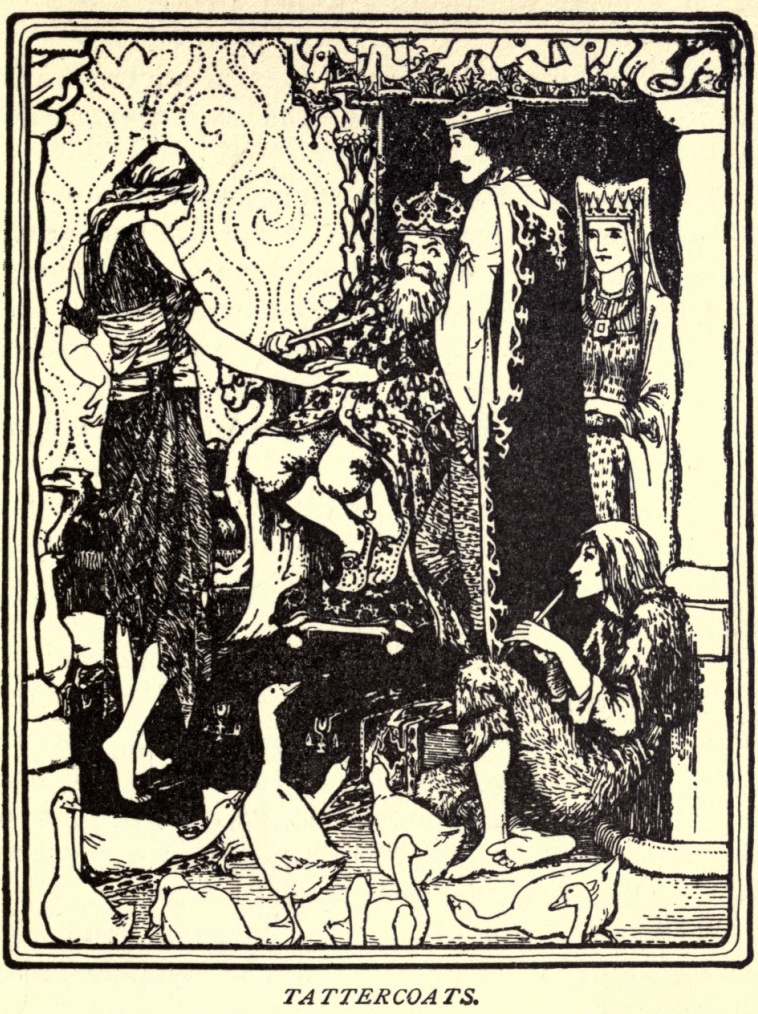
IN a great palace by the sea there once dwelt a very rich old lord who had neither wife nor children living, only one little granddaughter whose face he had never seen in all her life. He hated her bitterly because at her birth his favourite daughter died, and, when the old nurse brought him the baby, he swore that it might live or die as it liked, but he would never look on its face as long as it lived.

So he turned his back and sat by his window, looking out over the sea and weeping great tears for his lost daughter till his white hair and beard grew down over his shoulders and twined round his chair and crept into the chinks of the floor, and his tears, dropping on to the window ledge, wore a channel through the stone and ran away in a little river to the great sea.

And, meanwhile, his granddaughter grew up with no one to care for her or clothe her; only the old nurse, when no one was by, would sometimes give her a dish of scraps from the kitchen, or a torn petticoat from the rag-bag, while the other servants of the palace would drive her from the house with blows and mocking words, calling her 'Tattercoats' and pointing at her bare feet and shoulders, till she ran away crying to hide among the bushes.

And so she grew up, with little to eat or wear, spending her days in the fields and lanes, with only the gooseherd for a companion, who would play to her so merrily on his little pipe when she was hungry or cold or tired that she forgot all her troubles and fell to dancing, with his flock of noisy geese for partners.

But, one day, people told each other that the king was travelling through the land, and in the town near by was to give a great ball to all the lords and ladies of the country when the prince, his only son, was to choose a wife.

One of the royal invitations was brought to the palace by the sea, and the servants carried it up to the old lord, who still sat by his window, wrapped in his long white hair and weeping into the little river that was fed by his tears.

But when he heard the king's command, he dried his eyes and bade them bring shears to cut him loose for his hair had bound him a fast prisoner and he could not move. And then he sent them for rich clothes and jewels, which he put on, and he ordered them to saddle the white horse, with gold and silk, that he might ride to meet the king.

Meanwhile Tattercoats had heard of the great doings in the town, and she sat by the kitchen door weeping because she could not go to see them. And when the old nurse heard her crying, she went to the lord of the palace and begged him to take his granddaughter with him to the king's ball.

But he only frowned and told her to be silent, while the servants laughed and said: 'Tattercoats is happy in her rags, playing with the gooseherd, let her be — it is all she is fit for.'

A second, and then a third time, the old nurse begged him to let the girl go with him, but she was answered only by black looks and fierce words, till she was driven from the room by the jeering servants with blows and mocking words.

Weeping over her ill success, the old nurse went to look for Tattercoats, but the girl had been turned from the door by the cook and had run away to tell her friend the gooseherd how unhappy she was because she could not go to the king's ball.

But when the gooseherd had listened to her story, he bade her cheer up and proposed that they should go together into the town to see the king and all the fine things, and when she looked sorrowfully down at her rags and bare feet, he played a note or two upon his pipe, so gay and merry that she forgot all about her tears and her troubles, and before she well knew, the herdboy had taken her by the hand, and she and he and the geese before them were dancing down the road towards the town.

Before they had gone very far, a handsome young man, splendidly dressed, rode up and stopped to ask the way to the castle where the king was staying, and when he found that they, too, were going thither, he got off his horse and walked beside them along the road.

The herdboy pulled out his pipe and played a low sweet tune, and the stranger looked again and again at Tattercoats's lovely face till he fell deeply in love with her and begged her to marry him.

But she only laughed, and shook her golden head.

'You would be finely put to shame if you had a goosegirl for your wife!' said she; 'go and ask one of the great ladies you will see tonight at the king's ball, and do not flout poor Tattercoats.'

But the more she refused him, the sweeter the pipe played, and the deeper the young man fell in love, till at last he begged her, as a proof of his sincerity, to come that night at twelve to the king's ball, just as she was, with the herdboy and his geese, and in her torn petticoat and bare feet, and he would dance with her before the king and the lords and ladies, and present her to them all, as his dear and honoured bride.

So when night came, and the hall in the castle was full of light and music, and the lords and ladies were dancing before the king, just as the clock struck twelve, Tattercoats and the herdboy, followed by his flock of noisy geese, entered at the great doors and walked straight up the ballroom, while on either side the ladies whispered, the lords laughed, and the king seated at the far end stared in amazement.

But as they came in front of the throne, Tattercoats's lover rose from beside the king and came to meet her. Taking her by the hand, he kissed her thrice before them all and turned to the king.

'Father!' he said, for it was the prince himself, 'I have made my choice, and here is my bride, the loveliest girl in all the land, and the sweetest as well!'

Before he had finished speaking, the herdboy put his pipe to his lips and played a few low notes that sounded like a bird singing far off in the woods, and as he played, Tattercoats's rags were changed to shining robes sewn with glittering jewels, a golden crown lay upon her golden hair, and the flock of geese behind her became a crowd of dainty pages, bearing her long train.

And as the king rose to greet her as his daughter, the trumpets sounded loudly in honour of the new princess, and the people outside in the street said to each other: 'Ah! now the prince has chosen for his wife the loveliest girl in all the land!'

But the gooseherd was never seen again, and no one knew what became of him, while the old lord went home once more to his palace by the sea, for he could not stay at court when he had sworn never to look on his granddaughter's face.

So there he still sits by his window, if you could only see him, as you some day may, weeping more bitterly than ever, as he looks out over the sea.


(1300 words)

More English Fairy Tales: Johnny Gloke

You will find variations on the story of "The Valiant Little Tailor" in many European fairy tale traditions, and not only in Europe; as you can see, this English fairy tale is very similar to a fairy tale in the Persian unit for this class: Muhammad Tirandaz, The Archer.

[Notes by LKG]

This story is part of the English Fairy Tales (2) unit. Story source: More English Fairy Tales by Joseph Jacobs with illustrations by John D. Batten (1894).


Johnny Gloke

JOHNNY GLOKE was a tailor by trade, but, like a man of spirit, he grew tired of his tailoring and wished to follow some other path that would lead to honour and fame. But he did not know what to do at first to gain fame and fortune, so for a time he was fonder of basking idly in the sun than in plying the needle and scissors.

One warm day as he was enjoying his ease, he was annoyed by the flies alighting on his bare ankles. He brought his hand down on them with force and killed a goodly number of them. On counting the victims of his valour, he was overjoyed at his success; his heart rose to the doing of great deeds, and he gave vent to his feelings in the saying:

Well done! Johnny Gloke,
Kilt fifty flies at one stroke.

His resolution was now taken to cut out his path to fortune and honour. So he took down from its resting-place a rusty old sword that had belonged to some of his forebears and set out in search of adventures.

After travelling a long way, he came to a country that was much troubled by two giants whom no one was bold enough to meet and strong enough to overcome. He was soon told of the giants and learned that the king of the country had offered a great reward and the hand of his daughter in marriage to the man who should rid his land of this scourge. John's heart rose to the deed, and he offered himself for the service.

The great haunt of the giants was a wood, and John set out with his old sword to perform his task. When he reached the wood, he laid himself down to think what course he would follow, for he knew how weak he was compared to those he had undertaken to kill. He had not waited long when he saw them coming with a wagon to fetch wood for fuel. My! they were big ones, with huge heads and long tusks for teeth.

Johnny hid himself in the hollow of a tree, thinking only of his own safety. Feeling himself safe, he peeped out of his hiding-place and watched the two at work. Thus watching, he formed his plan for action. He picked up a pebble, threw it with force at one of them, and struck him a sharp blow on the head. The giant in his pain turned at once on his companion and blamed him in strong words for hitting him. The other denied in anger that he had thrown the pebble.


John now saw himself on the high way to gain his reward and the hand of the king's daughter. He kept still and carefully watched for an opportunity of striking another blow. He soon found it, and right against the giant's head went another pebble. The injured giant fell on his companion in fury, and the two belaboured each other till they were utterly tired out. They sat down on a log to breathe, rest and recover themselves.

While sitting, one of them said, 'Well, all the king's army was not able to take us, but I fear an old woman with a rope's end would be too much for us now.'

'If that be so,' said Johnny Gloke, as he sprang, bold as a lion, from his hiding-place, 'what do you say to Johnny Gloke with his old roosty sword?' So saying he fell upon them, cut off their heads, and returned in triumph. He received the king's daughter in marriage and for a time lived in peace and happiness. He never told the mode he followed in his dealing with the giants.

Some time after, a rebellion broke out among the subjects of his father-in-law. John, on the strength of his former valiant deed, was chosen to quell the rebellion. His heart sank within him, but he could not refuse and so lose his great name. He was mounted on the fiercest horse that ever saw sun or wind and set out on his desperate task. He was not accustomed to ride on horseback, and he soon lost all control of his steed. It galloped off at full speed, in the direction of the rebel army. In its wild career it passed under the gallows that stood by the wayside. The gallows was somewhat old and frail, and down it fell on the horse's neck. Still the horse made no stop, but always forward at furious speed towards the rebels.

On seeing this strange sight approaching towards them at such a speed, the rebels were seized with terror and cried out to one another, 'There comes Johnny Gloke that killed the two giants with the gallows on his horse's neck to hang us all.' They broke their ranks, fled in dismay, and never stopped till they reached their homes.

Thus was Johnny Gloke a second time victorious. So in due time he came to the throne and lived a long, happy, and good life as king.

Next: Scrapefoot


(900 words)

More English Fairy Tales: Scrapefoot

This story is part of the English Fairy Tales (2) unit. Story source: More English Fairy Tales by Joseph Jacobs with illustrations by John D. Batten (1894).

Scrapefoot


ONCE upon a time, there were three Bears who lived in a castle in a great wood. One of them was a great big Bear, and one was a middling Bear, and one was a little Bear. And in the same wood there was a Fox who lived all alone, his name was Scrapefoot.

Scrapefoot was very much afraid of the Bears, but for all that he wanted very much to know all about them. And one day as he went through the wood, he found himself near the Bears' castle, and he wondered whether he could get into the castle. He looked all about him everywhere, and he could not see anyone. So he came up very quietly, till at last he came up to the door of the castle, and he tried whether he could open it. Yes! the door was not locked, and he opened it just a little way, and put his nose in and looked, and he could not see anyone. So then he opened it a little way farther, and put one paw in, and then another paw, and another and another, and then he was all in the Bears' castle.

He found he was in a great hall with three chairs in it — one big, one middling, and one little chair, and he thought he would like to sit down and rest and look about him, so he sat down on the big chair. But he found it so hard and uncomfortable that it made his bones ache, and he jumped down at once and got into the middling chair, and he turned round and round in it, but he couldn't make himself comfortable. So then he went to the little chair and sat down in it, and it was so soft and warm and comfortable that Scrapefoot was quite happy, but all at once it broke to pieces under him and he couldn't put it together again!

So he got up and began to look about him again, and on one table he saw three saucers, of which one was very big, one was middling, one was quite a little saucer. Scrapefoot was very thirsty, and he began to drink out of the big saucer. But he only just tasted the milk in the big saucer, which was so sour and so nasty that he would not taste another drop of it. Then he tried the middling saucer, and he drank a little of that. He tried two or three mouthfuls, but it was not nice, and then he left it and went to the little saucer, and the milk in the little saucer was so sweet and so nice that he went on drinking it till it was all gone.

Then Scrapefoot thought he would like to go upstairs, and he listened and he could not hear anyone. So upstairs he went, and he found a great room with three beds in it; one was a big bed, and one was a middling bed, and one was a little white bed, and he climbed up into the big bed, but it was so hard and lumpy and uncomfortable that he jumped down again at once, and tried the middling bed. That was rather better, but he could not get comfortable in it, so after turning about a little while he got up and went to the little bed, and that was so soft and so warm and so nice that he fell fast asleep at once.

And after a time the Bears came home, and when they got into the hall, the big Bear went to his chair and said, 'WHO'S BEEN SITTING IN MY CHAIR?' and the middling Bear said, 'WHO'S BEEN SITTING IN MY CHAIR?' and the little Bear said, 'Who's been sitting in my chair and has broken it all to pieces?'

And then they went to have their milk, and the big Bear said, 'WHO'S BEEN DRINKING MY MILK?' and the middling Bear said, 'WHO'S BEEN DRINKING MY MILK?' and the little Bear said, 'Who's been drinking my milk and has drunk it all up?'

Then they went upstairs and into the bedroom, and the big Bear said, 'WHO'S BEEN SLEEPING IN MY BED?' and the middling Bear said, 'WHO'S BEEN SLEEPING IN MY BED?' and the little Bear said, 'Who's been sleeping in my bed? And see, here he is!'

So then the Bears came and wondered what they should do with him, and the big Bear said, 'Let's hang him!' and then the middling Bear said, 'Let's drown him!' and then the little Bear said, 'Let's throw him out of the window.' And then the Bears took him to the window, and the big Bear took two legs on one side and the middling Bear took two legs on the other side, and they swung him backwards and forwards, backwards and forwards, and out of the window.

Poor Scrapefoot was so frightened, and he thought every bone in his body must be broken. But he got up and first shook one leg — no, that was not broken; and then another, and that was not broken; and another and another, and then he wagged his tail and found there were no bones broken. So then he galloped off home as fast as he could go and never went near the Bears' castle again.


(900 words)

More English Fairy Tales: The Old Witch

This story is part of the English Fairy Tales (2) unit. Story source: More English Fairy Tales by Joseph Jacobs with illustrations by John D. Batten (1894).


The Old Witch


ONCE upon a time there were two girls who lived with their mother and father. Their father had no work, and the girls wanted to go away and seek their fortunes.

Now one girl wanted to go to service, and her mother said she might if she could find a place. So she started for the town. Well, she went all about the town, but no one wanted a girl like her.

So she went on farther into the country, and she came to the place where there was an oven where there was lots of bread baking. And the bread said, 'Little girl, little girl, take us out, take us out. We have been baking seven years, and no one has come to take us out.' So the girl took out the bread, laid it on the ground and went on her way.

Then she met a cow, and the cow said, 'Little girl, little girl, milk me, milk me! Seven years have I been waiting, and no one has come to milk me.' The girl milked the cow into the pails that stood by. As she was thirsty she drank some, and left the rest in the pails by the cow.

Then she went on a little farther, and came to an apple-tree, so loaded with fruit that its branches were breaking down, and the tree said, 'Little girl, little girl, help me shake my fruit. My branches are breaking, it is so heavy.' And the girl said, 'Of course I will, you poor tree.' So she shook the fruit all off, propped up the branches, and left the fruit on the ground under the tree.

Then she went on again till she came to a house. Now in this house there lived a witch, and this witch took girls into her house as servants. And when she heard that this girl had left her home to seek service, she said that she would try her and give her good wages.

The witch told the girl what work she was to do. 'You must keep the house clean and tidy, sweep the floor and the fireplace, but there is one thing you must never do. You must never look up the chimney, or something bad will befall you.'

So the girl promised to do as she was told, but one morning as she was cleaning, and the witch was out, she forgot what the witch said and looked up the chimney. When she did this a great bag of money fell down in her lap. This happened again and again. So the girl started to go off home.

When she had gone some way she heard the witch coming after her. So she ran to the apple-tree and cried:

'Apple-tree, apple-tree, hide me,
So the old witch can't find me;
If she does, she'll pick my bones
And bury me under the marble stones.'

So the apple-tree hid her. When the witch came up she said:

'Tree of mine, tree of mine,
Have you seen a girl
With a willy-willy wag and a long-tailed bag,
Who's stole my money, all I had?'

And the apple-tree said, 'No, mother; not for seven year.'

When the witch had gone down another way, the girl went on again and, just as she got to the cow, heard the witch coming after her again, so she ran to the cow and cried:

'Cow, cow, hide me,
So the old witch can't find me;
If she does, she'll pick my bones
And bury me under the marble stones.'

So the cow hid her.

When the old witch came up, she looked about and said to the cow:

'Cow of mine, cow of mine,
Have you seen a girl
With a willy-willy wag and a long-tailed bag,
Who's stole my money, all I had?'

And the cow said, 'No, mother, not for seven year.'

When the witch had gone off another way, the little girl went on again, and when she was near the oven, she heard the witch coming after her again, so she ran to the oven and cried:

'Oven, oven, hide me,
So the old witch can't find me;
If she does, she'll pick my bones
And bury me under the marble stones.'

And the oven said, 'I've no room; ask the baker,' and the baker hid her behind the oven.

When the witch came up she looked here and there and everywhere, and then said to the baker:

'Man of mine, man of mine,
Have you seen a girl,
With a willy-willy wag and a long-tailed bag,
Who's stole my money, all I had?'

So the baker said, 'Look in the oven.'

The old witch went to look, and the oven said, 'Get in and look in the furthest corner.'

The witch did so, and when she was inside the oven shut her door, and the witch was kept there for a very long time.

The girl then went off again and reached her home with her money bags, married a rich man, and lived happy ever afterwards.

The other sister then thought she would go and do the same. And she went the same way. But when she reached the oven, and the bread said, 'Little girl, little girl, take us out. Seven years have we been baking, and no one has come to take us out,' the girl said, 'No, I don't want to burn my fingers.' So she went on till she met the cow, and the cow said, 'Little girl, little girl, milk me, milk me, do. Seven years have I been waiting, and no one has come to milk me.' But the girl said, 'No, I can't milk you, I'm in a hurry,' and went on faster. Then she came to the apple-tree, and the apple-tree asked her to help shake the fruit. 'No, I can't; another day p'raps I may,' and went on till she came to the witch's house.

Well, it happened to her just the same as to the other girl — she forgot what she was told, and, one day when the witch was out, looked up the chimney, and down fell a bag of money. Well, she thought she would be off at once. When she reached the apple-tree, she heard the witch coming after her, and she cried:

'Apple-tree, apple-tree, hide me,
So the old witch can't find me;
If she does, she'll pick my bones
And bury me under the marble stones.'

But the tree didn't answer, and she ran on further. Presently the witch came up and said:

'Tree of mine, tree of mine,
Have you seen a girl,
With a willy-willy wag and a long-tailed bag,
Who's stole my money, all I had?'

The tree said, 'Yes, mother; she's gone down that way.'

So the old witch went after her and caught her; she took all the money away from her, beat her, and sent her off home just as she was.


(1100 words)

More English Fairy Tales: The Three Wishes

This story is part of the English Fairy Tales (2) unit. Story source: More English Fairy Tales by Joseph Jacobs with illustrations by John D. Batten (1894).


The Three Wishes


ONCE upon a time, and be sure 'twas a long time ago, there lived a poor woodman in a great forest, and every day of his life he went out to fell timber. So one day he started out, and the goodwife filled his wallet and slung his bottle on his back that he might have meat and drink in the forest.

He had marked out a huge old oak, which, thought he, would furnish many and many a good plank. And when he was come to it, he took his axe in his hand and swung it round his head as though he were minded to fell the tree at one stroke. But he hadn't given one blow when what should he hear but the pitifullest entreating, and there stood before him a fairy who prayed and beseeched him to spare the tree. He was dazed, as you may fancy, with wonderment and affright, and he couldn't open his mouth to utter a word. But he found his tongue at last and 'Well,' said he, 'I'll e'en do as thou wishest.'

'You've done better for yourself than you know,' answered the fairy, 'and to show I'm not ungrateful, I'll grant you your next three wishes, be they what they may.' And therewith the fairy was no more to be seen, and the woodman slung his wallet over his shoulder and his bottle at his side, and off he started home.

But the way was long, and the poor man was regularly dazed with the wonderful thing that had befallen him, and when he got home there was nothing in his noddle but the wish to sit down and rest. Maybe, too, 'twas a trick of the fairy's. Who can tell?

Anyhow, down he sat by the blazing fire, and as he sat he waxed hungry, though it was a long way off supper-time yet.

'Hasn't thou naught for supper, dame?' said he to his wife.

'Nay, not for a couple of hours yet,' said she.

'Ah!' groaned the woodman, 'I wish I'd a good link of black pudding here before me.'

No sooner had he said the word, when clatter, clatter, rustle, rustle, what should come down the chimney but a link of the finest black pudding the heart of man could wish for.

If the woodman stared, the goodwife stared three times as much. 'What's all this?' says she.

Then all the morning's work came back to the woodman, and he told his tale right out, from beginning to end, and as he told it the goodwife glowered and glowered, and when he had made an end of it she burst out, 'Thou bee'st but a fool, Jan, thou bee'st but a fool, and I wish the pudding were at thy nose, I do indeed.'

And before you could say Jack Robinson, there the Goodman sat and his nose was the longer for a noble link of black pudding.

He gave a pull, but it stuck, and she gave a pull, but it stuck, and they both pulled till they had nigh pulled the nose off, but it stuck and stuck.

'What's to be done now?' said he.

"Tisn't so very unsightly,' said she, looking hard at him.

Then the woodman saw that if he wished, he must need wish in a hurry, and wish he did that the black pudding might come off his nose. Well! there it lay in a dish on the table, and if the goodman and goodwife didn't ride in a golden coach, or dress in silk and satin, why, they had at least as fine a black pudding for their supper as the heart of man could desire.


(600 words)

More English Fairy Tales: The Children in the Wood

This story is part of the English Fairy Tales (2) unit. Story source: More English Fairy Tales by Joseph Jacobs with illustrations by John D. Batten (1894).


The Children in the Wood


Now ponder well, you parents dear,
These words which I shall write;
A doleful story you shall hear,
In time brought forth to light.
A gentleman of good account,
In Norfolk dwelt of late,
Who did in honour far surmount
Most men of his estate.

Sore sick he was and like to die;
No help his life could save.
His wife by him as sick did lie,
And both possest one grave.
No love between these two was lost,
Each was to other kind;
In love they lived, in love they died,
And left two babes behind.

The one a fine and pretty boy
Not passing three years old,
The other a girl more young than he,
And framed in beauty's mould.
The father left his little son,
As plainly did appear,
When he to perfect age should come,
Three hundred pounds a year;

And to his little daughter Jane
Five hundred pounds in gold,
To be paid down on marriage-day,
Which might not be controlled.
But if the children chanced to die
Ere they to age should come,
Their uncle should possess their wealth;
For so the will did run.

'Now, brother,' said the dying man,
'Look to my children dear;
Be good unto my boy and girl,
No friends else have they here.
To God and you I recommend
My children dear this day,
But little while be sure we have
Within this world to stay.

'You must be father and mother both,
And uncle, all in one;
God knows what will become of them
When I am dead and gone.'
With that bespake their mother dear;
'O brother kind,' quoth she,
'You are the man must bring our babes
To wealth or misery.

'And if you keep them carefully,
Then God will you reward;
But if you otherwise should deal,
God will your deeds regard.'
With lips as cold as any stone,
They kissed their children small:
'God bless you both, my children dear!'
With that the tears did fall.

These speeches then their brother spake
To this sick couple there:
'The keeping of your little ones,
Sweet sister, do not fear;
God never prosper me nor mine,
Nor aught else that I have,
If I do wrong your children dear
When you are laid in grave!'

The parents being dead and gone,
The children home he takes,
And brings them straight unto his house
Where much of them he makes.
He had not kept these pretty babes
A twelvemonth and a day,
But, for their wealth, he did devise
To make them both away.

He bargained with two ruffians strong,
Which were of furious mood,
That they should take these children young,
And slay them in a wood.
He told his wife an artful tale
He would the children send
To be brought up in London town
With one that was his friend.

Away then went those pretty babes,
Rejoicing at that tide,
Rejoicing with a merry mind
They should on cock-horse ride.
They prate and prattle pleasantly,
As they ride on the way,
To those that should their butchers be
And work their lives' decay:

So that the pretty speech they had
Made Murder's heart relent,
And they that undertook the deed
Full sore now did repent.
Yet one of them, more hard of heart,
Did vow to do his charge
Because the wretch that hired him
Had paid him very large.

The other won't agree thereto,
So there they fall to strife;
With one another they did fight
About the children's life,
And he that was of mildest mood
Did slay the other there,
Within an unfrequented wood;
The babes did quake for fear!

He took the children by the hand,
Tears standing in their eye,
And bade them straightway follow him,
And look: they did not cry;
And two long miles he led them on,
While they for food complain.
'Stay here,' quoth he, 'I'll bring you bread
When I come back again.'

These pretty babes, with hand in hand,
Went wandering up and down,
But never more could see the man
Approaching from the town.
Their pretty lips from blackberries
Were all besmeared and dyed,
And when they saw the darksome night,
They sat them down and cried.

Thus wandered these poor innocents,
Till death did end their grief;
In one another's arms they died,
As wanting due relief:
No burial this pretty pair
From any man receives,
Till Robin Redbreast piously
Did cover them with leaves.

And now the heavy wrath of God
Upon their uncle fell;
Yea, fearful fiends did haunt his house,
His conscience felt an hell:
His barns were fired, his goods consumed,
His hands were barren made,
His cattle died within the field,
And nothing with him stayed.

And in a voyage to Portugal
Two of his sons did die,
And, to conclude, himself was brought
To want and misery:
He pawned and mortgaged all his land
Ere seven years came about.
And now at last this wicked act
Did by this means come out.

The fellow that did take in hand
These children for to kill,
Was for a robbery judged to die —
Such was God's blessed will —
Who did confess the very truth,
As here hath been displayed:
The uncle having died in jail,
Where he for debt was laid.

You that executors be made
And overseers eke
Of children that be fatherless
And infants mild and meek,
Take you example by this thing,
And yield to each his right,
Lest God with suchlike misery
Your wicked minds requite.


(800 words)

More English Fairy Tales: King John and the Abbot of Canterbury

This story is part of the English Fairy Tales (2) unit. Story source: More English Fairy Tales by Joseph Jacobs with illustrations by John D. Batten (1894).


King John and the Abbot of Canterbury


IN the reign of King John there lived an Abbot of Canterbury who kept up grand state in his Abbey. A hundred of the Abbot's men dined each day with him in his refectory, and fifty knights in velvet coats and gold chains waited upon him daily. Well, King John, as you know, was a very bad king, and he couldn't brook the idea of anyone in his kingdom, however holy he might be, being honoured more than he. So he summoned the Abbot of Canterbury to his presence.

The Abbot came with a goodly retinue, with his fifty knights-at-arms in velvet cloaks and gold chains. The King went to meet him and said to him, 'How now, father Abbot? I hear it of thee, thou keepest far greater state than I. This becomes not our royal dignity, and savours of treason in thee.'

'My liege,' quoth the Abbot, bending low, 'I beg to say that all I spend has been freely given to the Abbey out of the piety of the folk. I trust your Grace will not take it ill that I spend for the Abbey's sake what is the Abbey's.'

'Nay, proud prelate,' answered the King, 'all that is in this fair realm of England is our own, and thou has no right to put me to shame by holding such state. However, of my clemency I will spare thy life and thy property if you can answer me but three questions.'

'I will do so, my liege,' said the Abbot, 'so far as my poor wit can extend.'

'Well, then,' said the King, 'tell me where is the centre of all the world round; then let me know how soon can I ride the whole world about; and, lastly, tell me what I think.'

'Your Majesty jesteth,' stammered the Abbot.

'Thou wilt find it no jest,' said the King. 'Unless thou canst answer me these questions three before a week is out, thy head will leave thy body,' and he turned away.

Well, the Abbot rode off in fear and trembling, and first he went to Oxford to see if any learned doctor could tell him the answer to those questions three, but none could help him, and he took his way to Canterbury, sad and sorrowful, to take leave of his monks. But on his way he met his shepherd as he was going to the fold.

'Welcome home, Lord Abbot,' quoth the shepherd; 'what news from good King John?'

'Sad news, sad news, my shepherd,' said the Abbot, and told him all that had happened.

'Now, cheer up, Sir Abbot,' said the shepherd. 'A fool may perhaps answer what a wise man knows not. I will go to London in your stead; grant me only your apparel and your retinue of knights. At the least I can die in your place.'

'Nay, shepherd, not so,' said the Abbot; 'I must meet the danger in my own person. And to that, thou canst not pass for me.'

'But I can and I will, Sir Abbot. In a cowl, who will know me for what I am?'

So, at last the Abbot consented and sent him to London in his most splendid array, and he approached King John with all his retinue as before, but dressed in his simple monk's dress and his cowl over his face.

'Now welcome, Sir Abbot,' said King John; 'thou art prepared for thy doom, I see.'

'I am ready to answer your Majesty,' said he.

'Well, then, question first — where is the centre of the round earth?' said the King.

'Here,' said the shepherd Abbot, planting his crozier in the ground; 'an' your Majesty believe me not, go measure it and see.'

'By St Botolph,' said the King, 'a merry answer and a shrewd; so to question the second. How soon may I ride this round world about?'

'If your Majesty will graciously rise with the sun, and ride along with him until the next morning he rise, your Grace will surely have ridden it round.'

'By St John,' laughed King John, 'I did not think it could be done so soon. But let that pass, and tell me question third and last, and that is — What do I think?'

'That is easy, your Grace,' said he. 'Your Majesty thinks I am my lord the Abbot of Canterbury, but as you may see,' and here he raised his cowl, 'I am but his poor shepherd, that am come to ask your pardon for him and for me.'

Loud laughed the King. 'Well caught. Thou hast more wit than thy lord, and thou shalt be Abbot in his place.'

'Nay, that cannot be,' quoth the shepherd; 'I know not to write nor to read.'

'Well, then, four nobles a week thou shalt have for the ready wit. And tell the Abbot from me that he has my pardon.' And with that King John sent away the shepherd with a right royal present, besides his pension.


(800 words)

More English Fairy Tales: Rushen Coatie

This story is part of the English Fairy Tales (2) unit. Story source: More English Fairy Tales by Joseph Jacobs with illustrations by John D. Batten (1894).


Rushen Coatie


THERE was once a king and a queen, as many a one has been; few have we seen, and as few may we see. But the queen died, leaving only one bonny girl, and she told her on her deathbed: 'My dear, after I am gone, there will come to you a little red calf, and whenever you want anything, speak to it, and it will give it you.'

Now, after a while, the king married again an ill-natured wife with three ugly daughters of her own. And they hated the king's daughter because she was so bonny. So they took all her fine clothes away from her and gave her only a coat made of rushes. So they called her Rushen Coatie and made her sit in the kitchen nook, amid the ashes.

And when dinner-time came, the nasty stepmother sent her out a thimbleful of broth, a grain of barley, a thread of meat, and a crumb of bread. But when she had eaten all this, she was just as hungry as before, so she said to herself: 'Oh! how I wish I had something to eat.'

Just then, who should come in but a little red calf and said to her: 'Put your finger into my left ear.' She did so, and found some nice bread. Then the calf told her to put her finger into its right ear, and she found there some cheese, and made a right good meal of the bread and cheese. And so it went on from day to day.

Now the king's wife thought Rushen Coatie would soon die from the scanty food she got, and she was surprised to see her as lively and healthy as ever. So she set one of her ugly daughters on the watch at meal-times to find out how Rushen Coatie got enough to live on. The daughter soon found out that the red calf gave food to Rushen Coatie, and told her mother.

So her mother went to the king and told him she was longing to have a sweetbread from a red calf. Then the king sent for his butcher, and had the little calf killed. And when Rushen Coatie heard of it, she sate down and wept by its side, but the dead calf said:

'Take me up, bone by bone,
And put me beneath yon grey stone;
When there is aught you want,
Tell it me, and that I'll grant.'

So she did so, but could not find the shank-bone of the calf.

Now the very next Sunday was Yuletide, and all the folk were going to church in their best clothes, so Rushen Coatie said: 'Oh! I should like to go to church, too,' but the three ugly sisters said: 'What would you do at the church, you nasty thing? You must bide at home and make the dinner.' And the king's wife said: 'And this is what you must make the soup of, a thimbleful of water, a grain of barley, and a crumb of bread.'

When they all went to church, Rushen Coatie sat down and wept, but looking up, who should she see coming in limping, lamping, with a shank wanting, but the dear red calf? And the red calf said to her: 'Do not sit there weeping, but go, put on these clothes, and above all, put on this pair of glass slippers, and go your way to church.'

'But what will become of the dinner?' said Rushen Coatie.

'Oh, do not fash about that,' said the red calf; 'all you have to do is to say to the fire:

"Every peat make t'other burn,
Every spit make t'other turn,
Every pot make t'other play,
Till I come from church this good Yuleday,"

and be off to church with you. But mind you come home first.'

So Rushen Coatie said this, and went off to church, and she was the grandest and finest lady there. There happened to be a young prince there, and he fell at once in love with her. But she came away before service was over, and was home before the rest, and had off with her fine clothes and on with her rushen coatie, and she found the calf had covered the table, and the dinner was ready, and everything was in good order when the rest came home.

The three sisters said to Rushen Coatie: 'Eh, lassie, if you had seen the bonny fine lady in church today that the young prince fell in love with!'

Then she said, 'Oh! I wish you would let me go with you to the church tomorrow,' for they used to go three days together to church at Yuletide.

But they said: 'What should the like of you do at church, nasty thing? The kitchen nook is good enough for you.'

So the next day they all went to church, and Rushen Coatie was left behind to make dinner out of a thimbleful of water, a grain of barley, a crumb of bread, and a thread of meat. But the red calf came to her help again, gave her finer clothes than before, and she went to church, where all the world was looking at her and wondering where such a grand lady came from, and the prince fell more in love with her than ever and tried to find out where she went to. But she was too quick for him and got home long before the rest, and the red calf had the dinner all ready.

The next day the calf dressed her in even grander clothes than before, and she went to the church. And the young prince was there again, and this time he put a guard at the door to keep her, but she took a hop and a run and jumped over their heads, and as she did so, down fell one of her glass slippers. She didn't wait to pick it up, you may be sure, but off she ran home, as fast as she could go, on with the rushen coatie, and the calf had all things ready.

The young prince put out a proclamation that whoever could put on the glass slipper should be his bride. All the ladies of his court went and tried to put on the slipper. And they tried and tried and tried, but it was too small for them all. Then he ordered one of his ambassadors to mount a fleet horse and ride through the kingdom and find an owner for the glass shoe.

He rode and he rode to town and castle, and made all the ladies try to put on the shoe. Many a one tried to get it on that she might be the prince's bride. But no, it wouldn't do, and many a one wept, I warrant, because she couldn't get on the bonny glass shoe.

The ambassador rode on and on till he came at the very last to the house where there were the three ugly sisters. The first two tried it and it wouldn't do, and the queen, mad with spite, hacked off the toes and heels of the third sister, and she could then put the slipper on, and the prince was brought to marry her, for he had to keep his promise. The ugly sister was dressed all in her best and was put up behind the prince on horseback, and off they rode in great gallantry. But ye all know, pride must have a fall, for as they rode along a raven sang out of a bush —

'Hacked Heels and Pinched Toes
Behind the young prince rides,
But Pretty Feet and Little Feet
Behind the cauldron bides.'

'What's that the birdie sings?' said the young prince.

'Nasty, lying thing,' said the stepsister; 'never mind what it says.'

But the prince looked down and saw the slipper dripping with blood, so he rode back and put her down. Then he said, 'There must be someone that the slipper has not been tried on.'

'Oh, no,' said they, 'there's none but a dirty thing that sits in the kitchen nook and wears a rushen coatie.'

But the prince was determined to try it on Rushen Coatie, but she ran away to the grey stone where the red calf dressed her in her bravest dress, and she went to the prince and the slipper jumped out of his pocket on to her foot, fitting her without any chipping or paring. So the prince married her that very day, and they lived happy ever after.


(1400 words)

More English Fairy Tales: The King o' the Cats

This story is part of the English Fairy Tales (2) unit. Story source: More English Fairy Tales by Joseph Jacobs with illustrations by John D. Batten (1894).


The King o' the Cats


ONE winter's evening the sexton's wife was sitting by the fireside with her big black cat, Old Tom, on the other side, both half asleep and waiting for the master to come home. They waited and they waited, but still he didn't come, till at last he came rushing in, calling out, 'Who's Tommy Tildrum?' in such a wild way that both his wife and his cat stared at him to know what was the matter.

'Why, what's the matter?' said his wife, 'and why do you want to know who Tommy Tildrum is?'

'Oh, I've had such an adventure. I was digging away at old Mr Fordyce's grave when I suppose I must have dropped asleep, and only woke up by hearing a cat's Miaou.'

'Miaou!' said Old Tom in answer.

'Yes, just like that! So I looked over the edge of the grave, and what do you think I saw?'

'Now, how can I tell?' said the sexton's wife.

'Why, nine black cats all like our friend Tom here, all with a white spot on their chestesses. And what do you think they were carrying? Why, a small coffin covered with a black velvet pall, and on the pall was a small coronet all of gold, and at every third step they took they cried all together, Miaou — '

'Miaou!' said Old Tom again.

'Yes, just like that!' said the sexton, 'and as they came nearer and nearer to me, I could see them more distinctly because their eyes shone out with a sort of green light. Well, they all came towards me, eight of them carrying the coffin, and the biggest cat of all walking in front for all the world like — but look at our Tom, how he's looking at me. You'd think he knew all I was saying.'

'Go on, go on,' said his wife; 'never mind Old Tom.'

'Well, as I was a-saying, they came towards me slowly and solemnly, and at every third step crying all together, Miaou —'

'Miaou!' said Old Tom again.

'Yes, just like that, till they came and stood right opposite Mr Fordyce's grave, where I was, when they all stood still and looked straight at me. I did feel queer, that I did! But look at Old Tom; he's looking at me just like they did.'

'Go on, go on,' said his wife; 'never mind Old Tom.'

'Where was I? Oh, they stood still looking at me, when the one that wasn't carrying the coffin came forward and, staring straight at me, said to me — yes, I tell 'ee, said to me with a squeaky voice, "Tell Tom Tildrum that Tim Toidrum's dead," and that's why I asked you if you knew who Tom Tildrum was, for how can I tell Tom Tildrum Tim Toldrum's dead if I don't know who Tom Tildrum is?'

'Look at Old Tom, look at Old Tom!' screamed his wife.

And well he might look, for Tom was swelling and Tom was staring, and at last Tom shrieked out, 'What -- old Tom dead! then I'm the King o' the Cats!' and rushed up the chimney and was nevermore seen.


(500 words)

More English Fairy Tales: The Stars in the Sky

This story is part of the English Fairy Tales (2) unit. Story source: More English Fairy Tales by Joseph Jacobs with illustrations by John D. Batten (1894).


The Stars in the Sky


ONCE on a time and twice on a time, and all times together as ever I heard tell of, there was a tiny lassie who would weep all day to have the stars in the sky to play with; she wouldn't have this, and she wouldn't have that, but it was always the stars she would have. So one fine day off she went to find them. And she walked and she walked and she walked, till by and by she came to a mill-dam.

'Goode' en to ye,' says she, 'I'm seeking the stars in the sky to play with. Have you seen any?'

'Oh, yes, my bonnie lassie,' said the mill-dam. 'They shine in my own face o' nights till I can't sleep for them. Jump in and perhaps you'll find one.'

So she jumped in, and swam about and swam about and swam about, but ne'er a one could she see. So she went on till she came to a brooklet.

'Goode'en to ye, Brooklet, Brooklet,' says she; 'I'm seeking the stars in the sky to play with. Have you seen any?'

'Yes, indeed, my bonny lassie,' said the Brooklet. 'They glint on my banks at night. Paddle about, and maybe you'll find one.'

So she paddled and she paddled and she paddled, but ne'er a one did she find. So on she went till she came to the Good Folk.

'Goode'en to ye, Good Folk,' says she; 'I'm looking for the stars in the sky to play with. Have ye seen e'er a one?'

'Why, yes, my bonnie lassie,' said the Good Folk. 'They shine on the grass here o' night. Dance with us, and maybe you'll find one.'

And she danced and she danced and she danced, but ne'er a one did she see. So down she sate; I suppose she wept.

'Oh dearie me, oh dearie me,' says she, 'I've swam and I've paddled and I've danced, and if ye'll not help me I shall never find the stars in the sky to play with.'

But the Good Folk whispered together, and one of them came up to her and took her by the hand and said, 'If you won't go home to your mother, go forward, go forward; mind you take the right road. Ask Four Feet to carry you to No Feet at all, and tell No Feet at all to carry you to the stairs without steps, and if you can climb that — '

'Oh, shall I be among the stars in the sky then?' cried the lassie.

'If you'll not be, then you'll be elsewhere,' said the Good Folk, and set to dancing again.

So on she went again with a light heart, and by and by she came to a saddled horse, tied to a tree.

'Goode'en to ye, Beast,' said she; 'I'm seeking the stars in the sky to play with. Will you give me a lift? for all my bones are an-aching.'

'Nay,' said the horse, 'I know naught of the stars in the sky, and I'm here to do the bidding of the Good Folk, and not my own will.'

'Well,' said she, 'it's from the Good Folk I come, and they bade me tell Four Feet to carry me to No Feet at all.'

'That's another story,' said he; 'jump up and ride with me.'

So they rode and they rode and they rode, till they got out of the forest and found themselves at the edge of the sea. And on the water in front of them was a wide glistening path running straight out towards a beautiful thing that rose out of the water and went up into the sky, and was all the colours in the world, blue and red and green, and wonderful to look at.

'Now get you down,' said the horse; 'I've brought ye to the end of the land, and that's as much as Four Feet can do. I must away home to my own folk.'

'But,' said the lassie, 'where's No Feet at all, and where's the stair without steps?'

'I know not,' said the horse; 'it's none of my business neither. So goode'en to ye, my bonny lassie,' and off he went.

So the lassie stood still and looked at the water, till a strange kind of fish came swimming up to her feet.

'Goode'en to ye, big Fish,' says she; 'I'm looking for the stars in the sky and for the stairs that climb up to them. Will ye show me the way?'

'Nay,' said the Fish, 'I can't unless you bring me word from the Good Folk.'

'Yes, indeed,' said she. 'They said Four Feet would bring me to No Feet at all, and No Feet at all would carry me to the stairs without steps.'

'Ah, well,' said the Fish; 'that's all right then. Get on my back and hold fast.'

And off he went -- kerplash! -- into the water, along the silver path, towards the bright arch. And the nearer they came the brighter the sheen of it, till she had to shade her eyes from the light of it.

And as they came to the foot of it, she saw it was a broad bright road, sloping up and away into the sky, and at the far, far end of it she could see wee shining things dancing about.

'Now,' said the Fish, 'here you are, and yon's the stair; climb up, if you can, but hold on fast. I'll warrant you find the stair easier at home than by such a way; 'twas ne'er meant for lassies' feet to travel,' and off he splashed through the water.

So she clomb and she clomb and she clomb, but ne'er a step higher did she get: the light was before her and around her, and the water behind her, and the more she struggled the more she was forced down into the dark and the cold, and the more she clomb the deeper she fell.

But she clomb and she clomb, till she got dizzy in the light, and shivered with the cold, and dazed with the fear, but still she clomb, till at last, quite amazed and silly-like, she let clean go, and sank down — down — down.

And bang she came on to the hard boards and found herself sitting, weeping and wailing, by the bedside at home all alone.


(1100 words)

More English Fairy Tales: The Little Bull-Calf

This story is part of the English Fairy Tales (2) unit. Story source: More English Fairy Tales by Joseph Jacobs with illustrations by John D. Batten (1894).


The Little Bull-Calf


CENTURIES of years ago, when almost all this part of the country was wilderness, there was a little boy who lived in a poor bit of property, and his father gave him a little bull-calf, and with it he gave him everything he wanted for it.

But soon after, his father died and his mother got married again to a man that turned out to be a very vicious stepfather who couldn't abide the little boy. So at last the stepfather said: 'If you bring that bull-calf into this house, I'll kill it.' What a villain he was, wasn't he?

Now this little boy used to go out and feed his bull-calf every day with barley bread, and when he did so this time, an old man came up to him — we can guess who that was, eh? — and said to him: 'You and your bull-calf had better go away and seek your fortune.'

So he went on and he went on and he went on, as far as I could tell you till tomorrow night, and he went up to a farmhouse and begged a crust of bread, and when he got back, he broke it in two and gave half of it to the bull-calf. And he went to another house and begged a bit of cheese curd, and when he got back, he wanted to give half of it to the bull-calf.

'No,' says the bull-calf, 'I'm going across the field, into the wild-wood wilderness country, where there'll be tigers, leopards, wolves, monkeys, and a fiery dragon, and I'll kill them all except the fiery dragon, and he'll kill me.'

The little boy did cry, and said: 'Oh, no, my little bull-calf; I hope he won't kill you.'

'Yes, he will,' said the little bull-calf, 'so you climb up that tree, so that no one can come nigh you but the monkeys, and if they come, the cheese curd will save you. And when I'm killed, the dragon will go away for a bit; then you must come down the tree and skin me, and take out my bladder and blow it out, and it will kill everything you hit with it. So when the fiery dragon comes back, you hit it with my bladder and cut its tongue out.'

(We know there were fiery dragons in those days, like George and his dragon in the legend; but, there! it's not the same world nowadays. The world is turned topsy-turvey since then, like as if you'd turn it over with a spade!)

Of course, he did all the little bull-calf told him. He climbed up the tree, and the monkeys climbed up the tree after him. But he held the cheese curd in his hand and said: 'I'll squeeze your heart like the flint-stone.'

So the monkey cocked his eye as much as to say: 'If you can squeeze a flint-stone to make the juice come out of it, you can squeeze me.' But he didn't say anything, for a monkey's cunning, but down he went.

And all the while the little bull-calf was fighting all the wild beasts on the ground, and the little lad was clapping his hands up the tree and calling out: 'Go in, my little bull-calf! Well fought, little bull-calf!' And he mastered everything except the fiery dragon, but the fiery dragon killed the little bull-calf.

But the lad waited and waited till he saw the dragon go away, then he came down and skinned the little bull-calf, and took out its bladder, and went after the dragon. And as he went on, what should he see but a king's daughter, staked down by the hair of her head, for she had been put there for the dragon to destroy her.

So he went up and untied her hair, but she said: 'My time has come for the dragon to destroy me; go away — you can do no good.'

But he said: 'No! I can master it, and I won't go,' nor for all her begging and praying he would stop.

And soon he heard it coming, roaring and raging from afar off, and at last it came near, spitting fire, and with a tongue like a great spear, and you could hear it roaring for miles, and it was making for the place where the king's daughter was staked down. But when it came up to them, the lad just hit it on the head with the bladder, and the dragon fell down dead, but before it died, it bit off the little boy's forefinger.

Then the lad cut out the dragon's tongue and said to the king's daughter: 'I've done all I can; I must leave you.' And sorry she was he had to go, and before he went, she tied a diamond ring in his hair and said good-bye to him.

By and by, who should come along but the old king, lamenting and weeping, expecting to see nothing of his daughter but the prints of the place where she had been. But he was surprised to find her there alive and safe, and he said: 'How came you to be saved?' So she told him how she had been saved, and he took her home to his castle again.

Well, he put it into all the papers to find out who saved his daughter, and who had the dragon's tongue and the princess's diamond ring and was without his forefinger. Whoever could show these signs should marry his daughter and have his kingdom after his death.

Well, any number of gentlemen came from all parts of England, with forefingers cut off, and with diamond rings and all kinds of tongues, wild beasts' tongues and foreign tongues. But they couldn't show any dragons' tongues, so they were turned away.

At last the little boy turned up, looking very ragged and desolated like, and the king's daughter cast her eye on him till her father grew very angry and ordered them to turn the little beggar boy away.

'Father,' says she, 'I know something of that boy.'

Well, still the fine gentlemen came, bringing up their dragons' tongues that weren't dragons' tongues, and at last the little boy came up, dressed a little better. So the old king says: 'I see you've got an eye on that boy. If it has to be him, it must be him.'

But all the others were fit to kill him and cried out: 'Pooh, pooh, turn that boy out; it can't be him.'

But the king said: 'Now, my boy, let's see what you have to show.'

Well, he showed the diamond ring with her name on it and the fiery dragon's tongue. How the others were thunderstruck when he showed his proofs!

But the king told him: 'You shall have my daughter and my estate.'

So he married the princess and, afterwards, got the king's estate. Then his stepfather came and wanted to own him, but the young king didn't know such a man.


(1200 words)

More English Fairy Tales: Old Mother Wiggle-Waggle

This story is part of the English Fairy Tales (2) unit. Story source: More English Fairy Tales by Joseph Jacobs with illustrations by John D. Batten (1894).


Old Mother Wiggle-Waggle


The fox and his wife they had a great strife:
They never ate mustard in all their whole life;
They ate their meat without fork or knife
And loved to be picking a bone, e-ho!

The fox went out, one still, clear night,
And he prayed the moon to give him light,
For he'd a long way to travel that night,
Before he got back to his den-o!

The fox when he came to yonder stile,
He lifted his lugs and he listened a while!
'Oh, ho!' said the fox, 'it's but a short mile
From this unto yonder wee town, e-ho!'

And first he arrived at a farmer's yard,
Where the ducks and geese declared it was hard
That their nerves should be shaken and their rest should be marred
By the visits of Mister Fox-o!

The fox when he came to the farmer's gate,
Who should he see but the farmer's drake;
'I love you well for your master's sake,
And long to be picking your bones, e-ho!'

The grey goose she ran round the hay-stack,
Oh, ho!' said the fox, 'you are very fat;
You'll grease my beard and ride on my back
From this into yonder wee town, e-ho!'

Then he took the grey goose by her sleeve,
And said: 'Madam Grey Goose, by your leave
I'll take you away without reprieve,
And carry you back to my den-o!'

And he seized the black duck by the neck,
And slung him all across his back,
The black duck cried out 'quack, quack, quack,'
With his legs all dangling down-o!

Old Mother Wiggle-Waggle hopped out of bed,
Out of the window she popped her old head;
'Oh! husband, oh! husband, the grey goose is gone,
And the fox is off to his den, oh!'

Then the old man got up in his red cap,
And swore he would catch the fox in a trap,
But the fox was too cunning and gave him the slip,
And ran through the town, the town, oh!

When he got to the top of the hill,
He blew his trumpet both loud and shrill,
For joy that he was safe and sound
Through the town, oh!

But at last he arrived at his home again,
To his dear little foxes, eight, nine, ten,
Says he, 'You're in luck, here's a fine fat duck
With his legs all dangling down-o!'

So he sat down together with his hungry wife,
And they did very well without fork or knife;
They never ate a better duck in all their life,
And the little ones picked the bones-o!

Next: Catskin


(400 words)

More English Fairy Tales: Catskin

This story is part of the English Fairy Tales (2) unit. Story source: More English Fairy Tales by Joseph Jacobs with illustrations by John D. Batten (1894).


Catskin


WELL, there was once a gentleman who had fine lands and houses, and he very much wanted to have a son to be heir to them. So when his wife brought him a daughter, bonny as bonny could be, he cared nothing for her and said, 'Let me never see her face.'

So she grew up a bonny girl, though her father never set eyes on her till she was fifteen years old and was ready to be married. But her father said, 'Let her marry the first that comes for her.' And when this was known, who should be first but a nasty rough old man.

So she didn't know what to do and went to the hen-wife and asked her advice. The hen-wife said, 'Say you will not take him unless they give you a coat of silver cloth.'

Well, they gave her a coat of silver cloth, but she wouldn't take him for all that, but went again to the hen-wife, who said, 'Say you will not take him unless they give you a coat of beaten gold.'

Well, they gave her a coat of beaten gold, but still she would not take him, but went to the hen-wife, who said, 'Say you will not take him unless they give you a coat made of the feathers of all the birds of the air.'

So they sent a man with a great heap of peas, and the man cried to all the birds of the air, 'Each bird take a pea, and put down a feather.' So each bird took a pea and put down one of its feathers, and they took all the feathers and made a coat of them and gave it to her; but still she would not, but asked the henwife once again, who said, 'Say they must first make you a coat of catskin.' So they made her a coat of catskin, and she put it on, and tied up her other coats, and ran away into the woods.

So she went along and went along and went along, till she came to the end of the wood, and saw a fine castle. So there she hid her fine dresses, and went up to the castle gates, and asked for work. The lady of the castle saw her, and told her, 'I'm sorry I have no better place, but if you like you may be our scullion.' So down she went into the kitchen, and they called her Catskin because of her dress. But the cook was very cruel to her and led her a sad life.

Well, it happened soon after that the young lord of the castle was coming home, and there was to be a grand ball in honour of the occasion. And when they were speaking about it among the servants, 'Dear me, Mrs Cook,' said Catskin, 'how much I should like to go.'

'What! you dirty impudent slut,' said the cook, 'you go among all the fine lords and ladies with your filthy catskin? A fine figure you'd cut!' and with that she took a basin of water and dashed it into Catskin's face. But she only briskly shook her ears and said nothing.

When the day of the ball arrived, Catskin slipped out of the house and went to the edge of the forest where she had hidden her dresses. So she bathed herself in a crystal waterfall, and then put on her coat of silver cloth, and hastened away to the ball. As soon as she entered, all were overcome by her beauty and grace, while the young lord at once lost his heart to her. He asked her to be his partner for the first dance, and he would dance with none other the livelong night.

When it came to parting-time, the young lord said, 'Pray tell me, fair maid, where you live.'

But Catskin curtsied and said:

'Kind sir, if the truth I must tell,
At the sign of the "Basin of Water" I dwell.'

Then she flew from the castle, and donned her catskin robe again, and slipped into the scullery again, unbeknown to the cook.

The young lord went the very next day to his mother, the lady of the castle, and declared he would wed none other but the lady of the silver dress and would never rest till he had found her. So another ball was soon arranged for, in hope that the beautiful maid would appear again.

So Catskin said to the cook, 'Oh, how I should like to go!'

Whereupon the cook screamed out in a rage, 'What, you, you dirty impudent slut! You would cut a fine figure among all the fine lords and ladies.' And with that she up with a ladle and broke it across Catskin's back. But she only shook her ears, and ran off to the forest, where she first of all bathed, and then put on her coat of beaten gold, and off she went to the ballroom.

As soon as she entered, all eyes were upon her, and the young lord soon recognised her as the lady of the 'Basin of Water,' and claimed her hand for the first dance, and did not leave her till the last.

When that came, he again asked her where she lived. But all that she would say was:

'Kind sir, if the truth I must tell,
At the sign of the "Broken Ladle" I dwell,'

and with that she curtsied, and flew from the ball, off with her golden robe, on with her catskin, and into the scullery without the cook's knowing.

Next day when the young lord could not find where was the sign of the 'Basin of Water' or of the 'Broken Ladle,' he begged his mother to have another grand ball, so that he might meet the beautiful maid once more.

All happened as before. Catskin told the cook how much she would like to go to the ball, and the cook called her 'a dirty slut' and broke the skimmer across her head. But she only shook her ears, and went off to the forest, where she first bathed in the crystal spring, and then donned her coat of feathers, and so off to the ballroom.

When she entered, everyone was surprised at so beautiful a face and form dressed in so rich and rare a dress, but the young lord soon recognised his beautiful sweetheart and would dance with none but her the whole evening.

When the ball came to an end, he pressed her to tell him where she lived, but all she would answer was:

'Kind sir, if the truth I must tell,
At the sign of the "Broken Skimmer" I dwell,'

and with that she curtsied, and was off to the forest.

But this time the young lord followed her, and watched her change her fine dress of feathers for her catskin dress, and then he knew her for his own scullery-maid.

Next day he went to his mother, the lady of the castle, and told her that he wished to marry the scullery-maid, Catskin.

'Never,' said the lady and rushed from the room.

Well, the young lord was so grieved at that that he took to his bed and was very ill. The doctor tried to cure him, but he would not take any medicine unless from the hands of Catskin. So the doctor went to the lady of the castle and told her her son would die if she did not consent to his marriage with Catskin.

So she had to give way and summoned Catskin to her. But she put on her coat of beaten gold and went to the lady, who soon was glad to wed her son to so beautiful a maid.

Well, so they were married, and after a time a dear little son came to them and grew up a bonny lad, and one day, when he was four years old, a beggar woman came to the door, so Lady Catskin gave some money to the little lord and told him to go and give it to the beggar woman. So he went and gave it, but put it into the hand of the woman's child, who leant forward and kissed the little lord.

Now the wicked old cook — why hadn't she been sent away? — was looking on, so she said, 'Only see how beggars' brats take to one another.'

This insult went to Catskin's heart, so she went to her husband, the young lord, and told him all about her father, and begged he would go and find out what had become of her parents. So they set out in the lord's grand coach and travelled through the forest till they came to Catskin's father's house, and put up at an inn near, where Catskin stopped, while her husband went to see if her father would own her.

Now her father had never had any other child, and his wife had died; he was all alone in the world and sate moping and miserable. When the young lord came in, he hardly looked up till he saw a chair close up to him, and asked him: 'Pray, sir, had you not once a young daughter whom you would never see or own?'

The old gentleman said: 'It is true; I am a hardened sinner. But I would give all my worldly goods if I could but see her once before I die.'

Then the young lord told him what had happened to Catskin, and took him to the inn, and brought his father-in-law to his own castle where they lived happy ever afterwards.


(1600 words)