Showing posts with label Unit: Japan (Ozaki). Show all posts

Myth-Folklore Unit: Japanese Fairy Tales (Ozaki)

Overview. Yei Theodora Ozaki, as you can guess from her name, was of mixed heritage: her mother was English, and her father was Japanese. She grew up in England and later moved back to Japan, making her an ideal person to retell these Japanese Fairy Tales for an English audience. This unit contains such famous stories as Kintaro, the super-strong "golden boy" and future samurai, along with tales of warriors who battle supernatural monsters such as the "Goblin of Adachigahara" or the "Ogre of Rashomon." There is also the lovely story of Princess Hase who endures her stepmother's cruelty with great bravery, along with the tale of the virtuous Tawara Toda and the origin of his name, which means "My Lord Bag of Rice" or "Rice-Bag Toda."

Language. The book is written in contemporary English, so the language used should not pose any problems.

Story Length. These are all multi-page stories, mostly three or four pages in length, for a total of six different stories.

Navigation. You will find the table of contents below, and you can also use this link to see the story posts displayed on two pages total: Japanese Fairy Tales (Ozaki). Click "Older Posts" at the bottom of that page to see the second page.


READING A:
  1. My Lord Bag of Rice
  2. My Lord Bag of Rice (cont.)
  3. My Lord Bag of Rice (end)
  4. The Adventures of Kintaro, The Golden Boy
  5. The Adventures of Kintaro (cont.)
  6. The Adventures of Kintaro (cont. again)
  7. The Adventures of Kintaro (end)
  8. The Man Who Did Not Wish to Die
  9. The Man Who Did Not Wish to Die (cont.)
  10. The Man Who Did Not Wish to Die (end)
READING B:
  1. The Goblin of Adachigahara
  2. The Goblin of Adachigahara (cont.)
  3. The Ogre of Rashomon
  4. The Ogre of Rashomon (cont.)
  5. The Ogre of Rashomon (end)
  6. The Story of Princess Hase
  7. The Story of Princess Hase (cont.)
  8. The Story of Princess Hase (cont. again)
  9. The Story of Princess Hase (end)

Japan: My Lord Bag of Rice

This story is part of the Japanese Fairy Tales (Ozaki) unit. Story source: Japanese Fairy Tales by Yei Theodora Ozaki (1908).


My Lord Bag of Rice
LONG, long ago there lived, in Japan a brave warrior known to all as Tawara Toda, or "My Lord Bag of Rice." His true name was Fujiwara Hidesato, and there is a very interesting story of how he came to change his name.

One day he sallied forth in search of adventures for he had the nature of a warrior and could not bear to be idle. So he buckled on his two swords, took his huge bow, much taller than himself, in his hand and, slinging his quiver on his back, started out. He had not gone far when he came to the bridge of Seta-no-Karashi spanning one end of the beautiful Lake Biwa.

No sooner had he set foot on the bridge than he saw lying right across his path a huge serpent-dragon. Its body was so big that it looked like the trunk of a large pine tree, and it took up the whole width of the bridge. One of its huge claws rested on the parapet of one side of the bridge, while its tail lay right against the other. The monster seemed to be asleep, and as it breathed, fire and smoke came out of its nostrils.

At first Hidesato could not help feeling alarmed at the sight of this horrible reptile lying in his path, for he must either turn back or walk right over its body. He was a brave man, however, and putting aside all fear went forward dauntlessly. Crunch, crunch! He stepped now on the dragon's body, now between its coils, and without even one glance backward he went on his way.

He had only gone a few steps when he heard someone calling him from behind. On turning back he was much surprised to see that the monster dragon had entirely disappeared, and in its place was a strange-looking man who was bowing most ceremoniously to the ground. His red hair streamed over his shoulders and was surmounted by a crown in the shape of a dragon's head, and his sea-green dress was patterned with shells.

Hidesato knew at once that this was no ordinary mortal, and he wondered much at the strange occurrence. Where had the dragon gone in such a short space of time? Or had it transformed itself into this man, and what did the whole thing mean?

While these thoughts passed through his mind he had come up to the man on the bridge and now addressed him: "Was it you that called me just now?"

"Yes, it was I," answered the man. "I have an earnest request to make to you. Do you think you can grant it to me?"

"If it is in my power to do so I will," answered Hidesato, "but first tell me who you are?"

"I am the Dragon King of the Lake, and my home is in these waters just under this bridge."

"And what is it you have to ask of me!" said Hidesato.

"I want you to kill my mortal enemy, the centipede who lives on the mountain beyond," and the Dragon King pointed to a high peak on the opposite shore of the lake.

"I have lived now for many years in this lake, and I have a large family of children and grand-children. For some time past we have lived in terror, for a monster centipede has discovered our home, and night after night it comes and carries off one of my family. I am powerless to save them. If it goes on much longer like this, not only shall I lose all my children, but I myself must fall a victim to the monster. I am, therefore, very unhappy, and in my extremity I determined to ask the help of a human being. For many days with this intention I have waited on the bridge in the shape of the horrible serpent-dragon that you saw, in the hope that some strong brave man would come along. But all who came this way, as soon as they saw me, were terrified and ran away as fast as they could. You are the first man I have found able to look at me without fear, so I knew at once that you were a man of great courage. I beg you to have pity upon me. Will you not help me and kill my enemy the centipede?"


(800 words)


Japan: My Lord Bag of Rice (cont.)

This story is part of the Japanese Fairy Tales (Ozaki) unit. Story source: Japanese Fairy Tales by Yei Theodora Ozaki (1908).


My Lord Bag of Rice (cont.)
(see previous page for audio)

Hidesato felt very sorry for the Dragon King on hearing his story and readily promised to do what he could to help him. The warrior asked where the centipede lived so that he might attack the creature at once. The Dragon King replied that its home was on the mountain Mikami, but that as it came every night at a certain hour to the palace of the lake, it would be better to wait till then.

So Hidesato was conducted to the palace of the Dragon King under the bridge. Strange to say, as he followed his host downwards, the waters parted to let them pass, and his clothes did not even feel damp as he passed through the flood. Never had Hidesato seen anything so beautiful as this palace built of white marble beneath the lake. He had often heard of the Sea King's palace at the bottom of the sea, where all the servants and retainers were salt-water fishes, but here was a magnificent building in the heart of Lake Biwa. The dainty goldfishes, red carp, and silvery trout, waited upon the Dragon King and his guest.

Hidesato was astonished at the feast that was spread for him. The dishes were crystallized lotus leaves and flowers, and the chopsticks were of the rarest ebony. As soon as they sat down, the sliding doors opened and ten lovely goldfish dancers came out, and behind them followed ten red-carp musicians with the koto and the samisen. Thus the hours flew by till midnight, and the beautiful music and dancing had banished all thoughts of the centipede. The Dragon King was about to pledge the warrior in a fresh cup of wine when the palace was suddenly shaken by a 'tramp, tramp!' as if a mighty army had begun to march not far away.

Hidesato and his host both rose to their feet and rushed to the balcony, and the warrior saw on the opposite mountain two great balls of glowing fire coming nearer and nearer. The Dragon King stood by the warrior's side trembling with fear.

"The centipede! The centipede! Those two balls of fire are its eyes. It is coming for its prey! Now is the time to kill it."

Hidesato looked where his host pointed and, in the dim light of the starlit evening, behind the two balls of fire he saw the long body of an enormous centipede winding round the mountains, and the light in its hundred feet glowed like so many distant lanterns moving slowly towards the shore.

Hidesato showed not the least sign of fear. He tried to calm the Dragon King.

"Don't be afraid. I shall surely kill the centipede. Just bring me my bow and arrows."

The Dragon King did as he was bid, and the warrior noticed that he had only three arrows left in his quiver. He took the bow and, fitting an arrow to the notch, took careful aim and let fly.

The arrow hit the centipede right in the middle of its head, but instead of penetrating, it glanced off harmless and fell to the ground.

Nothing daunted, Hidesato took another arrow, fitted it to the notch of the bow and let fly. Again the arrow hit the mark; it struck the centipede right in the middle of its head, only to glance off and fall to the ground. The centipede was invulnerable to weapons! When the Dragon King saw that even this brave warrior's arrows were powerless to kill the centipede, he lost heart and began to tremble with fear.

The warrior saw that he had now only one arrow left in his quiver, and if this one failed, he could not kill the centipede. He looked across the waters. The huge reptile had wound its horrid body seven times round the mountain and would soon come down to the lake. Nearer and nearer gleamed fireballs of eyes, and the light of its hundred feet began to throw reflections in the still waters of the lake.

Then suddenly the warrior remembered that he had heard that human saliva was deadly to centipedes. But this was no ordinary centipede. This was so monstrous that even to think of such a creature made one creep with horror. Hidesato determined to try his last chance. So taking his last arrow and first putting the end of it in his mouth, he fitted the notch to his bow, took careful aim once more and let fly.

This time the arrow again hit the centipede right in the middle of its head, but instead of glancing off harmlessly as before, it struck home to the creature's brain. Then with a convulsive shudder the serpentine body stopped moving, and the fiery light of its great eyes and hundred feet darkened to a dull glare like the sunset of a stormy day, and then went out in blackness. A great darkness now overspread the heavens, the thunder rolled and the lightning flashed, and the wind roared in fury, and it seemed as if the world were coming to an end. The Dragon King and his children and retainers all crouched in different parts of the palace, frightened to death, for the building was shaken to its foundation. At last the dreadful night was over. Day dawned beautiful and clear. The centipede was gone from the mountain.


(900 words)


Japan: My Lord Bag of Rice (end)

This story is part of the Japanese Fairy Tales (Ozaki) unit. Story source: Japanese Fairy Tales by Yei Theodora Ozaki (1908).

My Lord Bag of Rice (end)
(see previous page for audio)

Then Hidesato called to the Dragon King to come out with him on the balcony, for the centipede was dead and he had nothing more to fear.

Then all the inhabitants of the palace came out with joy, and Hidesato pointed to the lake. There lay the body of the dead centipede floating on the water, which was dyed red with its blood.

The gratitude of the Dragon King knew no bounds. The whole family came and bowed down before the warrior, calling him their preserver and the bravest warrior in all Japan.

Another feast was prepared, more sumptuous than the first. All kinds of fish, prepared in every imaginable way, raw, stewed, boiled and roasted, served on coral trays and crystal dishes, were put before him, and the wine was the best that Hidesato had ever tasted in his life. To add to the beauty of everything, the sun shone brightly, the lake glittered like a liquid diamond, and the palace was a thousand times more beautiful by day than by night.

His host tried to persuade the warrior to stay a few days, but Hidesato insisted on going home, saying that he had now finished what he had come to do and must return. The Dragon King and his family were all very sorry to have him leave so soon, but since he would go they begged him to accept a few small presents (so they said) in token of their gratitude to him for delivering them forever from their horrible enemy the centipede.

As the warrior stood in the porch taking leave, a train of fish was suddenly transformed into a retinue of men, all wearing ceremonial robes and dragon's crowns on their heads to show that they were servants of the great Dragon King. The presents that they carried were as follows:

First, a large bronze bell.
Second, a bag of rice.
Third, a roll of silk.
Fourth, a cooking pot.
Fifth, a bell.

Hidesato did not want to accept all these presents, but as the Dragon King insisted, he could not well refuse.

The Dragon King himself accompanied the warrior as far as the bridge, and then took leave of him with many bows and good wishes, leaving the procession of servants to accompany Hidesato to his house with the presents.

The warrior's household and servants had been very much concerned when they found that he did not return the night before, but they finally concluded that he had been kept by the violent storm and had taken shelter somewhere. When the servants on the watch for his return caught sight of him they called to every one that he was approaching, and the whole household turned out to meet him, wondering much what the retinue of men, bearing presents and banners, that followed him, could mean.

As soon as the Dragon King's retainers had put down the presents they vanished, and Hidesato told all that had happened to him.

The presents which he had received from the grateful Dragon King were found to be of magic power. The bell only was ordinary, and as Hidesato had no use for it he presented it to the temple near by, where it was hung up, to boom out the hour of day over the surrounding neighborhood.

The single bag of rice, however much was taken from it day after day for the meals of the knight and his whole family, never grew less — the supply in the bag was inexhaustible.

The roll of silk, too, never grew shorter, though time after time long pieces were cut off to make the warrior a new suit of clothes to go to Court in at the New Year.

The cooking pot was wonderful, too. No matter what was put into it, it cooked deliciously whatever was wanted without any firing — truly a very economical saucepan.

The fame of Hidesato's fortune spread far and wide, and as there was no need for him to spend money on rice or silk or firing, he became very rich and prosperous, and was henceforth known as My Lord Bag of Rice.


(700 words)


Japan: The Adventures of Kintaro, The Golden Boy

This story is part of the Japanese Fairy Tales (Ozaki) unit. Story source: Japanese Fairy Tales by Yei Theodora Ozaki (1908).


The Adventures of Kintaro, The Golden Boy
LONG, long ago there lived in Kyoto a brave soldier named Kintoki. Now he fell in love with a beautiful lady and married her. Not long after this, through the malice of some of his friends, he fell into disgrace at Court and was dismissed. This misfortune so preyed upon his mind that he did not long survive his dismissal — he died, leaving behind him his beautiful young wife to face the world alone.

Fearing her husband's enemies, she fled to the Ashigara Mountains as soon as her husband was dead, and there in the lonely forests where no one ever came except woodcutters, a little boy was born to her. She called him Kintaro or the Golden Boy.

Now the remarkable thing about this child was his great strength, and as he grew older, he grew stronger and stronger, so that by the time he was eight years of age he was able to cut down trees as quickly as the woodcutters. Then his mother gave him a large ax, and he used to go out in the forest and help the woodcutters, who called him "Wonder-child," and his mother the "Old Nurse of the Mountains," for they did not know her high rank. Another favorite pastime of Kintaro's was to smash up rocks and stones. You can imagine how strong he was!

Quite unlike other boys, Kintaro grew up all alone in the mountain wilds, and as he had no companions, he made friends with all the animals and learned to understand them and to speak their strange talk. By degrees they all grew quite tame and looked upon Kintaro as their master, and he used them as his servants and messengers. But his special retainers were the bear, the deer, the monkey and the hare.

The bear often brought her cubs for Kintaro to romp with, and when she came to take them home, Kintaro would get on her back and have a ride to her cave. He was very fond of the deer too, and would often put his arms round the creature's neck to show that its long horns did not frighten him. Great was the fun they all had together.

One day, as usual, Kintaro went up into the mountains, followed by the bear, the deer, the monkey, and the hare. After walking for some time up hill and down dale and over rough roads, they suddenly came out upon a wide and grassy plain covered with pretty wild flowers.

Here, indeed, was a nice place where they could all have a good romp together. The deer rubbed his horns against a tree for pleasure, the monkey scratched his back, the hare smoothed his long ears, and the bear gave a grunt of satisfaction.

Kintaro said, "Here is a place for a good game. What do you all say to a wrestling match?"

The bear being the biggest and the oldest, answered for the others:"That will be great fun," said she. "I am the strongest animal, so I will make the platform for the wrestlers," and she set to work with a will to dig up the earth and to pat it into shape.

"All right," said Kintaro, "I will look on while you all wrestle with each other. I shall give a prize to the one who wins in each round."

"What fun! we shall all try to get the prize," said the bear.

The deer, the monkey and the hare set to work to help the bear raise the platform on which they were all to wrestle. When this was finished, Kintaro cried out:"Now begin! the monkey and the hare shall open the sports and the deer shall be umpire. Now, Mr. Deer, you are to be umpire!"

"He, he!" answered the deer. "I will be umpire. Now, Mr. Monkey and Mr. Hare, if you are both ready, please walk out and take your places on the platform."

Then the monkey and the hare both hopped out, quickly and nimbly, to the wrestling platform.

The deer, as umpire, stood between the two and called out: "Red-back! Red-back!" (this to the monkey, who has a red back in Japan). "Are you ready?"

Then he turned to the hare: "Long-ears! Long-ears! are you ready?"

Both the little wrestlers faced each other while the deer raised a leaf on high as signal. When he dropped the leaf the monkey and the hare rushed upon each other, crying "Yoisho, yoisho!"


(800 words)


Japan: The Adventures of Kintaro (cont.)

This story is part of the Japanese Fairy Tales (Ozaki) unit. Story source: Japanese Fairy Tales by Yei Theodora Ozaki (1908).


The Adventures of Kintaro (cont.)
(see previous page for audio)

While the monkey and the hare wrestled, the deer called out encouragingly or shouted warnings to each of them as the hare or the monkey pushed each other near the edge of the platform and were in danger of falling over.

"Red-back! Red-back! Stand your ground!" called out the deer.

"Long-ears! Long-ears! Be strong, be strong — don't let the monkey beat you!" grunted the bear.

So the monkey and the hare, encouraged by their friends, tried their very hardest to beat each other. The hare at last gained on the monkey. The monkey seemed to trip up, and the hare giving him a good push sent him flying off the platform with a bound.

The poor monkey sat up rubbing his back, and his face was very long as he screamed angrily. "Oh, oh! how my back hurts — my back hurts me!"

Seeing the monkey in this plight on the ground, the deer holding his leaf on high said: "This round is finished — the hare has won."

Kintaro then opened his luncheon box and taking out a rice-dumpling, gave it to the hare, saying: "Here is your prize, and you have earned it well!"

Now the monkey got up, looking very cross, and as they say in Japan "his stomach stood up," for he felt that he had not been fairly beaten. So he said to Kintaro and the others who were standing by: "I have not been fairly beaten. My foot slipped and I tumbled. Please give me another chance and let the hare wrestle with me for another round."

Then, Kintaro consenting, the hare and the monkey began to wrestle again. Now, as everyone knows, the monkey is a cunning animal by nature, and he made up his mind to get the best of the hare this time if it were possible. To do this, he thought that the best and surest way would be to get hold of the hare's long ear. This he soon managed to do. The hare was quite thrown off his guard by the pain of having his long ear pulled so hard, and the monkey, seizing his opportunity at last, caught hold of one of the hare's legs and sent him sprawling in the middle of the dais. The monkey was now the victor and received a rice-dumpling from Kintaro, which pleased him so much that he quite forgot his sore back.

The deer now came up and asked the hare if he felt ready for another round, and if so whether he would try a round with him and, the hare consenting, they both stood up to wrestle. The bear came forward as umpire.

The deer with long horns and the hare with long ears: it must have been an amusing sight to those who watched this queer match. Suddenly the deer went down on one of his knees, and the bear with the leaf on high declared him beaten. In this way, sometimes the one, sometimes the other, conquering, the little party amused themselves till they were tired.

At last Kintaro got up and said: "This is enough for to-day. What a nice place we have found for wrestling; let us come again tomorrow. Now, we will all go home. Come along!" So saying, Kintaro led the way while the animals followed.

After walking some little distance they came out on the banks of a river flowing through a valley. Kintaro and his four furry friends stood and looked about for some means of crossing. Bridge there was none. The river rushed "don, don" on its way. All the animals looked serious, wondering how they could cross the stream and get home that evening.

Kintaro, however, said: "Wait a moment. I will make a good bridge for you all in a few minutes."

The bear, the deer, the monkey and the hare looked at him to see what he would do now.

Kintaro went from one tree to another that grew along the river bank. At last he stopped in front of a very large tree that was growing at the water's edge. He took hold of the trunk and pulled it with all his might, once, twice, thrice! At the third pull, so great was Kintaro's strength that the roots gave way, and "meri, meri" (crash, crash), over fell the tree, forming an excellent bridge across the stream.


(800 words)


Japan: The Adventures of Kintaro (cont. again)

This story is part of the Japanese Fairy Tales (Ozaki) unit. Story source: Japanese Fairy Tales by Yei Theodora Ozaki (1908).

The Adventures of Kintaro (cont. again)
(see previous page for audio)

"There," said Kintaro, "what do you think of my bridge? It is quite safe, so follow me," and he stepped across first. The four animals followed. Never had they seen any one so strong before, and they all exclaimed: "How strong he is! how strong he is!"

While all this was going on by the river, a woodcutter, who happened to be standing on a rock overlooking the stream, had seen all that passed beneath him. He watched with great surprise Kintaro and his animal companions. He rubbed his eyes to be sure that he was not dreaming when he saw this boy pull over a tree by the roots and throw it across the stream to form a bridge.

The woodcutter, for such he seemed to be by his dress, marveled at all he saw, and said to himself: "This is no ordinary child. Whose son can he be? I will find out before this day is done."

He hastened after the strange party and crossed the bridge behind them. Kintaro knew nothing of all this, and little guessed that he was being followed.

On reaching the other side of the river, he and the animals separated — they to their lairs in the woods and he to his mother, who was waiting for him.

As soon as he entered the cottage, which stood like a matchbox in the heart of the pine-woods, he went to greet his mother, saying: "Okkasan (mother), here I am!"

"O, Kimbo!" said his mother with a bright smile, glad to see her boy home safe after the long day. "How late you are today. I feared that something had happened to you. Where have you been all the time?"

"I took my four friends — the bear, the deer, the monkey, and the hare — up into the hills, and there I made them try a wrestling match to see which was the strongest. We all enjoyed the sport and are going to the same place tomorrow to have another match."

"Now tell me who is the strongest of all?" asked his mother, pretending not to know.

"Oh, mother," said Kintaro, "don't you know that I am the strongest? There was no need for me to wrestle with any of them."

"But next to you then, who is the strongest?"

"The bear comes next to me in strength," answered Kintaro.

"And after the bear?" asked his mother again.

"Next to the bear it is not easy to say which is the strongest, for the deer, the monkey, and the hare all seem to be as strong as each other," said Kintaro.

Suddenly Kintaro and his mother were startled by a voice from outside. "Listen to me, little boy! Next time you go, take this old man with you to the wrestling match. He would like to join the sport too!"

It was the old woodcutter who had followed Kintaro from the river. He slipped off his clogs and entered the cottage. Yama-uba and her son were both taken by surprise. They looked at the intruder wonderingly and saw that he was some one they had never seen before.

"Who are you?" they both exclaimed.

Then the woodcutter laughed and said: "It does not matter who I am yet, but let us see who has the strongest arm-this boy or myself?"

Then Kintaro, who had lived all his life in the forest, answered the old man without any ceremony, saying: "We will have a try if you wish it, but you must not be angry whoever is beaten."

Then Kintaro and the woodcutter both put out their right arms and grasped each other's hands. For a long time Kintaro and the old man wrestled together in this way, each trying to bend the other's arm, but the old man was very strong, and the strange pair were evenly matched.

At last the old man desisted, declaring it a drawn game.


(700 words)


Japan: The Adventures of Kintaro (end)

This story is part of the Japanese Fairy Tales (Ozaki) unit. Story source: Japanese Fairy Tales by Yei Theodora Ozaki (1908).


The Adventures of Kintaro (end)
(see previous page for audio)

"You are, indeed, a very strong child. There are few men who can boast of the strength of my right arm!" said the woodcutter. "I saw you first on the hanks of the river a few hours ago when you pulled up that large tree to make a bridge across the torrent. Hardly able to believe what I saw, I followed you home. Your strength of arm, which I have just tried, proves what I saw this afternoon. When you are full-grown you will surely be the strongest man in all Japan. It is a pity that you are hidden away in these wild mountains."

Then he turned to Kintaro's mother: "And you, mother, have you no thought of taking your child to the capital, and of teaching him to carry a sword as befits a samurai?"

"You are very kind to take so much interest in my son," replied the mother, "but he is as you see, wild and uneducated, and I fear it would be very difficult to do as you say. Because of his great strength as an infant I hid him away in this unknown part of the country, for he hurt everyone that came near him. I have often wished that I could, one day, see my boy a knight wearing two swords, but as we have no influential friend to introduce us at the Capital, I fear my hope will never come true."

"You need not trouble yourself about that. To tell you the truth, I am no woodcutter! I am one of the great generals of Japan. My name is Sadamitsu, and I am a vassal of the powerful Lord Minamoto-no-Raiko. He ordered me to go round the country and look for boys who give promise of remarkable strength so that they may be trained as soldiers for his army. I thought that I could best do this by assuming the disguise of a woodcutter. By good fortune, I have thus unexpectedly come across your son. Now if you really wish him to be a samurai, I will take him and present him to the Lord Raiko as a candidate for his service. What do you say to this?"

As the kind general gradually unfolded his plan the mother's heart was filled with a great joy. She saw that here was a wonderful chance of the one wish of her life being fulfilled-that of seeing Kintaro a samurai before she died.

Bowing her head to the ground, she replied: "I will then entrust my son to you if you really mean what you say."

Kintaro had all this time been sitting by his mother's side listening to what they said. When his mother finished speaking, he exclaimed: "Oh, joy! joy! I am to go with the general and one day I shall be a samurai!"

Thus Kintaro's fate was settled, and the general decided to start for the Capital at once, taking Kintaro with him. It need hardly be said that Yama-uba was sad at parting with her boy, for he was all that was left to her. But she hid her grief with a strong face, as they say in Japan. She knew that it was for her boy's good that he should leave her now, and she must not discourage him just as he was setting out. Kintaro promised never to forget her and said that as soon as he was a knight wearing two swords, he would build her a home and take care of her in her old age.

All the animals, those he had tamed to serve him — the bear, the deer, the monkey, and the hare — as soon as they found out that he was going away, came to ask if they might attend him as usual. When they learned that he was going away for good they followed him to the foot of the mountain to see him off.

"Kimbo," said his mother, "mind and be a good boy."

"Mr. Kintaro," said the faithful animals, "we wish you good health on your travels."

Then they all climbed a tree to see the last of him, and from that height they watched him and his shadow gradually grow smaller and smaller, till he was lost to sight.

The general Sadamitsu went on his way rejoicing at having so unexpectedly found such a prodigy as Kintaro.

Having arrived at their destination, the general took Kintaro at once to his Lord, Minamoto-no-Raiko, and told him all about Kintaro and how he had found the child. Lord Raiko was delighted with the story and, having commanded Kintaro to be brought to him, made him one of his vassals at once.

Lord Raiko's army was famous for its band called "The Four Braves." These warriors were chosen by himself from amongst the bravest and strongest of his soldiers, and the small and well-picked band was distinguished throughout the whole of Japan for the dauntless courage of its men.

When Kintaro grew up to be a man his master made him the Chief of the Four Braves. He was by far the strongest of them all. Soon after this event, news was brought to the city that a cannibal monster had taken up his abode not far away and that people were stricken with fear. Lord Raiko ordered Kintaro to the rescue. He immediately started off, delighted at the prospect of trying his sword.

Surprising the monster in its den, he made short work of cutting off its great head, which he carried back in triumph to his master.

Kintaro now rose to be the greatest hero of his country, and great was the power and honor and wealth that came to him. He now kept his promise and built a comfortable home for his old mother, who lived happily with him in the Capital to the end of her days.

Is not this the story of a great hero?


(1000 words)


Japan: The Man Who Did Not Wish to Die

You might recognize this story if you did the Japanese Mythology unit, which include Jofuku's tale as part of the labors of the hero Yamato: The Golden Apple.

[Notes by LKG]

This story is part of the Japanese Fairy Tales (Ozaki) unit. Story source: Japanese Fairy Tales by Yei Theodora Ozaki (1908).

The Story of the Man Who Did Not Wish to Die
LONG, long ago there lived a man called Sentaro. His surname meant "Millionaire," but although he was not so rich as all that, he was still very far removed from being poor. He had inherited a small fortune from his father and lived on this, spending his time carelessly, without any serious thoughts of work, till he was about thirty-two years of age.

One day, without any reason whatsoever, the thought of death and sickness came to him. The idea of falling ill or dying made him very wretched.

"I should like to live," he said to himself, "till I am five or six hundred years old at least, free from all sickness. The ordinary span of a man's life is very short."

He wondered whether it were possible, by living simply and frugally henceforth, to prolong his life as long as he wished. He knew there were many stories in ancient history of emperors who had lived a thousand years, and there was a Princess of Yamato, who, it was said, lived to the age of five hundred. This was the latest story of a very long life record.

Sentaro had often heard the tale of the Chinese King named Shin-no-Shiko. He was one of the most able and powerful rulers in Chinese history. He built all the large palaces, and also the famous great wall of China. He had everything in the world he could wish for, but in spite of all his happiness and the luxury and the splendor of his Court, the wisdom of his councilors and the glory of his reign, he was miserable because he knew that one day he must die and leave it all.

When Shin-no-Shiko went to bed at night, when he rose in the morning, as he went through his day, the thought of death was always with him. He could not get away from it. Ah-if only he could find the "Elixir of Life," he would be happy.

The Emperor at last called a meeting of his courtiers and asked them all if they could not find for him the "Elixir of Life" of which he had so often read and heard.

One old courtier, Jofuku by name, said that far away across the seas there was a country called Horaizan, and that certain hermits lived there who possessed the secret of the "Elixir of Life." Whoever drank of this wonderful draught lived forever.

The Emperor ordered Jofuku to set out for the land of Horaizan to find the hermits and to bring him back a phial of the magic elixir. He gave Jofuku one of his best junks, fitted it out for him, and loaded it with great quantities of treasures and precious stones for Jofuku to take as presents to the hermits.

Jofuku sailed for the land of Horaizan, but he never returned to the waiting Emperor — but ever since that time, Mount Fuji has been said to be the fabled Horaizan and the home of hermits who had the secret of the elixir, and Jofuku has been worshiped as their patron god.


Now Sentaro determined to set out to find the hermits and, if he could, to become one so that he might obtain the water of perpetual life. He remembered that as a child he had been told that not only did these hermits live on Mount Fuji, but that they were said to inhabit all the very high peaks.

So he left his old home to the care of his relatives and started out on his quest. He traveled through all the mountainous regions of the land, climbing to the tops of the highest peaks, but never a hermit did he find.

At last, after wandering in an unknown region for many days, he met a hunter.

"Can you tell me," asked Sentaro, "where the hermits live who have the Elixir of Life?"

"No," said the hunter, "I can't tell you where such hermits live, but there is a notorious robber living in these parts. It is said that he is chief of a band of two hundred followers."

This odd answer irritated Sentaro very much, and he thought how foolish it was to waste more time in looking for the hermits in this way, so he decided to go at once to the shrine of Jofuku, who is worshiped as the patron god of the hermits in the south of Japan.


(800 words)


Japan: The Man Who Did Not Wish to Die (cont.)

This story is part of the Japanese Fairy Tales (Ozaki) unit. Story source: Japanese Fairy Tales by Yei Theodora Ozaki (1908).

The Man Who Did Not Wish to Die (cont.)
(see previous page for audio)

Sentaro reached the shrine and prayed for seven days, entreating Jofuku to show him the way to a hermit who could give him what he wanted so much to find.

At midnight of the seventh day, as Sentaro knelt in the temple, the door of the innermost shrine flew open, and Jofuku appeared in a luminous cloud and, calling to Sentaro to come nearer, spoke thus:

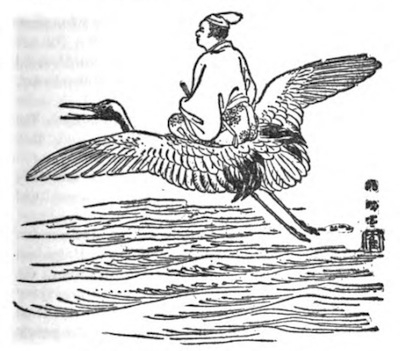
"Your desire is a very selfish one and cannot be easily granted. You think that you would like to become a hermit so as to find the Elixir of Life. Do you know how hard a hermit's life is? A hermit is only allowed to eat fruit and berries and the bark of pine trees; a hermit must cut himself off from the world so that his heart may become as pure as gold and free from every earthly desire. Gradually after following these strict rules, the hermit ceases to feel hunger or cold or heat, and his body becomes so light that he can ride on a crane or a carp, and he can walk on water without getting his feet wet.

"You, Sentaro, are fond of good living and of every comfort. You are not even like an ordinary man, for you are exceptionally idle, and more sensitive to heat and cold than most people. You would never be able to go barefoot or to wear only one thin dress in the winter time! Do you think that you would ever have the patience or the endurance to live a hermit's life?

"In answer to your prayer, however, I will help you in another way. I will send you to the country of Perpetual Life, where death never comes — where the people live forever!"

Saying this, Jofuku put into Sentaro's hand a little crane made of paper, telling him to sit on its back and it would carry him there.

Sentaro obeyed wonderingly. The crane grew large enough for him to ride on it with comfort. It then spread its wings, rose high in the air, and flew away over the mountains right out to sea.


Sentaro was at first quite frightened, but by degrees he grew accustomed to the swift flight through the air. On and on they went for thousands of miles. The bird never stopped for rest or food, but as it was a paper bird it doubtless did not require any nourishment, and strange to say, neither did Sentaro.

After several days they reached an island. The crane flew some distance inland and then alighted. As soon as Sentaro got down from the bird's back, the crane folded up of its own accord and flew into his pocket.

Now Sentaro began to look about him wonderingly, curious to see what the country of Perpetual Life was like. He walked first round about the country and then through the town. Everything was, of course, quite strange, and different from his own land. But both the land and the people seemed prosperous, so he decided that it would be good for him to stay there and took up lodgings at one of the hotels.

The proprietor was a kind man, and when Sentaro told him that he was a stranger and had come to live there, he promised to arrange everything that was necessary with the governor of the city concerning Sentaro's sojourn there. He even found a house for his guest, and in this way Sentaro obtained his great wish and became a resident in the country of Perpetual Life.

Within the memory of all the islanders no man had ever died there, and sickness was a thing unknown. Priests had come over from India and China and told them of a beautiful country called Paradise, where happiness and bliss and contentment fill all men's hearts, but its gates could only be reached by dying. This tradition was handed down for ages from generation to generation — but none knew exactly what death was except that it led to Paradise.

Quite unlike Sentaro and other ordinary people, instead of having a great dread of death, they all, both rich and poor, longed for it as something good and desirable. They were all tired of their long, long lives, and longed to go to the happy land of contentment called Paradise of which the priests had told them centuries ago.

All this Sentaro soon found out by talking to the islanders. He found himself, according to his ideas, in the land of Topsyturvydom. Everything was upside down. He had wished to escape from dying. He had come to the land of Perpetual Life with great relief and joy, only to find that the inhabitants themselves, doomed never to die, would consider it bliss to find death.

What he had hitherto considered poison these people ate as good food, and all the things to which he had been accustomed as food they rejected. Whenever any merchants from other countries arrived, the rich people rushed to them eager to buy poisons. These they swallowed eagerly, hoping for death to come so that they might go to Paradise.

But what were deadly poisons in other lands were without effect in this strange place, and people who swallowed them with the hope of dying only found that in a short time they felt better in health instead of worse.

Vainly they tried to imagine what death could be like. The wealthy would have given all their money and all their goods if they could but shorten their lives to two or three hundred years even. Without any change, to live on forever seemed to this people wearisome and sad.


(900 words)


Japan: The Man Who Did Not Wish to Die (end)

This story is part of the Japanese Fairy Tales (Ozaki) unit. Story source: Japanese Fairy Tales by Yei Theodora Ozaki (1908).


The Man Who Did Not Wish to Die (end)
(see previous page for audio)

In the chemist shops, there was a drug which was in constant demand because, after using it for a hundred years, it was supposed to turn the hair slightly gray and to bring about disorders of the stomach.

Sentaro was astonished to find that the poisonous globe-fish was served up in restaurants as a delectable dish, and hawkers in the streets went about selling sauces made of Spanish flies. He never saw any one ill after eating these horrible things, nor did he ever see any one with as much as a cold.

Sentaro was delighted. He said to himself that he would never grow tired of living and that he considered it profane to wish for death. He was the only happy man on the island. For his part he wished to live thousands of years and to enjoy life. He set himself up in business and, for the present, never even dreamed of going back to his native land.

As years went by, however, things did not go as smoothly as at first. He had heavy losses in business, and several times some affairs went wrong with his neighbors. This caused him great annoyance.

Time passed like the flight of an arrow for him, for he was busy from morning till night. Three hundred years went by in this monotonous way, and then at last he began to grow tired of life in this country, and he longed to see his own land and his old home. However long he lived here, life would always be the game, so was it not foolish and wearisome to stay on here forever?

Sentaro, in his wish to escape from the country of Perpetual Life, recollected Jofuku, who had helped him before when he was wishing to escape from death — and he prayed to the saint to bring him back to his own land again.

No sooner did he pray than the paper crane popped out of his pocket. Sentaro was amazed to see that it had remained undamaged after all these years. Once more the bird grew and grew till it was large enough for him to mount it. As he did so, the bird spread its wings and flew swiftly out across the sea in the direction of Japan.

Such was the willfulness of the man's nature that he looked back and regretted all he had left behind. He tried to stop the bird in vain. The crane held on its way for thousands of miles across the ocean.

Then a storm came on, and the wonderful paper crane got damp, crumpled up, and fell into the sea. Sentaro fell with it. Very much frightened at the thought of being drowned, he cried out loudly to Jofuku to save him. He looked round, but there was no ship in sight. He swallowed a quantity of sea-water, which only increased his miserable plight. While he was thus struggling to keep himself afloat, he saw a monstrous shark swimming towards him. As it came nearer it opened its huge mouth ready to devour him. Sentaro was all but paralyzed with fear now that he felt his end so near and screamed out as loudly as ever he could to Jofuku to come and rescue him.

Lo, and behold, Sentaro was awakened by his own screams, to find that during his long prayer he had fallen asleep before the shrine, and that all his extraordinary and frightful adventures had been only a wild dream. He was in a cold perspiration with fright, and utterly bewildered.

Suddenly a bright light came towards him, and in the light stood a messenger. The messenger held a book in his hand, and spoke to Sentaro: "I am sent to you by Jofuku, who in answer to your prayer has permitted you in a dream to see the land of Perpetual Life. But you grew weary of living there and begged to be allowed to return to your native land so that you might die. Jofuku, so that he might try you, allowed you to drop into the sea, and then sent a shark to swallow you up. Your desire for death was not real, for even at that moment you cried out loudly and shouted for help."

"It is also vain for you to wish to become a hermit or to find the Elixir of Life. These things are not for such as you — your life is not austere enough. It is best for you to go back to your paternal home, and to live a good and industrious life. Never neglect to keep the anniversaries of your ancestors, and make it your duty to provide for your children's future. Thus will you live to a good old age and be happy, but give up the vain desire to escape death, for no man can do that, and by this time you have surely found out that even when selfish desires are granted they do not bring happiness."

"In this book I give you there are many precepts good for you to know — if you study them, you will be guided in the way I have pointed out to you."

The angel disappeared as soon as he had finished speaking, and Sentaro took the lesson to heart. With the book in his hand he returned to his old home and, giving up all his old vain wishes, tried to live a good and useful life and to observe the lessons taught him in the book, and he and his house prospered henceforth.


(1000 words)


Japan: The Goblin of Adachigahara

This story is part of the Japanese Fairy Tales (Ozaki) unit. Story source: Japanese Fairy Tales by Yei Theodora Ozaki (1908).

The Goblin of Adachigahara
LONG, long ago there was a large plain called Adachigahara in the province of Mutsu in Japan. This place was said to be haunted by a cannibal goblin who took the form of an old woman. From time to time many travelers disappeared and were never heard of more, and the old women round the charcoal braziers in the evenings, and the girls washing the household rice at the wells in the mornings, whispered dreadful stories of how the missing folk had been lured to the goblin's cottage and devoured, for the goblin lived only on human flesh. No one dared to venture near the haunted spot after sunset, and all those who could avoided it in the daytime, and travelers were warned of the dreaded place.

One day as the sun was setting, a priest came to the plain. He was a belated traveler, and his robe showed that he was a Buddhist pilgrim walking from shrine to shrine to pray for some blessing or to crave for forgiveness of sins. He had apparently lost his way and, as it was late, he met no one who could show him the road or warn him of the haunted spot.

He had walked the whole day and was now tired and hungry, and the evenings were chilly, for it was late autumn, and he began to be very anxious to find some house where he could obtain a night's lodging. He found himself lost in the midst of the large plain and looked about in vain for some sign of human habitation.

At last, after wandering about for some hours, he saw a clump of trees in the distance, and through the trees he caught sight of the glimmer of a single ray of light. He exclaimed with joy: "Oh, surely that is some cottage where I can get a night's lodging!"

Keeping the light before his eyes, he dragged his weary, aching feet as quickly as he could towards the spot and soon came to a miserable-looking little cottage. As he drew near, he saw that it was in a tumble-down condition, the bamboo fence was broken, and weeds and grass pushed their way through the gaps. The paper screens which serve as windows and doors in Japan were full of holes, and the posts of the house were bent with age and seemed scarcely able to support the old thatched roof. The hut was open and, by the light of an old lantern, an old woman sat industriously spinning.

The pilgrim called to her across the bamboo fence and said: "O Baa San (old woman), good evening! I am a traveler! Please excuse me, but I have lost my way and do not know what to do, for I have nowhere to rest to-night. I beg you to be good enough to let me spend the night under your roof."

The old woman, as soon as she heard herself spoken to, stopped spinning, rose from her seat, and approached the intruder.

"I am very sorry for you. You must indeed be distressed to have lost your way in such a lonely spot so late at night. Unfortunately I cannot put you up, for I have no bed to offer you, and no accommodation whatsoever for a guest in this poor place!"

"Oh, that does not matter," said the priest; "all I want is a shelter under some roof for the night, and if you will be good enough just to let me lie on the kitchen floor, I shall be grateful. I am too tired to walk further tonight, so I hope you will not refuse me, otherwise I shall have to sleep out on the cold plain." And in this way he pressed the old woman to let him stay.


She seemed very reluctant, but at last she said: "Very well, I will let you stay here. I can offer you a very poor welcome only, but come in now and I will make a fire, for the night is cold."

The pilgrim was only too glad to do as he was told. He took off his sandals and entered the hut. The old woman then brought some sticks of wood, and lit the fire, and bade her guest draw near and warm himself.

"You must be hungry after your long tramp," said the old woman. "I will go and cook some supper for you." She then went to the kitchen to cook some rice.


(800 words)


Japan: The Goblin of Adachigahara (cont.)

This story is part of the Japanese Fairy Tales (Ozaki) unit. Story source: Japanese Fairy Tales by Yei Theodora Ozaki (1908).

The Goblin of Adachigahara (cont.)
(see previous page for audio)

After the priest had finished his supper the old woman sat down by the fire-place, and they talked together for a long time. The pilgrim thought to himself that he had been very lucky to come across such a kind, hospitable old woman. At last the wood gave out and, as the fire died slowly down, he began to shiver with cold just as he had done when he arrived.

"I see you are cold," said the old woman; "I will go out and gather some wood, for we have used it all. You must stay and take care of the house while I am gone."

"No, no," said the pilgrim, "let me go instead, for you are old, and I cannot think of letting you go out to get wood for me this cold night!"

The old woman shook her head and said: "You must stay quietly here, for you are my guest." Then she left him and went out.

In a minute she came back and said: "You must sit where you are and not move, and, whatever happens, don't go near or look into the inner room. Now mind what I tell you!"

"If you tell me not to go near the back room, of course I won't," said the priest, rather bewildered.

The old woman then went out again, and the priest was left alone. The fire had died out, and the only light in the hut was that of a dim lantern. For the first time that night, he began to feel that he was in a weird place, and the old woman's words, "Whatever you do don't peep into the back room," aroused his curiosity and his fear.

What hidden thing could be in that room that she did not wish him to see? For some time the remembrance of his promise to the old woman kept him still, but at last he could no longer resist his curiosity to peep into the forbidden place.

He got up and began to move slowly towards the back room. Then the thought that the old woman would be very angry with him if he disobeyed her made him come back to his place by the fireside.

As the minutes went slowly by and the old woman did not return, he began to feel more and more frightened, and to wonder what dreadful secret was in the room behind him. He must find out.

"She will not know that I have looked unless I tell her. I will just have a peep before she comes back," said the man to himself.

With these words he got up on his feet (for he had been sitting all this time in Japanese fashion with his feet under him) and stealthily crept towards the forbidden spot. With trembling hands he pushed back the sliding door and looked in. What he saw froze the blood in his veins.


The room was full of dead men's bones, and the walls were splashed and the floor was covered with human blood. In one corner skull upon skull rose to the ceiling, in another was a heap of arm bones, in another a heap of leg bones. The sickening smell made him faint. He fell backwards with horror, and for some time lay in a heap with fright on the floor, a pitiful sight. He trembled all over and his teeth chattered, and he could hardly crawl away from the dreadful spot.

"How horrible!" he cried out. "What awful den have I come to in my travels? May Buddha help me or I am lost. Is it possible that that kind old woman is really the cannibal goblin? When she comes back, she will show herself in her true character and eat me up at one mouthful!"

With these words, his strength came back to him and, snatching up his hat and staff, he rushed out of the house as fast as his legs could carry him. Out into the night he ran, his one thought to get as far as he could from the goblin's haunt. He had not gone far when he heard steps behind him and a voice crying: "Stop! Stop!"

He ran on, redoubling his speed, pretending not to hear. As he ran, he heard the steps behind him come nearer and nearer, and at last he recognized the old woman's voice which grew louder and louder as she came nearer. "Stop! stop, you wicked man, why did you look into the forbidden room?"

The priest quite forgot how tired he was, and his feet flew over the ground faster than ever. Fear gave him strength, for he knew that if the goblin caught him he would soon be one of her victims. With all his heart he repeated the prayer to Buddha: "Namu Amida Butsu, Namu Amida Butsu."

And after him rushed the dreadful old hag, her hair flying in the wind, and her face changing with rage into the demon that she was. In her hand she carried a large blood-stained knife, and she still shrieked after him, "Stop! Stop!"

At last, when the priest felt he could run no more, the dawn broke and, with the darkness of night, the goblin vanished, and he was safe. The priest now knew that he had met the Goblin of Adachigahara, the story of whom he had often heard but never believed to be true.

He felt that he owed his wonderful escape to the protection of Buddha to whom he had prayed for help, so he took out his rosary and, bowing his head as the sun rose, he said his prayers and made his thanksgiving earnestly. He then set forward for another part of the country, only too glad to leave the haunted plain behind him.


(1000 words)


Japan: The Ogre of Rashomon

This story is part of the Japanese Fairy Tales (Ozaki) unit. Story source: Japanese Fairy Tales by Yei Theodora Ozaki (1908).


The Ogre of Rashomon
LONG, long ago in Kyoto, the people of the city were terrified by accounts of a dreadful ogre who, it was said, haunted the Gate of Rashomon at twilight and seized whoever passed by. The missing victims were never seen again, so it was whispered that the ogre was a horrible cannibal who not only killed the unhappy victims but ate them also. Now everybody in the town and neighborhood was in great fear, and no one durst venture out after sunset near the Gate of Rashomon.

Now at this time there lived in Kyoto a general named Raiko who had made himself famous for his brave deeds. Some time before this he made the country ring with his name for he had attacked Oeyama, where a band of ogres lived with their chief who instead of wine drank the blood of human beings. He had routed them all and cut off the head of the chief monster.

This brave warrior was always followed by a band of faithful knights. In this band there were five knights of great valor. One evening as the five knights sat at a feast quaffing sake in their rice bowls and eating all kinds of fish, raw, and stewed, and broiled, and toasting each other's healths and exploits, the first knight, Hojo, said to the others: "Have you all heard the rumor that every evening after sunset there comes an ogre to the Gate of Rashomon and that he seizes all who pass by?"

The second knight, Watanabe, answered him, saying: "Do not talk such nonsense! All the ogres were killed by our chief Raiko at Oeyama! It cannot be true because, even if any ogres did escape from that great killing, they would not dare to show themselves in this city, for they know that our brave master would at once attack them if he knew that any of them were still alive!"

"Then do you disbelieve what I say, and think that I am telling you a falsehood?"

"No, I do not think that you are telling a lie," said Watanabe, "but you have heard some old woman's story which is not worth believing."

"Then the best plan is to prove what I say by going there yourself and finding out yourself whether it is true or not," said Hojo.

Watanabe, the second knight, could not bear the thought that his companion should believe he was afraid, so he answered quickly: "Of course, I will go at once and find out for myself!"

So Watanabe at once got ready to go — he buckled on his long sword, and put on a coat of armor, and tied on his large helmet. When he was ready to start he said to the others: "Give me something so that I can prove I have been there!"

Then one of the men got a roll of writing paper and his box of Indian ink and brushes, and the four comrades wrote their names on a piece of paper.

"I will take this," said Watanabe, "and put it on the Gate of Rashomon; so, tomorrow morning will you all go and look at it? I may be able to catch an ogre or two by then!" and he mounted his horse and rode off gallantly.

It was a very dark night, and there was neither moon nor star to light Watanabe on his way. To make the darkness worse, a storm came on, the rain fell heavily, and the wind howled like wolves in the mountains. Any ordinary man would have trembled at the thought of going out of doors, but Watanabe was a brave warrior and dauntless, and his honor and word were at stake, so he sped on into the night while his companions listened to the sound of his horse's hoofs dying away in the distance, then shut the sliding shutters close, and gathered round the charcoal fire and wondered what would happen — and whether their comrade would encounter one of those horrible Oni.

At last Watanabe reached the Gate of Rashomon, but peer as he might through the darkness, he could see no sign of an ogre.

"It is just as I thought," said Watanabe to himself. "There are certainly no ogres here; it is only an old woman's story. I will stick this paper on the gate so that the others can see I have been here when they come tomorrow, and then I will take my way home and laugh at them all."

He fastened the piece of paper, signed by all his four companions, on the gate, and then turned his horse's head towards home.


(800 words)


Japan: The Ogre of Rashomon (cont.)

This story is part of the Japanese Fairy Tales (Ozaki) unit. Story source: Japanese Fairy Tales by Yei Theodora Ozaki (1908).

The Ogre of Rashomon (cont.)
(see previous page for audio)

As he did so, he became aware that someone was behind him, and at the same time a voice called out to him to wait. Then his helmet was seized from the back.

"Who are you?" said Watanabe fearlessly.

He then put out his hand and groped around to find out who or what it was that held him by the helmet. As he did so, he touched something that felt like an arm — it was covered with hair and as big round as the trunk of a tree!

Watanabe knew at once that this was the arm of an ogre, so he drew his sword and cut at it fiercely.

There was a loud yell of pain, and then the ogre dashed in front of the warrior.

Watanabe's eyes grew large with wonder for he saw that the ogre was taller than the great gate, his eyes were flashing like mirrors in the sunlight, and his huge mouth was wide open and, as the monster breathed, flames of fire shot out of his mouth.

The ogre thought to terrify his foe, but Watanabe never flinched. He attacked the ogre with all his strength, and thus they fought face to face for a long time. At last the ogre, finding that he could neither frighten nor beat Watanabe and that he might himself be beaten, took to flight. But Watanabe, determined not to let the monster escape, put spurs to his horse and gave chase.

But though the knight rode very fast, the ogre ran faster, and to his disappointment he found himself unable to overtake the monster, who was gradually lost to sight.

Watanabe returned to the gate where the fierce fight had taken place and got down from his horse. As he did so, he stumbled upon something lying on the ground.


Stooping to pick it up, he found that it was one of the ogre's huge arms which he must have slashed off in the fight. His joy was great at having secured such a prize for this was the best of all proofs of his adventure with the ogre. So he took it up carefully and carried it home as a trophy of his victory.

When he got back, he showed the arm to his comrades, who one and all called him the hero of their band and gave him a great feast. His wonderful deed was soon noised abroad in Kyoto, and people from far and near came to see the ogre's arm.

Watanabe now began to grow uneasy as to how he should keep the arm in safety, for he knew that the ogre to whom it belonged was still alive. He felt sure that one day or other, as soon as the ogre got over his scare, he would come to try to get his arm back again. Watanabe therefore had a box made of the strongest wood and banded with iron. In this he placed the arm, and then he sealed down the heavy lid, refusing to open it for anyone. He kept the box in his own room and took charge of it himself, never allowing it out of his sight.

Now one night he heard some one knocking at the porch, asking for admittance.

When the servant went to the door to see who it was, there was only an old woman, very respectable in appearance. On being asked who she was and what was her business, the old woman replied with a smile that she had been nurse to the master of the house when he was a little baby. If the lord of the house were at home, she begged to be allowed to see him.

The servant left the old woman at the door and went to tell his master that his old nurse had come to see him. Watanabe thought it strange that she should come at that time of night, but at the thought of his old nurse, who had been like a foster-mother to him and whom he had not seen for a long time, a very tender feeling sprang up for her in his heart. He ordered the servant to show her in.


(700 words)


Japan: The Ogre of Rashomon (end)

This story is part of the Japanese Fairy Tales (Ozaki) unit. Story source: Japanese Fairy Tales by Yei Theodora Ozaki (1908).


The Ogre of Rashomon (end)
(see previous page for audio)

The old woman was ushered into the room and, after the customary bows and greetings were over, she said: "Master, the report of your brave fight with the ogre at the Gate of Rashomon is so widely known that even your poor old nurse has heard of it. Is it really true, what everyone says, that you cut off one of the ogre's arms? If you did, your deed is highly to be praised!"

"I was very disappointed," said Watanabe, "that I was not able take the monster captive, which was what I wished to do, instead of only cutting off an arm!"

"I am very proud to think," answered the old woman, "that my master was so brave as to dare to cut off an ogre's arm. There is nothing that can be compared to your courage. Before I die it is the great wish of my life to see this arm," she added pleadingly.

"No," said Watanabe, "I am sorry, but I cannot grant your request."

"But why?" asked the old woman.

"Because," replied Watanabe, "ogres are very revengeful creatures, and if I open the box there is no telling but that the ogre may suddenly appear and carry off his arm. I have had a box made on purpose with a very strong lid, and in this box I keep the ogre's arm secure, and I never show it to any one, whatever happens."

"Your precaution is very reasonable," said the old woman. "But I am your old nurse, so surely you will not refuse to show ME the arm. I have only just heard of your brave act and, not being able to wait till the morning, I came at once to ask you to show it to me."

Watanabe was very troubled at the old woman's pleading, but he still persisted in refusing. Then the old woman said: "Do you suspect me of being a spy sent by the ogre?"

"No, of course I do not suspect you of being the ogre's spy, for you are my old nurse," answered Watanabe.

"Then you cannot surely refuse to show me the arm any longer," entreated the old woman, "for it is the great wish of my heart to see for once in my life the arm of an ogre!"

Watanabe could not hold out in his refusal any longer, so he gave in at last, saying: "Then I will show you the ogre's arm since you so earnestly wish to see it. Come, follow me!" and he led the way to his own room, the old woman following.

When they were both in the room, Watanabe shut the door carefully and then, going towards a big box which stood in a corner of the room, he took off the heavy lid. He then called to the old woman to come near and look in, for he never took the arm out of the box.

"What is it like? Let me have a good look at it," said the old nurse, with a joyful face.

She came nearer and nearer, as if she were afraid, till she stood right against the box. Suddenly she plunged her hand into the box and seized the arm, crying with a fearful voice which made the room shake: "Oh, joy! I have got my arm back again!"

And from an old woman she was suddenly transformed into the towering figure of the frightful ogre!


Watanabe sprang back and was unable to move for a moment, so great was his astonishment, but recognizing the ogre who had attacked him at the Gate of Rashomon, he determined with his usual courage to put an end to him this time. He seized his sword, drew it out of its sheath in a flash, and tried to cut the ogre down.

So quick was Watanabe that the creature had a narrow escape. But the ogre sprang up to the ceiling and, bursting through the roof, disappeared in the mist and clouds.

In this way the ogre escaped with his arm. The knight gnashed his teeth with disappointment, but that was all he could do. He waited in patience for another opportunity to dispatch the ogre. But the latter was afraid of Watanabe's great strength and daring, and never troubled Kyoto again.

So once more the people of the city were able to go out without fear even at night time, and the brave deeds of Watanabe have never been forgotten!


(800 words)