Showing posts with label Unit: Panchatantra. Show all posts

Myth-Folklore Unit: Ryder's Panchatantra

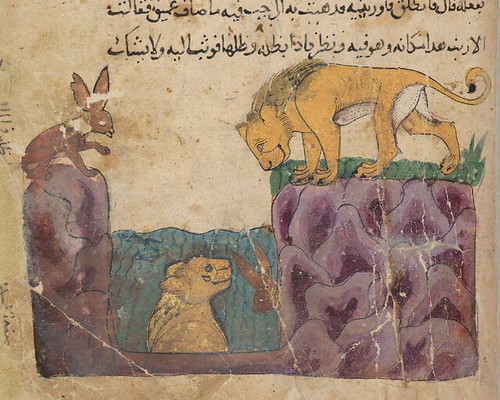
Overview. The Panchatantra (the "Five Tantras," the "Five Books of Wisdom") is an enormously influential collection of stories from ancient India which has been translated into many languages of both Asia and Europe over the past two millennia; for this unit, you'll be reading the marvelous translation by Arthur Ryder, a great Sanskrit scholar. The Panchatantra uses a "nested" storytelling style, which means that the characters in a given story are also storytellers, creating a "stories within stories within stories" effect. The Panchatantra is the oldest example of a "nested" story collection in world literature, and is thus the ancestor of similar story collections such as the Thousand-and-One Nights (a.k.a. The Arabian Nights) and Chaucer's Canterbury Tales. As for the stories themselves, you will find both human drama and animal tales, including many trickster stories, such as the rabbit who tricked a lion named Numskull, or the tiny sparrow who defeated an elephant with the help of a gnat, a woodpecker and a frog.

Language. This is a wonderful English translation of the Sanskrit original, using both prose and verse, just as the Sanskrit does. The stories are in prose, but they contain many proverbs in verse form. Ryder also translates the Sanskrit names into their English equivalents, so instead of strange Sanskrit names, you get to learn what the Sanskrit names actually mean!

Story Length. This unit contains only single-page stories, and those stories are nested one inside the other.

Choosing Between Units. If you are not sure which of the two Panchatantra units to choose — Ryder's Panchatantra of the Tales of Bidpai — the main factor to consider is literary style. Ryder's Panchatantra conveys the story-within-a-story-within-a-story style of the original Sanskrit Panchatantra, while the Tales of Bidpai unit tells the stories individually, without the literary frametale.

Navigation. You will find the table of contents below, and you can also use this link to see the story posts displayed on two pages total: Panchatantra. Click "Older Posts" at the bottom of that page to see the second page.


READING A:
  1. Introduction
  2. Numskull and the Rabbit
  3. The Ungrateful Man
  4. The Plover Who Fought the Ocean
  5. Forethought, Ready-Wit, and Fatalist
  6. The Duel between Elephant and Sparrow
  7. The Shrewd Old Gander
  8. The Lion and the Ram
READING B:
  1. Right-Mind and Wrong-Mind
  2. The Mice That Ate Iron
  3. The Sensible Enemy
  4. The Foolish Friend
  5. How the Rabbit Fooled the Elephant
  6. The Cat's Judgement
  7. The Brahman's Goat
  8. Mouse-Maid Made Mouse
  9. The Loyal Mongoose


Panchatantra: Introduction

As you will see, the translator has decided to translate the Sanskrit names into their equivalent English meanings! Thus it is that the king named Immortal-Power has three sons: Rich-Power, Fierce-Power, Endless-Power. Powerful they may be, but his sons are idiots, which is why he is in need of the wisdom contained in the stories of the Panchatantra, which means the "Five Tantras," i.e. the "Five Principles" or the "Five Techniques." It also refers to the five books into which the Panchatantra is divided, as you will see below.

Meanwhile, over two thousand years later, the stories of the Panchatantra continue to be popular reading for the children of India, included in the Amar Chitra Katha comic book series:


[Notes by LKG]

This story is part of the Panchatantra unit. Story source: The Panchatantra of Vishnu Sharma, translated by Arthur W. Ryder (1925).

Introduction

One Vishnusharman, shrewdly gleaning
All worldly wisdom's inner meaning,
In these five books the charm compresses
Of all such books the world possesses.

And this is how it happened. In the southern country is a city called Maidens' Delight. There lived a king named Immortal-Power. He was familiar with all the works treating of the wise conduct of life. His feet were made dazzling by the tangle of rays of light from jewels in the diadems of mighty kings who knelt before him. He had reached the far shore of all the arts that embellish life.

This king had three sons. Their names were Rich-Power, Fierce-Power, Endless-Power, and they were supreme blockheads.

Now when the king perceived that they were hostile to education, he summoned his counsellors and said: "Gentlemen, it is known to you that these sons of mine, being hostile to education, are lacking in discernment. So when I behold them, my kingdom brings me no happiness, though all external thorns are drawn. For there is wisdom in the proverb:

Of sons unborn, or dead, or fools,
Unborn or dead will do:
They cause a little grief, no doubt,
But fools, a long life through.

And again:

To what good purpose can a cow
That brings no calf nor milk, be bent?
Or why beget a son who proves
A dunce and disobedient?

Some means must therefore be devised to awaken their intelligence."

And they, one after another, replied: "O King, first one learns grammar, in twelve years. If this subject has somehow been mastered, then one masters the books on religion and practical life. Then the intelligence awakens."

But one of their number, a counsellor named Keen, said: "O King, the duration of life is limited, and the verbal sciences require much time for mastery. Therefore let some kind of epitome be devised to wake their intelligence. There is a proverb that says:

Since verbal science has no final end,
Since life is short, and obstacles impend,
Let central facts be picked and firmly fixed,
As swans extract the milk with water mixed.

"Now there is a Brahman here named Vishnusharman with a reputation for competence in numerous sciences. Entrust the princes to him. He will certainly make them intelligent in a twinkling."

When the king had listened to this, he summoned Vishnusharman and said: "Holy sir, as a favour to me you must make these princes incomparable masters of the art of practical life. In return, I will bestow upon you a hundred land-grants."

And Vishnusharman made answer to the king: "O King, listen. Here is the plain truth. I am not the man to sell good learning for a hundred land-grants. But if I do not, in six months' time, make the boys acquainted with the art of intelligent living, I will give up my own name. Let us cut the matter short. Listen to my lion-roar. My boasting arises from no greed for cash. Besides, I have no use for money; I am eighty years old, and all the objects of sensual desire have lost their charm. But in order that your request may be granted, I will show a sporting spirit in reference to artistic matters. Make a note of the date. If I fail to render your sons, in six months' time, incomparable masters of the art of intelligent living, then His Majesty is at liberty to show me His Majestic bare bottom."

When the king, surrounded by his counsellors, had listened to the Brahman's highly unconventional promise, he was penetrated with wonder, entrusted the princes to him, and experienced supreme contentment.

Meanwhile, Vishnusharman took the boys, went home, and made them learn by heart five books which he composed and called: (1) "The Loss of Friends," (2) "The Winning of Friends," (3) "Crows and Owls," (4) "Loss of Gains," (5) "Ill-considered Action."

These the princes learned, and in six months' time they answered the prescription. Since that day this work on the art of intelligent living, called Panchatantra, or the "Five Books," has travelled the world, aiming at the awakening of intelligence in the young.

To sum the matter up:
Whoever learns the work by heart,
Or through the story-teller's art
Becomes acquainted,
His life by sad defeat — although
The king of heaven be his foe —
Is never tainted.


(700 words)


Panchatantra: Numskull and the Rabbit

There are trickster rabbits in the cultures of many countries, and here you will find a marvelous tale of a tricky rabbit who is able to get the better of a mighty lion!

[Notes by LKG]

This story is part of the Panchatantra unit. Story source: The Panchatantra of Vishnu Sharma, translated by Arthur W. Ryder (1925).

Numskull and the Rabbit

In a part of a forest was a lion drunk with pride, and his name was Numskull. He slaughtered the animals without ceasing. If he saw an animal, he could not spare him.

So all the natives of the forest — deer, boars, buffaloes, wild oxen, rabbits, and others — came together, and with woe-begone countenances, bowed heads, and knees clinging to the ground, they undertook to beseech obsequiously the king of beasts: "Have done, O King, with this merciless, meaningless slaughter of all creatures. It is hostile to happiness in the other world. For the Scripture says:

A thousand future lives
Will pass in wretchedness
For sins a fool commits
His present life to bless.

Again:

What wisdom in a deed
That brings dishonour fell,
That causes loss of trust,
That paves the way to hell?

And yet again:

The ungrateful body, frail
And rank with filth within,
Is such that only fools
For its sake sink in sin.

"Consider these facts and cease, we pray, to slaughter our generations. For if the master will remain at home, we will of our own motion send him each day for his daily food one animal of the forest. In this way neither the royal sustenance nor our families will be cut short. In this way let the king's duty be performed. For the proverb says:

The king who tastes his kingdom like
Elixir, bit by bit,
Who does not overtax its life,
Will fully relish it.

The king who madly butchers men,
Their lives as little reckoned
As lives of goats, has one square meal,
But never has a second.

A king desiring profit, guards
His world from evil chance;
With gifts and honours waters it
As florists water plants.

Guard subjects like a cow, nor ask
For milk each passing hour:
A vine must first be sprinkled, then
It ripens fruit and flower.

The monarch-lamp from subjects draws
Tax-oil to keep it bright:
Has any ever noticed kings
That shone by inner light?

A seedling is a tender thing,
And yet, if not neglected,
It comes in time to bearing fruit:
So subjects well protected.

Their subjects form the only source
From which accrue to kings
Their gold, grain, gems, and varied drinks,
And many other things.

The kings who serve the common weal,
Luxuriantly sprout;
The common loss is kingly loss,
Without a shade of doubt."

After listening to this address, Numskull said: "Well, gentlemen, you are quite convincing. But if an animal does not come to me every day as I sit here, I promise you I will eat you all."

To this they assented, with much relief, and fearlessly roamed the wood. Each day at noon one of them appeared as his dinner, each species taking its turn and providing an individual grown old, or religious, or grief-smitten, or fearful of the loss of son or wife.

One day a rabbit's turn came, it being rabbit-day. And when all the thronging animals had given him directions, he reflected: "How is it possible to kill this lion - curse him! Yet after all,

In what can wisdom not prevail?
In what can resolution fail?
What cannot flattery subdue?
What cannot enterprise put through?

"I can kill even a lion."

So he went very slowly, planning to arrive tardily, and meditating with troubled spirit on a means of killing him. Late in the day he came into the presence of the lion, whose throat was pinched by hunger in consequence of the delay and who angrily thought as he licked his chops: "Aha! I must kill all the animals the first thing in the morning."

While he was thinking, the rabbit slowly drew near, bowed low, and stood before him. But when the lion saw that he was tardy and too small at that for a meal, his soul flamed with wrath, and he taunted the rabbit, saying: "You reprobate! First, you are too small for a meal. Second, you are tardy. Because of this wickedness I am going to kill you, and tomorrow morning I shall extirpate every species of animal."

Then the rabbit bowed low and said with deference: "Master, the wickedness is not mine, nor the other animals'. Pray hear the cause of it."

And the lion answered: "Well, tell it quick, before you are between my fangs."

"Master," said the rabbit, "all the animals recognized today that the rabbits' turn had come and, because I was quite small, they dispatched me with five other rabbits. But in mid-journey there issued from a great hole in the ground a lion who said: 'Where are you bound? Pray to your favourite god.'

"Then I said: 'We are travelling as the dinner of lion Numskull, our master, according to agreement.'

"'Is that so?' said he. 'This forest belongs to me. So all the animals, without exception, must deal with me according to agreement. This Numskull is a sneak thief. Call him out and bring him here at once. Then whichever of us proves stronger, shall be king and shall eat all these animals.'

"At his command, master, I have come to you. This is the cause of my tardiness. For the rest, my master is the sole judge."

After listening to this, Numskull said: "Well, well, my good fellow, show me that sneak thief of a lion, and be quick about it. I cannot find peace of mind until I have vented on him my anger against the animals. He should have remembered the saying:

Land and friends and gold at most
Have been won when battles cease;
If but one of these should fail,
Do not think of breaking peace.

Where no great reward is won,
Where defeat is nearly sure,
Never stir a quarrel, but
Find it wiser to endure."

"Quite so, master," said the rabbit. "Warriors fight for their country when they are insulted. But this fellow skulks in a fortress. You know he came out of a fortress when he held us up. And an enemy in a fortress is hard to handle. As the saying goes:

A single royal fortress adds
More military force
Than do a thousand elephants,
A hundred thousand horse.

A single archer from a wall
A hundred foes forfends;
And so the military art
A fortress recommends.

God Indra used the wit and skill
Of gods in days of old,
When Devil Gold-mat plagued the world,
To build a fortress-hold.

And he decreed that any king
Who built a fortress sound,
Should conquer foemen. This is why
Such fortresses abound."

When he heard this, Numskull said: "My good fellow, show me that thief. Even if he is hiding in a fortress, I will kill him. For the proverb says:

The strongest man who fails to crush
At birth, disease or foe,
Will later be destroyed by that
Which he permits to grow.

And again:

The man who reckons well his power,
Nor pride nor vigour lacks,
May single-handed smite his foes
Like Rama-with-the-axe."

"Very true," said the rabbit. "But after all, it was a mighty lion that I saw. So the master should not set out without realizing the enemy's capacity. As the saying runs:

A warrior failing to compare
Two hosts, in mad desire
For battle, plunges like a moth
Headforemost into fire.

And again:

The weak who challenge mighty foes
A battle to abide,
Like elephants with broken tusks,
Return with drooping pride."

But Numskull said: "What business is it of yours? Show him to me, even in his fortress."

"Very well," said the rabbit. "Follow me, master."

And he led the way to a well, where he said to the lion: "Master, who can endure your majesty? The moment he saw you, that thief crawled clear into his hole. Come, I will show him to you."

"Be quick about it, my good fellow," said Numskull.

So the rabbit showed him the well. And the lion, being a dreadful fool, saw his own reflection in the water and gave voice to a great roar. Then from the well issued a roar twice as loud, because of the echo.

This the lion heard, decided that his rival was very powerful, hurled himself down, and met his death.

Thereupon the rabbit cheerfully carried the glad news to all the animals, received their compliments, and lived there contentedly in the forest.


Leo et Puteus


(1400 words)


Panchatantra: The Ungrateful Man

This wonderful story also appears in the Buddhist jataka tradition, and thus it made its way to Tibet also, as you can read here: The Ingratitude of Man.

[Notes by LKG]

This story is part of the Panchatantra unit. Story source: The Panchatantra of Vishnu Sharma, translated by Arthur W. Ryder (1925).


The Ungrateful Man

In a certain town lived a Brahman whose name was Sacrifice. Every day his wife, chafing under their poverty, would say to him: "Come, Brahman! Lazybones! Stony-Heart! Don't you see your babies starving, while you hang about, mooning? Go somewhere, no matter where, find some way, any way, to get food, and come back in a hurry."

At last the Brahman, weary of this refrain, undertook a long journey and in a few days entered a great forest. While wandering hungry in this forest, he began to hunt for water. And in a certain spot he came upon a well, overgrown with grass. When he looked in, he discovered a tiger, a monkey, a snake, and a man at the bottom. They also saw him.

Then the tiger thought: "Here comes a man," and he cried: "O noble soul, there is great virtue in saving life. Think of that, and pull me out, so that I may live in the company of beloved friends, wife, sons, and relatives."

"Why," said the Brahman, "the very sound of your name brings a shiver to every living thing. I cannot deny that I fear you."

But the tiger resumed:

To Brahman-slayer, impotent,
To drunkard, him on treason bent,
To sinner through prevarication,
The holy grant an expiation:
While for ingratitude alone
No expiation will atone.

And he continued: "I bind myself by a triple oath that no danger threatens you from me. Have pity and pull me out."

Then the Brahman thought it through to this conclusion: "If disaster befalls in the saving of life, it is a disaster that spells salvation." So he pulled the tiger out.

Next the monkey said: "Holy sir, pull me out too." And the Brahman pulled him out too.

Then the snake said: "Brahman, pull me out too."

But the Brahman answered: "One shudders at the mere sound of your name; how much more at touching you!"

"But," said the snake, "we are not free agents. We bite only under orders. I bind myself by a triple oath that you need have no fear of me."

After listening to this, the Brahman pulled him out too. Then the animals said: "The man down there is a shrine of every sin. Beware. Do not pull him out. Do not trust him."

Furthermore, the tiger said: "Do you see this mountain with many peaks? My cave is in a wooded ravine on the north slope. You must do me the favour of paying me a visit there someday, so that I may make return for your kindness. I should not like to drag the debt into the next life." With these words he started for his cave.

Then the monkey said: "My home is quite near the cave, beside the waterfall. Please pay me a visit there." With this he departed.

Then the snake said: "In any emergency, remember me." And he went his way.

Then the man in the well shouted time and again: "Brahman! Pull me out too!"

At last the Brahman's pity was awakened, and he pulled him out, thinking: "He is a man, like me."

And the man said: "I am a goldsmith and live in Baroch. If you have any gold to be worked into shape, you must bring it to me." With this he started for home.

Then the Brahman continued his wanderings but found nothing whatever. As he started for home, he recalled the monkey's invitation. So he paid a visit, found the monkey at home, and received fruits sweet as nectar, which put new life into him.

Furthermore, the monkey said: "If you ever have use for fruit, pray come here at any time."

"You have done a friend's full duty," said the Brahman. "But please introduce me to the tiger." So the monkey led the way and introduced him to the tiger.

Now the tiger recognized him and, by way of returning his kindness, bestowed on him a necklace and other ornaments of wrought gold, saying: "A certain prince whose horse ran away with him came here alone, and when he was within range of a spring, I killed him. All this I took from his person and stored carefully for you. Pray accept it and go where you will."

So the Brahman took it, then recalled the goldsmith and visited him, thinking: "He will do me the favour of getting it sold."

Now the goldsmith welcomed him with respectful hospitality, offering water for the feet, an honourable gift, a seat, hard food and soft, drink, and other things, and then said: "Command me, sir. What may I do for you?"

And the Brahman said: "I have brought you gold. Please sell it."

"Show me the gold," said the goldsmith, and the other did so.

Now the goldsmith thought when he saw it: "I worked this gold for the prince."

And having made sure of the fact, he said: "Please stay right here while I show it to somebody." With this he went to court and showed it to the king.

On seeing it, the king asked: "Where did you get this?"

And the goldsmith replied: "In my house is a Brahman. He brought it."

Thereupon the king reflected: "Without question, that villain killed my son. I will show him what that costs." And he issued orders to the police: "Have this Brahman scum fettered, and impale him tomorrow morning."

When the Brahman was fettered, he remembered the snake, who appeared at once and said: "What can I do to serve you?"

"Free me from these fetters," said the Brahman.

And the snake replied: "I will bite the king's dear queen. Then, in spite of the charms employed by any great conjurer and the antidotes of other physicians, I will keep her poisoned. Only by the touch of your hand will the poison be neutralized. Then you will go free."

Having made this promise, the snake bit the queen, whereupon shouts of despair arose in the palace, and the entire city was filled with dismay. Then they summoned dealers in antidotes, conjurers, scientists, druggists, and foreigners, all of whom treated the case with such resources as they had, but none could neutralize the poison.

Finally, a proclamation was made with beat of drum, upon hearing which the Brahman said: "I will cure her."

The moment he spoke, they freed him from his fetters, took him to the king, and introduced him. And the king said: "Cure her, sir."

So he went to the queen and cured her by the mere touch of his hand. When the king saw her restored to life, he paid the Brahman honour and reverence, then respectfully asked him: "Reveal the truth, sir. How did you come by this gold?"

And the Brahman began at the beginning and related the whole adventure accurately.

As soon as the king comprehended the facts, he arrested the goldsmith, while he gave the Brahman a thousand villages and appointed him privy counsellor.

The Brahman summoned his family, was surrounded by friends and relatives, took delight in eating and other natural functions, acquired massive merit by the performance of numerous sacrifices, concentrated authority by heedful attention to all phases of royal duty, and lived happily.


(1200 words)


Panchatantra: The Plover Who Fought the Ocean

With this story, you will see how the stories in the Panchatantra are nested one inside the other, much like in 1001 Nights. You start with the story of the two plovers, husband and wife. To try to persuade her husband of something, the wife tells him the story of two geese and a tortoise, and then follows that story with a second story which you will read on the following page.

[Notes by LKG]

This story is part of the Panchatantra unit. Story source: The Panchatantra of Vishnu Sharma, translated by Arthur W. Ryder (1925).


The Plover Who Fought the Ocean

A plover and his wife once lived by the shore of the sea, the mighty sea that swarms with fish, crocodiles, turtles, sharks, porpoises, pearl oysters, shellfish, and other teeming life. The plover was called Sprawl, and his wife's name was Constance.

In due time she became pregnant and was ready to lay her eggs. So she said to her husband: "Please find a spot where I may lay my eggs."

"Why," said he, "this home of ours, inherited from our ancestors, promises progress. Lay your eggs here."

"Oh," said she, "don't mention this dreadful place. Here is the ocean near at hand. His tide might someday make a long reach and lick away my babies."

But the plover answered: "Sweetheart, he knows me, he knows Sprawl. Surely the great ocean cannot show such enmity to me. Did you never hear this?

What man is rash enough to take
The gleaming crest-jewel from a snake?
Or stirs the wrath of one so dread
His glance may strike his victim dead?

However summer heat distresses
In wild and treeless wildernesses,
Who, after all, would seek the shade
By some rogue elephant's body made?

And again:

When morning's chilly breezes blow
With whirling particles of snow,
What man with sense of value sure,
Employs for cold the water cure?

To visit Death what man desires,
So wakes the lion's sleeping fires,
Who, tired from slaying elephants,
Lies in a temporary trance?

Who dares to visit and defy
The death-god? Dares the fearless cry -
I challenge you to single strife;
If power be yours, pray take my life?

What son of man, with simple wit,
Defies the fire, and enters it -
The smokeless flame that terrifies,
Whose tongues by hundreds lick the skies?"

But even as he spoke, his wife laughed outright, since she knew the full measure of his capacity, and she said: "Very fine, indeed. There is plenty more where that came from. O king of birds,

Your heavy boastings startle, shock,
And make of you a laughingstock:
One marvels if the rabbit plants
A dung-pile like the elephant's.

How can you fail to appreciate your own strength and weakness? There is a saying:

To know one's self is hard, to know
Wise effort, effort vain;
But accurate self-critics are
Secure in times of strain.

This much of effort brings success;
I have the power; I can:
So think, then act, and reap the fruit
Of your judicious plan.

And there is sound sense in this:

To take advice from kindly friends
Be ever satisfied:
The stupid turtle lost his grip
Upon the stick, and died."

"How was that?" asked Sprawl. And Constance told the story of:

Shell-Neck, Slim, and Grim

In a certain lake lived a turtle named Shell-Neck. He had as friends two ganders whose names were Slim and Grim. Now in the vicissitudes of time there came a twelve-year drought, which begot ideas of this nature in the two ganders: "This lake has gone dry. Let us seek another body of water. However, we must first say farewell to Shell-Neck, our dear and long-proved friend."

When they did so, the turtle said: "Why do you bid me farewell? I am a water-dweller, and here I should perish very quickly from the scant supply of water and from grief at loss of you. Therefore, if you feel any affection for me, please rescue me from the jaws of this death. Besides, as the water dries in this lake, you two suffer nothing beyond a restricted diet, while to me it means immediate death. Consider which is more serious, loss of food or loss of life."

But they replied: "We are unable to take you with us since you are a water-creature without wings."

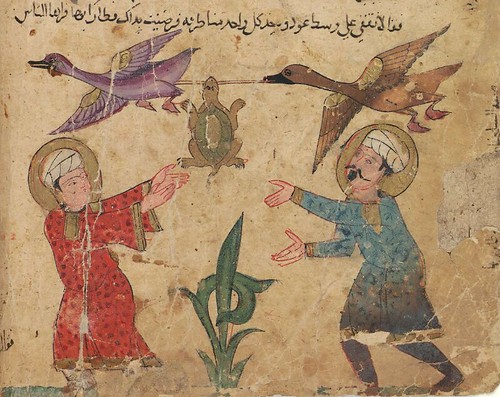
Yet the turtle continued: "There is a possible device. Bring a stick of wood." This they did, whereupon the turtle gripped the middle of the stick between his teeth, and said: "Now take firm hold with your bills, one on each side, fly up, and travel with even flight through the sky, until we discover another desirable body of water."

But they objected: "There is a hitch in this fine plan. If you happen to indulge in the smallest conversation, then you will lose your hold on the stick, will fall from a great height, and will be dashed to bits."

"Oh," said the turtle, "from this moment I take a vow of silence, to last as long as we are in heaven."

So they carried out the plan, but while the two ganders were painfully carrying the turtle over a neighbouring city, the people below noticed the spectacle, and there arose a confused buzz of talk as they asked: "What is this cartlike object that two birds are carrying through the atmosphere?"

Hearing this, the doomed turtle was heedless enough to ask: "What are these people chattering about?"

The moment he spoke, the poor simpleton lost his grip and fell to the ground. And persons who wanted meat cut him to bits in a moment with sharp knives.

Testudo Volans

"And that is why I say:

To take advice from kindly friends
Be ever satisfied:
The stupid turtle lost his grip
Upon the stick, and died."

And Constance continued:

Forethought and Ready-wit thrive;
Fatalist can't keep alive.

"How was that?" asked Sprawl.

And she told the story of ... Forethought, Ready-Wit, and Fatalist.


(900 words)


Panchatantra: Forethought, Ready-Wit, and Fatalist

In this story, the names of the three fish express the essential idea of the story, so you are lucky that Ryder has translated them for you. In Sanskrit, their names are Anagatavidhata, Pratyutpannamati and Yadbhavishya.

[Notes by LKG]

This story is part of the Panchatantra unit. Story source: The Panchatantra of Vishnu Sharma, translated by Arthur W. Ryder (1925).


Pisces Magni et Minuti


Forethought, Ready-Wit, and Fatalist
(inside the story of The Plover)

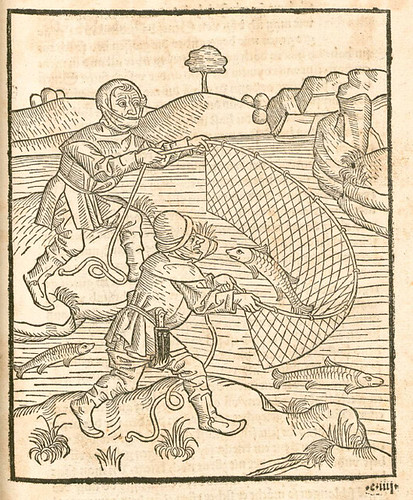
In a great lake lived three full-grown fishes, whose names were Forethought, Ready-wit, and Fatalist. Now one day the fish named Forethought overheard passers-by on the bank and fishermen saying: "There are plenty of fish in this pond. Tomorrow we go fishing."

On hearing this, Forethought reflected: "This looks bad. Tomorrow or the day after they will be sure to come here. I will take Ready-wit and Fatalist and move to another lake whose waters are not troubled.'

So he called them and put the question. Thereupon Ready-wit said: "I have lived long in this lake and cannot move in such a hurry. If fishermen come here, then I will protect myself by some means devised for the occasion."

But poor, doomed Fatalist said: "There are sizable lakes elsewhere. Who knows whether they will come here or not? One should not abandon the lake of his birth merely because of such small gossip. And the proverb says:

Since scamp and sneak and snake
So often undertake
A plan that does not thrive,
The world wags on, alive.

"Therefore I am determined not to go."

And when Forethought realized that their minds were made up, he went to another body of water.

On the next day, when he had gone, the fishermen with their boys beset the inner pool, cast a net, and caught all the fish without exception.

Under these circumstances Ready-wit, while still in the water, played dead. And since they thought: "This big fellow died without help," they drew him from the net and laid him on the bank, from which he wriggled back to safety in the water.

But Fatalist stuck his nose into the meshes of the net, struggling until they pounded him repeatedly with clubs and so killed him.

And that is why I say:

Forethought and Ready-wit thrive;
Fatalist can't keep alive."

"My dear," said the plover, "why do you think me like Fatalist?

Horses, elephants, and iron,
Water, woman, man,
Sticks and stones and clothes are built
On a different plan.

"Feel no anxiety. Who can bring humiliation upon you while my arms protect you?"

So Constance laid her eggs, but the ocean, who had listened to the previous conversation, thought: "Well, well! There is sense in the saying:

Of self-conceit all creatures show
An adequate supply:
The plover lies with claws upstretched
To prop the falling sky.

"I will just put his power to the test."

So the next day, when the two plovers had gone foraging, he made a long reach with his wave-hands and eagerly seized the eggs.

Then, when the hen-plover returned and found the nursery empty, she said to her husband: "See what has happened to poor me. The ocean seized my eggs today. I told you more than once that we should move, but you were stupid as Fatalist and would not go. Now I am so sad at the loss of my children that I have decided to burn myself."

"My dear," said the plover, "wait until you witness my power, until I dry up that rascally ocean with my bill."

But she replied: "My dear husband, how can you fight the ocean? Furthermore,

Gay simpletons who fight,
Not estimating right
The foe's power and their own,
Like moths in flame atone."

"My dear," said the plover, "you should not say such things.

The sun's new-risen beams
Upon the mountains fall:
Where glory is cognate,
Age matters not at all.

"With this bill I shall dry up the water to the last drop and turn the sea into dry land."

"Darling," said his wife, "with a bill that holds one drop how will you dry up the ocean, into which pour without ceasing the Ganges and the Indus, bearing the water of nine times nine hundred tributary streams? Why talk nonsense?"

But the plover said:

Success is rooted in the will;
And I possess an iron-strong bill;
Long days and nights before me lie:
Why should not ocean's flood go dry?

The highest glory to attain
Asks enterprise and manly strain:
The sun must first to Libra climb
Before he routs the cloudy time.

"Well," said his wife, "if you feel that you must make war on the ocean, at least call other birds to your aid before you begin. For the proverb says:

A host where each is weak
Brings victory to pass:
The elephant is bound
By woven ropes of grass.

And again:

Woodpecker and sparrow
With froggy and gnat,
Attacking en masse, laid
The elephant flat."

"How was that?" asked Sprawl. And Constance told the story of . . . The Duel of the Elephant and the Sparrow.


(800 words)


Panchatantra: The Duel between Elephant and Sparrow

There are actually two different kinds of fever that can afflict elephants: male elephants can suffer from musth (an intense rise in testosterone levels but not related to mating), while the rut happens during the mating season when the female elephants are sexually receptive.

[Notes by LKG]

This story is part of the Panchatantra unit. Story source: The Panchatantra of Vishnu Sharma, translated by Arthur W. Ryder (1925).


The Duel between Elephant and Sparrow
(inside the story of The Plover)

In a dense bit of jungle lived a sparrow and his wife, who had built their nest on the branch of a tamal tree, and in course of time a family appeared.

Now one day a jungle elephant with the spring fever was distressed by the heat and came beneath that tamal tree in search of shade. Blinded by his fever, he pulled with the tip of his trunk at the branch where the sparrows had their nest and broke it. In the process the sparrows' eggs were crushed, though the parent-birds — further life being predestined — barely escaped death.

Then the hen-sparrow lamented, desolate with grief at the death of her chicks. And presently, hearing her lamentation, a woodpecker bird, a great friend of hers, came grieved at her grief, and said: "My dear friend, why lament in vain? For the Scripture says:

For lost and dead and past
The wise have no laments:
Between the wise and fools
Is just this difference.

And again:

No life deserves lament;
Fools borrow trouble,
Add sadness to the sad,
So make it double.

And yet again:

Since kinsmen's sticky tears
Clog the departed,
Bury them decently,
Tearless, whole-hearted."

"That is good doctrine," said the hen-sparrow, "but what of it? This elephant curse — his spring fever! — killed my babies. So if you are my friend, think of some plan to kill this big elephant. If that were done, I should feel less grief at the death of my children. You know the saying:

While one brings comfort in distress,
Another jeers at pain;
By paying both as they deserve,
A man is born again."

"Madam," said the woodpecker, "your remark is very true. For the proverb says:

A friend in need is a friend indeed,
Although of different caste;
The whole world is your eager friend
So long as riches last.

And again:

A friend in need is a friend indeed;
Fathers indeed are those who feed;
True comrades they, and wives indeed,
Whence trust and sweet content proceed.

"Now see what my wit can devise. But you must know that I, too, have a friend, a gnat called Lute-Buzz. I will return with her, so that this villainous beast of an elephant may be killed."

So he went with the hen-sparrow, found the gnat, and said: "Dear madam, this is my friend the hen-sparrow. She is mourning because a villainous elephant smashed her eggs. So you must lend your assistance while I work out a plan for killing him."

"My good friend," said the gnat, "there is only one possible answer. But I also have a very intimate friend, a frog named Cloud-Messenger. Let us do the right thing by calling him into consultation. For the proverb says:

A wise companion find,
Shrewd, learnèd, righteous, kind;
For plans by him designed
Are never undermined."

So all three went together and told Cloud-Messenger the entire story. And the frog said: "How feeble a thing is that wretched elephant when pitted against a great throng enraged! Gnat, you must go and buzz in his fevered ear so that he may shut his eyes in delight at hearing your music. Then the woodpecker's bill will peck out his eyes. After that I will sit on the edge of a pit and croak. And he, being thirsty, will hear me, and will approach expecting to find a body of water. When he comes to the pit, he will fall in and perish."

When they carried out the plan, the fevered elephant shut his eyes in delight at the song of the gnat, was blinded by the woodpecker, wandered thirst-smitten at noonday, followed the croak of a frog, came to a great pit, fell in, and died.

"And that is why I say:

Woodpecker and sparrow
With froggy and gnat,
Attacking en masse, laid
The elephant flat."

"Very well," said the plover. "I will assemble my friends and dry up the ocean."

With this in mind, he summoned all the birds and related his grief at the rape of his chicks. And they started to beat the ocean with their wings, as a means of bringing relief to his sorrow.

But one bird said: "Our desires will not be accomplished in this manner. Let us rather fill up the ocean with clods and dust." So they all brought what clods and dust they could carry in the hollow of their bills and started to fill up the ocean.

Then another bird said: "It is plain that we are not equal to a contest with mighty ocean. So I will tell you what is now timely. There is an old gander who lives beside a banyan tree, who will give us sound and practical advice. Let us go and ask him. For there is a saying:

Take old folks' counsel (those are old
Who have experience)
The captive wild-goose flock was freed
By one old gander's sense."

"How was that?" asked the birds. And the speaker told the story of . . . The Shrewd Old Gander.


(800 words)


Panchatantra: The Shrewd Old Gander

In this story you will meet one of the great characters of Indian mythology: the mighty bird-like Garuda, on whom the god Indra likes to ride. You can read about Garuda at Wikipedia, and there is a gallery of Garuda images at the Indian Resources blog.

[Notes by LKG]

This story is part of the Panchatantra unit. Story source: The Panchatantra of Vishnu Sharma, translated by Arthur W. Ryder (1925).

The Shrewd Old Gander
(inside the story of The Plover)

In a part of a forest was a fig tree with massive branches. In it lived a flock of wild geese. At the root of this tree appeared a creeping vine of the species called koshambi.

Thereupon the old gander said: "This vine that is climbing our fig tree bodes ill to us. By means of it, someone might perhaps climb up here some day and kill us. Take it away while it is still slender and readily cut." But the geese despised his counsel and did not cut the vine, so that in course of time it wound its way up the tree.

Now one day when the geese were out foraging, a hunter climbed the fig tree by following the spiral vine, laid a snare among the nests, and went home. When the geese, after food and recreation, returned at nightfall, they were caught to the last one.

Whereupon the old gander said: "Well, the disaster has taken place. You are caught, having brought it on yourselves by not heeding my advice. We are all lost now."

Then the geese said to him: "Sir, the thing having come to pass, what ought we to do now?"

And the old fellow replied: "If you will take my advice, play dead when that hateful hunter comes. And when the hunter, inferring that we are dead, throws the last one to the ground, we then must all rise simultaneously, flying over his head."

At early dawn the hunter arrived, and when he looked them over, everyone seemed as good as dead. He therefore freed them from the snare with perfect assurance, and threw them all to the ground, one after the other. But when they saw him preparing to descend, they all followed the shrewd plan of the old gander and flew up simultaneously.

"And that is why I say:

Take old folks' counsel (those are old
Who have experience)
The captive wild-goose flock was freed
By one old gander's sense."


When the story had been told, all the birds visited the old gander and related their grief at the rape of the chicks by the ocean.

Then the old gander said: "The king of us all is Garuda. Therefore, the timely course of action is this. You must all stir the feelings of Garuda by a chorus of wailing lamentation. In consequence, he will remove our sorrow."

(Garuda, mount of the god Vishnu)

With this purpose they sought Garuda.

Now Garuda had just been summoned by blessed Vishnu to take part in an impending battle between gods and demons. At just this moment the birds reported to their master, the king of the birds, what sorrow in the separation of loved ones had been wrought by the ocean when he seized the chicks.

"O bird divine," they said, "while you gleam in royal radiance, we must live on what little is won by the labour of our bills. Because of our weak necessity of eating, the ocean has, in overbearing manner, carried away our young. Now there is a saying:

The poor are in peculiar need
Of being secret when they feed:
The lion killed the ram who could
Not check his appetite for food."

"How was that?" asked Garuda.

And an old bird told the story of . . . The Lion and the Ram.


(500 words)


Panchatantra: The Lion and the Ram

Now, at last, you get the end of the story of the plover which began so long ago! Just as a reminder, here is how those stories were organized:

The Plover Who Fought the Ocean
Inside that story, the lady plover told the story of...
Shell-Neck, Slim, and Grim
Then the lady plover told the story of...
Forethought, Ready-Wit, and Fatalist
Then the lady plover told the story of...
The Duel between Elephant and Sparrow

But the stories did not work, and the lady plover's husband still wanted to fight the ocean, but that effort failed. Then one of the plover's allies told the story of...
The Shrewd Old Gander

And then the plover and the other birds went to see Garuda, and one of the birds told him the story you are about to read:
The Lion and the Ram.

As you will see, this story inspires Garuda to ask the Lord Vishnu to help the birds, so you will reach the end of the plover story at the bottom of this page.


[Notes by LKG]

This story is part of the Panchatantra unit. Story source: The Panchatantra of Vishnu Sharma, translated by Arthur W. Ryder (1925).

The Lion and the Ram
(inside the story of The Plover)

In a part of a forest was a ram, separated from his flock. In the armour of his great fleece and horns, he roamed the wood, a tough customer.

Now one day a lion in that forest, who had a retinue of all kinds of animals, encountered him. At this unprecedented sight, since the wool so bristled in every direction as to conceal the body, the lion's heart was troubled and invaded by fear.

"Surely, he is more powerful than I am," thought he. "That is why he wanders here so fearlessly." And the lion edged away.

But on a later day, the lion saw the same ram cropping grass on the forest floor, and he thought: "What! The fellow nibbles grass! His strength must be in relation to his diet."

So he made a quick spring and killed the ram.

"And that is why I say:

The poor are in peculiar need
Of being secret when they feed:
The lion killed the ram who could
Not check his appetite for food."

While they were thus conferring, Vishnu's messenger returned and said: "Garuda, Lord Vishnu sends orders that you repair at once to the celestial city."

On hearing this, Garuda proudly said to him: "Messenger, what will the master do with so poor a servant as I am?"

"Garuda," said the messenger, "it may be that the blessèd one has spoken to you harshly. But why should you display pride toward the blessèd one?"

And Garuda replied: "The ocean, the resting-place of the blessèd one, has stolen the eggs of the plover, who is my servant. If I do not chastise him, then I am not the servant of the blessèd one. Make this report to the master."

Now when Vishnu learned from the messenger's lips that Garuda was feigning anger, he thought: "Ah, he is dreadfully angry. I will therefore go in person, will address him, and bring him back with all honour. For the proverb says:

Shame no servant showing worth,
Loyalty, and noble birth;
Pet him ever like a son,
If you wish your business done.

And again:

Masters, fully satisfied,
Pay by gratifying pride;
Servants, for such honour's pay,
Gladly throw their lives away."

Having reached this conclusion, he hastened to Garuda, who, beholding his master a visitor in his own house, modestly gazed on the ground, bowed low, and said: "O blessèd one, the ocean, made insolent by his service as your resting-place, has stolen — behold! has stolen the eggs of my servant, and thus brought shame upon me. From reverence for the blessèd one, I have delayed. But if nothing is done, I myself will this day reduce him to dry land. For the proverb says:

A loyal servant dies, but shrinks
From doing deeds of such a kind
As bring contempt from common men
And lower him in his master's mind."

To this the blessèd one replied: "O son of Vinata, your speech is justified. Because

For servants' crimes the master should
Be made to suffer, say the good,
So long as he does not erase
From service, cruel folk and base.

"Come, then, so that we may recover the eggs from ocean, may satisfy the plover, and then proceed to the celestial city on the gods' business."

To this Garuda agreed, and the blessèd one reproached the ocean, then fitted the fire-arrow to his bow and said: "Villain, give the plover his eggs. Else, I will reduce you to dry land."

On hearing this, the ocean, while all his train shook with fright, tremblingly took the eggs and restored them to the plover, as the blessèd one directed.


(600 words)


Panchatantra: Right-Mind and Wrong-Mind

On this page, you will get another one of those stories within a story: the main tale here is about two men named Right-Mind and Wrong-Mind, and at a certain point in the story, Wrong-Mind's father tells him the story of the heron, the snake, the crab and the mongoose as a warning.

[Notes by LKG]

This story is part of the Panchatantra unit. Story source: The Panchatantra of Vishnu Sharma, translated by Arthur W. Ryder (1925).

Right-Mind and Wrong-Mind

In a certain city lived two friends, sons of merchants, and their names were Right-Mind and Wrong-Mind. These two travelled to another country far away in order to earn money. There the one named Right-Mind, as a consequence of favouring fortune, found a pot containing a thousand dinars, which had been hidden long before by a holy man. He debated the matter with Wrong-Mind, and they decided to go home since their object was attained. So they returned together.

When they drew near their native city, Right-Mind said: "My good friend, a half of this falls to your share. Pray take it, so that, now that we are at home, we may cut a brilliant figure before our friends and those less friendly."

But Wrong-Mind, with a sneaking thought of his own advantage, said to the other: "My good friend, so long as we two hold this treasure in common, so long will our virtuous friendship suffer no interruption. Let us each take a hundred dinars and go to our homes after burying the remainder. The decrease or increase of this treasure will serve as a test of our virtue."

Now Right-Mind, in the nobility of his nature, did not comprehend the hidden duplicity of his friend and agreed to the proposal. Each then took a certain sum of money. They carefully hid the residue in the ground, and made their entrance into the city.

Before long, Wrong-Mind exhausted his preliminary portion because he practiced the vice of unwise expenditure and because his predetermined fate offered vulnerable points. He therefore made a second division with Right-Mind, each taking a second hundred. Within a year this, too, had slipped in the same way through Wrong-Mind's fingers.

As a result, his thoughts took this form: "Suppose I divide another two hundred with him, then what is the good of the remainder, a paltry four hundred, even if I steal it? I think I prefer to steal a round six hundred."

After this meditation, he went alone, removed the treasure, and levelled the ground.

A mere month later, he took the initiative, going to Right-Mind and saying: "My good friend, let us divide the rest of the money equally." So he and Right-Mind visited the spot and began to dig.

When the excavation failed to reveal any treasure, that impudent Wrong-Mind first of all smote his own head with the empty pot, and then shouted: "What became of that good lucre? Surely, Right-Mind, you must have stolen it. Give me my half. If you don't, I will bring you into court."

"Be silent, villain!" said the other. "My name is Right-Mind. Such thefts are not in my line. You know the verse:

A man right-minded sees but trash,
Mere clods of earth, in others' cash;
A mother in his neighbour's wife;
In all that lives, his own dear life."

So together they carried their dispute to court and related the theft of the money. And when the magistrates learned the facts, they decreed an ordeal for each.

But Wrong-Mind said: "Come! This judgement is not proper. For the legal dictum runs:

Best evidence is written word;
Next, witnesses who saw and heard;
Then only let ordeals prevail
When witnesses completely fail.

"In the present case, I have a witness, the goddess of the wood. She will reveal to you which one of us is guilty, which not guilty."

And they replied: "You are quite right, sir. For there is a further saying:

To meanest witnesses, ordeals
Should never be preferred;
Of course much less, if you possess
A forest goddess' word.

"Now we also feel a great interest in the case. You two must accompany us tomorrow morning to that part of the forest."

With this, they accepted bail from each and sent them home.

Then Wrong-Mind went home and asked his father's help. "Father dear," said he, "the dinars are in my hand. They only require one little word from you. This very night I am going to hide you out of sight in a hole in the mimosa tree that grows near the spot where I dug out the treasure before. In the morning you must be my witness in the presence of the magistrates."


"Oh, my son," said the father, "we are both lost. This is no kind of a scheme. There is wisdom in the old story:

The good and bad of given schemes
Wise thought must first reveal:
The stupid heron saw his chicks
Provide a mongoose meal."

"How was that?" asked Wrong-Mind. And his father told the story of

A Remedy Worse Than the Disease

A flock of herons once had their nests on a fig tree in a part of a forest. In a hole in the tree lived a black snake who made a practice of eating the heron chicks before their wings sprouted.

At last, one heron, in utter woe at seeing the young ones eaten by a snake, went to the shore of the pond, shed a flood of tears, and stood with downcast face.

And a crab who noticed him in this attitude, said: "Uncle, why are you so tearful today?"

"My good friend," said the heron, "what am I to do? Fate is against me. My babies and the youngsters belonging to my relatives have been eaten by a snake that lives in a hole in the fig tree. Grieved at their grief, I weep. Tell me, is there any possible device for killing him?"

On hearing this, the crab reflected: "After all, he is a natural-born enemy of my race. I will give him such advice - a kind of true lie - that other herons may also perish. For the proverb says:

Let your speech like butter be;
Steel your heart remorselessly:
Stir an enemy to action
That destroys him with his faction."

And he said aloud: "Uncle, conditions being as they are, scatter bits of fish all the way from the mongoose burrow to the snake's hole. The mongoose will follow that trail and will destroy the villainous snake."

When this had been done, the mongoose followed the bits of fish, killed the villainous snake, and also ate at his leisure all the herons who made their home in the tree.

"And that is why I say:

The good and bad of given schemes
Wise thought must first reveal:
The stupid heron saw his chicks
Provide a mongoose meal."

But Wrong-Mind disdained the paternal warning, and during the night, he hid his father out of sight in the hole in the tree. When morning came, the scamp took a bath, put on clean garments, and followed Right-Mind and the magistrates to the mimosa tree, where he cried in piercing tones:

"Earth, heaven, and death, the feeling mind,
Sun, moon, and water, fire and wind,
Both twilights, justice, day and night
Discern man's conduct, wrong or right.

O blessèd goddess of the wood, which of us two is the thief? Speak."

Then Wrong-Mind's father spoke from his hole in the mimosa: "Gentlemen, Right-Mind took that money."

And when all the king's men heard this statement, their eyes blossomed with astonishment, and they searched their minds to discover the appropriate legal penalty for stealing money, in order to visit it on Right-Mind.

Meanwhile Right-Mind heaped inflammable matter about the hole in the mimosa and set fire to it. As the mimosa burned, Wrong-Mind's father issued from the hole with a pitiful wail, his body scorched and his eyes popping out. And they all asked: "Why, sir! What does this mean?"

"It is all Wrong-Mind's doing," he replied.

Whereupon the king's men hanged Wrong-Mind to a branch of the mimosa, while they commended Right-Mind and caused him satisfaction by conferring upon him the king's favour and other things.


(1300 words)


Panchatantra: The Mice That Ate Iron

This is one of the stories from the Panchatantra tradition that made its way into the poetry of La Fontaine via the fables of Bidpai, and as a result is is known all over Europe. Here is an illustration by Granville for La Fontaine's poem:


[Notes by LKG]

This story is part of the Panchatantra unit. Story source: The Panchatantra of Vishnu Sharma, translated by Arthur W. Ryder (1925).

The Mice That Ate Iron

In a certain town lived a merchant named Naduk, who lost his money and determined to travel abroad. For

The meanest of mankind is he
Who, having lost his money, can
Inhabit lands or towns where once
He spent it like a gentleman.

And again:

The neighbour gossips blame
His poverty as shame
Who long was wont to play
Among them, proud and gay.

In his house was an iron balance-beam inherited from his ancestors, and it weighed a thousand pals. This he put in pawn with Merchant Lakshman before he departed for foreign countries.

Now after he had long travelled wherever business led him through foreign lands, he returned to his native city and said to Merchant Lakshman: "Friend Lakshman, return my deposit, the balance-beam."

And Lakshman said: "Friend Naduk, your balance beam has been eaten by mice."

To this Naduk replied: "Lakshman, you are in no way to blame, if it has been eaten by mice. Such is life. Nothing in the universe has any permanence. However, I am going to the river for a bath. Please send your boy Money-God with me, to carry my bathing things."

Since Lakshman was conscience-stricken at his own theft, he said to his son Money-God: "My dear boy, let me introduce Uncle Naduk, who is going to the river to bathe. You must go with him and carry his bathing things."

Ah, there is too much truth in the saying:

There is no purely loving deed
Without a pinch of fear or greed
Or service of a selfish need.

And again:

Wherever there is fond attention
That does not seek a service pension,
Was there no timid apprehension?

So Lakshman's son took the bathing things and delightedly accompanied Naduk to the river. After Naduk had taken his bath, he thrust Lakshman's son Money-God into a mountain cave, blocked the entrance with a great rock, and returned to Lakshman's house.

And when Lakshman said: "Friend Naduk, tell me what has become of my son Money-God who went with you," Naduk answered: "My good Lakshman, a hawk carried him off from the river-bank."

"Oh, Naduk!" cried Lakshman. "You liar! How could a hawk possibly carry off a big boy like Money-God?"

"But, Lakshman," retorted Naduk, "the mice could eat a balance-beam made of iron. Give me my balance-beam, if you want your son."

Finally, they carried their dispute to the palace gate, where Lakshman cried in a piercing tone: "Help! Help! A ghastly deed! This Naduk person has carried off my son his name is Money-God."

Thereupon the magistrates said to Naduk: "Sir, restore the boy to Lakshman."

But Naduk pleaded: "What am I to do? Before my eyes a hawk carried him from the river-bank."

"Come, Naduk!" said they, "you are not telling the truth. How can a hawk carry off a fifteen-year-old boy?"

Then Naduk laughed outright and said: "Gentlemen, listen to my words.

Where mice eat balance-beams of iron
A thousand pals in weight,
A hawk might steal an elephant;
A boy is trifling freight."

"How was that?" they asked, and Naduk told them the story of the balance-beam. At this they laughed and caused the restoration of balance-beam and boy to the respective owners.


(600 words)


Panchatantra: The Sensible Enemy

If you are wondering about the little poems that fill these stories, there is a limitless supply of them in Sanskrit. This poetic form is called a subhashita, something "well-spoken," and you can read about the subhashita tradition at Wikipedia.

[Notes by LKG]

This story is part of the Panchatantra unit. Story source: The Panchatantra of Vishnu Sharma, translated by Arthur W. Ryder (1925).

The Sensible Enemy

There was once a prince who made friends with a merchant's son and the son of a man of learning. Every day the three found entertainment in various diversions, flirtations, and pastimes in public squares, parks, and gardens. Every day the prince showed his aversion to the science of archery, to equitation and elephant-riding, to driving and hunting.

At last, when his father one day gave him a wigging, telling him that he showed no aptitude for kingly pursuits, he disclosed to his two friends the injury inflicted on his self-esteem. And they rejoined: "Our fathers, too, are continually talking nonsense when we show our aversion to their business. This tribulation, however, we have not noticed for many days because of the pleasure we took in your friendship. But now that we see you also grieved with the same grief, we are grieved exceedingly."

Thereupon the prince said: "It would be unmanly to remain here after being insulted. Let us depart together, all grieved with the same grief, and go somewhere else. For

The truly self-respecting man
Discovers what he is, and can,
Deserves, and dares, and understands
By travelling in foreign lands."

So much being determined, they considered where it was advisable to go. And the merchant's son said: "You know that no desire is anywhere attained without money. Let us therefore go to Climbing Mountain, where we may find precious gems and enjoy every heart's desire." The truth of this presentation they all recognized, so started for Climbing Mountain.

There, as fate decreed, each of them found a priceless, magnificent gem, whereupon they debated as follows: "How are we to guard these gems when we leave this spot by a forest trail thick with peril?"

Then the son of the man of learning said: "You know I am the son of a counsellor, and I have consequently thought out an appropriate plan, namely, that we swallow our gems and carry them in our stomachs. Thus we shall not be an object of interest to merchants, highwaymen, and other such people."

Having adopted this plan, each inserted his gem in a mouthful of food at dinner time and swallowed it. But while they were doing so, a fellow who was resting unperceived on the mountain slope, observed them and reflected: "Look here! I, too, have tramped Climbing Mountain for many days, searching for gems. But I had no luck. I found nothing. So I will travel with them and wherever they grow weary and go to sleep, I will cut their stomachs open and take all three gems."

With this in mind, he came down the slope and overtook them, saying: "Good masters, I cannot pierce the frightful forest alone and reach my home. Let me join your caravan and travel with you."

To this they assented for they desired the increase of friendliness, and the four continued their journey.

Now in that forest, near the trail, was a Bhil village, nestling in a rugged bit of jungle. As the travellers passed through its outskirts, an old bird in a cage began to sing — this bird belonging to a numerous aviary kept as pets in the hut of the village chief.


This chief understood the meaning that all kinds of birds express in their song. He therefore comprehended the old bird's intention and cried with great delight to his men: "Listen to what this bird tells us. He says that there are precious gems in the possession of yonder travellers on the trail and that we ought to stop them. Catch them, and bring them here."

When the robbers had done so, the chief stripped the travellers with his own hand, but found nothing. So he set them free to resume their journey, clad in loincloths only. But the bird sang the same story, so that the village chief had them brought back and freed them only after a most particular and minute inspection.

Once more they started, but when the bird impatiently screamed the same song, the chief recalled them once more and questioned them, saying: "I have tested this bird time and again, and he never tells a lie. Now he says there are gems in your possession. Where are they?"

And they replied: "If there are gems in our possession, how did your most careful search fail to reveal them?"

But the chief retorted: "If this bird says the thing over and over, the gems are certainly there, in your stomachs. It is now evening. At dawn I am determined to cut your stomachs open for gems." After this scolding, he had them thrust into a dungeon.

Then the captive thief reflected: "In the morning, when their stomachs are cut open and the chief finds such splendid gems, the greedy villain will be quite certain to slash my belly too. So my death is a certainty, whatever happens. What am I to do? Well, the proverb says:

When that last hour arrives, that none,
However shrewd, may miss,
A noble spirit serves his kind,
And death itself is bliss.

"It is best, then, to offer my own stomach first to the knife, saving the very men I had planned to kill. For when my stomach is cut open first of all and that villain finds nothing, grub as he may, then he will cease to suspect the existence of gems and, heartless though he be, will yet have mercy enough to renounce the cutting of the stomachs of those others. Thus, by giving them life and wealth I shall gain the glory of a generous deed in this world and a rebirth in purity hereafter. This is, so to speak, a wise man's death, though I did not seek the opportunity." And so the night passed.

At dawn the village chief was preparing to cut open their stomachs when the thief clasped his hands and humbly entreated him. "I cannot," he said, "behold the cutting of the stomachs of these my brothers. Pray be gracious, and cut my stomach first."

To this the chief mercifully agreed, but he found no sign of a gem in the stomach, cut as he would.

Thereupon he penitently cried: "Woe, woe is me! Swelling with greed at the mere interpretation of a bird's song, I have done a ghastly deed. I infer that no more gems will be found in the other stomachs than in this."

The three were therefore set free uninjured, and hastening through the forest, they reached a civilized spot.

The robber for his victims died.

Better the sensible enemy than ... The Foolish Friend.


(1100 words)


Panchatantra: The Foolish Friend

The story of what the monkey does here to the king is very similar to the story of the man who made friends with a bear. You can find that story in the fables of Bidpai, and from there it made its way into the fables of La Fontaine.

[Notes by LKG]

This story is part of the Panchatantra unit. Story source: The Panchatantra of Vishnu Sharma, translated by Arthur W. Ryder (1925).

The Foolish Friend
(a follow-up to The Sensible Enemy)

In this spot they sold all three gems, the merchant's son serving as their agent. The considerable capital thus obtained he laid before the prince, who, having appointed the son of the man of learning his prime minister, planned to seize the kingdom of the monarch of that country, and made the merchant's son his secretary of the treasury. He then, by offering double pay, assembled an army of picked elephants, horse, and infantry, began hostilities with a prime minister intelligent in the six expedients, killed the king in battle, seized his kingdom, and himself became king. Next he delegated all burdensome administrative functions to his two friends and consulted his ease in a life of graceful luxury.

After a time, as he dallied now and then in the ladies' apartments, he made a pet and constant companion of a monkey from the stable nearby. For it is a well-known fact that kings take naturally to parrots, partridges, pigeons, rams, monkeys, and such creatures.

In course of time, the monkey, regaled with a variety of dainties from the royal hand, grew to be a big fellow, and became an object of respect to the entire court.


The king, indeed, felt such confidence in the monkey and such affection that he made him his personal sword-bearer.

Now the king had near his palace a pleasure-grove made charming by clumps of trees of various species. When springtime came, he perceived how delightful was this grove, since it advertised the glory of Love in the humming of swarms of bees, and was fragrant with the perfumes of crowding blossoms. He therefore entered it with his queen in a passion of love, and all his human retinue were left behind at the entrance.

After a period of delighted wandering and gazing, the king grew weary and said to the monkey: "I shall rest and sleep a moment in this arbour. You must keep careful watch to prevent anyone from disturbing me." With this he went to sleep.

Presently a bee, drawn by the fragrance of flowers, of musk, and other perfumes, hovered over him and alighted on his head. On seeing this, the monkey angrily thought: "What! Under my very eyes this wretched creature looks upon the king!" And he undertook to drive him away.

But when the bee, for all his efforts, continued to approach the king, the monkey went blind with rage, drew his sword, and fetched a blow at the bee a blow that split the king's head.

And the queen, who was sleeping beside him, started up in terror, screaming when she beheld the incomprehensible fact: "You fool! You monkey! The king trusted you. How could you do it?"

Then the monkey told what had happened, after which everybody, by common consent, scolded him and shunned him. So there is reason in saying that one should not make friends with a fool, inasmuch as the monkey killed the king.

To foes of sense, not foolish friends,
It's wiser far to cling:
The robber for his victims died;
The monkey killed the king.


(500 words)


Panchatantra: How the Rabbit Fooled the Elephant

Remember the story of how the rabbit tricked the lion named Numskull? Now you will see a rabbit who manages to trick an elephant.

[Notes by LKG]

This story is part of the Panchatantra unit. Story source: The Panchatantra of Vishnu Sharma, translated by Arthur W. Ryder (1925).


How the Rabbit Fooled the Elephant

In a part of a forest lived an elephant-king named Four-Tusk, who had a numerous retinue of elephants. His time was spent in protecting the herd.

Now once there came a twelve-year drought, so that tanks, ponds, swamps, and lakes went dry. Then all the elephants said to the lord of the herd: "O King, our little ones are so tortured by thirst that some are like to die, and some are dead. Pray devise a method of removing thirst." So, he sent in eight directions elephants fleet as the wind to search for water.

Now those who went east found beside a path near a hermitage a lake named Lake of the Moon. It was beautiful with swans, herons, ospreys, ducks, sheldrakes, cranes, and water-creatures. It was embowered in flowering sprays of branches drooping under the weight of various blossoms. Both banks were embellished with trees. It had beaches made lovely by sheets of foam born of the splashing of transparent waves that danced in the breeze and broke on the shore. Its water was perfumed by the ichor-juice that oozed from elephant-temples washed clean of bees; for these flew up when the lordly creatures plunged. It was ever screened from the heat of the sun by hundreds of parasols in the shape of the countless leaves of trees on its banks. It gave forth deep-toned music from uncounted waves that turned aside on meeting the plump legs, hips, and bosoms of mountain maidens diving. It was brimming with crystal water, and beautified with thickets of water lilies in full bloom. Why describe it? It was a segment of paradise.

When they saw this, they hastened back to report to the elephant-king.

So Four-Tusk, on hearing their report, travelled with them by easy stages to the Lake of the Moon. And finding a gentle slope all around the lake, the elephants plunged in, thereby crushing the heads, necks, fore-paws and hind-paws of thousands of rabbits who long before had made their home on the banks. Now after drinking and bathing, the elephant-king with his followers departed to his own portion of the jungle.

Then the rabbits who were left alive held an emergency convention. "What are we to do now?" said they. "Those fellows — curse their tracks! — will come here every day. Let some plan be framed at once to prevent their return."

Thereupon a rabbit named Victory, perceiving their terror and their utter woe at the crushing of sons, wives, and relatives, said compassionately: "Have no fear. They shall not return. I promise it. For my guardian angel has granted me this grace."

And hearing this, the rabbit-king, whose name was Block-Snout, said to Victory: "Dear friend, this is beyond peradventure. For

Good Victory knows every fact
The textbooks teach; knows how to act
In every place and time. Where he
Is sent, there comes prosperity.

And again:

Speak for pleasure, speak with measure,
Speak with grammar's richest treasure,
Not too much, and with reflection -
Deeds will follow words' direction.

"The elephants, sir, making acquaintance with your ripe wisdom, will become aware of my majesty, wisdom, and energy, though I am not present. For the proverb says:

I learn if foreign kings be fools or no
By their dispatches or their nuncio.

And there is a saying:

The envoy binds; he loosens what is bound;
Through him success in war, if found, is found.

And if you go, it is as if I went myself. Because, if you

Speak what lies in your commission,
Speak with careful composition,
Grammar and good ethics seeking,
'It's as if myself were speaking.

And again:

This is, in brief, the envoy's care:
An argument to fit the facts
And sound results, so far as speech
May be translated into acts.

"Depart then, dear friend. And may the office of envoy prove a second guardian angel to you."

So Victory departed and espied the elephant-king in the act of returning to the lake. He was surrounded by thousands of lordly elephants, whose ears, like flowering branches, were swaying in a dignified dance. His body was dappled with masses of pollen from his couch made of twigs from the tips of branches of flowering cassia trees; so that he seemed a laden cloud with many clinging lightning-flashes. His trumpeting was as deep toned and awe inspiring as the clash of countless thunderbolts from which in the rainy season piercing flashes gleam. He had the glossy beauty of leaves in a bed of pure blue lotuses. His twisting trunk had the charm of a perfect snake. His presence was that of an elephant of heaven. His two tusks, shapely, smooth, and full, had the colour of honey. Around his entire visage rose a charming hum from swarms of bees drawn by the fragrant perfume of the ichor-juice that issued from his temples.

And Victory reflected: "It is impossible for folk like me to come too near. Because, as the proverb puts it:

An elephant will kill you if
He touch; a serpent if he sniff;
King's laughter has a deadly sting;
A rascal kills by honouring.

"I must by all odds seek impregnable terrain before introducing myself."

After these reflections, he climbed upon a tall and jagged rock-pile before saying: "Is it well with you, lord of the two-tusked breed?"

And the elephant king, hearing this, peered narrowly about, and said "Who are you, sir?"

"I am an envoy," said the rabbit.

"In whose service?" asked the elephant, and the envoy answered: "In the service of the blessèd Moon."

"State your business," said the elephant king, and the rabbit stated it thus.

"You are aware, sir, that no injury may be done an envoy in the discharge of his function. For all kings, without exception, use envoys as their mouthpieces. Indeed, there is a proverb:

Though swords be out and kinsmen fall in strife,
The king still spares the harsh-tongued envoy's life.

"Therefore by command of the Moon I say to you: 'Why, O mortal, why have you used violence upon others, with no true reckoning of your own power or your foe's? For the Scripture says:

All those who madly march to deeds,
Not reckoning who are masters,
Themselves or powerful enemies,
Are asking for disasters.

"'Now you have sinfully violated the Lake of the Moon, known afar by my sacred name. And there you have slain rabbits who are under my special protection, who are of the race of that rabbit-king cherished in my bosom. This is iniquitous. Nay, one would think you the only creature in the world who does not know the rabbit in the moon. But what is gained by much speaking? Desist from such actions, or great disaster will befall you at my hands. But if from this hour you desist, great distinction will be yours; for your body will be nourished by my moonlight, and with your companions you shall pursue your happy, carefree fancies in this forest. In the alternative case, my light shall be withheld, your body will be scorched by summer heat, and you with your companions will perish.'"

On hearing this, the elephant-king felt his heart stagger, and after long reflection he said: "It is true, sir. I have sinned against the blessèd Moon. Who am I that I should longer contend with him? Pray point out to me, and quickly, the way that I must travel to win the blessèd Moon's forgiveness."

The rabbit said: "Come, sir, alone. I will point it out." So he went by night to the Lake of the Moon, and showed him the moon reflected in the water. There was the brilliant, quivering disk, of lustrous loveliness, surrounded by planets, the Seven Sages, and hosts of stars, all dancing in the reflection of heaven's broad expanse. And its circle was complete, with the full complement of digits.

Seeing this, the elephant said: "I purify myself and worship the deity," and he dropped upon the water a trunk that two men's arms might have encircled. Thereby he disturbed the water, the moon's disk danced to and fro as if mounted on a whirling wheel, and he saw a thousand moons.

Then Victory started back in great agitation, and said to the elephant-king: "Woe, woe to you, O King! You have doubly enraged the Moon."

The elephant said: "For what reason is the blessèd Moon angry with me?"

"Because," said Victory, "you have touched this water."

So the elephant-king, with drooping ears, bowed his head to the very earth in deep obeisance, in order to win forgiveness from the blessèd Moon.

And he spoke again to Victory: "My worthy sir, in all other manners, also, beseech for me the forgiveness of the blessèd Moon. I shall never return here."

And with these words he went to his own place.


(1500 words)