Showing posts with label Unit: Nursery Rhymes. Show all posts

Myth-Folklore Unit: Nursery Rhymes

Overview. There are many collections and editions of the English nursery rhymes, but this particular edition — The Nursery Rhyme Book by Andrew Lang, with plentiful illustrations by L Leslie Brooke — is my own personal favorite. It is full of wonderful rhymes, and Lang has organized them into some helpful categories, as you will see in the table of contents. Before you begin reading this unit, try writing out a list of all the nursery rhymes you can think of, and then check them off as you read. My guess is that you will find all your old favorites here, along with many delightful new rhymes that perhaps you have never heard before. There are also riddles and games: did your parents play "This Little Piggy" with your fingers or your toes when you were little? That's one of the nursery rhyme games you will find here, along with many more!

Language. As you can guess, the nursery rhymes all... rhyme, and so they are wonderfully fun to read out loud.

Story Length. The nursery rhymes are all very short, with each page containing a selection of rhymes.

Navigation. You will find the table of contents below, and you can also use this link to see the story posts displayed on two pages total: Nursery Rhymes. Click "Older Posts" at the bottom of that page to see the second page.

Read More. The chapters of Lang's book included below are all complete, but there are three chapters I omitted for reasons of space. If you want more rhymes, you can read them online! Here are the links to the chapters that I omitted: Historical RhymesLiteral and Scholastic Rhymes, and Gaffers and Gammers.


READING A:
  1. Nursery Rhymes: Tales
  2. Nursery Rhymes: Proverbs
  3. Nursery Rhymes: Songs, Part 1
  4. Nursery Rhymes: Songs, Part 2
  5. Nursery Rhymes: Riddles
  6. Nursery Rhymes: Paradoxes
  7. Nursery Rhymes: Charms and Lullabies
  8. Nursery Rhymes: Games
READING B:
  1. Nursery Rhymes: Jingles
  2. Nursery Rhymes: Love and Matrimony
  3. Nursery Rhymes: Natural History, Part 1
  4. Nursery Rhymes: Natural History, Part 2
  5. Nursery Rhymes: Accumulative Stories
  6. Nursery Rhymes: Relics


Nursery Rhymes: Tales

Some of the nursery rhymes you will read here remain famous today, while others are more obscure. Many rhymes have an article of their own in Wikipedia, so I've linked to those articles when available; you'll see the link next to the first line of the rhyme.

[Notes by LKG]

This story is part of the Nursery Rhymes unit. Story source: The Nursery Rhyme Book edited by Andrew Lang and illustrated by L. Leslie Brooke (1897).


Nursery Rhymes: Tales


THE man in the moon,
Came tumbling down,
And ask'd his way to Norwich;
He went by the south,
And burnt his mouth
With supping cold pease-porridge.

~ ~ ~

(Wikipedia: Babes in the Wood)

   MY dear, do you know,
How a long time ago,
Two poor little children,
Whose names I don't know,
Were stolen away on a fine summer's day,
And left in a wood, as I've heard people say.

And when it was night,
So sad was their plight,
The sun it went down,
And the moon gave no light.
They sobbed and they sighed, and they bitterly cried,
And the poor little things, they lay down and died.

And when they were dead,
The robins so red
Brought strawberry-leaves
And over them spread,
And all the day long
They sung them this song:
"Poor babes in the wood! Poor babes in the wood!
And don't you remember the babes in the wood?"


~ ~ ~


(Wikipedia: There was a Crooked Man)

THERE was a crooked man, and he went a crooked mile,
He found a crooked sixpence against a crooked stile;
He bought a crooked cat, which caught a crooked mouse,
And they all lived together in a little crooked house.


~ ~ ~


(Wikipedia: Simple Simon)

Simple Simon met a pieman,
Going to the fair;
Says Simple Simon to the pieman,
"Let me taste your ware."

Says the pieman to Simple Simon,
"Show me first your penny."
Says Simple Simon to the pieman,
"Indeed I have not any."

Simple Simon went a-fishing
For to catch a whale:
All the water he had got
Was in his mother's pail!

~ ~ ~

I'LL tell you a story
About Jack a Nory, —
And now my story's begun.
I'll tell you another
About Jack his brother, —
And now my story's done.


~ ~ ~


THERE was a man, and he had nought,
And robbers came to rob him;
He crept up to the chimney-pot,
And then they thought they had him.

There was a man, and he had nought
But he got down on t' other side,
And then they could not find him.
He ran fourteen miles in fifteen days,
And never looked behind him.

~ ~ ~


(Wikipedia: The Lion and the Unicorn)

The lion and the unicorn
Were fighting for the crown;
The lion beat the unicorn
All round about the town.

Some gave them white bread,
And some gave them brown;
Some gave them plum-cake,
And sent them out of town.

~ ~ ~

THERE was a fat man of Bombay,
Who was smoking one sunshiny day,
When a bird, called a snipe,
Flew away with his pipe,
Which vexed the fat man of Bombay.

~ ~ ~


TOM, Tom, the piper's son,
Stole a pig, and away he run!
The pig was eat, and Tom was beat,
And Tom went roaring down the street.

~ ~ ~

BRYAN O'LIN, and his wife, and wife's mother,
They all went over a bridge together;
The bridge was broken, and they all fell in,
The deuce go with all! quoth Bryan O'Lin.


~ ~ ~


THERE was a little man,
And he had a little gun,
And his bullets were made of lead, lead, lead;

He went to the brook
And saw a little duck,
And he shot it right through the head, head, head.

He carried it home
To his old wife Joan,
And bid her a fire for to make, make, make;

To roast the little duck
He had shot in the brook,
And he'd go and fetch her the drake, drake, drake.

~ ~ ~


THREE wise men of Gotham
Went to sea in a bowl:
And if the bowl had been stronger,
My song would have been longer.

~ ~ ~

DOCTOR FOSTER went to Glo'ster
In a shower of rain;
He stepped in a puddle, up to his middle,
And never went there again.

~ ~ ~

ROBIN the Bobbin, the big-bellied Ben,
He ate more meat than fourscore men:

He ate a cow, he ate a calf,
He ate a butcher and a half;
He ate a church, he ate a steeple,
He ate the priest and all the people!

A cow and a calf,
An ox and a half,
A church and a steeple,
And all the good people,
And yet he complained that his stomach wasn't full.

~ ~ ~

ROBIN and Richard were two pretty men;
They laid in bed till the clock struck ten;
Then up starts Robin and looks at the sky,
"Oh! Brother Richard, the sun's very high:

"The bull's in the barn threshing the corn,
The cock's on the dunghill blowing his horn,
The cat's at the fire frying of fish,
The dog's in the pantry breaking his dish."

~ ~ ~

[About the anti-Semitic theme here, see the notes to Chaucer's Little Hugh.]

OLD Mother Goose, when
She wanted to wander,
Would ride through the air
On a very fine gander.

Mother Goose had a house,
'Twas built in a wood,
Where an owl at the door
For sentinel stood.

This is her son Jack,
A plain-looking lad,
He is not very good,
Nor yet very bad.

She sent him to market,
A live goose he bought,
"Here, Mother," says he,
"It will not go for nought."

Jack's goose and her gander
Grew very fond;
They'd both eat together,
Or swim in one pond.

Jack found one morning,
As I have been told,
His goose had laid him
An egg of pure gold.

Jack rode to his mother
The news for to tell;
She call'd him a good boy,
And said it was well.

Jack sold his gold egg
To a rogue of a Jew,
Who cheated him out of
The half of his due.

Then Jack went a-courting
A lady so gay,
As fair as the lily,
And sweet as the May.

The Jew and the Squire
Came behind his back,
And began to belabour
The sides of poor Jack.

The old Mother Goose
That instant came in,
And turned her son Jack
Into famed Harlequin.

She then with her wand
Touch'd the lady so fine,
And turn'd her at once
Into sweet Columbine.

The gold egg into the sea
Was thrown then,
When Jack jump'd in,
And got the egg back again.

The Jew got the goose,
Which he vow'd he would kill,
Resolving at once
His pockets to fill.

Jack's mother came in,
And caught the goose soon,
And mounting its back,
Flow up to the moon.


~ ~ ~


Old Abram Brown
OLD Abram Brown is dead and gone,
You'll never see him more;
He used to wear a long brown coat,
That button'd down before.

~ ~ ~

MY lady Wind, my lady Wind,
Went round about the house to find
A chink to get her foot in:
She tried the key-hole in the door,
She tried the crevice in the floor,
And drove the chimney soot in.

And then one night when it was dark,
She blew up such a tiny spark,
That all the house was pothered:
From it she raised up such a flame,
As flamed away to Belting Lane,
And White Cross folks were smothered.

And thus when once, my little dears,
A whisper reaches itching ears,
The same will come, you'll find:
Take my advice, restrain the tongue,
Remember what old nurse has sung
Of busy lady Wind.

~ ~ ~

PUNCH and Judy
Fought for a pie;
Punch gave Judy
A sad blow on the eye.

~ ~ ~


(Wikipedia: Taffy was a Welshman)

TAFFY was a Welshman, Taffy was a thief;
Taffy came to my house and stole a piece of beef:
I went to Taffy's house, Taffy was not at home;
Taffy came to my house and stole a marrow-bone.

I went to Taffy's house, Taffy was not in;
Taffy came to my house and stole a silver pin:
I went to Taffy's house, Taffy was in bed,
I took up a poker and flung it at his head.

~ ~ ~


LITTLE Tommy Tittlemouse
Lived in a little house;
He caught fishes
In other men's ditches.

~ ~ ~

(Wikipedia: Little Jack Horner)

LITTLE Jack Horner sat in a corner,
Eating a Christmas pie;
He put in his thumb, and he pulled out a plum,
And said, "What a good boy am I!"

~ ~ ~

(Wikipedia: Solomon Grundy)

SOLOMON GRUNDY,
Born on a Monday,
Christened on Tuesday,
Married on Wednesday,
Took ill on Thursday,
Worse on Friday,
Died on Saturday,
Buried on Sunday:
This is the end
Of Solomon Grundy.


(1100 words)


Nursery Rhymes: Proverbs

This story is part of the Nursery Rhymes unit. Story source: The Nursery Rhyme Book edited by Andrew Lang and illustrated by L. Leslie Brooke (1897).


Nursery Rhymes: Proverbs

(Wikipedia: St. Swithin's Day)

ST. SWITHIN's day, if thou dost rain,
For forty days it will remain:
St. Swithin's day, if thou be fair,
For forty days 'twill rain na mair.

~ ~ ~

(Wikipedia: If Wishes Were Horses)

IF wishes were horses,
Beggars would ride;
If turnips were watches,
I would wear one by my side.

~ ~ ~

NATURE requires five,
Custom gives seven!
Laziness takes nine,
And Wickedness eleven.    

[Answer: hours of sleep.]

~ ~ ~

SEE a pin and pick it up,
All the day you'll have good luck;
See a pin and let it lay,
Bad luck you'll have all the day!

~ ~ ~

NEEDLES and pins, needles and pins.
When a man marries, his trouble begins.

~ ~ ~

A MAN of words and not of deeds,
Is like a garden full of weeds;
And when the weeds begin to grow,
It's like a garden full of snow;
And when the snow begins to fall,
It's like a bird upon the wall;
And when the bird away does fly,
It's like an eagle in the sky;
And when the sky begins to roar,
It's like a lion at the door;
And when the door begins to crack,
It's like a stick across your back;
And when your back begins to smart,
It's like a penknife in your heart;
And when your heart begins to bleed,
You're dead, and dead, and dead, indeed.

~ ~ ~


IF you sneeze on Monday, you sneeze for danger;
Sneeze on a Tuesday, kiss a stranger;
Sneeze on a Wednesday, sneeze for a letter;
Sneeze on a Thursday, something better;
Sneeze on a Friday, sneeze for sorrow;
Sneeze on a Saturday, see your sweetheart to-morrow.

~ ~ ~


WHEN the wind is in the east,
'Tis neither good for man nor beast;
When the wind is in the north,
The skilful fisher goes not forth;
When the wind is in the south,
It blows the bait in the fishes' mouth;
When the wind is in the west,
Then 'tis at the very best.

~ ~ ~

HE that would thrive
Must rise at five;
He that hath thriven
May lie till seven;
And he that by the plough would thrive,
Himself must either hold or drive.

~ ~ ~

A SWARM of bees in May
Is worth a load of hay;
A swarm of bees in June
Is worth a silver spoon;
A swarm of bees in July
Is not worth a fly.

~ ~ ~

YEOW mussent sing a' Sunday,
Becaze it is a sin,
But yeow may sing a' Monday
Till Sunday cums agin.

~ ~ ~

A SUNSHINY shower
Won't last half an hour.

~ ~ ~

FOR every evil under the sun,
There is a remedy, or there is none.
If there be one, try and find it;
If there be none, never mind it.

~ ~ ~

THE art of good driving's a paradox quite,
Though custom has prov'd it so long;
If you go to the left, you're sure to go right,
If you go to the right, you go wrong.

~ ~ ~

AS the days lengthen,
So the storms strengthen.

~ ~ ~

THE fair maid who, the first of May,
Goes to the fields at break of day,
And washes in dew from the hawthorn tree,
Will ever after handsome be.

~ ~ ~

FRIDAY night's dream,
On the Saturday told,
Is sure to come true,
Be it never so old.

~ ~ ~

EARLY to bed, and early to rise,
Makes a man healthy, wealthy, and wise.

~ ~ ~

(Wikipedia: Monday's Child)

MONDAY'S bairn is fair of face,
Tuesday's bairn is full of grace,
Wednesday's bairn is full of woe,
Thursday's bairn has far to go,
Friday's bairn is loving and giving,
Saturday's bairn works hard for its living,
But the bairn that is born on the Sabbath day
Is bonny and blithe, and good and gay.

~ ~ ~

(Wikipedia: For Want of a Nail)

FOR want of a nail, the shoe was lost;
For want of the shoe, the horse was lost;
For want of the horse, the rider was lost;
For want of the rider, the battle was lost;
For want of the battle, the kingdom was lost;
And all from the want of a horseshoe nail.

~ ~ ~

MARCH winds and April showers
Bring forth May flowers.


(600 words)


Nursery Rhymes: Songs, Part 1

This story is part of the Nursery Rhymes unit. Story source: The Nursery Rhyme Book edited by Andrew Lang and illustrated by L. Leslie Brooke (1897).


Nursery Rhymes: Songs, Part 1


ONE misty moisty morning,
When cloudy was the weather,
There I met an old man
Clothed all in leather;
Clothed all in leather,
With cap under his chin,—
How do you do, and how do you do,
And how do you do again!

~ ~ ~

THE fox and his wife they had a great strife;
They never eat mustard in all their whole life.
They eat their meat without fork or knife,
And loved to be picking a bone, e-ho!

The fox jumped up on a moonlight night;
The stars they were shining, and all things bright;
Oh, ho! said the fox, it's a very fine night
For me to go through the town, e-ho!

The fox when he came to yonder stile,
He lifted his lugs and he listened a while!
Oh, ho! said the fox, it's but a short mile
From this unto yonder wee town, e-ho!

The fox when he came to the farmer's gate,
Who should he see but the farmer's drake;
I love you well for your master's sake,
And long to be picking your bone, e-ho!

The grey goose she ran round the hay-stack,
Oh, ho! said the fox, you are very fat;
You'll grease my beard and ride on my back
From this into yonder wee town, e-ho!

Old Gammer Hipple-hopple hopped out of bed,
She opened the casement, and popped out her head;
Oh! husband, oh! husband, the grey goose is dead,
And the fox is gone through the town, oh!

Then the old man got up in his red cap,
And swore he would catch the fox in a trap;
But the fox was too cunning, and gave him the slip,
And ran through the town, the town, oh!

When he got up to the top of the hill,
He blew his trumpet both loud and shrill,
For joy that he was safe
Through the town, oh!

When the fox came back to his den,
He had young ones both nine and ten,
"You're welcome home, daddy, you may go again,
If you bring us such nice meat
From the town, oh!"

~ ~ ~

MY father he died, but I can't tell you how;
He left me six horses to drive in my plough:
With my wing wang waddle oh,
Jack sing saddle oh,
Blowsey boys buble oh,
Under the broom.

I sold my six horses and I bought me a cow,
I'd fain have made a fortune but did not know how:
With my, &c.

I sold my cow, and I bought me a calf;
I'd fain have made a fortune, but lost the best half!
With my, &c.

I sold my calf, and I bought me a cat;
A pretty thing she was, in my chimney corner sat:
With my, &c.

I sold my cat, and bought me a mouse;
He carried fire in his tail, and burnt down my house:
With my, &c.

~ ~ ~


SAYS t'auld man tit oak tree,
Young and lusty was I when I kenn'd thee;
I was young and lusty, I was fair and clear,
Young and lusty was I mony a lang year;
But sair fail'd am I, sair fail'd now,
Sair fail'd am I sen I kenn'd thou.

~ ~ ~

POLLY put the kettle on,
Polly put the kettle on,
And let's drink tea.

Sukey take it off again,
They're all gone away.

~ ~ ~

(Wikipedia: Little Bo-Peep)

LITTLE Bo-Peep has lost her sheep,
And can't tell where to find them;
Leave them alone, and they'll come home,
And bring their tails behind them.

Little Bo-peep fell fast asleep,
And dreamt she heard them bleating;
But when she awoke, she found it a joke,
For they were still a-fleeting.

Then up she took her little crook,
Determin'd for to find them;
She found them indeed, but it made her heart bleed,
For they'd left all their tails behind 'em.

~ ~ ~
SING a song of sixpence,
A bag full of rye;
Four and twenty blackbirds
Baked in a pie;

When the pie was open'd,
The birds began to sing;
Was not that a dainty dish,
To set before the king?

The king was in his counting-house
Counting out his money;
The queen was in the parlour
Eating bread and honey;

The maid was in the garden
Hanging out the clothes,
There came a little blackbird,
And snapt off her nose.

~ ~ ~

JOHNNY shall have a new bonnet,
And Johnny shall go to the fair,
And Johnny shall have a blue ribbon
To tie up his bonny brown hair.

And why may not I love Johnny?
And why may not Johnny love me?
And why may not I love Johnny
As well as another body?

And here's a leg for a stocking,
And here is a leg for a shoe,
And he has a kiss for his daddy,
And two for his mammy, I trow.

And why may not I love Johnny?
And why may not Johnny love me?
And why may not I love Johnny,
As well as another body?

~ ~ ~

ELSIE MARLEY is grown so fine,
She won't get up to serve the swine,
But lies in bed till eight or nine,
And surely she does take her time.

And do you ken Elsie Marley, honey?
The wife who sells the barley, honey?
She won't get up to serve her swine,
And do you ken Elsie Marley, honey?


~ ~ ~


(Wikipedia: Tom, the Piper's Son)

TOM he was a piper's son,
He learn'd to play when he was young,
But all the tunes that he could play,
Was "Over the hills and far away;"
Over the hills, and a great way off,
And the wind will blow my top-knot off.

Now Tom with his pipe made such a noise,
That he pleas'd both the girls and boys,
And they stopp'd to hear him play
"Over the hills and far away."

Tom with his pipe did play with such skill,
That those who heard him could never keep still;
Whenever they heard they began for to dance,
Even pigs on their hind legs would after him prance.


As Dolly was milking her cow one day,
Tom took out his pipe and began for to play;
So Doll and the cow danced "the Cheshire round,"
Till the pail was broke, and the milk ran on the ground.


He met old Dame Trot with a basket of eggs;
He used his pipe, and she used her legs;
She danced about till the eggs were all broke;
She began for to fret, but he laughed at the joke.

He saw a cross fellow was beating an ass,
Heavy laden with pots, pans, dishes, and glass;
He took out his pipe and played them a tune,
And the jackass's load was lightened full soon.

~ ~ ~
LONDON BRIDGE is broken down,
Dance o'er my Lady Lee;
London Bridge is broken down,
With a gay lady.

How shall we build it up again?
Dance o'er my Lady Lee;
How shall we build it up again?
With a gay lady.

Build it up with silver and gold,
Dance o'er my Lady Lee;
Build it up with silver and gold,
With a gay lady.

Silver and gold will be stole away,
Dance o'er my Lady Lee;
Silver and gold will be stole away,
With a gay lady.

Build it up with iron and steel,
Dance o'er my Lady Lee;
Build it up with iron and steel,
With a gay lady.

Iron and steel will bend and bow,
Dance o'er my Lady Lee;
Iron and steel will bend and bow,
With a gay lady.

Build it up with wood and clay,
Dance o'er my Lady Lee;
Build it up with wood and clay,
With a gay lady.

Wood and clay will wash away,
Dance o'er my Lady Lee;
Wood and clay will wash away,
With a gay lady.

Build it up with stone so strong,
Dance o'er my Lady Lee;
Huzza! 'twill last for ages long,
With a gay lady.

~ ~ ~

I love sixpence, pretty little sixpence,
I love sixpence better than my life;
I spent a penny of it, I spent another,
And took fourpence home to my wife.

Oh, my little fourpence, pretty little fourpence,
I love fourpence better than my life;
I spent a penny of it, I spent another,
And I took twopence home to my wife.

Oh, my little twopence, my pretty little twopence,
I love twopence better than my life;
I spent a penny of it, I spent another,
And I took nothing home to my wife.

Oh, my little nothing, my pretty little nothing,
What will nothing buy for my wife?
I have nothing, I spend nothing,
I love nothing better than my wife.

~ ~ ~


The north wind doth blow,
And we shall have snow,
And what will poor Robin do then?
Poor thing!

He'll sit in a barn,
And to keep himself warm,
Will hide his head under his wing.
Poor thing!


(1300 words)


Nursery Rhymes: Songs, Part 2

This story is part of the Nursery Rhymes unit. Story source: The Nursery Rhyme Book edited by Andrew Lang and illustrated by L. Leslie Brooke (1897).


Nursery Rhymes: Songs, Part 2


A CARRION crow sat on an oak,
Fol de riddle, lol de riddle, hi ding do,
Watching a tailor shape his cloak;
Sing heigh ho, the carrion crow,
Fol de riddle, lol de riddle, hi ding do.

Wife, bring me my old bent bow,
Fol de riddle, lol de riddle, hi ding do,
That I may shoot yon carrion crow;
Sing heigh ho, the carrion crow,
Fol de riddle, lol de riddle, hi ding do.

The tailor he shot and missed his mark,
Fol de riddle, lol de riddle, hi ding do,
And shot his own sow quite through the heart;
Sing heigh ho, the carrion crow,
Fol de riddle, lol de riddle, hi ding do.

Wife, bring brandy in a spoon,
Fol de riddle, lol de riddle, hi ding do,
For our old sow is in a swoon;
Sing heigh ho, the carrion crow,
Fol de riddle, lol de riddle, hi ding do.

~ ~ ~


MERRY are the bells, and merry would they ring;
Merry was myself, and merry could I sing;
With a merry ding-dong, happy, gay, and free,
And a merry sing-song, happy let us be!

Waddle goes your gait, and hollow are your hose;
Noddle goes your pate, and purple is your nose;
Merry is your sing-song, happy, gay, and free,
With a merry ding-dong, happy let us be!

Merry have we met, and merry have we been;
Merry let us part, and merry meet again;
With our merry sing-song, happy, gay, and free,
And a merry ding-dong, happy let us be!

~ ~ ~

(Wikipedia: Hot Cross Buns)

HOT-CROSS Buns!
Hot-cross Buns!
One a penny, two a penny,
Hot-cross Buns!

Hot-cross Buns!
Hot-cross Buns!
If ye have no daughters,
Give them to your sons.

~ ~ ~

(Wikipedia: Three Blind Mice)

THREE blind mice, see how they run!
They all ran after the farmer's wife,
Who cut off their tails with the carving-knife;
Did you ever see such fools in your life?
Three blind mice.

~ ~ ~

YOU shall have an apple,
You shall have a plum,
You shall have a rattle-basket,
When your dad comes home.

~ ~ ~

(Wikipedia: Frog Went A-Courting)

THERE was a frog liv'd in a well,
Kitty alone, Kitty alone;
There was a frog liv'd in a well,
Kitty alone, and I!

There was a frog liv'd in a well,
And a farce mouse in a mill;
Cock me cary, Kitty alone,
Kitty alone and I.

This frog he would a-wooing ride,
Kitty alone, &c.;

This frog he would a-wooing ride,
And on a snail he got astride,
Cock me cary, &c.

He rode till he came to my Lady Mouse hall,
Kitty alone, &c;

He rode till he came to my Lady Mouse hall,
And there he did both knock and call;
Cock me cary, &c.


Quoth he, "Miss Mouse, I'm come to thee,"
Kitty alone, &c.;
Quoth he, "Miss Mouse, I'm come to thee,
To see if thou canst fancy me;"
Cock me cary, &c.

Quoth she, "Answer I'll give you none,"
Kitty alone, &c.;
Quoth she, "Answer I'll give you none,
Until my uncle Rat come home;"
Cock me cary, &c.

And when her uncle Rat came home,
Kitty alone, &c.;
And when her uncle Rat came home,
"Who's been here since I've been gone?"
Cock me cary, &c.

"Sir, there's been a worthy gentleman,"
Kitty alone, &c.;
"Sir, there's been a worthy gentleman,
That's been here since you've been gone;"
Cock me cary, &c.

The frog he came whistling through the brook,
Kitty alone, &c.
The frog he came whistling through the brook,
And there he met with a dainty duck,
Cock me cary, &c.

This duck she swallow'd him up with a pluck,
Kitty alone, Kitty alone;
This duck she swallow'd him up with a pluck,
So there's an end of my history book.
Cock me cary, Kitty alone,
Kitty alone and I.


~ ~ ~


THERE were two birds sat on a stone,
Fa, la, la, la, lal, de;
One flew away, and then there was one,
Fa, la, la, la, lal, de;
The other flew after, and then there was none,
Fa, la, la, la, lal, de;
And so the poor stone was left all alone,
Fa, la, la, la, lal, de!

~ ~ ~

"WHERE are you going, my pretty maid?"
"I'm going a-milking, sir," she said.
"May I go with you, my pretty maid?"
"You're kindly welcome, sir," she said.
"What is your father, my pretty maid?"
"My father's a farmer, sir," she said.

"Say, will you marry me, my pretty maid?"
"Yes, if you please, kind sir," she said.
"What is your fortune, my pretty maid?"
"My face is my fortune, sir," she said.
"Then I can't marry you, my pretty maid!"
"Nobody asked you, sir," she said.

~ ~ ~

THERE was a jolly miller
Lived on the river Dee:
He worked and sung from morn till night,
No lark so blithe as he;
And this the burden of his song
For ever used to be—
I jump mejerrime jee!
I care for nobody—no! not I,
Since nobody cares for me.

~ ~ ~

IF I'd as much money as I could spend,
I never would cry old chairs to mend;
Old chairs to mend, old chairs to mend,
I never would cry old chairs to mend.

If I'd as much money as I could tell,
I never would cry old clothes to sell;
Old clothes to sell, old clothes to sell,
I never would cry old clothes to sell.

~ ~ ~

MY maid Mary
She minds her dairy,
While I go a-hoeing and mowing each morn.

Merrily run the reel
And the little spinning-wheel
Whilst I am singing and mowing my corn.

~ ~ ~

UP at Piccadilly oh!
The coachman takes his stand,
And when he meets a pretty girl,
He takes her by the hand.
Whip away for ever oh!
Drive away so clever oh!
All the way to Bristol oh!
He drives her four-in-hand.

~ ~ ~

"JACKY, come give me thy fiddle,
If ever thou mean to thrive:"
"Nay; I'll not give my fiddle
To any man alive.

"If I should give my fiddle,
They'll think that I'm gone mad,
For many a joyful day
My fiddle and I have had."

~ ~ ~

I'LL sing you a song,
Though not very long,
Yet I think it as pretty as any.

Put your hand in your purse,
You'll never be worse,
And give the poor singer a penny.

~ ~ ~

LITTLE Polly Flinders
Sat among the cinders,
Warming her pretty little toes.

Her mother came and caught her,
And whipped her little daughter
For spoiling her nice new clothes.

~ ~ ~

JOHN COOK had a little grey mare; he, haw, hum!
Her back stood up, and her bones they were bare; he, haw, hum!

John Cook was riding up Shuter's bank; he, haw, hum!
And there his nag did kick and prank; he, haw, hum!

John Cook was riding up Shuter's hill; he, haw, hum!
His mare fell down, and she made her will; he, haw, hum!

The bridle and saddle were laid on the shelf; he, haw, hum!
If you want any more you may sing it yourself; he, haw, hum!


~ ~ ~

RIDE away, ride away, Johnny shall ride,
And he shall have pussy-cat tied to one side,
And he shall have little dog tied to the other,
And Johnny shall ride to see his grandmother.

~ ~ ~

(Wikipedia: The Queen of Hearts)

THE Queen of Hearts,
She made some tarts,
All on a summer's day;
The Knave of Hearts,
He stole those tarts,
And took them clean away.

The King of Hearts
Called for the tarts,
And beat the Knave full sore;
The Knave of Hearts
Brought back the tarts,
And vowed he'd steal no more.

~ ~ ~

THERE was a little woman, as I've been told,
Who was not very young, nor yet very old;
Now this little woman her living got,
By selling codlins, hot, hot, hot.

~ ~ ~

DAME, get up and bake your pies,
Bake your pies, bake your pies;
Dame, get up and bake your pies
On Christmas Day in the morning.

Dame, what makes your maidens lie,
Maidens lie, maidens lie;
Dame, what makes your maidens lie
On Christmas Day in the morning?

Dame, what makes your ducks to die,
Ducks to die, ducks to die;
Dame, what makes your ducks to die
On Christmas Day in the morning?

Their wings are cut and they cannot fly,
Cannot fly, cannot fly;
Their wings are cut and they cannot fly
On Christmas Day in the morning.

~ ~ ~

COLD and raw the north wind doth blow,
Bleak in a morning early;
All the hills are covered with snow,
And winter's now come fairly.

~ ~ ~


(Wikipedia: I Saw Three Ships)

I saw three ships come sailing by,
Come sailing by, come sailing by;
I saw three ships come sailing by,
On New Year's Day in the morning.

And what do you think was in them then,
Was in them then, was in them then?
And what do you think was in them then,
On New Year's Day in the morning?

Three pretty girls were in them then,
Were in them then, were in them then;
Three pretty girls were in them then,
On New Year's Day in the morning.

And one could whistle, and one could sing,
And one could play on the violin—
Such joy there was at my wedding,
On New Year's day in the morning.

~ ~ ~

(Wikipedia: Wee Willie Winkie)

WEE Willie Winkie runs through the town,
Upstairs and downstairs in his nightgown,
Rapping at the window, crying through the lock,
"Are the children in their beds, for now it's eight o'clock?"

~ ~ ~

WHEN Little Fred was called to bed,
He always acted right;
He kissed Mamma, and then Papa,
And wished them all good night.

He made no noise, like naughty boys,
But gently upstairs
Directly went, when he was sent,
And always said his prayers.


(1400 words)


Nursery Rhymes: Riddles

This story is part of the Nursery Rhymes unit. Story source: The Nursery Rhyme Book edited by Andrew Lang and illustrated by L. Leslie Brooke (1897).


Nursery Rhymes: Riddles


I WENT to the wood and got it;
I sat me down and looked at it;
The more I looked at it the less I liked it;
And I brought it home because I couldn't help it.

[A thorn.]

~ ~ ~

HICK-A-MORE, Hack-a-more,
On the king's kitchen door;
All the king's horses,
And all the king's men,
Couldn't drive Hick-a-more, Hack-a-more,
Off the king's kitchen door!

[Sunshine.]

~ ~ ~

AS soft as silk, as white as milk,
As bitter as gall, a thick wall,
And a green coat covers me all.

[A walnut.]

~ ~ ~

LONG legs, crooked thighs,
Little head, and no eyes.

[Pair of tongs.]

~ ~ ~


ARTHUR O'BOWER has broken his band,
He comes roaring up the land;—
The King of Scots, with all his power,
Cannot turn Arthur of the Bower!

[A storm of wind.]

~ ~ ~

THERE was a king met a king
In a narrow lane;
Says this king to that king,
"Where have you been?"

"Oh! I've been a hunting
With my dog and my doe."
"Pray lend him to me,
That I may do so."

"There's the dog take the dog."
"What's the dog's name?"
"I've told you already."
"Pray tell me again."

[The dog's name is "Take."]
~ ~ ~

IN marble walls as white as milk,
Lined with a skin as soft as silk;
Within a fountain crystal clear,
A golden apple doth appear.
No doors there are to this stronghold.
Yet things break in and steal the gold.

[An egg.]

~ ~ ~

FLOUR of England, fruit of Spain,
Met together in a shower of rain;
Put in a bag tied round with a string,
If you'll tell me this riddle, I'll give you a ring.

[A plum-pudding.]

~ ~ ~

I HAVE a little sister, they call her Peep, Peep;
She wades the waters deep, deep, deep;
She climbs the mountains high, high, high;
Poor little creature she has but one eye.

[A star.]

~ ~ ~

HIGGLEDY piggledy
Here we lie,
Pick'd and pluck'd,
And put in a pie.
My first is snapping, snarling, growling,
My second's industrious, romping, and prowling.
Higgledy piggledy
Here we lie,
Pick'd and pluck'd,
And put in a pie.

[Currants.]

~ ~ ~


(Wikipedia: Humpty Dumpty)

HUMPTY DUMPTY sate on a wall;
Humpty Dumpty had a great fall;
Three score men and three score more
Cannot place Humpty Dumpty as he was before.

[An egg.]

~ ~ ~

THIRTY white horses upon a red hill,
Now they tramp, now they champ, now they stand still.

[Teeth and gums.]

~ ~ ~

THOMAS A TATTAMUS took two T's,
To tie two tups to two tall trees,
To frighten the terrible Thomas a Tattamus!
Tell me how many T's there are in all that.

[Just 2 ("all that").]

~ ~ ~

OLD mother Twitchett had but one eye,
And a long tail which she let fly;
And every time she went over a gap,
She left a bit of her tail in a trap.

[A needle and thread.]

~ ~ ~

LITTLE Nancy Etticoat
In a white petticoat,
And a red rose.
The longer she stands
The shorter she grows.

[A candle.]

~ ~ ~

FORMED long ago, yet made to-day,
Employed while others sleep;
What few would like to give away,
Nor any wish to keep.

[A Bed.]

~ ~ ~

(Wikipedia: St Ives; see the article for the many answers to this riddle.)

AS I was going to St. Ives,
I met a man with seven wives;
Every wife had seven sacks,
Every sack had seven cats,
Every cat had seven kits:
Kits, cats, sacks, and wives.
How many were there going to St. Ives?

~ ~ ~

AS I went through the garden gap,
Who should I meet but Dick Red-cap!
A stick in his hand, a stone in his throat,
If you'll tell me this riddle, I'll give you a groat.

[A cherry.]


~ ~ ~

TWO legs sat upon three legs,
With one leg in his lap;
In comes four legs,
And runs away with one leg.
Up jumps two legs,
Catches up three legs,
Throws it after four legs,
And makes him bring back one leg.

[One leg is a leg of mutton; two legs, a man; three legs, a stool; four legs, a dog.]

~ ~ ~


ELIZABETH, Elspeth, Betsy, and Bess,
They all went together to seek a bird's nest.
They found a bird's nest with five eggs in,
They all took one, and left four in.


[Elizabeth, Elspeth, Betsy, and Bess are one person, different names.]


(700 words)


Nursery Rhymes: Paradoxes

This story is part of the Nursery Rhymes unit. Story source: The Nursery Rhyme Book edited by Andrew Lang and illustrated by L. Leslie Brooke (1897).


Nursery Rhymes: Paradoxes


THREE children sliding on the ice
Upon a summer's day,
As it fell out, they all fell in;
The rest they ran away.

Now had these children been at home,
Or sliding on dry ground,
Ten thousand pounds to one penny
They had not all been drown'd.

You parents all that children have,
And you that have got none,
If you would have them safe abroad,
Pray keep them safe at home.

~ ~ ~


IF all the world was apple-pie,
And all the sea was ink,
And all the trees were bread and cheese,
What should we have for drink?

~ ~ ~

THERE was a man of Thessaly,
And he was wond'rous wise;
He jump'd into a quickset hedge,
And scratch'd out both his eyes.
But when he saw his eyes were out,
With all his might and main
He jump'd into another hedge,
And scratch'd 'em in again.

~ ~ ~

I WOULD if I cou'd,
If I cou'dn't, how cou'd I?
I cou'dn't, without I cou'd, cou'd I?
Cou'd you, without you cou'd, cou'd ye?
Cou'd ye, cou'd ye?
Cou'd you, without you cou'd, cou'd ye?

~ ~ ~


PETER WHITE will ne'er go right.
Would you know the reason why?
He follows his nose where'er he goes,
And that stands all awry.

~ ~ ~

THERE was a little Guinea-pig,
Who, being little, was not big;
He always walked upon his feet,
And never fasted when he eat.

When from a place he ran away,
He never at that place did stay;
And while he ran, as I am told,
He ne'er stood still for young or old.

He often squeak'd and sometimes vi'lent,
And when he squeak'd he ne'er was silent;
Though ne'er instructed by a cat,
He knew a mouse was not a rat.

One day, as I am certified,
He took a whim and fairly died;
And, as I'm told by men of sense,
He never has been living since.

~ ~ ~


THE man in the wilderness asked me
How many strawberries grew in the sea.
I answered him as I thought good,
As many as red herrings grew in the wood.

~ ~ ~

(Wikipedia: The Riddle Song)

MY true love lives far from me,
Perrie, Merrie, Dixie, Dominie.
Many a rich present he sends to me,
Petrum, Partrum, Paradise, Temporie,
Perrie, Merrie, Dixie, Dominie.

He sent me a goose without a bone;
He sent me a cherry without a stone.
Petrum, &c.

He sent me a Bible no man could read;
He sent me a blanket without a thread.
Petrum, &c.

How could there be a goose without a bone?
How could there be a cherry without a stone?
Petrum, &c.

How could there be a Bible no man could read?
How could there be a blanket without a thread?
Petrum, &c.

When the goose is in the egg-shell, there is no bone;
When the cherry is in the blossom, there is no stone.
Petrum, &c.

When the Bible is in the press no man it can read;
When the wool is on the sheep's back, there is no thread.
Petrum, &c.

~ ~ ~

I SAW a ship a-sailing,
A-sailing on the sea;
And, oh! it was all laden
With pretty things for thee!

There were comfits in the cabin,
And apples in the hold
The sails were made of silk,
And the masts were made of gold.

The four-and-twenty sailors
That stood between the decks,
Were four-and-twenty white mice
With chains about their necks.

The captain was a duck,
With a packet on his back;
And when the ship began to move,
The captain said, "Quack! quack!"

~ ~ ~


Here am I, little jumping Joan
HERE am I, little jumping Joan.
When nobody's with me,
I'm always alone.

~ ~ ~

O THAT I was where I would be,
Then would I be where I am not!
But where I am there I must be,
And where I would be I cannot.

~ ~ ~

TOBACCO reek! tobacco reek!
When you're well, 'twill make you sick.
Tobacco reek! tobacco reek!
'Twill make you well when you are sick.

~ ~ ~

THERE was an old woman, and what do you think?
She lived upon nothing but victuals and drink:
Victuals and drink were the chief of her diet;
This tiresome old woman could never be quiet.

~ ~ ~

I SAW a peacock with a fiery tail;
I saw a blazing comet drop down hail;
I saw a cloud wrapped with ivy round;
I saw an oak creep upon the ground;
I saw a pismire swallow up a whale;
I saw the sea brimful of ale;
I saw a Venice glass full fifteen feet deep;
I saw a well full of men's tears that weep;
I saw red eyes all of a flaming fire;
I saw a house bigger than the moon and higher;
I saw the sun at twelve o'clock at night;
I saw the man that saw this wondrous sight.

[Break up the lines differently:
I saw a peacock;
with a fiery tail, I saw a blazing comet;
drop down hail, I saw a cloud;
wrapped with ivy round, I saw an oak;
creep upon the ground, I saw a pismire;
swallow up a whale, I saw the sea;
brimful of ale, I saw a Venice glass;
full fifteen feet deep, I saw a well;
full of men's tears that weep, I saw red eyes;
all of a flaming fire, I saw a house;
bigger than the moon and higher, I saw the sun;
at twelve o'clock at night,
I saw the man that saw this wondrous sight.]

~ ~ ~

THERE was a man and he was mad,
And he jump'd into a pea-swad;
The pea-swad was over-full,
So he jump'd into a roaring bull;
The roaring bull was over-fat,
So he jump'd into a gentleman's hat;
The gentleman's hat was over-fine,
So he jump'd into a bottle of wine;
The bottle of wine was over-dear,
So he jump'd into a bottle of beer;
The bottle of beer was over-thick,
So he jump'd into a club-stick;
The club-stick was over-narrow,
So he jump'd into a wheel-barrow;
The wheel-barrow began to crack,
So he jump'd on to a hay-stack;
The hay-stack began to blaze,
So he did nothing but cough and sneeze!
 The pod or shell of a pea.


(1000 words)


Nursery Rhymes: Charms and Lullabies

This story is part of the Nursery Rhymes unit. Story source: The Nursery Rhyme Book edited by Andrew Lang and illustrated by L. Leslie Brooke (1897).


Nursery Rhymes: Charms and Lullabies


CUSHY cow bonny, let down thy milk,
And I will give thee a gown of silk;
A gown of silk and a silver tee,
If thou wilt let down thy milk to me.
If you love me, pop and fly;
If you hate me, lie and die.

[Said to pips placed in the fire; a species of divination practised by children.]

~ ~ ~


(Wikipedia: Peter Piper)

PETER PIPER picked a peck of pickled pepper;
A peck of pickled pepper Peter Piper picked;

If Peter Piper picked a peck of pickled pepper,
Where's the peck of pickled pepper Peter Piper picked?


~ ~ ~

(Wikipedia: Matthew, Mark, Luke and John)

MATTHEW, Mark, Luke, and John,
Guard the bed that I lay on!
Four corners to my bed,
Four angels round my head;
One to watch, one to pray,
And two to bear my soul away!

~ ~ ~

COME, butter, come,
Come, butter, come!
Peter stands at the gate,
Waiting for a butter'd cake;
Come, butter, come!

~ ~ ~

(Wikipedia: Bye, Baby Bunting)

BYE, baby bunting,
Daddy's gone a hunting,
To get a little hare's skin
To wrap a baby bunting in.

~ ~ ~

HUSHY baby, my doll, I pray you don't cry,
And I'll give you some bread and some milk by-and-by;
Or perhaps you like custard, or maybe a tart,—
Then to either you're welcome, with all my whole heart.

~ ~ ~

DANCE to your daddy,
My little babby;
Dance to your daddy,
My little lamb.

You shall have a fishy,
In a little dishy;
You shall have a fishy
When the boat comes in.

~ ~ ~


(Wikipedia: Rock-a-bye Baby)

HUSH-A-BYE, baby, on the tree top;
When the wind blows, the cradle will rock;
When the bough bends, the cradle will fall;
Down will come baby, bough, cradle, and all.

~ ~ ~

RABBIT, rabbit, rabbit-pie!
Come, my ladies, come and buy,
Else your babies they will cry.

~ ~ ~

HEY, my kitten, my kitten,
And hey, my kitten, my deary!
Such a sweet pet as this
Was neither far nor neary.

Here we go up, up, up,
And here we go down, down, downy;
And here we go backwards and forwards,
And here we go round, round, roundy.

~ ~ ~

YOUNG lambs to sell!
Young lambs to sell!
If I'd as much money as I can tell,
I never would cry, Young lambs to sell!

~ ~ ~

Rock-a-bye, baby, thy cradle is green;
Father's a nobleman, mother's a queen;
And Betty's a lady, and wears a gold ring;
And Johnny's a drummer, and drums for the king.

~ ~ ~


To market, to market,
To buy a plum bun;
Home again, come again,
Market is done.

~ ~ ~

Hickup, hickup, go away!
Come again another day;
Hickup, hickup, when I bake,
I'll give to you a butter-cake.

~ ~ ~

Hickup, snicup,
Rise up, right up,
Three drops in the cup
Are good for the hiccup.

~ ~ ~

Swan swam over the sea —
Swim, swan, swim,
Swan swam back again,
Well swam swan.


(400 words)


Nursery Rhymes: Games

This story is part of the Nursery Rhymes unit. Story source: The Nursery Rhyme Book edited by Andrew Lang and illustrated by L. Leslie Brooke (1897).


Nursery Rhymes: Games


THERE were three jovial Welshmen,
As I have heard them say,
And they would go a-hunting
Upon St. David's day.

All the day they hunted,
And nothing could they find
But a ship a-sailing,
A-sailing with the wind.

One said it was a ship;
The other he said nay;
The third said it was a house,
With the chimney blown away.

And all the night they hunted,
And nothing could they find
But the moon a-gliding,
A-gliding with the wind.

One said it was the moon;
The other he said nay;
The third said it was a cheese,
And half o't cut away.

And all the day they hunted,
And nothing could they find
But a hedgehog in a bramble-bush,
And that they left behind.

The first said it was a hedgehog;
The second he said nay;
The third it was a pin-cushion,
And the pins stuck in wrong way.

And all the night they hunted,
And nothing could they find
But a hare in a turnip field,
And that they left behind.

The first said it was a hare;
The second he said nay;
The third said it was a calf,
And the cow had run away.

And all the day they hunted,
And nothing could they find
But an owl in a holly-tree,
And that they left behind.

One said it was an owl;
The other he said nay;
The third said 'twas an old man,
And his beard growing grey.

~ ~ ~

(Wikipedia: Jack Be Nimble)

JACK, be nimble,
And, Jack, be quick;
And, Jack, jump over
The candlestick.

~ ~ ~

QUEEN ANNE, Queen Anne, you sit in the sun,
As fair as a lily, as white as a wand.
I send you three letters, and pray read one;
You must read one, if you can't read all;
So pray, Miss or Master, throw up the ball.

~ ~ ~

BAT, bat,
(clap hands)
Come under my hat,
And I'll give you a slice of bacon;
And when I bake,
I'll give you a cake,
If I am not mistaken.

~ ~ ~

(Wikipedia: Oranges and Lemons)

GAY go up and gay go down,
To ring the bells of London town.

Bull's eyes and targets,
Say the bells of St. Marg'ret's.

Brickbats and tiles,
Say the bells of St. Giles'.

Halfpence and farthings,
Say the bells of St. Martin's.

Oranges and lemons,
Say the bells of St. Clement's.

Pancakes and fritters,
Say the bells of St. Peter's.

Two sticks and an apple,
Say the bells at Whitechapel.

Old Father Baldpate,
Say the slow bells at Aldgate.

You owe me ten shillings,
Say the bells at St. Helen's.

Pokers and tongs,
Say the bells at St. John's.

Kettles and pans,
Say the bells at St. Ann's.

When will you pay me?
Say the bells at Old Bailey.

When I grow rich,
Say the bells at Shoreditch.

Pray when will that be?
Say the bells of Stepney.

I am sure I don't know,
Says the great bell at Bow.

Here comes a candle to light you to bed,
And here comes a chopper to chop off your head.

[At the conclusion, the captive is privately asked if he will have oranges or lemons (the two leaders of the arch having previously agreed which designation shall belong to each), and he goes behind the one he may chance to name. When all are thus divided into two parties, they conclude the game by trying to pull each other beyond a certain line.]


~ ~ ~

HERE sits the Lord Mayor;
Here sit his two men;
Here sits the cock;
Here sits the hen;
Here sit the little chickens;
Here they run in,
Chinchopper, chinchopper,
Chinchopper, chin!

[Game on a child's features.]
[Forehead.]
[Eyes.]
[Right cheek.]
[Left cheek.]
[Tip of nose.]
[Mouth.]

[Chuck the chin.]

~ ~ ~

DANCE, Thumbkin, dance;
Dance, ye merrymen, every one;
For Thumbkin, he can dance alone,
Thumbkin, he can dance alone;
Dance, Foreman, dance,
Dance, ye merrymen, every one;
But, Foreman, he can dance alone,
Foreman, he can dance alone.

[Keep the thumb in motion.]
[All the fingers in motion.]
[The thumb only moving.]
[Ditto.]
[The first finger moving.]
[The whole moving.]
[And so on with the others, naming the second finger "Longman," the third finger "Ringman," and the fourth finger "Littleman." Littleman cannot dance alone.]

~ ~ ~

(Wikipedia: Hickory Dickory Dock)

HICKORY, Dickory, Dock,
The mouse ran up the clock;
The clock struck one;
The mouse was gone;
O U T spells out!

[Children stand round, and are counted one by one, by means of this rhyme. The child upon whom the last number falls is out, for "Hide and Seek," or any other game where a victim is required.]

HICKORY (1),
Dickory (2),
Dock (3),
The mouse ran up the clock (4);
The clock struck one (5);
The mouse was gone (6);
O (7),
U (8),
T (9), spells out!

~ ~ ~

[A game at ball.]

CUCKOO, cherry-tree,
Catch a bird, and give it to me;
Let the tree be high or low,
Let it hail, rain, or snow.

~ ~ ~

(Wikipedia: This Little Piggy)

[A song set to five fingers.]

THIS pig went to market;
This pig stayed at home;
This pig had a bit of meat,
And this pig had none;
This pig said, "Wee, wee, wee!
I can't find my way home."


~ ~ ~

[A play with the face. The child exclaims:]

RING the bell!
Knock at the door!
Draw the latch!
And walk in!

[Giving a lock of its hair a pull.]
[Tapping its forehead.]
[Pulling up its nose.]
[Opening its mouth and putting in its finger.]

~~~

(Wikipedia: Pease Porridge Hot)

[Game with the hands.]

PEASE-PUDDING hot,
Pease-pudding cold,
Pease-pudding in the pot,
Nine days old.
Some like it hot,
Some like it cold,
Some like it in the pot,
Nine days old.

~~~

IS John Smith within?" —
"Yes, that he is."
"Can he set a shoe?" —
"Ay, marry, two,
Here a nail, there a nail,
Tick, tack, too."

~ ~ ~

1. I WENT up one pair of stairs.
2. Just like me.
1. I went up two pair of stairs.
2. Just like me.
1. I went into a room.
2. Just like me.
1. I looked out of a window.
2. Just like me.
1. And there I saw a monkey.
2. Just like me.

~ ~ ~

1. I AM a gold lock.
2. I am a gold key.
1. I am a silver lock.
2. I am a silver key.
1. I am a brass lock.
2. I am a brass key.
1. I am a lead lock.
2. I am a lead key.
1. I am a monk lock.
2. I am a monk key!

~ ~ ~

Suitors.
WE are three brethren out of Spain,
Come to court your daughter Jane.
Mother.
My daughter Jane she is too young,
And has not learned her mother-tongue.
Suitors.
Be she young, or be she old,
For her beauty she must be sold.
So fare you well, my lady gay,
We'll call again another day.
Mother.
Turn back, turn back, thou scornful knight,
And rub thy spurs till they be bright.
Suitors.
Of my spurs take you no thought,
For in this town they were not bought;
So fare you well, my lady gay,
We'll call again another day.
Mother.
Turn back, turn back, thou scornful knight,
And take the fairest in your sight.
Suitor.
The fairest maid that I can see,
Is pretty Nancy—come to me.

Here comes your daughter safe and sound,
Every pocket with a thousand pound,
Every finger with a gay gold ring.
Please to take your daughter in.

~ ~ ~

(Wikipedia: Ride a Cock Horse to Banbury Cross)

RIDE a cock-horse to Banbury Cross,
To buy little Johnny a galloping-horse;
It trots behind, and it ambles before,
And Johnny shall ride till he can ride no more.

~ ~ ~

RIDE a cock-horse to Banbury Cross,
To see what Tommy can buy;
A penny white loaf, a penny white cake,
And a twopenny apple-pie.

~ ~ ~

RIDE a cock-horse to Banbury Cross,
To see an old lady upon a white horse;
Rings on her fingers, and bells on her toes,
And so she makes music wherever she goes.

~ ~ ~


(Wikipedia: How Many Miles to Babylon?)

[The following is a game played thus: A string of boys and girls, each holding by his predecessor's skirts, approaches two others, who with joined and elevated hands form a double arch. After the dialogue, the line passes through, and the last is caught by a sudden lowering of the arms—if possible.]

HOW many miles is it to Babylon?"—
"Threescore miles and ten."
"Can I get there by candle-light?" —
"Yes, and back again!
If your heels are nimble and light,
You may get there by candle-light."

~ ~ ~

[A string of children, hand in hand, stand in a row. A child (a) stands in front of them, as leader; two other children (b and c) form an arch, each holding both the hands of the other.]

A. DRAW a pail of water
For my lady's daughter.
My father's a king, and my mother's a queen;
My two little sisters are dress'd in green,
Stamping grass and parsley,
Marigold leaves and daisies.

One rush, two rush,
Pray thee, fine lady, come under my bush.
[a passes by under the arch, followed by the whole string of children, the last of whom is taken captive by b and c. The verses are repeated, until all are taken.]
SEE-SAW sacradown,
Which is the way to London town?
One foot up and the other down,
And that is the way to London town.

~ ~ ~

(Wikipedia: See Saw Margery Daw)

SEE, saw, Margery Daw
Sold her bed and lay upon straw.
Was not she a dirty slut,
To sell her bed and lie in the dirt!

SEE, saw, Margery Daw,
Little Jackey shall have a new master;
Little Jackey shall have but a penny a day,
Because he can't work any faster.


~ ~ ~

[The following is used by schoolboys, when two are starting to run a race.]

ONE to make ready,
And two to prepare;
Good luck to the rider,
And away goes the mare.

~ ~ ~

(Wikipedia: Counting-Out Rhyme)

EGGS, butter, bread,
Stick, stock, stone dead!
Stick him up, stick him down,
Stick him in the old man's crown!

~ ~ ~

WHO goes round my house this night?
None but bloody Tom!
Who steals all the sheep at night?
None but this poor one.

~ ~ ~

WHOOP, whoop, and hollow,
Good dogs won't follow,
Without the hare cries "Pee-wit."

~ ~ ~


THIS is the way the ladies ride:
Tri, tre, tre, tree,
Tri, tre, tre, tree!
This is the way the ladies ride:
Tri, tre, tre, tre, tri-tre-tre-tree!

This is the way the gentlemen ride:
Gallop-a-trot,
Gallop-a-trot!
This is the way the gentlemen ride:
Gallop-a-gallop-a-trot!


This is the way the farmers ride:
Hobbledy-hoy,
Hobbledy-hoy!
This is the way the farmers ride:
Hobbledy hobbledy-hoy!


~ ~ ~

HERE stands a post.
"Who put it there?"
"A better man than you:
Touch it if you dare!"

~ ~ ~

THERE were two blackbirds
Sitting on a hill,
The one nam'd Jack,
The other nam'd Jill.
Fly away Jack!
Fly away Jill!
Come again Jack!
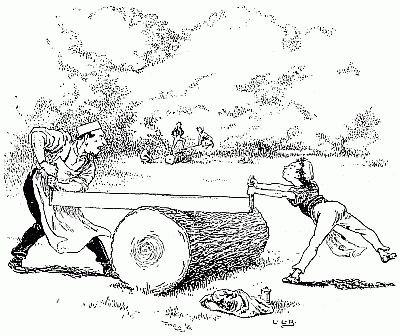
Come again Jill!


(1500 words)