Showing posts with label Unit: Ovid I. Show all posts

Myth-Folklore Unit: Ovid's Metamorphoses (Books 1-4)

Overview. The readings for this unit come from Ovid's Metamorphoses, as translated into English by Tony Kline. This epic poem is one of our most important sources for Greek mythology. The title — Metamorphoses — refers to the unifying theme of the whole poem: the stories are myths of changing shapes, of trans-formation (meta-morphoses). In these selections from Books 1-4 of the poem, you will read about the great flood that destroyed the world, with Deucalion and Pyrrha as the only survivors. There are stories of Zeus's disastrous love affairs with Io, Callisto, and Semele, along with the tragic love stories of Pyamus and Thisbe and of Echo and Narcissus. You will also read the story of poor Phaethon, mortal offspring of the divine Sun, who wanted to drive his father's fiery chariot across the sky.

Language. This is a modern English prose translation of Ovid's epic poem. That means the language might pose some difficulties, but not too many. Just remember that you are reading a poem intended for a sophisticated literary audience in ancient Rome; you were not Ovid's intended audience! :-)

Navigation. You will find the table of contents below, and you can also use this link to see the story posts displayed on two pages total: Ovid's Metamorphoses I. Click "Older Posts" at the bottom of that page to see the second page.

Notes. This unit has notes from me on each page, but please feel free to ask questions, too! You can leave comments here just like at any other blog. You can also rate each page with the star ratings checkbox at the bottom of each post. Your feedback and questions are much appreciated!

Choosing Between Units. There are three different units with myths from Ovid's Metamorphoses as follows: Metamorphoses I, Metamorphoses II, Metamorphoses III. They can be read independently and in any order, so take a look at each one and see the myths listed in the Table of Contents for each unit that might grab your attention. And if you want to give yourself a crash course in Greek mythology, you can choose two of the three units, reading Ovid for both Week 2 and Week 3!

Read More. In this unit, you read only a small part of Ovid's Metamorphoses. If you want to read Tony Kline's complete translation, you can find it online at his website: Ovid's Metamorphoses.

Additional Resources. Wikipedia has good background information about Ovid's life, and also about The Metamorphoses. For learning more about the Greek gods and goddess, Theoi.com is an excellent resource.


READING A
  1. Deucalion and Pyrrha
  2. Io
  3. Phaethon and the Sun
  4. Phaethon's Ride
  5. The Death of Phaethon
  6. Callisto
  7. Semele
READING B
  1. Echo
  2. Narcissus
  3. Pyramus and Thisbe
  4. Mars and Venus
  5. Perseus and Andromeda
  6. Perseus and Medusa

Ovid's Metamorphoses: Deucalion and Pyrrha

Jupiter (Greek Zeus) has grown angry at the wicked deeds of mankind. Helped by his brother Neptune (Poseidon), he decides to destroy the earth with a flood. This is one of the great flood myths; you can see many other flood myths at Wikipedia.

The two survivors, Deucalion and his wife Pyrrha, then ask Themis, the goddess of law and order, for advice about what to do next. Deucalion and Pyrrha are among the most ancient members of the human race: Deucalion was the son of the Titan god Prometheus, while his wife Pyrrha was the daughter of the Titan god Epimetheus (brother of Prometheus) and his wife Pandora.

[Notes by LKG]

This story is part of the Ovid's Metamorphoses unit. Story source: Ovid's Metamorphoses, translated by Tony Kline (2000).


The Flood

Jupiter’s anger is not satisfied with only his own aerial waters: his brother the sea-god helps him, with the ocean waves. He calls the rivers to council, and when they have entered their ruler’s house, says, ‘Now is not the time for long speeches! Exert all your strength. That is what is needed. Throw open your doors, drain the dams, and loose the reins of all your streams!’ Those are his commands. The rivers return and uncurb their fountains’ mouths, and race an unbridled course to the sea.

Neptune himself strikes the ground with his trident, so that it trembles, and with that blow opens up channels for the waters. Overflowing, the rivers rush across the open plains, sweeping away at the same time not just orchards, flocks, houses and human beings, but sacred temples and their contents. Any building that has stood firm, surviving the great disaster undamaged, still has its roof drowned by the highest waves, and its towers buried below the flood.  And now the land and sea are not distinct, all is the sea, the sea without a shore.

The world is drowned

There one man escapes to a hilltop, while another seated in his rowing boat pulls the oars over places where lately he was ploughing. One man sails over his cornfields or over the roof of his drowned farmhouse, while another man fishes in the topmost branches of an elm. Sometimes, by chance, an anchor embeds itself in a green meadow, or the curved boats graze the tops of vineyards. Where lately lean goats browsed, shapeless seals play. The Nereids are astonished to see woodlands, houses and whole towns under the water. There are dolphins in the trees, disturbing the upper branches and stirring the oak-trees as they brush against them. Wolves swim among the sheep, and the waves carry tigers and tawny lions. The boar has no use for his powerful tusks, the deer for its quick legs, both are swept away together, and the circling bird, after a long search for a place to land, falls on tired wings into the water. The sea in unchecked freedom has buried the hills, and fresh waves beat against the mountaintops. The waters wash away most living things, and those the sea spares, lacking food, are defeated by slow starvation.


Deucalion and his wife Pyrrha

Phocis, a fertile country when it was still land, separates Aonia from Oeta, though at that time it was part of the sea, a wide expanse of suddenly created water. There Mount Parnassus lifts its twin steep summits to the stars, its peaks above the clouds.

When Deucalion and his wife landed here in their small boat, everywhere else being drowned by the waters, they worshipped the Corycian nymphs, the mountain gods, and the goddess of the oracles, prophetic Themis. No one was more virtuous or fonder of justice than Deucalion was, and no woman showed greater reverence for the gods.

When Jupiter saw the earth covered with the clear waters, and that only one man was left of all those thousands of men, only one woman left of all those thousands of women, both innocent and both worshippers of the gods, he scattered the clouds and mist, with the north wind, and revealed the heavens to the earth and the earth to the sky.  It was no longer an angry sea, since the king of the oceans putting aside his three-pronged spear calmed the waves, and called sea-dark Triton, showing from the depths his shoulders thick with shells, to blow into his echoing conch and give the rivers and streams the signal to return.

He lifted the hollow shell that coils from its base in broad spirals, that shell that filled with his breath in mid-ocean makes the eastern and the western shores sound. So now when it touched the god’s mouth, and dripping beard, and sounded out the order for retreat, it was heard by all the waters on earth and in the ocean, and all the waters hearing it were checked. Now the sea has shorelines, the brimming rivers keep to their channels, the floods subside, and hills appear. Earth rises, the soil increasing as the water ebbs, and finally the trees show their naked tops, the slime still clinging to their leaves.

They ask Themis for help

The world was restored. But when Deucalion saw its emptiness, and the deep silence of the desolate lands, he spoke to Pyrrha, through welling tears. ‘Wife, cousin, sole surviving woman, joined to me by our shared race, our family origins, then by the marriage bed, and now joined to me in danger, we two are the people of all the countries seen by the setting and the rising sun, the sea took all the rest. Even now our lives are not guaranteed with certainty: the storm clouds still terrify my mind. How would you feel now, poor soul, if the fates had willed you to be saved, but not me? How could you endure your fear alone? Who would comfort your tears? Believe me, dear wife, if the sea had you, I would follow you, and the sea would have me too. If only I, by my father’s arts, could recreate earth’s peoples, and breathe life into the shaping clay! The human race remains in us. The gods willed it that we are the only examples of mankind left behind.’

He spoke and they wept, resolving to appeal to the sky-god, and ask his help by sacred oracles. Immediately they went side by side to the springs of Cephisus that, though still unclear, flowed in its usual course.

When they had sprinkled their heads and clothing with its watery libations, they traced their steps to the temple of the sacred goddess, whose pediments were green with disfiguring moss, her altars without fire.

When they reached the steps of the sanctuary they fell forward together and lay prone on the ground, and, kissing the cold rock with trembling lips, said, ‘If the gods wills soften, appeased by the prayers of the just, if in this way their anger can be deflected, Themis, tell us by what art the damage to our race can be repaired, and bring help, most gentle one, to this drowned world!’

The human race is re-created

The goddess was moved, and uttered oracular speech: ‘Leave the temple and with veiled heads and loosened clothes throw behind you the bones of your great mother!’

For a long time they stand there, dumbfounded. Pyrrha is first to break the silence: she refuses to obey the goddess’s command. Her lips trembling she asks for pardon, fearing to offend her mother’s spirit by scattering her bones.

Meanwhile they reconsider the dark words the oracle gave, and their uncertain meaning, turning them over and over in their minds. Then Prometheus’s son comforted Epimetheus’s daughter with quiet words: ‘Either this idea is wrong, or, since oracles are godly and never urge evil, our great mother must be the earth: I think the bones she spoke about are stones in the body of the earth. It is these we are told to throw behind us.’

Though the Titan’s daughter is stirred by her husband’s thoughts, still hope is uncertain: they are both so unsure of the divine promptings; but what harm can it do to try?

They descended the steps, covered their heads and loosened their clothes, and threw the stones needed behind them. The stones, and who would believe it if it were not for ancient tradition, began to lose their rigidity and hardness, and after a while softened, and once softened acquired new form. Then after growing, and ripening in nature, a certain likeness to a human shape could be vaguely seen, like marble statues at first inexact and roughly carved. The earthy part, however, wet with moisture, turned to flesh; what was solid and inflexible mutated to bone; the veins stayed veins; and quickly, through the power of the gods, stones the man threw took on the shapes of men, and women were remade from those thrown by the woman.

So the toughness of our race, our ability to endure hard labour, and the proof we give of the source from which we are sprung.

Next: Io


(1400 words)


Ovid's Metamorphoses: Io

As the story begins, Jupiter (Zeus), the king of the gods, has fallen in lust with a woman named Io (sometimes called "Phoronis"), the daughter of the river god Inachus, who is a priestess in the temple of Juno (Hera), Jupiter's wife, the queen of the gods.

You will also see that Juno is referred to as "Saturnia," as both she and Jupiter are the children of the god Saturn. You will also see a reference to Juno's special bird: the peacock. In addition to being a story about Io, this is also a story about how the peacock got its colorful tail feathers, decorated with what look like eyes.

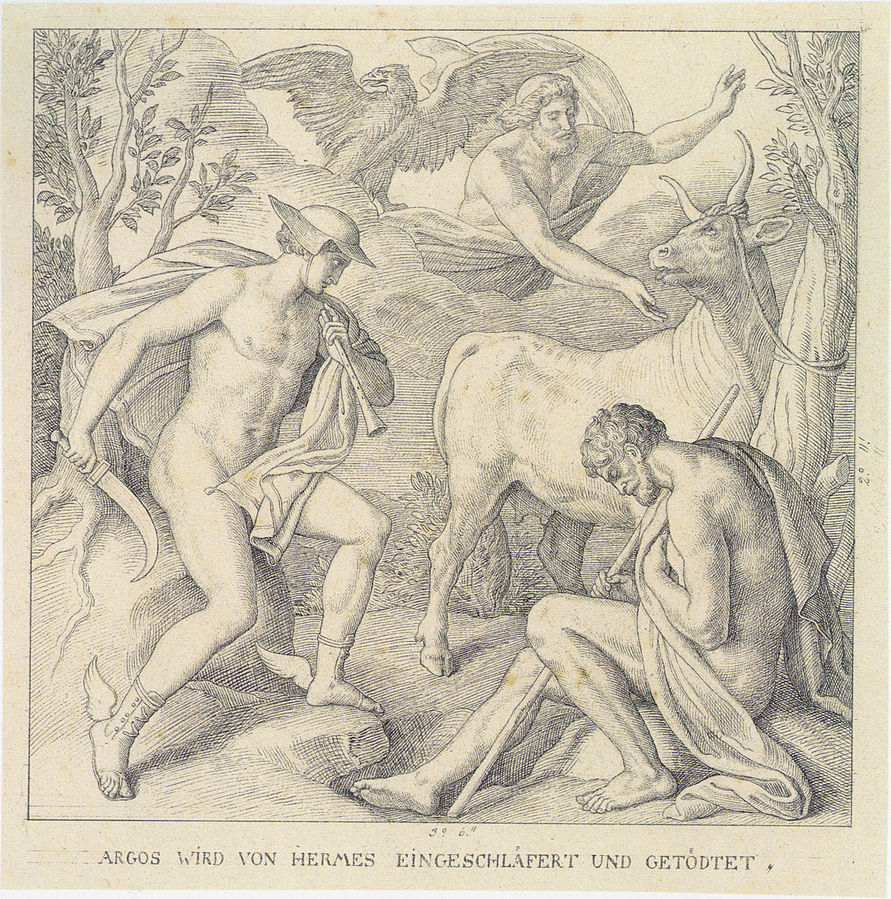
I have omitted part of Ovid's poem here, a "story within a story" when Mercury is lulling Argus to sleep; he tells Argus the story of Syrinx, the story of a nymph pursued by the lusty god Pan.


[Notes by LKG]

This story is part of the Ovid's Metamorphoses unit. Story source: Ovid's Metamorphoses, translated by Tony Kline (2000).


Jupiter’s rape of Io

Jupiter first saw her returning from her father’s stream, and said, ‘Virgin, worthy of Jupiter himself, who will make some unknown man happy when you share his bed, while it is hot and the sun is at the highest point of its arc, find shade in the deep woods!’ (And he showed her the woods’ shade). ‘But if you are afraid to enter the wild beasts’ lairs, you can go into the remote woods in safety, protected by a god, and not by any lesser god, but by the one who holds the sceptre of heaven in his mighty hand, and who hurls the flickering bolts of lightning. Do not fly from me!’ She was already in flight. She had left behind Lerna’s pastures, and the Lyrcean plain’s wooded fields, when the god hid the wide earth in a covering of fog, caught the fleeing girl, and raped her.

Jupiter transforms Io to a heifer

Meanwhile Juno looked down into the heart of Argos, surprised that rapid mists had created night in shining daylight. She knew they were not vapours from the river, or breath from the damp earth. She looked around to see where her husband was, knowing by now the intrigues of a spouse so often caught in the act.

When she could not find him in the skies, she said ‘Either I am wrong, or being wronged’ and gliding down from heaven’s peak, she stood on earth ordering the clouds to melt.

Jupiter had a presage of his wife’s arrival and had changed Inachus’s daughter into a gleaming heifer. Even in that form she was beautiful. Saturnia approved the animal’s looks, though grudgingly, asking, then, whose she was, where from, what herd, as if she did not know.

Jupiter, to stop all inquiry, lied, saying she had been born from the earth.

Then Saturnia claimed her as a gift. What could he do? Cruel to sacrifice his love, but suspicious not to. Shame urges him to it, Amor urges not. Amor would have conquered Shame, but if he refused so slight a gift as a heifer to the companion of his race and bed, it might appear no heifer!

Juno claims Io and Argus guards her

Though her rival was given up the goddess did not abandon her fears at once, cautious of Jupiter and afraid of his trickery, until she had given Io into Argus’s keeping, that son of Arestor. Argus had a hundred eyes round his head, that took their rest two at a time in succession while the others kept watch and stayed on guard. Wherever he stood he was looking at Io, and had Io in front of his eyes when his back was turned.

He let her graze in the light, but when the sun sank below the earth, he penned her, and fastened a rope round her innocent neck. She grazed on the leaves of trees and bitter herbs. She often lay on the bare ground, and the poor thing drank water from muddy streams. When she wished to stretch her arms out to Argus in supplication, she had no arms to stretch. Trying to complain, a lowing came from her mouth, and she was alarmed and frightened by the sound of her own voice. When she came to Inachus’s riverbanks where she often used to play and saw her gaping mouth and her new horns in the water, she grew frightened and fled terrified of herself.

Inachus finds Io and grieves for her

The Naiads did not know her: Inachus himself did not know her, but she followed her father, followed her sisters, allowing herself to be petted, and offering herself to be admired.

Old Inachus pulled some grasses and held them out to her: she licked her father’s hand and kissed his palm, could not hold back her tears, and if only words could have come she would have begged for help, telling her name and her distress. With letters drawn in the dust with her hoof, instead of words, she traced the sad story of her changed form.

‘Pity me!’ said her father Inachus, clinging to the groaning heifer’s horns and snow-white neck. ‘Pity me!’ he sighed; ‘Are you really my daughter I searched the wide world for? There was less sadness with you lost than found! Without speech, you do not answer in words to mine, only heave deep sighs from your breast, and all you can do is low in reply to me.  Unknowingly I was arranging marriage and a marriage-bed for you, hoping for a son-in-law first and then grandchildren. Now you must find a mate from the herd, and from the herd get you a son. I am not allowed by dying to end such sorrow; it is hard to be a god, the door of death closed to me, my grief goes on immortal for ever.’

As he mourned, Argus with his star-like eyes drove her to distant pastures, dragging her out of her father’s arms. There, sitting at a distance he occupied a high peak of the mountain, where resting he could keep a watch on every side.

Jupiter sends Mercury to kill Argus

Now the king of the gods can no longer stand Phoronis’s great sufferings, and he calls his son, born of the shining Pleiad, and orders him to kill Argus. Mercury, quickly puts on his winged sandals, takes his sleep-inducing wand in his divine hand, and sets his cap on his head.

Dressed like this the son of Jupiter touches down on the earth from his father’s stronghold. There, he takes off his cap, and doffs his wings, only keeping his wand. Taking this, disguised as a shepherd, he drives she-goats, stolen on the way, through solitary lanes, and plays his reed pipe as he goes.

Juno’s guard is captivated by this new sound. ‘You there, whoever you are’ Argus calls ‘you could sit here beside me on this rock; there’s no better grass elsewhere for your flock, and you can see that the shade is fine for shepherds.’

The descendant of Atlas sits down and passes the day in conversation, talking of many things and playing on his reed pipe, trying to conquer those watching eyes. Argus however fights to overcome gentle sleep, and though he allows some of his eyes to close, the rest stay vigilant.

Cyllenian Mercury saw that every eye had succumbed and their light was lost in sleep. Quickly he stops speaking and deepens their rest, caressing those drowsy eyes with touches of his magic wand. Then straightaway he strikes the nodding head, where it joins the neck, with his curved sword, and sends it bloody down the rocks, staining the steep cliff. Argus, you are overthrown, the light of your many eyes is extinguished, and one dark sleeps under so many eyelids.

Io is returned to human form

Saturnia took his eyes and set them into the feathers of her own bird, and filled the tail with star-like jewels.

Immediately she blazed with anger, and did not hold back from its consequences. She set a terrifying Fury in front of the eyes and mind of that ‘slut’ from the Argolis, buried a tormenting restlessness in her breast, and drove her as a fugitive through the world.

You, Nile, put an end to her immeasurable suffering. When Io reached you, she fell forward onto her knees on the riverbank and turning back her long neck with her face upwards, in the only way she could, looked to the sky, and with groans and tears and sad lowing seemed to reproach Jupiter and beg him to end her troubles.

Jupiter threw his arms round his wife’s neck and pleaded for an end to vengeance, saying, ‘Do not fear; in future she will never be a source of pain,’ and he called the Stygian waters to witness his words.

As the goddess grows calmer, Io regains her previous appearance, and becomes what she once was. The rough hair leaves her body, the horns disappear, the great eyes grow smaller, the gaping mouth shrinks, the shoulders and hands return, and the hooves vanish, each hoof changing back into five nails. Nothing of the heifer is left except her whiteness. Able to stand on two feet she raises herself erect and fearing to speak in case she lows like a heifer, timidly attempts long neglected words.


(1500 words)

Ovid's Metamorphoses: Phaethon and the Sun

The story of Phaethon which you will now read is in some ways similar to the story of Daedalus and Icarus, but in this case, Phaethon has a divine father — the sun god Phoebus Apollo (Helios in some versions of the story) — and Phaethon does not just want to fly; he wants to drive the sun god's chariot across the sky. Because of this myth, the word "phaethon" became part of the English language, referring to a type of carriage.

The story picks up with Io, restored to human form, who bears a child, son of Zeus, named Epaphus. Ovid tells us that Phaethon, son of the Sun God, was a friend of Epaphus, and thus he transitions from the story of Io into the story of Phaethon.

[Notes by LKG]

This story is part of the Ovid's Metamorphoses unit. Story source: Ovid's Metamorphoses, translated by Tony Kline (2000).


Phaethon’s parentage

Now Io is worshipped as a greatly honoured goddess by crowds of linen clad acolytes. In due time she bore a son, Epaphus, who shared the cities’ temples with his mother, and was believed to have been conceived from mighty Jupiter’s seed.

He had a friend, Phaethon, child of the Sun, equal to him in spirit and years, who once boasted proudly that Phoebus was his father and refused to concede the claim, which Inachus’s grandson could not accept. ‘You are mad to believe all your mother says, and you have an inflated image of your father.’

Phaethon reddened but, from shame, repressed his anger, and went to his mother Clymene with Inachus’s reproof. ‘To sadden you more, Mother, I the free, proud, spirit was silent! I am ashamed that such a reproach can be spoken and not answered. But if I am born at all of divine stock, give me some proof of my high birth, and let me claim my divinity!’

So saying he flung his arms round his mother’s neck, entreating her, by his own and her husband Merops’s life, and by his sisters’ marriages, to reveal to him some true sign of his parentage.

Phaethon sets out for the Palace of the Sun

Clymene, moved perhaps by Phaethon’s entreaties or more by anger at the words spoken, stretched both arms out to the sky and looking up at the sun’s glow said, ‘By that brightness marked out by glittering rays, that sees us and hears us, I swear to you, my son, that you are the child of the Sun; of that being you see; you are the child of he who governs the world; if I lie, may he himself decline to look on me again, and may this be the last light to reach our eyes!  It is no great effort for you yourself to find your father’s house. The place he rises from is near our land. If you have it in mind to do so, go and ask the sun himself!’

Immediately Phaethon, delighted at his mother’s words, imagining the heavens in his mind, darts off and crosses Ethiopia his people’s land, then India, land of those bathed in radiant fire, and with energy reaches the East.

The Palace of the Sun

The palace of the Sun towered up with raised columns, bright with glittering gold, and gleaming bronze like fire. Shining ivory crowned the roofs, and the twin doors radiated light from polished silver. The work of art was finer than the material: on the doors Mulciber (the god Vulcan) had engraved the waters that surround the earth’s centre, the earthly globe, and the overarching sky. The dark blue sea contains the gods, melodious Triton, shifting Proteus, Aegaeon crushing two huge whales together, his arms across their backs, and Doris with her daughters, some seen swimming, some sitting on rocks drying their sea-green hair, some riding the backs of fish. They are neither all alike, nor all different, just as sisters should be. The land shows men and towns, woods and creatures, rivers and nymphs and other rural gods. Above them was an image of the glowing sky, with six signs of the zodiac on the right hand door and the same number on the left.

As soon as Clymene’s son had climbed the steep path there, and entered the house of this parent of whose relationship to himself he was uncertain, he immediately made his way into his father’s presence, but stopped some way off, unable to bear his light too close.

Wearing a purple robe, Phoebus sat on a throne shining with bright emeralds. To right and left stood the Day, Month, and Year, the Century and the equally spaced Hours. Young Spring stood there circled with a crown of flowers, naked Summer wore a garland of ears of corn, Autumn was stained by the trodden grapes, and icy Winter had white, bristling hair.

Phaethon and his father

The Sun, seated in the middle of them, looked at the boy, who was fearful of the strangeness of it all, with eyes that see everything, and said, ‘What reason brings you here? What do you look for on these heights, Phaethon, son that no father need deny?’

Phaethon replied ‘Universal light of the great world, Phoebus, Father, if you let me use that name, if Clymene is not hiding some fault behind false pretence, give me proof, Father, so they will believe I am your true offspring, and take away this uncertainty from my mind!’

He spoke, and his father removed the crown of glittering rays from his head and ordered him to come nearer. Embracing him, he said, ‘It is not to be denied you are worthy to be mine, and Clymene has told you the truth of your birth. So that you can banish doubt, ask for any favour, so that I can grant it to you. May the Stygian lake, that my eyes have never seen, by which the gods swear, witness my promise.’

Hardly had he settled back properly in his seat when the boy asked for his father’s chariot and the right to control his wing-footed horses for a day.

The Sun’s admonitions

His father regretted his oath. Three times, and then a fourth, shaking his bright head, he said, ‘Your words show mine were rash; if only it were right to retract my promise! I confess, my boy, I would only refuse you this one thing. It is right to dissuade you. What you want is unsafe. Phaethon, you ask too great a favour, and one that is unfitting for your strength and boyish years. Your fate is mortal: it is not mortal what you ask. Unknowingly you aspire to more than the gods can share. Though each deity can please themselves, within what is allowed, no one except myself has the power to occupy the chariot of fire. Even the lord of mighty Olympus, who hurls terrifying lightning-bolts from his right hand, cannot drive this team, and who is greater than Jupiter?’

His further warnings

‘The first part of the track is steep, and one that my fresh horses at dawn can hardly climb. In mid-heaven it is highest, where to look down on earth and sea often alarms even me, and makes my heart tremble with awesome fear. The last part of the track is downwards and needs sure control. Then even Tethys herself, who receives me in her submissive waves, is accustomed to fear that I might dive headlong. Moreover, the rushing sky is constantly turning, and drags along the remote stars, and whirls them in rapid orbits.  I move the opposite way, and its momentum does not overcome me as it does all other things, and I ride contrary to its swift rotation.

‘Suppose you are given the chariot. What will you do? Will you be able to counter the turning poles so that the swiftness of the skies does not carry you away? Perhaps you conceive in imagination that there are groves there and cities of the gods and temples with rich gifts. The way runs through ambush, and apparitions of wild beasts! Even if you keep your course, and do not steer awry, you must still avoid the horns of Taurus the Bull, Sagittarius the Haemonian Archer, raging Leo and the Lion’s jaw, Scorpio’s cruel pincers sweeping out to encircle you from one side, and Cancer’s crab-claws reaching out from the other.

‘You will not easily rule those proud horses, breathing out through mouth and nostrils the fires burning in their chests. They scarcely tolerate my control when their fierce spirits are hot, and their necks resist the reins. Beware, my boy, that I am not the source of a gift fatal to you, while something can still be done to set right your request!’


(1400 words)

Ovid's Metamorphoses: Phaethon's Ride

In this part of the story, you see what happens when Aurora, the dawn goddess, awakens in the east, and the Sun needs to begin his journey. Disaster results, and now instead of being destroyed by flood, the Earth now risks being destroyed by fire.

[Notes by LKG]

This story is part of the Ovid's Metamorphoses unit. Story source: Ovid's Metamorphoses, translated by Tony Kline (2000).


Phaethon insists on driving the chariot

‘No doubt, since you ask for a certain sign to give you confidence in being born of my blood, I give you that sure sign by fearing for you, and show myself a father by fatherly anxiety. Look at me. If only you could look into my heart, and see a father’s concern from within!

‘Finally, look around you, at the riches the world holds, and ask for anything from all of the good things in earth, sea, and sky. I can refuse you nothing. Only this one thing I take exception to, which would truly be a punishment and not an honour. Phaethon, you ask for punishment as your reward! Why do you unknowingly throw your coaxing arms around my neck? Have no doubt! Whatever you ask will be given, I have sworn it by the Stygian streams, but make a wiser choice!’

The warning ended, but Phaethon still rejected his words, and pressed his purpose, blazing with desire to drive the chariot. So, as he had the right, his father led the youth to the high chariot, Vulcan’s work. It had an axle of gold, and a gold chariot pole, wheels with golden rims, and circles of silver spokes. Along the yoke chrysolites and gemstones, set in order, glowed with brilliance reflecting Phoebus’s own light.

The Sun’s instructions

Now while brave Phaethon is gazing in wonder at the workmanship, see, Aurora, awake in the glowing east, opens wide her bright doors, and her rose-filled courts. The stars, whose ranks are shepherded by Lucifer the morning star, vanish, and he, last of all, leaves his station in the sky.

When Titan saw his setting, as the earth and skies were reddening, and just as the crescent of the vanishing moon faded, he ordered the swift Hours to yoke his horses. The goddesses quickly obeyed his command, and led the team, sated with ambrosial food and breathing fire, out of the tall stables, and put on their ringing harness.

Then the father rubbed his son’s face with a sacred ointment and made it proof against consuming flames, and placed his rays amongst his hair, and foreseeing tragedy, and fetching up sighs from his troubled heart, said, ‘If you can at least obey your father’s promptings, spare the whip, boy, and rein them in more strongly! They run swiftly of their own accord. It is a hard task to check their eagerness. And do not please yourself, taking a path straight through the five zones of heaven! The track runs obliquely in a wide curve, and bounded by the three central regions, avoids the southern pole and the Arctic north. This is your road, you will clearly see my wheel-marks, and so that heaven and earth receive equal warmth, do not sink down too far or heave the chariot into the upper air! Too high and you will scorch the roof of heaven: too low, the earth. The middle way is safest.

‘Nor must you swerve too far right towards writhing Serpens, nor lead your wheels too far left towards sunken Ara. Hold your way between them! I leave the rest to Fortune; I pray she helps you, and takes better care of you than you do yourself. While I have been speaking, dewy night has touched her limit on Hesperus’s far western shore. We have no time for freedom! We are needed: Aurora, the dawn, shines, and the shadows are gone. Seize the reins in your hand, or if your mind can be changed, take my counsel, do not take my horses! While you can, while you still stand on solid ground, before unknowingly you take to the chariot you have unluckily chosen, let me light the world, while you watch in safety!’

The Horses run wild

The boy has already taken possession of the fleet chariot, and stands proudly, and joyfully, takes the light reins in his hands, and thanks his unwilling father.

Meanwhile the sun’s swift horses, Pyroïs, Eoüs, Aethon, and the fourth, Phlegon, fill the air with fiery whinnying, and strike the bars with their hooves. When Tethys, ignorant of her grandson’s fate, pushed back the gate, and gave them access to the wide heavens, rushing out, they tore through the mists in the way with their hooves and, lifted by their wings, overtook the East winds rising from the same region. But the weight was lighter than the horses of the Sun could feel, and the yoke was free of its accustomed load. Just as curved-sided boats rock in the waves without their proper ballast, and being too light are unstable at sea, so the chariot, free of its usual burden, leaps in the air and rushes into the heights as though it were empty.

As soon as they feel this the team of four run wild and leave the beaten track, no longer running in their pre-ordained course. He was terrified, unable to handle the reins entrusted to him, not knowing where the track was, nor, if he had known, how to control the team. Then for the first time the chill stars of the Great and Little Bears, grew hot, and tried in vain to douse themselves in forbidden waters. And the Dragon, Draco, that is nearest to the frozen pole, never formidable before and sluggish with the cold, now glowed with heat, and took to seething with new fury. They say that you, Bootës, also fled in confusion, slow as you are and hampered by the Plough.

Phaethon lets go of the reins

When the unlucky Phaethon looked down from the heights of the sky at the earth far, far below he grew pale and his knees quaked with sudden fear, and his eyes were robbed of shadow by the excess light. Now he would rather he had never touched his father’s horses, and regrets knowing his true parentage and possessing what he asked for. Now he wants only to be called Merops’s son, as he is driven along like a ship in a northern gale, whose master lets go the ropes, and leaves her to prayer and the gods.

What can he do? Much of the sky is now behind his back, but more is before his eyes. Measuring both in his mind, he looks ahead to the west he is not fated to reach and at times back to the east. Dazed, he is ignorant how to act, and can neither grasp the reins nor has the power to loose them, nor can he change course by calling the horses by name.

Also, alarmed, he sees the marvellous forms of huge creatures everywhere in the glowing sky. There is a place where Scorpio bends his pincers in twin arcs, and, with his tail and his curving arms stretched out to both sides, spreads his body and limbs over two star signs. When the boy saw this monster drenched with black and poisonous venom threatening to wound him with its arched sting, robbed of his wits by chilling horror, he dropped the reins.

The mountains burn

When the horses feel the reins lying across their backs, after he has thrown them down, they veer off course and run unchecked through unknown regions of the air. Wherever their momentum takes them there they run, lawlessly, striking against the fixed stars in deep space and hurrying the chariot along remote tracks. Now they climb to the heights of heaven, now rush headlong down its precipitous slope, sweeping a course nearer to the earth.

The Moon, amazed, sees her brother’s horses running below her own, and the boiling clouds smoke. The earth bursts into flame, in the highest regions first, opens in deep fissures and all its moisture dries up. The meadows turn white, the trees are consumed with all their leaves, and the scorched corn makes its own destruction. But I am bemoaning the lesser things. Great cities are destroyed with all their walls, and the flames reduce whole nations with all their peoples to ashes.

Earth complains

Nevertheless, kindly Earth, surrounded as she was by sea, between the open waters and the dwindling streams that had buried themselves in their mother’s dark womb, lifted her smothered face. Putting her hand to her brow, and shaking everything with her mighty tremors, she sank back a little lower than she used to be, and spoke in a faint voice, ‘If this pleases you, if I have deserved it, O king of the gods, why delay your lightning bolts? If it is right for me to die through the power of fire, let me die by your fire and let the doer of it lessen the pain of the deed! I can hardly open my lips to say these words’ (the heat was choking her). ‘Look at my scorched hair and the ashes in my eyes, the ashes over my face! Is this the honour and reward you give me for my fruitfulness and service, for carrying wounds from the curved plough and the hoe, for being worked throughout the year, providing herbage and tender grazing for the flocks, produce for the human race and incense to minister to you gods?

‘Even if you find me deserving of ruin, what have the waves done, why does your brother deserve this? Why are the waters that were his share by lot diminished and so much further from the sky? If neither regard for me or for your brother moves you pity at least your own heavens! Look around you on either side: both the poles are steaming! If the fire should melt them, your own palace will fall! Atlas himself is suffering, and can barely hold up the white-hot sky on his shoulders! If the sea and the land and the kingdom of the heavens are destroyed, we are lost in ancient chaos!  Save whatever is left from the flames, and think of our common interest!’


(1700 words)

Ovid's Metamorphoses: The Death of Phaethon

After Phaethon plunges to his death, you get the transformation (metamorphosis) part of the story: his sisters, the daughters of the Sun, turn into poplar trees. Meanwhile, Cycnus, another friend of Phaethon, turned into a swan; the Greek word "cycnus" means swan (as you can see in the English word "cygnet," meaning a baby swan).

[Notes by LKG]

This story is part of the Ovid's Metamorphoses unit. Story source: Ovid's Metamorphoses, translated by Tony Kline (2000).


Jupiter intervenes and Phaethon dies

So the Earth spoke, and unable to tolerate the heat any longer or speak any further, she withdrew her face into her depths closer to the caverns of the dead. But the all-powerful father of the gods climbs to the highest summit of heaven, from where he spreads his clouds over the wide earth, from where he moves the thunder and hurls his quivering lightning bolts, calling on the gods, especially on him who had handed over the sun chariot, to witness that, unless he himself helps, the whole world will be overtaken by a ruinous fate.

Now he has no clouds to cover the earth or rain to shower from the sky. He thundered, and balancing a lightning bolt in his right hand threw it from eye-level at the charioteer, removing him, at the same moment, from the chariot and from life, extinguishing fire with fierce fire. Thrown into confusion, the horses, lurching in different directions, wrench their necks from the yoke and throw off the broken harness. Here the reins lie, there the axle torn from the pole, there the spokes of shattered wheels, and the fragments of the wrecked chariot are flung far and wide.

But Phaethon, flames ravaging his glowing hair, is hurled headlong, leaving a long trail in the air, as sometimes a star does in the clear sky, appearing to fall although it does not fall. Far from his own country, in a distant part of the world, the river god Eridanus takes him from the air, and bathes his smoke-blackened face. There the Italian nymphs consign his body, still smoking from that triple-forked flame, to the earth, and they also carve a verse in the rock:

HERE PHAETHON LIES
WHO THE SUN’S JOURNEY MADE
DARED ALL THOUGH HE
BY WEAKNESS WAS BETRAYED

Now the father, pitiful, ill with grief, hid his face, and, if we can believe it, a whole day went by without the sun. But the fires gave light, so there was something beneficial amongst all that evil.

But Clymene, having uttered whatever can be uttered at such misfortune, grieving and frantic and tearing her breast, wandered over the whole earth first looking for her son’s limbs, and then failing that his bones. She found his bones already buried however, beside the riverbank in a foreign country. Falling to the ground she bathed with tears the name she could read on the cold stone and warmed it against her naked breast.

The Heliads, her daughters and the Sun’s, cry no less, and offer their empty tribute of tears to the dead, and, beating their breasts with their hands, they call for their brother night and day, and lie down on his tomb, though he cannot hear their pitiful sighs.

The sisters turned into poplar trees

Four times the moon had joined her crescent horns to form her bright disc. They by habit, since use creates habit, devoted themselves to mourning.  Then Phaethüsa, the eldest sister, when she tried to throw herself to the ground, complained that her ankles had stiffened, and when radiant Lampetia tried to come near her she was suddenly rooted to the spot. A third sister attempting to tear at her hair pulled out leaves. One cried out in pain that her legs were sheathed in wood, another that her arms had become long branches. While they wondered at this, bark closed round their thighs and by degrees over their waists, breasts, shoulders, and hands, and all that was left free were their mouths calling for their mother.

What can their mother do but go here and there as the impulse takes her, pressing her lips to theirs where she can? It is no good. She tries to pull the bark from their bodies and break off new branches with her hands, but drops of blood are left behind like wounds.

‘Stop, mother, please’ cries out whichever one she hurts. ‘Please stop: It is my body in the tree you are tearing. Now, farewell.’

And the bark closed over her with her last words. Their tears still flow, and hardened by the sun, fall as amber from the virgin branches, to be taken by the bright river and sent onwards to adorn Roman brides.

Cycnus

Cycnus, the son of Sthenelus witnessed this marvel, who though he was kin to you, Phaethon, through his mother, was closer still in love. Now, though he had ruled the people and great cities of Liguria, he left his kingdom, and filled Eridanus’s green banks and streams, and the woods the sisters had become part of, with his grief. As he did so his voice vanished and white feathers hid his hair, his long neck stretched out from his body, his reddened fingers became webbed, wings covered his sides, and a rounded beak his mouth.

So Cycnus became a new kind of bird, the swan. But he had no faith in Jupiter and the heavens, remembering the lightning bolt the god in his severity had hurled. He looked for standing water, and open lakes hating fire, choosing to live in floods rather than flames.

The Sun returns to his task

Meanwhile Phaethon’s father, mourning and without his accustomed brightness, as if in eclipse, hated the light, himself and the day. He gave his mind over to grief, and to grief added his anger, and refused to provide his service to the earth.

‘Enough’ he says ‘since the beginning, my task has given me no rest and I am weary of work without end and labour without honour! Whoever chooses to can steer the chariot of light! If no one does, and all the gods acknowledge they cannot, let Jupiter himself do it, so that for a while at least, while he tries to take the reins, he must put aside the lightning bolts that leave fathers bereft! Then he will know when he has tried the strength of those horses, with hooves of fire, that the one who failed to rule them well did not deserve to be killed.’

All the gods gather round Sol as he talks like this, and beg him not to shroud everything with darkness. Jupiter himself tries to excuse the fire he hurled, adding threats to his entreaties as kings do. Then Phoebus rounds up his horses, maddened and still trembling with terror, and in pain lashes out at them with goad and whip (really lashes out) reproaching them and blaming them for his son’s death.

Next: Callisto


(1100 words)


Ovid's Metamorphoses: Callisto

The previous story made reference to the many constellations that are named for animals, and in this story you will learn the origin of the constellations known as the Great Bear and the Little Bear, Ursa Major and Ursa Minor. Once again, as with the story of Io, it all starts with Jupiter's unbridled libido. This time, he falls in love with Callisto, a nymph who is devoted to the goddess Diana (Artemis), the virgin goddess of the hunt.

[Notes by LKG]

This story is part of the Ovid's Metamorphoses unit. Story source: Ovid's Metamorphoses, translated by Tony Kline (2000).


Jupiter sees Callisto

Now the all-powerful father of the gods circuits the vast walls of heaven and examines them to check if anything has been loosened by the violent fires. When he sees they are as solid and robust as ever he inspects the earth and the works of humankind. Arcadia above all is his greatest care. He restores her fountains and streams, that are still hardly daring to flow, gives grass to the bare earth, leaves to the trees, and makes the scorched forests grow green again.

Often, as he came and went, he would stop short at the sight of a girl from Nonacris, feeling the fire take in the very marrow of his bones. She was not one to spin soft wool or play with her hair. A clasp fastened her tunic, and a white ribbon held back her loose tresses. Dressed like this, with a spear or a bow in her hand, she was one of Diana’s companions. No nymph who roamed Maenalus was dearer to Trivia, goddess of the crossways, than she, Callisto, was. But no favour lasts long.

Jupiter rapes Callisto

The sun was high, just past the zenith, when she entered a grove that had been untouched through the years. Here she took her quiver from her shoulder, unstrung her curved bow, and lay down on the grass, her head resting on her painted quiver. Jupiter, seeing her there weary and unprotected, said, ‘Here, surely, my wife will not see my cunning, or if she does find out it is, oh it is, worth a quarrel!’

Quickly he took on the face and dress of Diana, and said ‘Oh, girl who follows me, where in my domains have you been hunting?’

The virgin girl got up from the turf replying, ‘Greetings, goddess greater than Jupiter: I say it even though he himself hears it.’

He did hear, and laughed, happy to be judged greater than himself, and gave her kisses unrestrainedly, and not those that virgins give.

When she started to say which woods she had hunted, he embraced and prevented her and not without committing a crime. Face to face with him, as far as a woman could (I wish you had seen her, Juno: you would have been kinder to her) she fought him, but how could a girl win, and who is more powerful than Jove?

Victorious, Jupiter made for the furthest reaches of the sky, while to Callisto the grove was odious and the wood seemed knowing. As she retraced her steps she almost forgot her quiver and its arrows, and the bow she had left hanging.

Diana discover’s Callisto’s shame
   
Behold how Diana, with her band of huntresses, approaching from the heights of Maenalus, magnificent from the kill, spies her there, and seeing her calls out.

At the shout she runs, afraid at first in case it is Jupiter disguised, but when she sees the other nymphs come forward she realises there is no trickery and joins their number. Alas! How hard it is not to show one’s guilt in one’s face! She can scarcely lift her eyes from the ground, not as she used to be, wedded to her goddess’s side or first of the whole company, but is silent and by her blushing shows signs of her shame at being attacked. Even if she were not herself virgin, Diana could sense her guilt in a thousand ways. They say all the nymphs could feel it.

Nine crescent moons had since grown full when the goddess faint from the chase in her brother’s hot sunlight found a cool grove out of which a murmuring stream ran, winding over fine sand. She loved the place and tested the water with her foot. Pleased with this too she said, ‘Any witness is far away, let’s bathe our bodies naked in the flowing water.’

The Arcadian girl blushed: all of them took off their clothes; one of them tried to delay — hesitantly the tunic was removed and there her shame was revealed with her naked body. Terrified she tried to conceal her swollen belly.

Diana cried ‘Go, far away from here: do not pollute the sacred fountain!’ and the Moon-goddess commanded her to leave her band of followers.

Callisto turned into a bear

The great Thunderer’s wife had known about all this for a long time and had held back her severe punishment until the proper time. Now there was no reason to wait.

The girl had given birth to a boy, Arcas, and that in itself enraged Juno. When she turned her angry eyes and mind to thought of him she cried out, ‘Nothing more was needed, you adulteress, than your fertility, and your marking the insult to me by giving birth, making public my Jupiter’s crime. You’ll not carry this off safely. Now, insolent girl, I will take that shape away from you, that pleased you and my husband so much!’

At this she clutched her in front by the hair of her forehead and pulled her face forwards onto the ground. Callisto stretched out her arms for mercy: those arms began to bristle with coarse black hairs; her hands arched over and changed into curved claws to serve as feet, and her face, that Jupiter had once praised, was disfigured by gaping jaws, and so that her prayers and words of entreaty might not attract him her power of speech was taken from her. An angry, threatening growl, harsh and terrifying, came from her throat.

Still her former feelings remained intact though she was now a bear.  She showed her misery in continual groaning, raising such hands as she had left to the starry sky, feeling, though she could not speak it, Jupiter’s indifference.

Ah, how often she wandered near the house and fields that had once been her home, not daring to sleep in the lonely woods! Ah, how often she was driven among the rocks by the baying hounds, and the huntress fled in fear from the hunters! Often she hid at the sight of wild beasts forgetting what she was, and though a bear she shuddered at the sight of other bears on the mountains and feared the wolves though her father Lycaon ran with them.

Arcas and Callisto become constellations

And now Arcas, grandson of Lycaon, had reached his fifteenth year ignorant of his parentage. While he was hunting wild animals, while he was finding suitable glades and penning up the Erymanthian groves with woven nets, he came across his mother, who stood still at sight of Arcas and appeared to know him.

He shrank back from those unmoving eyes gazing at him so fixedly, uncertain what made him afraid, and when she quickly came nearer he was about to pierce her chest with his lethal spear. All-powerful Jupiter restrained him and in the same moment removed them and the possibility of that wrong, and together, caught up through the void on the winds, he set them in the heavens and made them similar constellations, the Great and Little Bear.

Next: Semele


(1200 words)


Ovid's Metamorphoses: Semele

This story is also about the infidelity of Zeus: this time Juno is outraged that Jupiter (also called Jove by the Romans) has had an affair with the woman Semele, daughter of Cadmus, who is now pregnant with Jupiter's child. The child who will be born, although not in the usual way, is the god Dionysus, called Bacchus by the Romans.

[Notes by LKG]

This story is part of the Ovid's Metamorphoses unit. Story source: Ovid's Metamorphoses, translated by Tony Kline (2000).


Juno angry about Semele

Juno was grieved by the fact that Semele was pregnant, with the seed of mighty Jove. Swallowing words of reproach, she said ‘What, in truth, have I gained from frequent reproaches? I must attack her. If I am rightly to be called most powerful Juno, if it is right for me to hold the jewelled sceptre in my hand, if I am queen, and sister and wife of Jove, sister at least, then it is her I must destroy. Yet I think she is content with her secret, and the injury to my marriage will be brief. But she has conceived – and that damages me – and makes her crime visible in her swollen belly, and wants, what I have barely achieved, to be confirmed as the mother of Jupiter’s child, so great is her faith in her beauty. I will render that faith hollow. I am not Saturnia if she does not plunge into the Stygian waters, overwhelmed by Jove himself.’

Semele is consumed by Jupiter’s fire.

At this she rose from her seat and cloaked in a dark cloud she came to Semele’s threshold. But before she removed the cloud she disguised herself as an old woman, ageing her hair, ploughing her skin with wrinkles, and walking with bowed legs and tottering steps. She made her voice sound old and was herself Beroë, Semele’s Epidaurian nurse.

So, when they came to Jupiter’s name, in the midst of their lengthy gossiping, she sighed, and said, ‘I hope, for your sake, that it really is Jupiter, but I am suspicious of all that sort of thing. Many men have entered the bedrooms of chaste women in the name of the gods. It’s not good enough for him merely to be Jove: he must give a proof of his love if it truly is him. Beg him to assume all his powers before he embraces you, and be just as glorious as when Juno welcomes him on high.’

With such words Juno gulled the unsuspecting daughter of Cadmus. Semele asked Jupiter for an unspecified gift.

‘Choose!’ said the god. ‘Nothing will be refused, and, so that you may believe it more firmly, I swear it by the Stygian torrent, that is the divine conscience, the fear, and god, of all the gods.’

Pleased by her misfortune, too successful, and doomed to be undone by her lover’s indulgence, Semele said, ‘As Saturnia is used to your embrace, when you enter into the pact of Venus, give yourself to me!’

The god would have stopped her lips as she spoke: but her voice had already rushed into the air. He groans, since she cannot un-wish it or he un-swear it.

So, most sorrowfully, he climbs the heights of heaven, and, with a look, gathered the trailing clouds, then added their vapours to lightning mixed with storm-winds, and thunder and fateful lightning bolts. Still, he tries to reduce his power in whatever way he can, and does not arm himself with that lightning with which he deposed hundred-handed Typhoeus: it is too savage in his grasp. There is a lighter dart to which the Cyclops’s hands gave a less violent fire, a lesser anger. The gods call these his secondary weapons. Taking these he enters Agenor’s house.

But still Semele’s mortal body could not endure the storm, and she was consumed by the fire of her nuptial gift.

The infant Bacchus, still unfinished, is torn from the mother’s womb, and (if it can be believed) is sewn into his father’s thigh to complete his full term. Ino, his mother’s sister reared him secretly, in infancy, and then he was given to the nymphs of Mount Nysa who hid him in their cave and fed him on milk.


Next: Echo


(600 words)


Ovid's Metamorphoses: Echo

The story begins with the birth of the god Bacchus (Dionysus) who is "twice-born" as the story says: born once when they took him from the womb of his mother Semele, and then born a second time when they took him from the thigh of Jupiter where he was placed for safekeeping after his premature first birth. The birth of Dionysus, leads to a debate between Jupiter and Juno about who enjoys lovemaking more: the man, or the woman?

From this beginning, Ovid reaches the story of the vain young man Narcissus and the nymph Echo who loves him. The word "echo" in Greek means just what it does in English, and this story provides an explanation of just where the phenomenon of the echo comes from.

[Notes by LKG]

This story is part of the Ovid's Metamorphoses unit. Story source: Ovid's Metamorphoses, translated by Tony Kline (2000).


The judgement of Tiresias

While these things were brought about on earth because of that fatal oath, and while twice-born Bacchus’s cradle remained safe, they say that Jupiter, expansive with wine, set aside his onerous duties, and relaxing, exchanging pleasantries, with Juno, said, ‘You gain more than we do from the pleasures of love.’ She denied it. They agreed to ask learned Tiresias for his opinion. He had known Venus in both ways.

Once, with a blow of his stick, he had disturbed two large snakes mating in the green forest, and, marvellous to tell, he was changed from a man to a woman, and lived as such for seven years. In the eighth year he saw the same snakes again and said, ‘Since there is such power in plaguing you that it changes the giver of a blow to the opposite sex, I will strike you again, now.’ He struck the snakes and regained his former shape, and returned to the sex he was born with.

As the arbiter of the light-hearted dispute he confirmed Jupiter’s words.

Saturnia, it is said, was more deeply upset than was justified and than the dispute warranted, and damned the one who had made the judgement to eternal night. But, since no god has the right to void what another god has done, the all-powerful father of the gods gave Tiresias knowledge of the future, in exchange for his lost sight, and lightened the punishment with honour.

Echo sees Narcissus

Famous throughout all the Aonian cities, Tiresias gave faultless answers to people who consulted him. Dusky Liriope, the Naiad, was the first to test the truth and the accuracy of his words, whom once the river-god Cephisus clasped in his winding streams, and took by force under the waves. This loveliest of nymphs gave birth at full term to a child whom, even then, one could fall in love with, called Narcissus. Being consulted as to whether the child would live a long life, to a ripe old age, the seer with prophetic vision replied ‘If he does not discover himself.’

For a long time the augur’s pronouncement appeared empty words. But in the end it proved true: the outcome, and the cause of his death, and the strangeness of his passion.

One year the son of Cephisus had reached sixteen and might seem both boy and youth. Many youths, and many young girls, desired him. But there was such intense pride in that delicate form that none of the youths or young girls affected him.

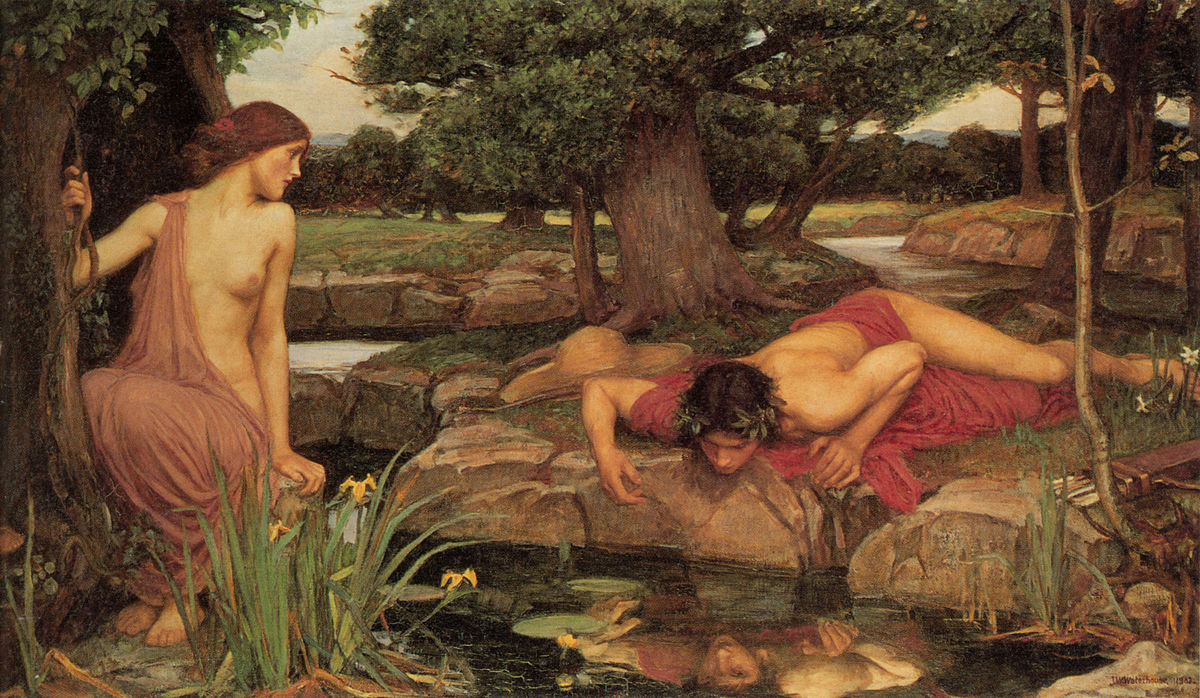
One day the nymph Echo saw him, driving frightened deer into his nets, she of the echoing voice, who cannot be silent when others have spoken, nor learn how to speak first herself.

How Juno altered Echo’s speech

Echo still had a body then and was not merely a voice. But though she was garrulous, she had no other trick of speech than she has now: she can repeat the last words out of many. Juno made her like that, because often when she might have caught the nymphs lying beneath her Jupiter, on the mountain slopes, Echo knowingly held her in long conversations, while the nymphs fled. When Saturnia realised this she said, ‘I shall give you less power over that tongue by which I have been deluded, and the briefest ability to speak,’ and what she threatened she did. Echo only repeats the last of what is spoken and returns the words she hears.

Now when she saw Narcissus wandering through the remote fields, she was inflamed, following him secretly, and the more she followed the closer she burned with fire, no differently than inflammable sulphur, pasted round the tops of torches, catches fire, when a flame is brought near it. O how often she wants to get close to him with seductive words, and call him with soft entreaties! Her nature denies it, and will not let her begin, but she is ready for what it will allow her to do, to wait for sounds, to which she can return words.

By chance, the boy, separated from his faithful band of followers, had called out ‘Is anyone here?’ and ‘Here’ Echo replied.

He is astonished, and glances everywhere, and shouts in a loud voice ‘Come to me!’

She calls as he calls.

He looks back, and no one appearing behind, asks, ‘Why do you run from me?’ and receives the same words as he speaks.

He stands still and, deceived by the likeness to an answering voice, says, ‘Here, let us meet together.’ And, never answering to another sound more gladly, Echo replies ‘Together,’ and to assist her words comes out of the woods to put her arms around his neck, in longing.

He runs from her and running cries, ‘Away with these encircling hands! May I die before what’s mine is yours.’

She answers only, ‘What’s mine is yours!’

Scorned, she wanders in the woods and hides her face in shame among the leaves, and from that time on lives in lonely caves. But still her love endures, increased by the sadness of rejection. Her sleepless thoughts waste her sad form, and her body’s strength vanishes into the air. Only her bones and the sound of her voice are left.

Her voice remains, her bones, they say, were changed to shapes of stone. She hides in the woods, no longer to be seen on the hills, but to be heard by everyone. It is sound that lives in her.

Next: Narcissus


(900 words)


Ovid's Metamorphoses: Narcissus

As you begin this part of Narcissus's story, remember the prediction of the prophet Teiresias when Narcissus was born: Being consulted as to whether the child would live a long life, to a ripe old age, the seer with prophetic vision replied ‘If he does not discover himself.’ You will see just why someone who is obsessed with himself can be called a "narcissist."

[Notes by LKG]

This story is part of the Ovid's Metamorphoses unit. Story source: Ovid's Metamorphoses, translated by Tony Kline (2000).

(a continuation of the story of Echo)


Narcissus sees himself and falls in love

As Narcissus had scorned her, so he had scorned the other nymphs of the rivers and mountains, so he had scorned the companies of young men. Then one of those who had been mocked, lifting hands to the skies, said ‘So may he himself love, and so may he fail to command what he loves!’

Rhamnusia, who is the goddess Nemesis, heard this just request.

There was an unclouded fountain, with silver-bright water, which neither shepherds nor goats grazing the hills, nor other flocks, touched, that no animal or bird disturbed not even a branch falling from a tree. Grass was around it, fed by the moisture nearby, and a grove of trees that prevented the sun from warming the place. Here, the boy, tired by the heat and his enthusiasm for the chase, lies down, drawn to it by its look and by the fountain.

While he desires to quench his thirst, a different thirst is created. While he drinks he is seized by the vision of his reflected form. He loves a bodiless dream. He thinks that a body, which is only a shadow. He is astonished by himself, and hangs there motionless, with a fixed expression, like a statue carved from Parian marble.

Flat on the ground, he contemplates two stars, his eyes, and his hair, fit for Bacchus, fit for Apollo, his youthful cheeks and ivory neck, the beauty of his face, the rose-flush mingled in the whiteness of snow, admiring everything for which he is himself admired. Unknowingly he desires himself, and the one who praises is himself praised, and, while he courts, is courted, so that, equally, he inflames and burns.

How often he gave his lips in vain to the deceptive pool, how often, trying to embrace the neck he could see, he plunged his arms into the water, but could not catch himself within them! What he has seen he does not understand, but what he sees he is on fire for, and the same error both seduces and deceives his eyes.

Fool, why try to catch a fleeting image, in vain? What you search for is nowhere: turning away, what you love is lost! What you perceive is the shadow of reflected form: nothing of you is in it. It comes and stays with you, and leaves with you, if you can leave!

Narcissus laments the pain of unrequited love
   
No care for Ceres’s gift of bread, or for rest, can draw him away. Stretched on the shadowed grass he gazes at that false image with un-sated eyes, and loses himself in his own vision. Raising himself a little way and holding his arms out to the woods, he asks, ‘Has anyone ever loved more cruelly than I? You must know, since you have been a chance hiding place for many people. Do you remember in your life that lasts so many centuries, in all the long ages past, anyone who pined away like this? I am enchanted and I see, but I cannot reach what I see and what enchants me’ – so deep in error is this lover – ‘and it increases my pain the more, that no wide sea separates us, no road, no mountains, no walls with locked doors.

‘We are only kept apart by a little water! Whenever I extend my lips to the clear liquid, he tries to raise his lips to me. He desires to be held. You would think he could be touched: it is such a small thing that prevents our love. Whoever you are come out to me! Why do you disappoint me, you extraordinary boy? Where do you vanish when I reach for you? Surely my form and years are not what you flee from, and I am one that the nymphs have loved! You offer me some unknown hope with your friendly look, and when I stretch my arms out to you, you stretch out yours. When I smile, you smile back. And I have often seen your tears when I weep tears. You return the gesture of my head with a nod, and, from the movements of your lovely mouth, I guess that you reply with words that do not reach my ears!

‘I am he. I sense it and I am not deceived by my own image. I am burning with love for myself. I move and bear the flames. What shall I do? Surely not court and be courted? Why court then? What I want I have. My riches make me poor. O I wish I could leave my own body! Strange prayer for a lover, I desire what I love to be distant from me. Now sadness takes away my strength, not much time is left for me to live, and I am cut off in the prime of youth. Nor is dying painful to me, laying down my sadness in death. I wish that him I love might live on, but now we shall die united, two in one spirit.’

Narcissus is changed into a flower

He spoke, and returned madly to the same reflection, and his tears stirred the water, and the image became obscured in the rippling pool. As he saw it vanishing, he cried out ‘Where do you fly to? Stay, cruel one, do not abandon one who loves you! I am allowed to gaze at what I cannot touch, and so provide food for my miserable passion!’

While he weeps, he tears at the top of his clothes; then strikes his naked chest with hands of marble. His chest flushes red when they strike it, as apples are often pale in part, part red, or as grapes in their different bunches are stained with purple when they are not yet ripe.

As he sees all this reflected in the dissolving waves, he can bear it no longer, but as yellow wax melts in a light flame, as morning frost thaws in the sun, so he is weakened and melted by love, and worn away little by little by the hidden fire. He no longer retains his colour, the white mingled with red, no longer has life and strength, and that form so pleasing to look at, nor has he that body which Echo loved.

Still, when she saw this, though angered and remembering, she pitied him, and as often as the poor boy said ‘Alas!’ she repeated with her echoing voice ‘Alas!’ and when his hands strike at his shoulders, she returns the same sounds of pain.

His last words as he looked into the familiar pool were ‘Alas, in vain, beloved boy!’ and the place echoed every word, and when he said ‘Goodbye!’ Echo also said ‘Goodbye!’

He laid down his weary head in the green grass, death closing those eyes that had marvelled at their lord’s beauty.

And even when he had been received into the house of shadows, he gazed into the Stygian waters. His sisters the Naiads lamented, and let down their hair for their brother, and the Dryads lamented. Echo returned their laments. And now they were preparing the funeral pyre, the quivering torches and the bier, but there was no body. They came upon a flower, instead of his body, with white petals surrounding a yellow heart.


(1200 words)


Ovid's Metamorphoses: Pyramus and Thisbe

The story of Pyramus and Thisbe which you are about to read is probably most famous today because it is used by Shakespeare as the mock-play acted out in A Midsummer Night's Dream. Meanwhile, the story itself is very similar to the tragic story of another Shakespeare play, Romeo and Juliet.

[Notes by LKG]

This story is part of the Ovid's Metamorphoses unit. Story source: Ovid's Metamorphoses, translated by Tony Kline (2000).


The story of Pyramus and Thisbe

Pyramus and Thisbe, he the loveliest youth, and she the most sought after girl, the East held, lived in neighbouring houses, in the towering city of Babylon, that Semiramis is said to have enclosed with walls of brick. Their nearness and their first childhood steps made them acquainted and in time love appeared.

They would have agreed to swear the marriage oath as well, but their parents prevented it. They were both on fire, with hearts equally captivated, something no parent can prevent. They had no one to confide all this to: nods and signs were their speech, and the more they kept the fire hidden, the more it burned.

There was a fissure, a thin split, in the shared wall between their houses, which traced back to when it was built. No one had discovered the flaw in all those years – but what can love not detect? – You lovers saw it first, and made it a path for your voices. Your endearments passed that way, in safety, in the gentlest of murmurs. Often, when they were in place, Thisbe here, and Pyramus there, and they had each caught the sound of the other’s breath, they said “Unfriendly wall, why do you hinder lovers? How hard would it be for you to let our whole bodies meet, or if that is too much perhaps, to open to the kisses we give each other? Not that we are not grateful. We confess that we owe it to you that words are allowed to pass to loving ears.” So they talked, hopelessly, sitting opposite, saying, as night fell, “Farewell,” each touching the wall with kisses that could not reach the other side.

One morning when Aurora had quenched the fires of night, and the sun’s rays had thawed the frosty grass, they came to their usual places. Then they decided, first with a little murmur of their great sorrows, to try, in the silence of night, to deceive the guards, and vanish outside. Once out of the house they would leave the city as well, and they agreed, in case they went astray crossing the open country, to meet by the grave of Ninus, and hide in the shelter of a tree. There was a tall mulberry tree there, dense with white berries, bordering a cool fountain. They were satisfied with their plan, and the light, slow to lose its strength, was drowned in the waters, and out of the same waters the night emerged.

The death of Pyramus

Carefully opening the door, Thisbe, slipped out, deceiving her people, and came to the tomb, her face veiled, and seated herself under the tree they had agreed on. Love made her brave. But a lioness fresh from the kill, her jaws foaming, smeared with the blood of cattle, came to slake her thirst at the nearby spring. In the moonlight, Babylonian Thisbe sees her some way off, and flees in fear to a dark cave, and as she flees, she leaves behind her fallen veil. When the fierce lioness has drunk deeply, returning towards the trees, she chances to find the flimsy fabric, without its owner, and rips it in her bloodstained jaws.

Leaving the city a little later, Pyramus sees the creature’s tracks in the thick dust, and his face is drained of colour. When he also discovers the veil stained with blood, he cries, “Two lovers will be lost in one night. She was the more deserving of a long life. I am the guilty spirit. I have killed you, poor girl, who told you to come by night to this place filled with danger, and did not reach it first. O, all you lions, that live amongst these rocks, tear my body to pieces, and devour my sinful flesh in your fierce jaws! Though it is cowardly to ask for death”

He picks up Thisbe’s veil, and carries it with him to the shadow of the tree they had chosen. Kissing the token, and wetting it with tears, he cries, “Now, be soaked in my blood too.” Having spoken he drove the sword he had been wearing into his side, and, dying, pulled it, warm, from the wound. As he lay back again on the ground, the blood spurted out, like a pipe fracturing at a weak spot in the lead, and sending long bursts of water hissing through the split, cutting through the air, beat by beat. Sprinkled with blood, the tree’s fruit turned a deep blackish-red, and the roots, soaked through, also imbued the same overhanging mulberries with the dark purplish colour.

The death of Thisbe

Now Thisbe returns, not yet free of fear, lest she disappoint her lover, and she calls for him with her eyes and in her mind, eager to tell him about the great danger she has escaped. Though she recognises the place and the shape of the familiar tree, the colour of the berries puzzles her. She waits there: perhaps this is it. Hesitating, she sees quivering limbs writhing on the bloodstained earth, and starts back, terrified, like the sea, that trembles when the slightest breeze touches its surface, her face showing whiter than boxwood. But when, staying a moment longer, she recognises her lover, she cries out loud with grief, striking at her innocent arms, and tearing at her hair.

Cradling the beloved body, she bathes his wounds with tears, mingling their drops with blood. Planting kisses on his cold face, she cries out ‘Pyramus, what misfortune has robbed me of you? Pyramus, answer me! Your dearest Thisbe calls to you: obey me, lift your fallen head!’ At Thisbe’s name, Pyramus raised his eyes, darkening with death, and having looked at her, buried them again in darkness.

When she recognised her veil and saw the ivory scabbard without its sword, she said, “Unhappy boy, your own hand, and your love, have destroyed you! I too have a firm enough hand for once, and I, too, love. It will give me strength in my misfortune. I will follow you to destruction, and they will say I was a most pitiful friend and companion to you. He, who could only be removed from me by death, death cannot remove. Nevertheless I ask this for both of us, in uttering these words, O our poor parents, mine and his, do not deny us the right to be laid in one tomb, we whom certain love, and the strangest hour have joined. And you, the tree, that now covers the one poor body with your branches, and soon will cover two, retain the emblems of our death, and always carry your fruit darkened in mourning, a remembrance of the blood of us both.”

Saying this, and placing the point under her heart, she fell forward onto the blade, still warm with his blood. Then her prayer moved the gods, and stirred her parents’ feelings, for the colour of the berry is blackish-red, when fully ripened, and what was left from the funeral pyres rests in a single urn.


(1200 words)