Showing posts with label Unit: Aesop (English). Show all posts

Myth-Folklore Unit: Aesop's Fables (English)

Overview. This reading unit gives you another chance to experience the very popular tradition of Aesop's fables. The fables in this unit are in both prose and verse, coming from the 17th, 18th and 19th centuries! The 17th-century fables are by Sir Roger L'Estrange, whose monumental collection of Aesop's fables — Fables of Aesop and Other Eminent Mythologists — is the biggest and best book of Aesop's fables in English. From the 18th century, there are the fables of the Roman poet Phaedrus translated into rhyming English couplets by Christopher Smart. From the 19th-century, there are more verse fables from Sir Brooke Boothby and James Davies. There are also many illustrations which in turn come from many different sources. If you like to read out loud, this would be a wonderful unit to choose: poetry always sounds good when read out loud, and L'Estrange's hilarious, hyperbolic English prose is as good as poetry for reading aloud!

Language. L'Estrange's 17th-century prose is very old-fashioned but it is also very fun to read out loud. The verse fables by Davies, Smart and Boothby all have rhyme, which makes them fun to read out loud too.

Story Length. Most of the fables are quite short, with several fables on a single page, grouped by the type of animal.

Navigation. You will find the table of contents below, and you can also use this link to see the story posts displayed on two pages total: Aesop's Fables (English). Click "Older Posts" at the bottom of that page to see the second page.

Additional Resources. There is an Aesop Index page for all the fables in the various Aesop units in this course, and you can use this link to see the four different Aesop units listed on a single page. If you would like to see all 600 of the fables that are part of the Greek and Roman Aesop tradition, you can find a listing at Aesopica.net.


READING A:
  1. The Gods (Davies)
  2. More Gods (Smart)
  3. Fables about People (Boothby)
  4. More Fables about People (L'Estrange)
  5. Apes (L'Estrange)
  6. Foxes (Smart)
  7. More Foxes (L'Estrange)
  8. Lions (Boothby)
  9. A Lion and a Man (L'Estrange)
  10. Lions and Asses (Smart)
  11. Asses (Boothby)
  12. More Asses (L'Estrange)
READING B:
  1. Wolves (Smart)
  2. More Wolves (L'Estrange)
  3. Dogs (Smart)
  4. More Dogs (Boothby)
  5. Yet More Dogs (L'Estrange)
  6. Cats and Weasels (Smart)
  7. Birds (Smart)
  8. More Birds (Boothby)
  9. Yet More Birds (L'Estrange)
  10. Insects (Smart)
  11. Insects, Fishes, and Frogs (Boothby)
  12. More Frogs (Smart)

Aesop's Fables: The Gods

This page contains a sampling of English verse translations of the fables of Babrius, a Greek poet whose collection of Aesop's fables is one of our most important sources for the ancient Aesopic tradition. You can read more about Babrius at Wikipedia.

Babrius's poems are usually short, even very short, and they sometimes tell the events of the story in a very abbreviated manner, so I have provided a brief note for each poem to help make the plot more clear. 

As always with poetry, you will probably enjoy the poems more if you read them out loud!


These fables are part of the Aesop's Fables (English) unit. Story source: The Fables of Babrius translated by James Davies (1860).


Aesop's Fables: The Gods


In this fable, Jupiter is judge in a beauty contest among the baby animals.

Jupiter and the Monkey
A baby show with prizes Jove decreed
For all the beasts and gave the choice due heed.
A monkey mother came among the rest,
A naked, snub-nosed pug upon her breast
She bore, in mother's fashion. At the sight,
Assembled gods were moved to laugh outright.
Said she, "Jove knoweth where his prize will fall;
I know my child's the beauty of them all!"
This Fable will a general law attest:
That each one deems that what's his own is best.


In this fable, Jupiter engages in an archery competition with his son, Apollo, but it turns out Jupiter is so huge in size that he can stride as far as Apollo can shoot!

Apollo and Jupiter
Said the far darter to the gods on high,
"Not one can farther shoot or throw than I."
In sport, great Jove Apollo's challenge took,
And quick the lots in Mars' cap Hermes shook.
Luck was with Phoebus. Soon the golden bow
And string he circles, lets the arrow go,
And shoots within the Gardens of the West.
Said Jove, when the same range his feet had prest,
"Space fails me, boy. To what point can I shoot?"
Thus without shaft he won the arrow's fruit.


This fable is a variation of the story of Pandora's box, but in this time the present is given to a man who cannot restrain his curiosity.

Jove's Cask
Jove in a cask all blessings pack'd and hid,
A charge for man, but first secured the lid.
Unbridled man, agog to scan the gift
And its contents, essay'd the top to lift.
Releas'd, each blessing mounted to the sky
And would not bide below when free to fly.
Hope only tarried. Her the lid secured
When closed at last. And thus hath Hope endured
In human homes. In her sole form we see
Earnest of all the goods that then did flee.


This fable plays on the word "herm" in Greek. Herms were statues of Hermes (called Mercury by the Romans) which served various purposes, honoring the dead sometimes, and sometimes in honor of the god Mercury himself. In this fable, the god Mercury contemplates his fate in the form of a statue!

The Sculptor and Mercury
A man had wrought a Mercury for sale
In marble. Would-be buyers did not fail.
One for a pillar (he'd just lost a son)
To buy it wish'd; for a god's statue, one.
Night came, yet it the sculptor had not sold.
So he agreed at morn again t' unfold
The statue, if they'd come. In slumber deep
He gazed on Hermes at the Gates of Sleep,
Who said, "Good measure of my worth you take,
Since god or corpse of me you mean to make."


Many people worshiped the demigod Hercules (sometimes called Alcides), and this fable shows what happens when a wagon driver calls upon the god for help. He learns that "god helps them that help themselves." 

The Carter and Hercules
A carter from the village drove his wain,
And when it fell into a rugged lane,
Inactive stood nor lent a helping hand,
But to that God whom of the heavenly band
He really honour'd most, Alcides, pray'd.
"Push at your wheels," the God appearing said,
"And goad your team, but, when you pray again,
Help yourself likewise, or you'll pray in vain."


Here a cattle driver asks the local woodland gods such as Hermes and Pan to find one of his bulls that had gotten lost, but he is terrified when he finds a lion is the thief.

The Drover that Lost a Bull
To a far forest for a bull that stray'd,
A well horn'd beast, a drover quest had made.
Then to the mountain nymphs and gods around,
Hermes and Pan, he sware, in case he found
The thief, a lamb should fall a sacrifice.
Crossing a hill, his noble bull he spies,
Feasting a lion. Then he vows in grief,
To add an ox, if he escape the thief.


A cat who falls in love with a man begs Venus, the goddess of love, to turn her into a woman so that he can marry her. Venus agrees, but things do not go as planned!

The Cat and Venus
A cat that loved a handsome man was blest
By the Loves' mother granting her request:
To change her shape permission Venus gave
For lovely woman's, such who would not rave
Unless he won. 'Twas now the man's to bend
To love and marriage. At the banquet's end,
A mouse ran past. Down the deep couch's side,
Intent upon its capture, sprang the bride.
The nuptials ceased. Love vanish'd from among
His mocking sports, for nature was too strong.


In this fable, the goddess Fortune (Luck) tries to save a man from certain disaster, knowing that he will blame "Bad Luck" for the mishap, rather than taking the blame himself.

The Workman and Fortune
Close to a well a workman slept one night,
Unwittingly. But Fortune met his sight.
He seem'd to hear, "What ho there, sirrah, wake!
Lest of thy tumble I the blame should take
Among mankind and earn an uglier name:
For each man's trips and haps I bear the blame,
Howe'er his own the fault, 'tis just the same."

Next: More Gods


(600 words)


Aesop's Fables: More Gods

The poems on this page are English verse renderings of another ancient poet: the Roman Phaedrus whose Aesopic fables are the oldest collection of Aesop's fables that has survived. You can read more about Phaedrus at Wikipedia.

Again, since poems are not always the most clear at explaining the events of a story, I have provided a brief note for each one.

[Notes by LKG]

These fables are part of the Aesop's Fables (English) unit. Story source: The Fables of Phaedrus, translated by Christopher Smart (1887).


Aesop's Fables: More Gods


This fable is based on the special association between each tree and its god: Jupiter/Jove (Zeus) and the oak, Venus (Aphrodite) and the myrtle, Apollo and the bay laurel, Cybele and the pine, Hercules and the poplar, and Minerva (Athena) and the olive.

The Trees Protected

The gods took certain trees (th' affair
Was some time since) into their care.
The oak was best approved by Jove,
The myrtle by the queen of love;
The god of music and the day
Vouchsafed to patronise the bay;
The pine Cybele chanced to please,
And the tall poplar Hercules.

Minerva upon this inquired
Why they all barren trees admired.

"The cause," says Jupiter, "is plain:
Lest we give honour up for gain."

"Let every one their fancy suit,
I choose the olive for its fruit."

The sire of gods and men replies,
"Daughter, thou shalt be reckon'd wise
By all the world, and justly too;
For whatsover things we do,
If not a life of useful days,
How vain is all pretence to praise!"

Whate'er experiments you try,
Have some advantage in your eye.


This is an allegory that explains why we are so quick to see the faults of others and so slow to see our own!

The Two Bags

Great Jove, in his paternal care,
Has giv'n a man two Bags to bear;
That which his own default contains
Behind his back unseen remains,
But that which others' vice attests
Swags full in view before our breasts.

Hence we're inevitably blind,
Relating to the Bag behind;
But when our neighbours misdemean,
Our censures are exceeding keen.


Each of the gods has their own special animal, and the peacock is the bird of Juno (Hera), which is why the peacock takes its complaint to the goddess. The peacock in this fable is jealous of the song of Philomela, which is the mythological name of the nightingale.

Juno and the Peacock

Her favorite bird to Juno came,
And was in dudgeon at the dame
That she had not attuned her throat
With Philomela's matchless note;
"She is the wonder of all ears,
But when I speak the audience sneers."

The goddess to the bird replied,
Willing to have him pacified,
"You are above the rest endued
With beauty and with magnitude;
Your neck the emerald's gloss outvies,
And what a blaze of gemmeous dyes
Shines from the plumage of your tail!"

"All this dumb show will not avail,"
Cries he, "if I'm surpass'd in voice."

"The fates entirely have the choice
Of all the lots; fair form is yours.
The eagle's strength his prey secures;
The nightingale can sing an ode;
The crow and raven may forebode:
All these in sheer contentment crave
No other voice than Nature gave."

By affectation be not sway'd
Where Nature has not lent her aid,
Nor to that flattering hope attend
Which must in disappointment end.


(300 words)


Aesop's Fables: Fables about People

These poems are from yet another source: Sir Brooke Boothby. You can read more about his life and work at Wikipedia. In his two volumes of Aesopic poetry, he draws on a wide range of Greek and Latin sources for the stories, along with more modern sources too (like the story about the Quaker below). Again, I've provided a brief note for each poem to help make sure the plot of the story comes through!

[Notes by LKG]

These fables are part of the Aesop's Fables (English) unit. Story source: Fables and Satires by Sir Brooke Boothby (1809).


Aesop's Fables: People


This is the famous story of "the boy who cried wolf."

The Wolf and the Shepherd's Boy

In wantonness a Shepherd's boy
Alarm'd the neighbours with his cry
"The Wolf! the Wolf!" and, when they came,
Of their lost labour made his game.

At last the Wolf, when there indeed,
His real cries they did not heed;
He and his flock a prey were made,
And for his lies he dearly paid.

Those who are known to have deceived,
When they speak truth, are not believ'd.


This is the famous story of "the goose that laid the golden eggs."

The Man and the Goose

He who on sordid gain is bent,
Oft disappoints his own intent.

A man possess'd a wond'rous Goose
That of pure gold did eggs produce.

At once in riches to abound,
He cut her up and nothing found.


This is a story similar to that of the goose that laid the golden eggs, but without any supernatural element. Instead, the woman just wants her hen to lay more regular eggs!

The Housewife and her Hen

A Housewife once a Hen possessed
That every morning in her nest
Left a fine egg. Twice in the day
The beldame wanted her to lay,
And so her nourishment increas'd.
Grown fat, to lay at all she ceas'd.


This is an anecdote about the Greek philosopher Socrates. The fate referred to is the infamous execution of Socrates by the state; you can read about that at Wikipedia.

Socrates and his Friends

The name of friend we often hear;
But the reality is rare.

Good Socrates (O name rever'd
Whose fame and fate I would have shar'd)
A house was building. Says a man,
"Why build you on so small a plan?"

The Sage replies: "Though small, I fear
There's more than room for friends sincere."


This is a fable about Aesop himself! Notice how both Aesop and Socrates rebuke the foolish questions people ask them. Aesop uses a relaxed bow as a symbol for the need that humans likewise have to spend some time in relaxation. The "taw" referred to here is a marble "shooter." You can read more about taws at Wikipedia.

Esop at Play

When an Athenian Esop saw,
Playing with school-boys once at taw,
The man with laughter shook his sides.

Esop the laugher thus derides:
"Of this slack bow before you laid,
The meaning, sprightly Sir," he said,
"Explain!" (A crowd had gather'd round.)

Surpris'd, the man no answer found.
He puzzled long, but all his wit
Could on no explanation hit.

The laugh on Esop's side, says he,
"Why you this bow unbended see,
It is because it needs must break,
If always bent; so we must take
Due relaxation, that the mind
Its vigour may when wanted find."

He who in harmless sport employs
A vacant hour, is not unwise.


In this paradoxical fable a man goes bald thanks to the opposite attentions of his two mistresses.

The Man and his Mistresses

Loving or lov'd, from their good man,
Women take every thing they can.

One somewhat more than middle ag'd,
At once two mistresses engag'd:
One an experienc'd coquette
Who knew with art to spread her net
And seem much younger than she was;
T'other a blooming, buxom lass.

Each, wishing to assimilate
Her man, began to pluck his pate,
As to be comb'd he doting sat;
The young the grey, the old the brown,
Till bald they left his addled crown.


In this fable, the wolf rebukes the shepherds for their hypocrisy.

The Wolf and the Shepherds

The powerful too oft abuse
Rights which to others they refuse.

A prowling Wolf one evening put
His muzzle in a Shepherd's hut
And there at table saw them seated,
To a young lamb's fat quarter treated.

"Aye, aye, 'tis very well," said he,
"Did you at such a feast find me,
The country up in arms would be."


This fable also exposes the hypocrisy of a human being, in this case a Quaker. For the non-violence of the Quaker religion, see Wikipedia.

The Dog and the Quaker

Quakers forbidd'n are by their teachers,
To lift their hand against God's creatures,
But, injur'd, their revenge to take,
Their instruments of others make.

A Dog had stol'n from one of these
His evening mess of bread and cheese.
He struck him not, but calling out
"Mad Dog! Mad Dog!" the rabble rout
Seizing on bludgeons, bricks, and stones,
Pursu'd the Dog, and broke his bones.


This fable exposes the hypocrisy of a trumpeter who claims to be a non-combatant in the war.

The Trumpeter Taken Prisoner

A Trumpeter, in battle ta'en,
Pleading for quarter, urg'd in vain
That none he ever kill'd or wounded.

His plea by all was judg'd unfounded:
"That he who to the war excites
Is more to blame than he who fights;
That like the rest must be his lot,"
And the poor Trumpeter was shot.


In this fable, the satyr interprets the traveler "blowing hot and cold" as a symbol of hypocrisy. For more about Satyrs (also known as Fauns), mythological creatures who are half-man half-goat, see Wikipedia.

The Satyr and the Traveller

Satyrs and Fauns the poets feign'd
In woods and forests that remain'd,
Of rustic manners, plain and true,
The wiles of men who little knew.

A Traveller, having lost his way,
Met one of those one winter's day;
A hearty welcome to his cave
The hospitable Satyr gave.

The Traveller, half froze to death,
Blew on his fingers with his breath.

"Why do you so?" the Sylvan cried;

"To warm my hands," the man replied.

Then near a fire his guest he seated,
And soon some rustic porridge heated.
In haste, and not to scald his mouth,
The hungry Traveller blew the broth.

"Why blow you now?" the Satyr cries;

"To cool the soup," the man replies.

"How!" says the Sylvan, "cold and hot?
Why what a knave we here have got!
Begone! No intercourse I hold
With him that blows both hot and cold."


(700 words)


Aesop's Fables: More Fables about People

The prose fables in this unit come from what I consider to be the biggest and best collection of Aesop's fables in English: Sir Roger L'Estrange's late 17th-century masterpiece, Fables of Aesop and Other Eminent Mythologists with Morals and Reflections. I have not included the morals and reflections here, just the story — but the morals and reflections make for good reading too, and if you are curious, you can see the whole (enormous) book online at the Internet Archive. L'Estrange was an important, and controversial, figure in British public life also; you can read his biography at Wikipedia.

As you will see, English spelling and capitalization in the late 17th century did not follow modern norms, and L'Estrange's English style is very colorful and hyperbolic. Even though these are prose fables and not poetry, I would strongly suggest you read them out loud to get the full effect!

[Notes by LKG]

These fables are part of the Aesop's Fables (English) unit. Story source: Story source: Fables of Aesop and Other Eminent Mythologists by Roger L'Estrange (1692).


Aesop's Fables: More Fables about People


A Boy that would not learn his Book

There was a Stomachful Boy put to School, and the whole World could not bring him to Pronounce the First Letter of his Alphabet.

"Open your Mouth," says the Master, "and cry A."

The Boy Gapes with so much as offering at the Vowel.

When the Master could do not good upon him, his School-Fellows took him to Task among Themselves. "Why 'tis not so hard a Thing methinks," says one of 'em, "to cry A."

"No," says the Boy, "'tis not so hard neither; but if I should cry A once, they'd make me cry B too, and I'll never do that, I'm Resolv'd."

There's no Contending with Obstinacy and Ill Nature; especially where there's a Perverseness of Affection that goes along with it.


A Miser and Rotten Apples

There was a Stingy Narrow-Hearted Fellow, that had a Great deal of Choice Fruit in his Ground, but had not the Heart to touch any of it 'till it began to be Rotten.

This Man's Son would every foot and anon be taking some of his Companions into the Orchard with him.

"Look ye." says he, t"hat's an Excellent Apple, and here's a Delicate sort of Plums. Gather and Eat what you will of these, provided you don't Meddle with any of the Rotten Ones: For my Father (you must know) keeps them for this own Eating."

This is to set forth the Wicked and Scandlous Wretchedness of Avarice, that rather then make use of the Bounties of Providence in their Seasons, suffers them to lye by and Perish.


Two Travellers find an Oyster

As Two Men were Walking by the Sea-Side, at a Low-water, they saw an Oyster, and they both Pointed at it together: The One Stoops to take it up; the other gives him a Push, and tells him, "'Tis not yet Decided whether it shall be Yours or Mine."

In the Interim, while they were Disputing their Title to't, comes a Passenger that way, and to him they referr'd the Matter by Consent, which of the Two had the Better Right to the Oyster.

The Arbitrator very Gravely takes out his Knife, and Opens it, the Plaintiff and Defendant at the same time Gaping at the Man, to see what would come on't. He Loosens the Fish, Gulps it down, and so soon as ever the Morsel was gone the way of all Flesh, wipes his Mouth, and Pronounces Judgment.

"My Masters," says he, with the Voice of Authority, "the Court has Order'd each of ye a Shell, without Costs; and so pray go Home again, and Live Peaceably among your Neighbours."

Referees and Arbitrators seldom forget Themselves.


A Widow and a Green Ass

There was a Widow that had a Twittering toward a Second Husband, and she took a gossiping Companion of hers to her Assistance, how to manage the Job.

"The Truth of it is," says she, "I have a dear Mind to another Bedfellow: But the Devilish People would keep such a Snearing, and Pointing at me, they'd make me e'en weary of my Life."

"You are a Fine Widow i' faith," says T'other, "to trouble your Head for the Talk of the People. Pray will ye mind what I say to ye now. You have an Ass here in your Grounds; go your Ways and get that Ass painted Green, and then let him be carry'd up and down the Country for a Show. Do this, I say, without any more Words; for talk does but Burn Day-Light."

The Thing was done accordingly; and for the First Four or Five days, the Green Ass had the whole Country at his Heels, Man, Woman and Child, staring and hooting after him. In Four or Five Days more, the Humour was quite spent, and the Ass might travel from Morning to Night, and not one Creature to take Notice of him.

"Now," says the friendly Adviser, "a New-marry'd Widow is a kind of a Green Ass: Every Body's Mouth will be full on't for the First Four or Five Days, and in Four or Five more, the Story will e'en talk it self asleep."

Common Fame is as False and Impudent as a Common Strumpet. Let every Man live to his Confidence, and never trouble his Head with the Talk of the People.


An Old Man and an Ass

An Old Man and a Little Boy were driving an Ass before 'em to the next Market to Sell.

"Why have you no more Wit," says One to the Man upon the Way, "than you and your Son to Trudge it afoot, and let the Ass go Light?"

So the Man set the Boy upon the Ass, and Footed it himself.

"Why, Sirray," says another after this, to the Boy, "you lazy Rogue you, must you Ride, and let your Ancient Father go a Foot?"

The Man upon this, took down his Boy, and got up Himself.

"D'ye see," says a Third, "how the Lazy Old Knave Rides Himself, and the poor Little Child has much ado to Creep after him!"

The Father, upon this, took up his Son behind him. The next they met, ask'd the Old Man whether his Ass were his Own or no? He said, "Yes."

"Troth there's little Sign on't," says t'other, "by your Loading him thus."

"Well," says the Fellow to himself, "what am I to do now? For I am laugh'd at, if either the Ass be empty, or if One of us Rides, or Both."

And so in the Conclusion, he bound the Ass's Legs together with a Cord, and they try'd to Carry him to Market with a Pole upon their Shoulders betwixt them. This was Sport to every Body that saw it, insomuch that the Old Fellow in great Wrath threw down the Ass into a River, and so went his Way Home again.

The Good Man, in fine, was willing to please Every Body, but had the ill Fortune to please No Body, and lost his Ass into the Bargain.

He that resolves not to go to Bed, 'till all the World is pleas'd, shall be troubled with the Head-Ach.

Next: Apes


(1000 words)


Aesop's Fables: Apes

These fables are part of the Aesop's Fables (English) unit. Story source: Story source: Fables of Aesop and Other Eminent Mythologists by Roger L'Estrange (1692).


Aesop's Fables: Apes
An Ape and her Two Brats

There was an Ape that had Twins. She doted upon one of them, and did not much care for t'other. She took a sudden Fright once, and in a Hurry whips up her Darling under her Arm, and carries the Other a Pick-a-pack upon her Shoulders.

In this haste and maze, down she comes, and beats out her Favourite's Brains against a Stone; but that which she had at her Back came off safe and sound.

Fondlings are commonly unfortunate.


An Ape and a Mountebank

There was a Mountebank Trick'd up as Fine as a Lord; a certain Ape, that had a Mind to set up for a Beau, spies him out, and nothing would serve him, but he must have a Suit and Dress after the same Pattern; he press'd the Quack so hard for't, that at last he told him plainly, "Upon condition," says he, "that you shall wear a Silver Chain about your neck, I'll give ye the very Fellow on't; for you'll be running away with your Livery else."

Jack agrees to't, and is presently rigg'd out in his Gold and Silver Lace, with a Feather in's Cap, and as Figures go now a-days, a very pretty Figure he made in the World, I can assure ye; though upon Second Thoughts, when the heat of the Vanity was over, he grew Sick of his Bargain; for he found that he had sold his Liberty for a Fools Coat.

'Tis with us in our Lives, as with the Indians in their Trade, that truck Gold and Pearl, for Beads and Glasses. We part with the Blessings of Both Worlds for Pleasures, Court-Favours, and Commissions; and at last, when we have sold our selves to our Lust, we grow Sick of our Bargain.


An Ape and a Fox

Upon the Decease of a Lion of late famous Memory, the Beasts met in Council to chuse a King. There were several put up; but one was not of Make for a King, another wanted either Brains, or Strength, or Stature, or Humour, or something else; but in fine, the Buffoon-Ape with his Grimaces and Gamboles carry’d it form the Field by I know not how many Voices.

The Fox (being one of the Pretenders) stomach’d it extremely to see the Choice go against him, and presently rounds the New-elect in the Ear, with a piece of secret Service that he could do him.

"Sir," he says, "I have discover’d some hidden Treasure yonder; but ‘tis a Royalty that belongs to your Majesty, and I have nothing to do with it."

So he carry’d the Ape to take possession: And what should this Treasure be, but a Bait in a Ditch. The Ape lays his Hand upon’t, and the Trap springs and catches him by the Fingers.

"Ah, thou perfidious Wretch!" cries the Ape.

"Or thou simple Prince, rather," replies the Fox. "You are a Governour of others, with a vengeance, that han’t Wit enough to look at your own Fingers."

Governours should be Men of Business, rather than Pleasure. There’s one great Folly in making an ill Choice of a Ruler, and another in the Acceptance of it; for it exposes Authority to Scorn.


The Dancing Apes

A Certain Aegyptian King endow's a Dancing-School for the Institution of Apes of Quality: and when they came to be perfect in their Lessons, they were Dress'd up after the best Manner, and so brought forth for a Spectacle upon the Stage. As they were in the middle of their Gambols, some Body threw a Handful of Apples among them, that set them presently together by the Ears upon the Scramble, without any Regard in the World to the Business in Hand, or to the Dignity of their Education.

The Force of Nature is infinitely beyond that of Discipline and Imitation.


The Kingdom of Apes

Two Men took a Voyage together into the Kingdom of Apes; the one a Trimmer, the other a Plain Dealer. They were taken into Custody, and carried to the Prince of the Country, as he sat in State, and a Mighty Court about him.

"Well," says the King to the Trimmer, "look me in the Face now, and say, what you do take me to be?"

"A Great Emperor, undoubtedly," says the Trimmer.

"Well," says his Majesty once again, "and what d'ye take all these People about me for?"

"Why Sir," says he, "I take them for your Majesties Nobility and Great Officers."

The Prince was wonderfully pleas'd with the Civility and Respect of the Man and Order'd him a Bushel of Pippins, as a singular Mark of his Royal Favour. His Majesty after this, put the same Questions to the Plain Dealer, who fell to computing with Himself that if his Companion had gotten a Reward for a Damn'd Lye, certainly he should have twice as much for a Plain Honest Truth; and so he told the King Bluntly, that he took him for a very Extraordinary Ape, and all those People about him for his Trusty and Well-beloved Counsellors and Cozens: But the Poor Man Paid dearly for his Simplicity; for upon a Signal from the Emperor, the whole Band of Apes fell Tooth and Nail upon him, and tore him one Limb from another.

Where the Rules and Measures of Policy are Perverted, there must needs Ensue a Failure of Justice, and a Corruption of Manners: And in a Kingdom of Apes, Buffoons may well put in for Commission-Officers.

Next: Foxes


(900 words)


Aesop's Fables: Foxes

Here you have some more of Christopher Smart's rhyming translations of the ancient verse fables of the Roman poet Phaedrus. As poetry can sometimes be a bit harder to follow than prose, I have provided a brief note for each poem to help make the plot more clear.

[Notes by LKG]

These fables are part of the Aesop's Fables (English) unit. Story source: The Fables of Phaedrus, translated by Christopher Smart (1887).


Aesop's Fables: Foxes

This famous fable shows the fox as a trickster, able to deceive the credulous crow. The poet refers to the fox as "Renard," which is the fox's name in the French tradition. You can read more about the French fox at Wikipedia.

The Fox and the Crow

His folly in repentance ends,
Who to a flatt'ring knave attends.
A Crow, her hunger to appease,
Had from a window stolen some cheese
And, sitting on a lofty pine
In state, was just about to dine.

This when a Fox observed below,
He thus harangued the foolish Crow:
'Lady, how beauteous to the view
Those glossy plumes of sable hue!
Thy features how divinely fair!
With what a shape and what an air!
Could you but frame your voice to sing,
You'd have no rival on the wing.'

But she, now willing to display
Her talents in the vocal way,
Let go the cheese of luscious taste,
Which Renard seized with greedy haste.
The grudging dupe now sees at last
That for her folly she must fast.


This fable shows the fox as a trickster, but this time the fox is out-foxed by another trickster: the stork.

The Fox and the Stork

One should do injury to none,
But he that has th' assault begun,
Ought, says the fabulist, to find
The dread of being served in kind.

A Fox to sup within his cave
The Stork an invitation gave,
Where, in a shallow dish, was pour'd
Some broth, which he himself devoured,
While the poor hungry Stork was fain
Inevitably to abstain.

The Stork, in turn, the Fox invites,
And brings her liver and her lights
In a tall flagon, finely minced,
And, thrusting in her beak, convinced
The Fox that he in grief must fast,
While she enjoy'd the rich repast.
Then, as in vain he lick'd the neck,
The Stork was heard her guest to check,
'That every one the fruits should bear
Of their example is but fair."


In this fable, the fox is a much more sympathetic character, cast in the role of a mother desperate to get her children back from the cruel eagle.

The Fox and Eagle

Howe'er exalted in your sphere,
There's something from the mean to fear
For, if their property you wrong,
The poor's revenge is quick and strong.

When on a time an Eagle stole
The cubs from out a Fox's hole
And bore them to her young away
That they might feast upon the prey,
The dam pursues the winged thief
And deprecates so great a grief,
But, safe upon the lofty tree,
The Eagle scorn'd the Fox's plea.

With that the Fox perceived at hand
An altar, whence she snatched a brand
And, compassing with flames the wood,
Put her in terror for her brood.
She therefore, lest her house should burn,
Submissive did the cubs return.


This famous fable about the fox is the origin of the phrase "sour grapes," although, as you will see, the grapes are not sour at all!

The Fox and the Grapes

An hungry Fox with fierce attack
Sprang on a Vine, but tumbled back
Nor could attain the point in view,
So near the sky the bunches grew.

As he went off, "They're scurvy stuff,"
Says he, "and not half ripe enough —
And I 've more rev'rence for my tripes
Than to torment them with the gripes."

For those this tale is very pat
Who lessen what they can't come at.


In this fable, the fox is a figure of wisdom, teaching a valuable lesson to a foolish dragon. Then, at the end of the story, the poet Phaedrus appends a kind of sermon addressed to people who, like the dragon, watch their riches without spending them.

The Fox and the Dragon

A Fox was throwing up the soil,
And while with his assiduous toil
He burrow'd deep into the ground,
A Dragon in his den he found,
A-watching hidden treasure there —
Whom seeing, Renard speaks him fair:
"First, for your pardon I apply
For breaking on your privacy;
Then, as you very plainly see
That gold is of no use to me,
Your gentle leave let me obtain
To ask you, what can be the gain
Of all this care, and what the fruit,
That you should not with sleep recruit
Your spirits, but your life consume
Thus in an everlasting gloom?"

"'Tis not my profit here to stay,"
He cries; " but I must Jove obey."

"What! Will you therefore nothing take
Yourself, nor others welcome make?"

"Ev'n so the fates decree." — "Then, sir,
Have patience, whilst I do aver
That he who like affections knows
Is born with all the gods his foes.
Since to that place you needs must speed,
Where all your ancestors precede,
Why in the blindness of your heart
Do you torment your noble part?"

All this to thee do I indite,
Thou grudging churl, thy heir's delight,
Who robb'st the gods of incense due,
Thyself of food and raiment too;
Who hear'st the harp with sullen mien,
To whom the piper gives the spleen;
Who'rt full of heavy groans and sighs
When in their price provisions rise;
Who with thy frauds heaven's patience tire
To make thy heap a little higher,
And, lest death thank thee, in thy will
Hast tax'd the undertaker's bill.


And the final fable brings us back around to the fox as trickster again; this time, the victim is a credulous goat.

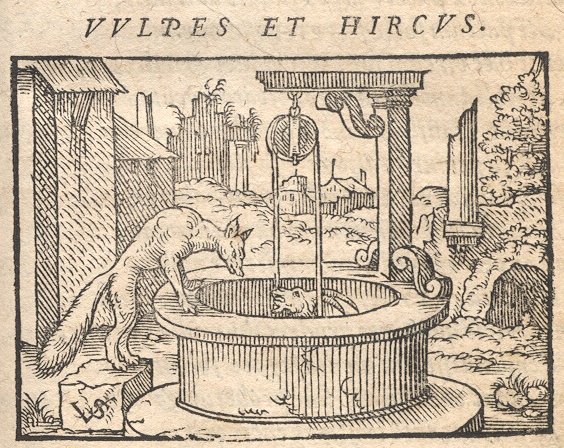
The Fox and the Goat

A crafty knave will make escape,
When once he gets into a scrape,
Still meditating self-defence,
At any other man's expense.

A Fox by some disaster fell
Into a deep and fenced well;
A thirsty Goat came down in haste
And ask'd about the water's taste,
If it was plentiful and sweet?

At which the Fox, in rank deceit,
"So great the solace of the run,
I thought I never should have done.
Be quick, my friend, your sorrows drown."
This said, the silly Goat comes down.

The subtle Fox herself avails
And by his horns the mound she scales,
And leaves the Goat in all the mire
To gratify his heart's desire.

Next: More Foxes


(700 words)


Aesop's Fables: More Foxes

These fables are part of the Aesop's Fables (English) unit. Story source: Story source: Fables of Aesop and Other Eminent Mythologists by Roger L'Estrange (1692).


Aesop's Fables: More Foxes


A Boar and a Fox

As a Boar was whetting his Teeth against a Tree, up comes a Fox to him.

"Pray, what do you mean by That?" says he, "for I see no occasion for't."

"Well," says the Boar, "but I do; for when I come once to be set upon, 'twill be too late for me to be Whetting when I should be Fighting."

No Man, or State can be safe in Peace, that is no always in readiness to encounter an Enemy in Case of War.


A Fox and a Divining Cock

A Fox that had spy'd out a Cock at Roost upon a Tree, and out of his Reach, fell all of a sudden into an Extravagant Fit of Kindness for him; and to Enlarge upon the Wonderful Esteem he had for the Faculties and good Graces of the Bird, but more particularly for his Skill in Divination, and the Foreknowledge of Things to come.

"Oh," says he, "that I were but Worthy the Friendship of so great a Prophet!"

This Flattery brought the Cock down from the Tree into the very Mouth of the Fox, and so away he Trudges with him into the Woods; reflecting still as he went, upon the strange Force that Fair Words have upon vain Fools: "For this Sot of a Cock," says he, "to take himself for a Diviner, and yet not foresee at the same time, that if he fell into my Clutches, I should certainly make a Supper of him."

A Fool that will Swallow Flattery, shall never want a Knave to give it him.


A Fox and a Cock

A Hungry Fox that had got a Cock in his Eye, and could not tell how to come at him; cast himself at his length upon the Ground, and there he lay winking and pinking as if he had Sore Eyes.

"Ah," says he to the Cock, "I have gotten a Thorn here, with Creeping through a hedge t'other Day; 'twould be the greatest Charity in the World, if you would but help me out with it."

"Why truly," says the Cock, "I am no Oculist, and if I should go to Help One Eye, and put Out T'other with my Spur, we should have but an Untoward Business on't; but if you are not in very great Haft, I can fly Home in a Trice, and bring ye One that shall certainly Cure ye."

The Fox finding 'twas all but Banter: "Well," says he, "'tis no Great Matter then; for the more Physicians, the more Danger, they say."

Shuffling and Fencing, is in many Cases both Allowable and Necessary: Especially where Craft is to be Encounter'd with Craft.


A Cock and a Fox

A Fox spy'd a Cock at Roost with his Hens about him.

"Why how, my Friend," says Reynard, "what makes you upon a Tree there? Your Bus'ness lies upon the Terra Firma, and a Cock in the Air is out of his Element, methinks. But you don't hear the News perhaps, and it is certainly true: There's a General Peace concluded among all Living Creatures, and not one of them to presume, upon Pain of Life and Limb, directly or indirectly, to hurt another."

"The Blessedest Tidings in the World," says the Cock; and at the same time he stretches out his Neck, as if he were a looking at somewhat a great way off.

"What are you Peering at?" says the Fox.

"Nothing," says t'other, "but a Couple of Great Dogs younder, that are coming this Way, Open-Mouth, as hard as they can drive."

"Why then," says Reynard, "I fancy I'd e'ev best be Jogging."

"No, no, "says the Cock, "the General Peace will secure you."

"Ay," quoth the Fox, "so it will; but if these Roguy Curs should not have heard of the Proclamation, my Coat may come to be Pink'd yet for all that."

And so away he scamper'd.

In all the Liberties of Sharping and Tricking one upon another, there must still a Regard be had to the Punctilio's of Honour and Justice.


A Fox and a Cat

There was a Question started betwixt a Fox and a Cat which of the Two could make the best Shift in the World if they were put to a Pinch.

"For my own Part," says Reynard, "when the worst comes to the worst, I have a whole Budget of Tricks to come off with at last."

At that very Instant, up comes a Pack of Dogs full cry towards them. The Cat presently takes a Tree, and sees the poor Fox torn to Pieces upon the very Spot.

"Well," says Puss to her self, "one sure Trick, I find, is better than a Hundred slippery ones."

Nature has provided better for us, than we could have done for our selves.

Next: Lions


(800 words)


Aesop's Fables: Lions

Here are some more poems by Sir Brooke Boothby and, as poetry can sometimes be harder to follow than prose, I have provided a brief note for each poem to help make the plot more clear.

[Notes by LKG]

These fables are part of the Aesop's Fables (English) unit. Story source: Fables and Satires by Sir Brooke Boothby (1809).


Aesop's Fables: Lions


In this fable, the lion is able to hold a conversation with the man, but that does not mean the lion is able to do all that a human can. In particular, lions cannot create sculptures!

The Lion and the Man

Lion and Man, on some pretense,
Disputed for preeminence.
In marble wrought, the latter show'd
A man who o'er a lion strode.

"If that be all," the beast replied,
"A lion on a man astride
You soon assuredly would view,
The sculptor's art if lions knew."

Each nation would the rest excel,
If their own tale allow'd to tell.


This story shows the lion as a more crafty and dangerous creature, using a strategy of "divide and conquer" to defeat the bulls.

The Lion and the Bulls

This tale a double moral bears:
'Gainst calumny to shut our ears —
And that on unity of friends,
Their common safety oft depends.

Four Bulls in friendly league agreed
Together they would always feed;
With rage a hungry Lion saw
They were too powerful for his paw,
And sent out mischief-making spies,
Well vers'd in calumnies and lies.

The simple beasts they circumvent,
Sow jealousy and discontent
Till lost affection ends in hate
And by consent they separate.

The Lion now his ends had gain'd,
And easily his prey obtain'd.


While the bulls in the previous fable fell victim to the scheming lion, the goat in this fable proves more wise!

The Lion and the Goats

Prefer a safe and humble lot
To luxuries by danger got.

A Lion, seeing from below
Goats feeding on a craggy brow,
"Come down," he says; "you here will find
Grass of a much superior kind."

"We thank you for your royal care,"
Says one, "but here we better are;
The pasture, if not quite so good,
In safety we can crop our food."


Here the lion poses a danger to his own courtiers because it proves fatal both to tell the truth and to likewise to tell flattering lies! Not surprisingly, it is the fox who manages to find a solution.

The Lion King

Than truth we nought more useful know,
And yet the following tale may show
The danger to be too sincere,
With those all-powerful who are.

A Lion o'er the beasts who reign'd
An equitable conduct feign'd,
And, satisfied with moderate food,
Appear'd to seek the nation's good.

But weary, nature to restrain,
Yet show of justice to maintain,
He with this plot his courtiers snar'd:
That he was sick, the King declar'd,
That sleep and appetite he wanted,
And he believ'd his breath was tainted.

The Bear was ask'd; who, blunt and rough,
Says, "Yes, you stink, Sir, sure enough."
Decided quick poor Bruin's fate is;
Guilty of Laesus Majestatis.

The Ape then swore that to his nose
"'Twas cassia, cinnamon, and rose;"
And by the law was doom'd to swing,
For lies and flattery to the King.

The Fox came next, who from the scrape
Did by this subterfuge escape:
"I with a cold am so unwell,"
He says, "I've neither taste nor smell;
But here's the Fox-hound, who for scent,
As we all know is excellent."

True courtier, he avoids the snare
To place his adversary there.


Finally, in this famous lion fable, you will see a better side of the mighty beast.

The Lion and the Mouse.

The following fable may advise
Never inferiors to despise
Or harm the weak.

                     Some Mice at play,
Where once a slumb'ring Lion lay,
A young one, giddier than the rest,
Leapt on and wak'd the royal beast.
Caught in his paws, she grace implor'd.

Leo forgave her, and restor'd
To liberty. Ere many days
The woodlands as by night he strays,
Caught in a toil, the hills around
Rebellow with his roar.

                                     The sound
Soon draws the grateful Mouse, who said,
"Fear nothing, Sir; I bring you aid,
"For kindness past," and with these words,
She set to work to gnaw the cords
That bound the toil, and persever'd
Till Leo was from durance clear'd.


(500 words)


Aesop's Fables: Another Lion

This fable is part of the Aesop's Fables (English) unit. Story source: Story source: Fables of Aesop and Other Eminent Mythologists by Roger L'Estrange (1692).


A Lion and a Man

Among other good Counsels that an Old Experienced Lion gave to his Whelp, this was One: That he should never Contend with a Man.

"For," says he, "if ever you do, you'll be Worsted."

The Little Lion gave his Father the Hearing, and kept the Advice in his Thought, but it never went near his Heart. When he came to be grown up afterward, and in the Flower of his Strength and Vigour, About and About he Ranges to look for a Man to Grapple with.

In his Ramble he changes to Spy a Yoak of Oxen; so up to 'em he goes presently; "Heark ye Friends," says he, "are you MEN?"

They told him No; but their Master was a Man.

Upon leaving the Oxen, he went to a Horse, that he saw Bridled, and Ty'd to a Tree, and ask'd him the same Question; "No," says the Horse, "I am no Man my Self, but he that Bridled and Saddled me, and ty'd me up here, he's a Man."

He goes after this to one that was Cleaving of Blocks. "D'ye hear," says the Lion, "you seem to be a Man."

"And a Man I am," says the Fellow.

"That's well," quoth the Lion, "and dare you Fight with Me?"

"Yes," says the Man, "I dare Fight with ye. Why I can Tear all these Blocks to Pieces ye see. Put your Feet now into this Gap, where you see an Iron Thing there, and try what you can do."

The Lion presently put his Claws into the Gaping of the Wood, and with one Lusty Pluck, made it give way, and out drops the Wedge, the Wood immediately Closing upon't; and there was the Lion caught by the Toes. The Woodman presently upon this, Raises the Country; and the Lion finding what a Streight he was in, gave one Hearty Twitch, and got his Feet out of the Trap, but left his Claws Behind him.

So away he goes back to his Father, all Lame and Bloody, with this Confession in his Mouth; "Alas, my Dear Father," says he. "This had never been, if I had follow'd your Advice."

Disobedience to Parents is against the Laws of Nature and of Nations, Common Justice, Prudence and Good Manners; and the Vengeance of Heaven, Sooner or Later, Treads upon the Heels on't.


(400 words)


Aesop's Fables: Lions and Asses

Here you have some more of Christopher Smart's rhyming translations of the ancient verse fables of the Roman poet Phaedrus. As poetry can sometimes be a bit harder to follow than prose, I have provided a brief note for each poem to help make the plot more clear.

[Notes by LKG]

These fables are part of the Aesop's Fables (English) unit. Story source: The Fables of Phaedrus, translated by Christopher Smart (1887).


Aesop's Fables: Lions and Asses


This is the famous fable of "the lion's share," and, as you will see, the lion's share is not the largest share . . . it is the whole thing. In other words: it is not sharing at all!

The Heifer, Goat, Sheep, and Lion

A partnership with men in power
We cannot build upon an hour.
This Fable proves the fact too true:

An Heifer, Goat, and harmless Ewe,
Were with the Lion as allies,
To raise in desert woods supplies.

There, when they jointly had the luck
To take a most enormous buck,
The Lion first the parts disposed,
And then his royal will disclosed.

"The first, as Lion hight, I crave;
The next you yield to me, as brave;
The third is my peculiar due,
As being stronger far than you;
The fourth you likewise will renounce,
For him that touches, I shall trounce."

Thus rank unrighteousness and force
Seized all the prey without remorse.


As you can see from the previous fable, the lion did not earn the loyalty and trust of the other animals, so he pays a price for that in his old age as all the animals get their revenge, even the most lowly among them.

The Old Lion

Whoever, to his honor's cost,
His pristine dignity has lost,
Is the fool's jest and coward's scorn,
When once deserted and forlorn.

With years enfeebled and decay'd,
A Lion gasping hard was laid.
Then came, with furious tusk, a boar,
To vindicate his wrongs of yore.

The bull was next in hostile spite,
With goring horn his foe to smite.

At length the ass himself, secure
That now impunity was sure,
His blow too insolently deals,
And kicks his forehead with his heel.

Then thus the Lion, as he died:
"'Twas hard to bear the brave," he cried,
"But to be trampled on by thee
Is Nature's last indignity;
And thou, O despicable thing,
Giv'st death at least a double sting."


Here is another fable about the donkey and the lion and, this time, they are partners . . . well, sort of!

The Ass and the Lion Hunting

A coward, full of pompous speech,
The ignorant may overreach
But is the laughing-stock of those
Who know how far his valor goes.

Once on a time it came to pass,
The Lion hunted with the Ass,
Whom hiding in the thickest shade
He there proposed should lend him aid,
By trumpeting so strange a bray,
That all the beasts he should dismay
And drive them o'er the desert heath
Into the lurking Lion's teeth.

Proud of the task, the long-ear'd loon
Struck up such an outrageous tune
That 'twas a miracle to hear.
The beasts forsake their haunts with fear,
And in the Lion's fangs expired,
Who, being now with slaughter tired,
Call'd out the Ass, whose noise he stops.

The Ass, parading from the copse,
Cried out with most conceited scoff,
"How did my music-piece go off?"

"So well, were not thy courage known,
Their terror had been all my own!"


In this fable, the donkey is not boastful or conceited at all; instead, he is quite wise (which is what "sapient" means, as in the name "homo sapiens").

The Sapient Ass

In all the changes of a state,
The poor are the most fortunate,
Who, save the name of him they call
Their king, can find no odds at all.
The truth of this you now may read:

A fearful old man in a mead,
While leading of his Ass about,
Was startled at the sudden shout
Of enemies approaching nigh.

He then advised the Ass to fly,
"Lest we be taken in the place."

But loth at all to mend his pace,
"Pray, will the conqueror," quoth Jack,
"With double panniers load my back?"

"No," says the man.

                         "If that's the thing,"
Cries he, "I care not who is king."


This fable is about a long-suffering donkey who is in the servants of the priests of Cybele, priests who were famous for their wild dances to the sound of drums and tambourines, musical instruments made out of . . . animal hide.

The Ass and Priests of Cybele

The luckless wretch that's born to woe
Must all his life affliction know,
And, harder still, his cruel fate
Will on his very ashes wait.

Cybele's priests, in quest of bread,
An Ass about the village led,
With things for sale from door to door
Till, work'd and beaten more and more,
At length, when the poor creature died,
They made them drums out of his hide.

Then question'd how it came to pass
They thus could serve their darling Ass,
The answer was, " He thought of peace
In death, and that his toils would cease,
But see his mis'ry knows no bounds:
Still with our blows his back resounds."

Next: Asses


(600 words)


Aesop's Fables: Asses

And here are some more donkey fables in verse, this time by Sir Brooke Boothby, and I have also provided here a brief note for each poem to help make the plot more clear.

[Notes by LKG]

These fables are part of the Aesop's Fables (English) unit. Story source: Fables and Satires by Sir Brooke Boothby (1809).


Aesop's Fables: Asses
The fable of "the donkey in the lion's skin" is one of the most famous of Aesop's fables.

The Ass in the Lion's Skin

Fools may on other fools impose;
The sage their real value knows.

An Ass once found a lion's skin
And, rolling up himself therein,
From every fold that he came nigh
Made flocks and herds and shepherds fly.

Ranging the country round, at last
He meets his master where he past,
Who Long-ears instantly descries
Through his magnificent disguise.

Laying his cudgel on his side,
"Get home thou stupid fool," he cried;
"With others for a Lion pass;
I know thee for an arrant Ass."


In this fable, the donkey and ape think that they are badly off, but have a lesson to learn from the mole.

The Ass, the Ape and the Mole

They who their sorrows most bemoan
May find worse miseries than their own.

An Ass his want of horns bewails;
An Ape that Apes are short of tails;
"What would you say," a Mole replies,
"Were you, like me, depriv'd of eyes?"


In this fable likewise, the donkey learns that his lot in life is not the best, but it certainly could be worse!

The Horse and the Ass

He on the ground who rests his head
Sleeps of no precipice in dread.

An Ass with envying eye surveyed
A Courser in his war-parade,
Curvetting to the trumpet's sound,
With steps that scarcely touch'd the ground.

The squadrons join, the battle burns,
Stript, wounded, lame, the Horse returns.

The Ass then grateful felt that Heav'n
To him a humbler lot had giv'n.


And while the donkey in the previous fable learned modesty and humility, that is a lesson the donkey in this fable has yet to learn.

The Ass Carrying Relics

An Ass some Relics bore along,
Which, worshiped by the stupid throng,
He thought 'twas him they thus respected.

With stately step and ears erected
As pleas'd he star'd about, the guide
Drubb'd with a stick his dusty hide,
Crying, "March, idiot! Don't you see
Thy load they kneel to, not to thee!"

Next: More Asses


(300 words)


Aesop's Fables: More Asses

These fables are part of the Aesop's Fables (English) unit. Story source: Story source: Fables of Aesop and Other Eminent Mythologists by Roger L'Estrange (1692).

Aesop's Fables: More Asses

The Ass's Wish

An Ass was wishing in a hard Winter, for a little warm Weather, and a Mouthful of fresh Grass to knap upon, in Exchange for a heartless Truss of Straw, and a cold Lodging.

In good time, the warm Weather, and the fresh Grass comes on; but so much Toil and Bus'ness along with it, that the Ass grows quickly as sick of the Spring, as he was of the Winter.

His next Longing is for Summer; but what with Harvest-Work, and other Drudgeries of that Season, he is worse now than he was in the Spring and then he fancies he shall never be well 'till Autumn comes.

But there again, what with carrying Apples, Grapes, Fewel, Winter-Provisions, etc. he finds himself in a greater Hurry than ever.

In fine, when he has trod the Circle of the Year in a Course of restless Labour, his last Prayer is for Winter again; and that he may but take up his Rest where he began his Complaint.

The Life of an unsteady Man runs away in a Course of vain Wishes, and unprofitable Repentance: An unsettled Mind can never be at rest. There's no Season without its Bus'ness.


Two Laden Asses

There's an Old Story of Two Asses Travelling upon the Road, the One Laden with Oats, the other with Mony: The Mony-Merchant, I Warrant ye, was so Proud of his Trust, and of his Bell, that he went Juking and Tossing of his Head, and Tabring with his Feet all the way, as if no Ground would hold him. The other Plodding on with his Nose in the Breech of his Leader, as Gravely as One Foot could follow another.

While they were Jogging on thus upon the Way, out comes a Band of Highway-Men from the next Wood, and falls upon the Ass that carried the Treasure. They Beat, Wound and Rifle him, and so leave him, without so much as taking the least Notice of his Fellow.

"Well," says the King's Ass, "and for all this Mischief I may e'en thank my Mony."

"Right," says the other; "and it has been my Happiness that I was not thought worth the Robbing."

Poverty is both Safe and Easie; and Riches a Great Snare to People in many Cases: As it far'd worse here with the State-Ass then the Muletiers.


Next: Wolves


(400 words)


Aesop's Fables: Wolves

These fables in verse come from Christopher Smart's translation of the verse fables of the Roman poet Phaedrus, and I've again provided notes to clarify the plot.

[Notes by LKG]

These fables are part of the Aesop's Fables (English) unit. Story source: The Fables of Phaedrus, translated by Christopher Smart (1887).


Aesop's Fables: Wolves


This fable is about the injustice of the world which, this time, takes the form of a wolf who is unimpressed by a lamb's protestations of innocence.

The Wolf and the Lamb

BY thirst incited, to the brook
The Wolf and Lamb themselves betook.
The Wolf high up the current drank,
The Lamb far lower down the bank.

Then, bent his ravenous maw to cram,
The Wolf took umbrage at the Lamb.
"How dare you trouble all the flood,
And mingle my good drink with mud?"

"Sir," says the Lambkin, sore afraid,
"How should I act, as you upbraid?
The thing you mention cannot be;
The stream descends from you to me."

Abash'd by facts, says he, "I know
'Tis now exact six months ago
You strove my honest fame to blot."

"Six months ago, sir, I was not."

"Then 'twas th' old ram, thy sire," he cried,
And so he tore him till he died.

To those this fable I address
Who are determined to oppress,
And trump up any false pretence,
But they will injure innocence.


In this fable, the crane also encounters the injustice of the wolf, and does so even more recklessly than the lamb!

The Wolf and Crane

Who for his merit seeks a price
From men of violence and vice
Is twice a fool — first so declared
As for the worthless he has cared;
Then after all, his honest aim
Must end in punishment and shame.

A bone the Wolf devoured in haste,
Stuck in his greedy throat so fast
That, tortured with the pain, he roar'd
And ev'ry beast around implored
That who a remedy could find
Should have a premium to his mind.

A Crane was wrought upon to trust
His oath at length — and down she thrust
Her neck into his throat impure
And so perform'd a desp'rate cure.

At which, when she desired her fee,
"You base, ungrateful minx," says he,
"Whom I, so kind, forbore to kill,
And now, forsooth, you'd bring your bill!"


In this fable, the sheep is more discerning than either the lamb or the crane!

The Sheep, the Stag, and the Wolf

When one rogue would another get
For surety in a case of debt,
'Tis not the thing t' accept the terms,
But dread th' event, the tale affirms.

A Stag approached the Sheep to treat
For one good bushel of her wheat.
"The honest Wolf will give his bond."

At which, beginning to despond,
"The Wolf" (cries she) "'s a vagrant bite,
And you are quickly out of sight;
Where shall I find or him or you
Upon the day the debt is due?"


The sheep in this fable, unfortunately, is not able to win the justice she deserves when falsely accused by a dog and a wolf, although the gods intervene to provide a kind of justice in the end.

The Sheep, the Dog, and the Wolf

Liars are liable to rue
The mischief they 're so prone to do.

The Sheep a Dog unjustly dunn'd
One loaf directly to refund,
Which he the Dog to the said Sheep
Had given in confidence to keep.

The Wolf was summoned, and he swore
It was not one, but ten or more.

The Sheep was therefore cast at law
To pay for things she never saw.

But, lo! ere many days ensued,
Dead in a ditch the Wolf she view'd;
"This, this," she cried, "is Heaven's decree
Of justice on a wretch like thee."


The wolf is a very different kind of symbol in this fable: he no longer represents brute and selfish injustice but instead . . . freedom! The wolf here gets the name "Isengrim" (or "Isgrim") which is the name he has in the Latin and French tradition, just as you earlier saw "Renard" as the name for the fox. You can read more about Latin Ysengrimus at Wikipedia.

The Dog and the Wolf

I will, as briefly as I may,
The sweets of liberty display.

A Wolf half famish'd, chanced to see
A Dog, as fat as dog could be.
For one day, meeting on the road,
They mutual compliments bestowed.

" Prithee," says Isgrim, faint and weak,
"How came you so well fed and sleek?
I starve, though stronger of the two."

"It will be just as well with you,"
The Dog quite cool and frank replied,
"If with my master you'll abide."

"For what?"

                         "Why merely to attend,
And from night thieves the door defend."

"I gladly will accept the post.
What! Shall I bear with snow and frost
And all this rough inclement plight,
Rather than have a home at night,
And feed on plenty at my ease?"

"Come, then, with me" — the Wolf agrees.
But as they went, the mark he found
Where the Dog's collar had been bound.

"What's this, my friend?"
                         "Why, nothing."
                                                  "Nay,
Be more explicit, sir, I pray."

"I'm somewhat fierce and apt to bite;
Therefore they hold me pretty tight
That in the day-time I may sleep
And night by night my vigils keep.
At eveningtide they let me out,
And then I freely walk about.
Bread comes without a care of mine;
I from my master's table dine;
The servants throw me many a scrap,
With choice of pot-liquor to lap,
So, I've my bellyful, you find."

"But can you go where you've a mind?"

"Not always, to be flat and plain."

"Then, Dog, enjoy your post again,
For to remain this servile thing,
Old Isgrim would not be a king."


(700 words)