Showing posts with label SummerDone. Show all posts

Roman Mosaic: The goddess Thetis

As you might know, the Greek hero Achilles had a divine mother: Thetis, the sea goddess. The mosaic below shows Thetis (with her name spelled out in Greek), along with fishes and other sea creatures. This is a mosaic from a Roman bath house in Armenia, dating to around the year 300 C.E. You can read more about the floor mosaic at this website: Armenian Heritage - Garni. Roman Baths.

At Wikipedia, you can read more about Thetis and about Achilles, and their story is told in the Iliad unit here at the UnTextbook.


Wikpedia Trail: From Thalaba the Destroyer to the Goldilocks Planet

I decided to do a Wikipedia Trail, starting with this book: Stories of the Magicians Alfred J. Church. The first part of that book is about "The Story of Thalaba," so I decided to start there with the Wikipedia article about Thalaba:


Thalaba the Destroyer
This is an epic poem written by Robert Southey published in 1801; the main character is named Thalaba and he is engaged in a war with sorcerers (the Wikipedia article has a detailed plot summary). The story is a mix of Islamic motifs (it even includes the Simurgh!) but it is set in a fantasy version of ancient Babylon. I don't know anything about Robert Southey, so I decided to look him up next.

Robert Southey
Southey was a Romantic poet, and Poet Laureate of England from 1813 to 1843. Some people consider the Thalaba poem to be his masterpiece, and he also wrote histories as well as poetry. And imagine my surprise: he was the first person to publish the story of The Three Bears. So of course I have to look that up next!


Goldilocks and the Three Bears
This story started out as being about three bachelor bears and an old woman who enters their house, but the old woman eventually turned into "Goldilocks" and the bears turned into a Papa Bear, Mama Bear, and Baby Bear. Robert Southey's version, published in 1837, has the three bachelor bears (one big, one small, and one in-between), and the old woman. A version with a little girl appeared in 1849, but "Goldilocks" belongs to the early 20th century.


Goldilocks Principle.
And from that article, I found out that there is even a Goldilocks Principle: "in a given sample, there may be entities belonging to extremes, but there will always be an entity belonging to the average." So, it's not really about Goldilocks, but about those three bears: two extreme and one in the middle. The article gives examples from economics, psychology, medicine, and even astrobiology: "The Rare Earth Hypothesis uses the Goldilocks principle in the argument that a planet must neither be too far away from, nor too close to a star and galactic center to support life, while either extreme would result in a planet incapable of supporting life." Such a planet is called a Goldilocks Planet... which is where I will end my Wikipedia Trail for today!


Wikipedia Trail: From the Seven Sleepers to an Irish Love Goddess

I like doing Wikipedia Trails too! This one starts with one of my favorite folktales: Seven Sleepers of Ephesus:

Seven Sleepers:
This is a story about faithful men who were sealed up in a cave by an emperor who persecuted their faith. They didn't die; instead, they slept for 200 years, awakening during the rule of an emperor who shared their faith... but they had no idea at first that they had been asleep that long, kind of like Rip van Winkle. The story is popular in both the Christian and Muslim traditions.


King in the mountain.
The Seven Sleepers article linked that story to the motif of the "king in the mountain" which is a common type of folktale in which a king or hero sleeps inside a mountain, waiting to return and rescue his nation in a time of danger. There is a HUGE list of the kings and heroes who appear in this type of legend; I know this story is told about King Arthur (in fact, it's in the UnTextbook: Arthur in the Cave), but there were so many other kings and heroes here. I'm having a hard time deciding which one to click on and follow.

Gerald FitzGerald, 3rd Earl of Desmond
Of the many heroes, I chose this one: Gerald FitzGerald was an Irish earl who lived in the 14th century, and some of his poetry has survived (he wrote poetry when he was imprisoned as a result of a violent struggle with a rival, Brian O'Brian), but he is more famous for the legends told about him. He supposedly had an affair with the goddess Aine, and when he disappeared in the year 1398, a legend told that he was sleeping in a cave near (or under) the lake of Lough Gur in County Limerick, Ireland, and that someday he will ride forth again on a silver-shod horse; in some legends, he appears on the banks of the lake every seven years.

(Lough Gur, where Gerald is sleeping)


Áine.
She is an Irish goddess of summer and of prosperity; she is also a love goddess and is considered to be "Queen of the Fairies" in County Limerick. In some versions of her encounter with Gerald, he raped her and, to punish him, she turned him into a goose or, in some versions, she killed him. Knockainy Hill in County Limerick is named after her: Knock-Ainy, The Hill of Aine:


That last bit really intrigued me, so I found an article online with more legends about Aine and Gerald: there are a lot of different stories about them. Very cool: Aine, Summer Goddess of Love, Light and Fertility by Judith Shaw (an article not at Wikipedia; it's at the Feminism and Religion blog).

Real Relationships with Imaginary Characters

This is a TEDx video from OU with an OU faculty member: Jennifer Barnes. It was featured on the TEDx Innovations page... and since you are spending a lot of time with imaginary characters in this class, I think you might really enjoy what she says about our emotional investment in fictional worlds.


The Brave Tamatori

From one of my favorite Twitter feeds, Bibliophilia, comes this gorgeous picture: the brave Tamatori attacked by the octopus by the artist Utagawa Kuniyoshi (1798 - 1861), and you can read about Princess Tamatori in the Japanese Mythology unit.


Roma Story: Death the Sweetheart

I just added a new book to the Freebookapalooza blog, Gypsy Folk Tales by Francis Hindes Groome, and I wanted to share this marvelous story from that collection. Meanwhile, you can read more about the Romani people at Wikipedia.

For more examples of this type of story, see the entry for Death Takes a Holiday at TVTropes.


Gypsy with a Mandolin


Death the Sweetheart

There was once a pretty young girl with no husband, no father, no mother, no brothers, no kinsfolk; they were all dead and gone. She lived alone in a hut at the end of the village, and no one came near her, and she never went near any one.

One evening a goodly wanderer came to her, opened the door, and cried, "I am a wanderer and have been far in the world. Here will I rest; I can no further go."

The maiden said, "Stay here; I will give thee a mattress to sleep on and, if thou wilt, victuals and drink too."

The goodly wanderer soon lay down and said, "Now once again I sleep; it is long since I slept last."

"How long?" asked the girl.

And he answered, "Dear maid, I sleep but one week in a thousand years."

The girl laughed and said, "Thou jestest, surely? Thou art a roguish fellow." But the wanderer was sound asleep.

Early next morning he arose and said, "Thou art a pretty young girl. If thou wilt, I will tarry here a whole week longer." She gladly agreed, for already she loved the goodly wanderer.

So once they were sleeping, and she roused him and said, "Dear man, I dreamt such an evil dream. I dreamt thou hadst grown cold and white, and we drove in a beautiful carriage, drawn by six white birds. Thou didst blow on a mighty horn; then dead folk came up and went with us —thou wert their king."

Then answered the goodly wanderer, " That was an evil dream." Straightway he arose and said, "Beloved, I must go, for not a soul has died this long while in all the world. I must off, let me go."

But the girl wept and said, "Go not away; bide with me."

"I must go," he answered. "God keep thee."

But, as he reached her his hand, she said sobbing, "Tell me, dear man, who thou art then."

"Who knows that dies," said the wanderer. "Thou askest vainly; I tell thee not who I am."

Then the girl wept and said, "I will suffer everything, only do tell me who thou art."

"Good," said the man," "then thou comest with me. I am Death."

The girl shuddered and died.


Game of Thrones: Seats of Power

I found this delightful graphic thanks to C. B. Watson in OU's Classics Department, who is TheRealDrWatson at Twitter. Game of Thrones is definitely a great frame of reference for pondering mythological themes!

The source is Lapham's Quarterly; click the image for a larger view, and you can see the text below:


You can also click on this image for a larger view:


Curule Chair
Used by: Consuls of the Roman Senate, Julius Caesar, Augustus 
Features: Folding stool, typically made of ivory, armless, curved legs; named after chariot (currus) used to drive magistrates to place of judgment

Stone of Scone
Used by: Every English monarch (except Mary I) at coronation
Features: 336 pounds of yellow sandstone, rectangular shape, Latin cross, iron rings for transport; stolen in 1950 by Scottish nationalists and never returned

Global Concorde Presidential Office Chair
Used by: George W. Bush, Barack Obama
Features: Push-button controls, ergonomic adjustment, available in range of colors, height and depth adjustment, tilt-tension control (with 3-year warranty) 

Ivory Throne
Used by: Queen Victoria
Features: Ivory carvings of plants and animals, green velvet cushions sewn with gold and silver threads, matching footstool

Gunlocke Executive Chair
Used by: John F. Kennedy, Gerald Ford 
Features: Ergonomic (designed for JFK’s back pain), black leather upholstery, padded arms, spring suspension, brass-capped cherry wood base, 2-inch rubber wheels (with 12-year warranty)

Popemobile
Used by: Pope Benedict XVI
Features: Mercedes-Benz M-Class SUV with bulletproof glass room, hydraulic lift, armored side panels, Vatican coat of arms, personalized license plates

Oz Books: Free to Read, plus Free Audiobooks

This post from Open Culture provides links to free online versions of all the Oz books, plus free audiobook versions. Visit the Open Culture post for all those links: The Complete Wizard of Oz Series, Available as Free eBooks and Free Audio Books.

Meanwhile, I've listed below the titles in the Oz series, linking each one to its Wikipedia article. If you only know the old Wizard of Oz movie from 1939, you are in for a treat with these books:

The Wonderful Wizard of Oz (1)
The Marvelous Land of Oz (2)
Ozma of Oz (3)
Dorothy and the Wizard of Oz (4)
The Road to Oz (5)
The Emerald City of Oz (6)
The Patchwork Girl of Oz (7)
Tik Tok of Oz (8)
The Scarecrow of Oz (9)
Rinkitink in Oz (10)
The Lost Princess of Oz (11)
The Tin Woodman of Oz (12)
The Magic of Oz (13)
Glinda of Oz (14)


Some Aesop's Fables

I was asked by John Lubans to provide some English versions of a few Aesop's fables for a book he is writing (I'll link to his book when it's done), paraphrasing the traditional Latin and Greek versions. Here they are:

The Dog and the Crocodiles
An ancient legend says that dogs who drank from the Nile had to do so on the run in order to escape the crocodiles. One day, a crocodile tried to trick a dog as he ran along the water's edge, taking little sips. "My dear dog," the crocodile said, "drink as much as you want; no need to hurry, no need to be afraid." The dog replied, "You can't fool me, crocodile! I might be tempted to stop and drink my fill, but I know you are waiting to gobble me up." Lesson learned: Don't waste your time with someone who is wise to you and your tricks; you'll be the one who ends up a fool.
(For a more literal translation, see Oxford Aesop 102.)

Canis et Crocodilus
(Illustration by Griset.)


The Bees and the Beetles 
The bees decided one day to invited the dung beetles to their home for a meal. The beetles agreed, and when they arrived, the bees offered them honey in the honeycomb to eat. The beetles only nibbled at the honeycomb, and then they flew away. To return the favor, the beetles invited the bees to dinner, and they heaped the table with platters of dung. The bees could not even eat so much as a bite, so they buzzed away back home. The dung beetles knew only carnal pleasures; the sweetness of the bees was beyond their comprehension.
(For a more literal translation, see Oxford Aesop 401.)


The Flying Beetle
There was once a beetle who lived in a dung heap. One day when he had eaten his fill, he crawled out from under the dung, looked up, and saw an eagle soaring high in the air, flying swiftly by. This made the beetle feel disgusted with himself and his way of life, so he said to the other beetles, "Do you see that eagle? He flies so quickly and he is so strong, with a sharp beak and deadly talons. He can rise up to the clouds or come racing back down to earth as he pleases. We beetles are so pathetic by comparison: we fly, but we're not birds, and we're not like the other bugs either. Yet when I raise my voice, it resounds like the eagle's cry, and I shine as brightly as the eagle does. No more dung heap for me! I am going to join the company of birds and fly together with them wherever they go, an equal in their ranks!" The beetle then flew upwards, letting forth a mighty cry that was actually just a nasty buzzing sound. He pursued the eagle high above the clouds, but the strong winds were too much for him, and he came crashing back to the ground, weak and shaken, far from the dung heap that was his home. Unable to find anything to eat, the little beetle lamented, "They can call me a bird or a bug, I don't care, just so long as I find my way back home to my dung heap!" Arrogance leads to disaster. If you pretend to be someone you are not, no one will respect you, and you will end up worse off than you were to begin with.
(For a more literal translation, see Oxford Aesop 332.)


Aesop and the Bow 
There was an Athenian who saw Aesop shooting marbles with some boys in the street. He burst out laughing, thinking how foolish Aesop looked, an old man playing marbles — but Aesop makes fun of you; you don't make fun of Aesop. So when Aesop heard the Athenian laughing, he said nothing in reply but simply took an unstrung bow and put it down on the ground where the man could see it. Then he said, "Hey, Mr. Know-It-All, riddle me this: what does this bow mean?" Aesop's words got the people's attention, and a crowd gathered round. The Athenian was baffled; he thought and he thought, but he could not figure out the riddle, and finally he gave up. Having defeated the man in this battle of wits, Aesop then revealed the meaning of the bow. "If you have your bow tightly strung at all times, it will break. You need to let it rest sometimes so that it will be ready whenever you need it." The human mind is like that bow: it needs to relax every once in a while.
(For a more literal translation, see Oxford Aesop 537.)

(Illustration from Croxall's Aesop.)


The Dog and the Reeds
Beware the company you keep. There was once a dog who liked to poop in the reeds by the river. The reeds didn't like this at all, so one of them poked the dog in the butt. The dog jumped back and began to bark at the reeds, but the reed replied, "Bark all you want! I'd rather listen to you complain at a distance than have to smell your dirty business nearby."
(For a more literal translation, see Oxford Aesop 566.)


The Dog-Catcher and the Dog
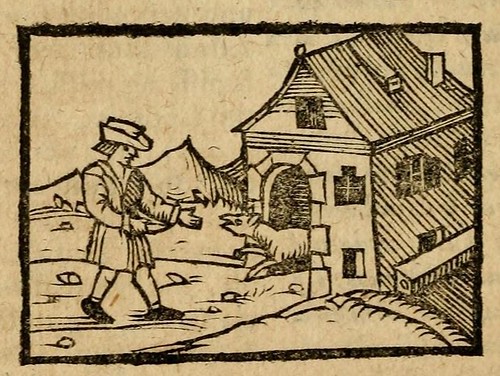
There was a man who wanted to catch a dog, so he threw the dog some food, and then some more food, but the dog wouldn't budge. "I'm not coming anywhere near you," the dog explained. "Your excessive generosity warns me to be on my guard." If someone gives you extravagant gifts, they are probably trying to trick you.
(For a more literal translation, see Oxford Aesop 88.)

Fur et Canis


The Dog and the Lion
There was once a dog who was chasing a lion as fast as he could, but then the lion turned around and roared at the dog. That changed the dog's mind, and he ran off with his tail between his legs. The fox saw what had happened and said to the dog, "You silly creature! You were chasing after someone whose voice was enough to terrify you." Don't try to challenge someone more powerful than you are: you will fail in your pursuit, and you will be made fun as well.
(For a more literal translation, see Oxford Aesop 228.)


The Cowardly Lion
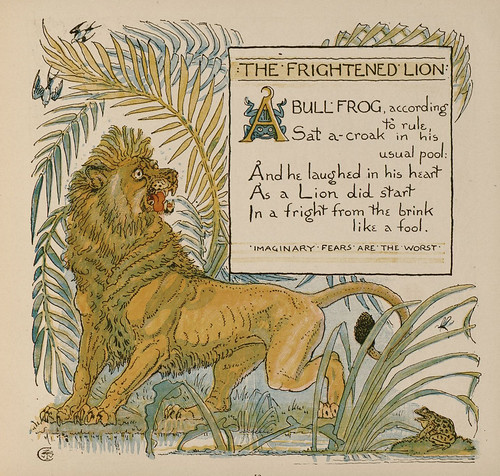
The lion had come to the river to take a drink when he heard a strange, rumbling sound. He looked around, but he could see no one. He stood there, listening, and then he heard the rumbling sound again, and he trembled with fear. At last he saw a bullfrog emerging from the river's waters. He realized it had been the frog making that sound all along, and so he crushed the frog beneath his paws. This fable is for someone who talks big but does nothing.
(For a translation from a classical source, see Oxford Aesop 270.)

Leo et Rana
(Illustration by Walter Crane.)


The Horse and the Goats
Sometimes you can see underlings who gossip about their boss; that is what this fable is about. There was once a horse who was being chased by a lion. Some goats saw the horse come running around the corner, and they made fun of him as he raced by, whereupon the horse replied, "You foolish creatures! You don't even realize who is chasing me. If you did, you would be even more scared than I am!" Higher-ups are often mocked by their ignorant inferiors.
(For a more literal translation, see Oxford Aesop 234.)


The Jar Who Went to Court
There was a woman from the ancient Greek city of Sybaris who broke a jar. The jar decided to take the woman to court, summoning witnesses to testify against her. The woman exclaimed, "What a foolish jar you are! You don't need a judge and jury; you need a plaster bandage to hold yourself together!"
(For a more literal translation, see Oxford Aesop 180.)


Jupiter and the Two Sacks
Jupiter, the ruler of gods and men, gives each person two sacks to carry. The first sack contains all your faults, and you wear that on your back. The second sack contains other people's faults, and that is the one that dangles in front of you, hanging around your neck. As a result, you find it easy to see other people's faults, but you cannot see your own.
(For a more literal translation, see Oxford Aesop 527.)


The Sow and the Wolf
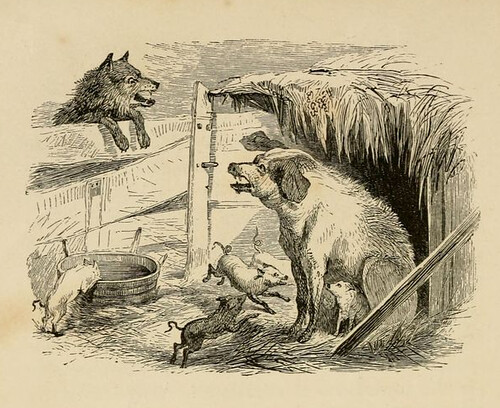
A sow, about to give birth to her piglets, was lying on the ground, groaning. A wolf ran up and offered to be her midwife. The sow realized that the wolf was only trying to trick her, so she said in reply, "The best way to help me is to keep your distance." If the sow had trusted that wolf, things would have been twice as bad: in addition to the pains of giving birth, she would have felt the pain of her own death.
(For a more literal translation, see Oxford Aesop 311.)

Picture 13
(Illustration by Herrick.)


The Athenian
If a man in ancient Athens claimed to be a philosopher, he had to pass a test: the Athenians would whip the man violently, and if he endured the whipping in silence, then they would declare him to be a true philosopher. There was once a man who presented himself for the test. The people whipped him, and as soon as the whipping stopped, but before judgment was passed, the man exclaimed, "I am exceedingly worthy of being called a philosopher!" One of the Athenians then shook his head and said, "That might have been the case, if only you had kept your mouth shut and waited for our judgment."
(For a more literal translation, see Jacobs Odo 104.)


The Weeping Man and the Birds
You need to beware of hypocritical politicians, as this fable shows. There was a man who used bird lime for catching birds, and the bird lime made his eyes water. As he was killing the birds he had caught, one of the birds remarked, "Look at that man! He is so good and pious." Another bird asked, "How can you tell?" And the first bird said, "Don't you see his tears? He is weeping with pity." A third bird chimed in, "And don't you see his wicked actions? A curse upon that man and his tears: he is weeping while he slaughters us." So it is with the mighty men who go to church and pray and give money, weeping piously all the while. Yet they exploit and slaughter the poor and those less fortunate than themselves. The prayers and tears of men like that are an abomination.
(For a more literal translation, see Jacobs Odo 15; see also Oxford Aesop 297.)


The Goat and the Ass
This fable exposes those who have no respect for their superiors. There was once a goat who was the servant of an ass. The goat saw that the ass was simple-minded and unassuming, so he he decided to climb up on the ass and take a ride. The ass got angry and made himself fall over backwards, crushing the goat and killing him. The ass then got up off the ground and said, "Just because your boss is an ass, don't assume you can ride him." The same is true if you work for someone who is foolish or slow or old: be careful not to mock them, or else you might end up like the goat.
(For a more literal translation, see Jacobs Odo 107.)


The Two Monks
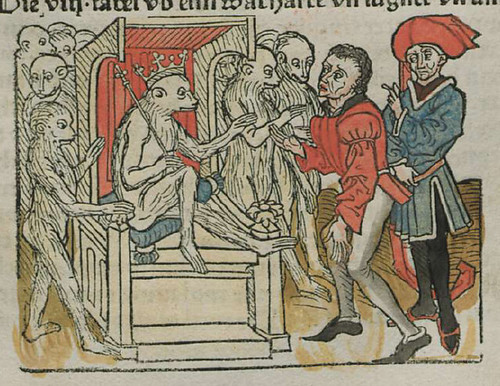
There were two monks who were on a journey, and along the way they came to a monastery. One of the monks, an inveterate liar, exclaimed, "Let's make a bet! By telling lies, I will be able to make more profit here than you and your truth-telling." The other monk, who always told the truth, agreed to the wager. They then went into the monastery, only to find that it was full of apes. The liar saluted the community of apes, and the abbot of the apes inquired, "What do you think of me and my brethren?" The liar replied, "I have never seen a religious community so fair as this one. As I gaze upon you, I realize that men are not superior to apes, but the other way around: you apes are the ideal to which we should aspire." And so he continued to praise the apes, and the apes, greatly pleased, gave him gold and silver and other precious gifts. Then the abbot of the apes asked the other man, "What do you think of me and my brethren?" The monk replied truthfully, saying, "I have never seen a congregation that looked so ridiculous or smelled so bad." The apes grew angry and attacked the man, beating him so badly that he barely escaped with his life. Telling the truth can be a risky business.
(For a more literal translation, see Jacobs Odo 41; see also Oxford Aesop 108.)

homo fallax et verax
(Steinhowel, not set in a monastery like Aesop)


I put these translations into the public domain:
CC0. I free my work of copyright restrictions.


References:
Aesop's Fables. A new translation by Laura Gibbs. Oxford University Press, 2002.
The Fables of Odo of Cheriton, translated by John Jacobs. Syracuse University Press, 1984.