Showing posts sorted by relevance for query wolf. Sort by date Show all posts

Aesop's Fables: Wolves

The wolf is a dangerous character; in many ways, more dangerous than the lion. He shares the lion's tyrannical nature as you can see in The Wolf and the Lamb. The wolf has no sense of injustice, yet the point of these stories is not so much that the wolf is unjust but rather that it is foolish to expect otherwise from a wolf, as in the fable of The Wolf and the Crane.

The wolf has some positive qualities, too, though. Like the fox, the wolf can denounce hypocrisy when he sees it, even though the wolf himself can also be a hypocrite, wrapped up in sheep's clothing.

In the fable of The Dog and the Wolf, you can see how the wolf is a symbol of freedom and liberty as opposed to the enslavement of the domesticated dog.

Finally, the wolf can play the role of a fool as well, such as when he takes the nurse at her word.

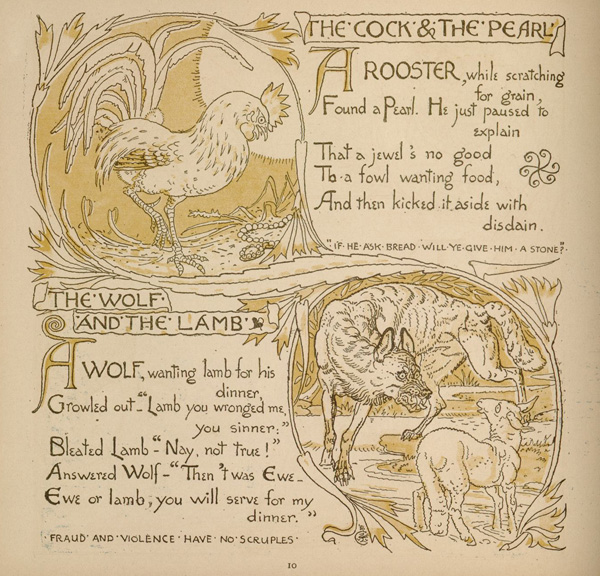
Note the two-fable illustrations here; you will get the fable of The Cock and the Pearl and the fable of The Fisherman and the Fish later.

[Notes by LKG]

These fables are part of the Aesop's Fables (Jacobs) unit. Story sources: The prose fables are from The Fables of Aesop by Joseph Jacobs (1894) and the limericks and illustrations are from The Baby's Own Aesop by W. J. Linton and illustrated by Walter Crane (1887).


Wolves


Jacobs 2. The Wolf and the Lamb (Perry 155)

Once upon a time a Wolf was lapping at a spring on a hillside, when, looking up, what should he see but a Lamb just beginning to drink a little lower down. "There's my supper," thought he, "if only I can find some excuse to seize it."

Then he called out to the Lamb, "How dare you muddle the water from which I am drinking?"

"Nay, master, nay," said Lambikin; "if the water be muddy up there, I cannot be the cause of it, for it runs down from you to me."

"Well, then," said the Wolf, "why did you call me bad names this time last year?"

"That cannot be," said the Lamb; "I am only six months old."

"I don't care," snarled the Wolf; "if it was not you it was your father." And with that he rushed upon the poor little Lamb and . . . WARRA WARRA WARRA WARRA WARRA . . . ate her all up.

But before she died she gasped out: "Any excuse will serve a tyrant."

Crane 3. The Wolf and The Lamb (Perry 155)

A Wolf, wanting lamb for his dinner,
Growled out, "Lamb, you wronged me, you sinner."
Bleated Lamb - "Nay, not true!"
Answered Wolf - "Then 't was Ewe -
Ewe or lamb, you will serve for my dinner."

FRAUD AND VIOLENCE HAVE NO SCRUPLES


~ ~ ~

Jacobs 5. The Wolf and the Crane (Perry 156)

A Wolf had been gorging on an animal he had killed, when suddenly a small bone in the meat stuck in his throat and he could not swallow it. He soon felt terrible pain in his throat, and ran up and down groaning and groaning and seeking for something to relieve the pain. He tried to induce every one he met to remove the bone. "I would give anything," said he, "if you would take it out."

At last the Crane agreed to try and told the Wolf to lie on his side and open his jaws as wide as he could. Then the Crane put its long neck down the Wolf's throat, and with its beak loosened the bone, till at last it got it out.

"Will you kindly give me the reward you promised?" said the Crane.

The Wolf grinned and showed his teeth and said: "Be content. You have put your head inside a Wolf's mouth and taken it out again in safety; that ought to be reward enough for you."

Crane 62. The Ungrateful Wolf (Perry 156)

To the Wolf, from whose throat the Crane
Drew the bone, his long bill made it plain
He expected his fee:
Snarled Wolf — "Fiddle de dee,
Be thankful your head's out again."

SOME CHARACTERS HAVE NO SENSE OF OBLIGATION


~ ~ ~

Jacobs 16. The Wolf and the Kid (Perry 98)

A Kid was perched up on the top of a house, and looking down saw a Wolf passing under him. Immediately he began to revile and attack his enemy. "Murderer and thief," he cried, "what do you here near honest folks' houses? How dare you make an appearance where your vile deeds are known?"

"Curse away, my young friend," said the Wolf: "It is easy to be brave from a safe distance."

~ ~ ~

Jacobs 28. The Dog and the Wolf (Perry 346)

A gaunt Wolf was almost dead with hunger when he happened to meet a House-dog who was passing by.

"Ah, Cousin," said the Dog, "I knew how it would be; your irregular life will soon be the ruin of you. Why do you not work steadily as I do, and get your food regularly given to you?"

"I would have no objection," said the Wolf, "if I could only get a place."

"I will easily arrange that for you," said the Dog; "come with me to my master and you shall share my work."

So the Wolf and the Dog went towards the town together. On the way there the Wolf noticed that the hair on a certain part of the Dog's neck was very much worn away, so he asked him how that had come about.

"Oh, it is nothing," said the Dog. "That is only the place where the collar is put on at night to keep me chained up; it chafes a bit, but one soon gets used to it."

"Is that all?" said the Wolf. "Then good-bye to you, Master Dog."

Better starve free than be a fat slave.

~ ~ ~

Jacobs 39. The Wolf in Sheep's Clothing (Perry 451)

A Wolf found great difficulty in getting at the sheep owing to the vigilance of the shepherd and his dogs. But one day it found the skin of a sheep that had been flayed and thrown aside, so it put it on over its own pelt and strolled down among the sheep.

The Lamb that belonged to the sheep, whose skin the Wolf was wearing, began to follow the Wolf in the Sheep's clothing; so, leading the Lamb a little apart, he soon made a meal off her, and for some time he succeeded in deceiving the sheep, and enjoying hearty meals.

Appearances are deceptive.

~ ~ ~

Jacobs 46. Nurse and the Wolf (Perry 158)

"Be quiet now," said an old Nurse to a child sitting on her lap. "If you make that noise again I will throw you to the Wolf."

Now it chanced that a Wolf was passing close under the window as this was said. So he crouched down by the side of the house and waited. "I am in good luck to-day," thought he. "It is sure to cry soon, and a daintier morsel I haven't had for many a long day."

So he waited, and he waited, and he waited, till at last the child began to cry, and the Wolf came forward before the window, and looked up to the Nurse, wagging his tail. But all the Nurse did was to shut down the window and call for help, and the dogs of the house came rushing out.

"Ah," said the Wolf as he galloped away: "enemies promises were made to be broken."


Next page: Dogs and Cats


(900 words)

More Brer Rabbit: How Mr. Rabbit Saved His Meat

The trick that Brer Rabbit uses to fool Brer Wolf at the end of this story is one of my favorites!

[Notes by LKG]

This story is part of the More Brer Rabbit unit. Story source: Uncle Remus: His Songs and His Sayings by Joel Chandler Harris (1881).

How Mr. Rabbit Saved His Meat

One time Brer Wolf was coming long home from a fishing frolic. He saunter long the road, he did, with his string of fish across his shoulder, when first news you know old Miss Partridge, she hop out of the bushes and flutter long right at Brer Wolf nose.


Brer Wolf he say to hisself that old Miss Partridge trying for to toll him away from her nest, and with that he lay his fish down and put out into the bushes where old Miss Partridge come from, and about that time Brer Rabbit, he happen long.

There was the fishes, and there was Brer Rabbit, and when that the case what you expect a sort of impertinent man like Brer Rabbit gonna do? I can tell you this, that them fishes ain't stay where Brer Wolf put 'em at, and when Brer Wolf come back they was gone.


Brer Wolf, he sat down and scratch his head, he did, and study and study, and then it sort of rush into his mind that Brer Rabbit been along there, and then Brer Wolf, he put out for Brer Rabbit house, and when he get there he hail him.

Brer Rabbit, he don't know nothing at all about no fishes.

Brer Wolf he up and say he pleased to believe Brer Rabbit got them fishes.

Brer Rabbit deny it up and down, but Brer Wolf stand to it that Brer Rabbit got them fishes. Brer Rabbit, he say that if Brer Wolf believe he got the fishes, then he give Brer Wolf leave for to kill the best cow he got.

Brer Wolf, he took Brer Rabbit at his word, and go off to the pasture and drive up the cattle and kill Brer Rabbit best cow.

Brer Rabbit, he hate mighty bad for to lose his cow, but he lay his plans, and he tell his chilluns that he going to have that beef yet.


Brer Wolf, he been took up by the patter-rollers before now, and he mighty scared of 'em, and first news you know, here come Brer Rabbit hollering and telling Brer Wolf that the patter-rollers coming. "You run and hide, Brer Wolf," says Brer Rabbit, says he, "and I'll stay here and take care of the cow till you gets back," says he.

Soon's Brer Wolf hear talk of the patter-rollers, he scramble off into the underbrush like he been shot out of a gun.


And he weren't more than gone before Brer Rabbit, he whirl in and skinned the cow and salt the hide down, and then he took and cut up the carcass and stow it away in the smoke-house, and then he took and stick the end of the cow-tail in the ground.

After he gone and done all this, then Brer Rabbit he squall out for Brer Wolf, "Run here, Brer Wolf! Run here! Your cow going in the ground! Run here!"


When old Brer Wolf got there, which he come a-scooting, there was Brer Rabbit holding onto the cow-tail, for to keep it from going in the ground. Brer Wolf, he catch hold, and they give a pull or two, and up come the tail.


Then Brer Rabbit, he wink his off eye and say, says he, "There! The tail done pull out and the cow gone," says he.

But Brer Wolf he weren't the man for to give it up that away, and he got him a spade, and a pick-axe, and a shovel, and he dig and dig for that cow till digging was past all endurance, and old Brer Rabbit he sat up there in his front porch and smoke his cigar.

Every time old Brer Wolf stuck the pick-axe in the clay, Brer Rabbit, he giggle to his chilluns, "He diggy, diggy, diggy, but no meat there! He diggy, diggy, diggy, but no meat there!"


'Cause all the time the cow was laying pile up in his smoke-house, and him and his chilluns was eating fried beef and onions every time they mouth water.


(700 words)


Pacific NW: Coyote in the Buffalo Country

This story is part of the Pacific Northwest unit. Story source: Myths and Legends of the Pacific Northwest, especially of Washington and Oregon, by Katharine Berry Judson (1910).


Coyote in the Buffalo Country
Flathead

COYOTE took to the trail again. After a while he had nothing to eat. He was nearly starved. He went into a tepee at noon and lay down to rest. He was very weak because he had had nothing to eat. This happened in the Jocko Valley.

Coyote heard someone halloo, but he could not see any one. Then someone called again. After he had looked carefully for some time, Coyote saw Eagle a long ways off. Eagle said that far away there was a country where there were buffalo all the time. Eagle said, "I am going there, but you cannot. You are too poor."

Then Coyote was angry. Coyote said, "I can go anywhere. I am going there." Coyote started out and in fifteen days he reached the place. It was near Great Falls. There was a big camp there and the chief's name was Bear. The people did not like Bear. When buffalo were killed, Bear would take  the best pieces for himself— all the good meat and the chunks of fat.

Coyote wanted to be chief himself. So he killed a big buffalo and stripped off all the fat. Then he cut the meat in strips and hung it up to dry. After that he built a big fire and heated some stones red hot.

Bear heard that Coyote had killed a buffalo, so he came to look at the meat. Bear said, "This is nice meat. I will take it."

Coyote said, "I saved some fat for you." Then Coyote took a red hot stone, wrapped it in fat, and put it in Bear's mouth. Thus Coyote killed Bear. Then the people made Coyote chief.

Now Bear was a great medicine man. Whatever he wished came true. There were many buffalo at Great Falls because Bear had wished it. After Coyote became chief all the buffalo went away. Then the people said, "Coyote is a bad chief."

Coyote went out again to hunt for buffalo. He was all alone and he hunted for five days. But the buffalo were all gone. Coyote was ashamed to go back to the camp so he kept right on.

In a little while Coyote met Wolf.

Wolf said, "Where are you going?"

Coyote said, "I am going to travel all over the world."

Wolf went on ahead. Soon Coyote heard someone coming. It was a man with plenty of meat.

Coyote lay down by the trail and pretended to be dead. The man stopped. He said, "This is pretty good fur." So he threw Coyote among the meat and went on.

Coyote ate all the meat he could hold. Then he ran away. After a while he met Wolf again. Wolf said, "You look fat. Where did you get meat?"

Coyote told him he had pretended to be dead. He said, "The man wanted me for my fur. Your fur is finer than mine. If you pretend to be dead, you can get meat."

Wolf heard the man coming so he lay down by the trail and pretended to be dead. The man stopped. He said, "This is pretty good fur, but I'll make sure he is dead."

Then he hit Wolf with a club. He hit Wolf twice. Then Wolf jumped up and ran away.

Wolf was very angry. He said, "Coyote did this on purpose. I will kill Coyote."

Wolf ran and Coyote ran. After a while Wolf overtook Coyote. Wolf said, "Why did you play that trick on me? Now I will kill you."

Coyote said, "Wait until I tell you something. Then you can kill me."

Wolf said, "What do you want to tell me?"

Coyote said, "There are only two of us. It is not fair for us to fight alone. Let us get others to fight with us. Then it will be like one tribe fighting another." Wolf agreed. So Wolf went in one direction and Coyote in another.

Wolf met Bear. Wolf said, "Come with me and fight Coyote." Then Bear and Wolf went on together. In a little while they met Mole. Wolf said, "Come with me and fight Coyote." So Wolf and Bear and Mole went on together.

Now Coyote had gone in another direction. He met Cat and Dog. Coyote said, "Come with me and fight Wolf." So Coyote and Cat and Dog went on together.

Now Wolf reached the meeting-place first. He looked up and said, "I see Coyote coming." Coyote was coming with Cat and Dog. Coyote was dressed up, with beaded moccasins and a beaded shirt. Therefore he was a great chief. When the fight began, Coyote with Cat and Dog killed all his enemies. Then Coyote went on alone.


(800 words)


Story of the Day: The Wolf and the Six Little Kids

As you read (or listen) to this story, you may notice something unusual about it: the words are really short! In fact, they are almost all just one-syllable words. This story comes from a collection of Grimm fairy tales that have been retold in words of one syllable. What do you think? After you read or listen to this version, you can compare it to a traditional version in English.

Here is the book: Grimm's Fairy Tales - Retold in One-Syllable Words.


The Wolf and the Six Little Kids
[listen to the LIBRIVOX AUDIO]

There was once an old goat who had six kids, of whom she was as fond as a moth-er could be. One day she had to go out to get some food for them, so she called them all to her and said, "Dear young ones, I must go out and get some food for you. Be on your guard that the wolf does not come in the house, for if he does, he will eat you all up. He will try in all ways to fool you, but you can tell him with ease by his rough voice and his black feet." 

"Dear moth-er," said the kids, "you need have no fear; we will take good care not to let the wolf in." So the old goat said good-bye and went off with her mind at rest. 

It was not long when the kids heard a knock at the door, and some-one cried, "O-pen the door, dear young ones; your moth-er has come home and has brought some-thing nice for each one of you." 

But the kids knew by the rough voice that it was the wolf, and they said, "We will not o-pen the door for you. You are not our moth-er; she has a fine, sweet voice, but yours is coarse and harsh; you must be the wolf."

So the wolf left them and went to a store where he bought a large piece of chalk. This he ate to make his voice soft, and then he came back and knocked at the door of the goat's house a-gain. "Open the door, dear young ones," he said; "your moth-er has brought some-thing nice for each one of you." 

But the wolf had put his black paws on the win-dow sill, and the kids saw them. So they cried, 'We will not o-pen the door for you. You are not our moth-er; she has not big, black feet. You must be the wolf." 


Then the wolf ran to a ba-ker and said, "I have hurt my foot; please put some dough on it." As soon as his foot was cov-ered with dough, he ran to the mil-ler and said, "Put some white flour on my foot." 

The mil-ler thought, "The wolf wants to play a trick on some-one," and he was not go-ing to do it, but the wolf said, "If you don't, I will eat you up." This put the mil-ler in a fright, so he spread flour on the wolf's feet. 

Then the bad wolf went a third time to the goat's house, knocked, and said, "O-pen the door, dear young ones; your moth-er has come home and has brought some-thing nice for each one of you." 

"Show us your feet first," said the kids, "that we may know if you are our moth-er or not." 

The wolf put his paw on the win-dow sill, and when they saw that it was white, they thought he must be their moth-er, and let him in. Great was their fear when they saw it was the wolf. They ran this way and that way to try to hide. One went un-der the ta-ble, an-oth-er in-to the bed, a third in-to the ov-en, a fourth in-to the cup-board, a fifth un-der the wash-tub, the sixth in-to the clock-case. But the wolf found them and ate up all but the young-est one of them — the one that was hid in the clock- case. Then the wolf went out, and lay down on the grass be-neath, and went to sleep. 


In a short time the old goat came home. What a sight met her eyes! The door stood wide o-pen, and the whole house was up-set. Not a kid was to be seen; she called each one, but no one spoke till she came to the name of the young-est, when a weak voice said, "Dear moth-er, I am hid in the clock-case." She helped the young kid out, and heard how the wolf had come and eat-en up all her oth-er dear young ones. She wept and wept as if she would nev-er stop. 


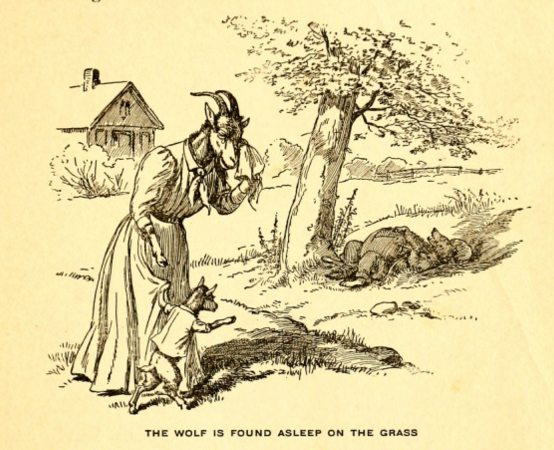
At length she and the kid went out for a walk. When they had gone a few steps, they saw the wolf, where he lay a-sleep on the grass, snor-ing so loud that he shook the leaves on the trees. The old goat looked at him with care and thought she could see some-thing move in-side of him. "Can it be, " she thought, "that my young ones whom he ate are still a-live?"

She at once sent the young kid home for the shears, and with them she cut the wolf o-pen. She had just made a small slit, when one of the kids put his head out. She cut some more, and out it sprang, and then an-oth-er, and an-oth-er, till all were out, as full of life as ever, for the wolf had been so gree-dy that he swal- lowed them whole and had not hurt them a bit. Oh, it was a time of joy! The kids danced and jumped a-bout, they were so full of glee. 

But the old goat said to them, "Go and get some stones, and we will put them in-side of this scamp, and sew him up be-fore he wakes."

So the kids ran in great haste and brought large stones, which they put in-side of the wolf. Then the old goat sewed up the slit and the wolf did not wake nor move. 

When the wolf's sleep was out, he got up, and as the stones gave him a great thirst, he went to a brook for a drink. As he stooped to drink, the weight of the stones made him fall in-to the wa-ter, and he was drowned. 

Then the six young ones gave a shout, "The wolf is dead! The wolf is dead!" and they and their moth-er danced for joy all the way home. 

Brer Rabbit: Mr. Wolf Makes a Failure

In addition to collecting folktales, Harris collected proverbs, too, and you can see Brer Rabbit using a proverb here when Brer Wolf comes knocking at his door, claiming to be a friend: Too many friends spoils the dinner. When Brer Wolf says he is bringing bad news, Brer Rabbit also replies with a proverb: Bad news is soon told. You'll find a collection of proverbs on the last page of this unit.

[Notes by LKG]

This story is part of the Brer Rabbit unit. Story source: Uncle Remus: His Songs and His Sayings by Joel Chandler Harris (1881).


Mr. Wolf Makes a Failure

Brer Fox feel so bad, and he get so mad about Brer Rabbit,  that he don't know what to do, and he look mighty down-hearted. By and by, one day whiles he was going along the road, old Brer Wolf come up with him.


When they done howdying and asking after one another's family connection, Brer Wolf, he allow, he did, that there was something wrong with Brer Fox, and Brer Fox, he allowed there weren't, and he went on and laugh and make great to do 'cause Brer Wolf look like he suspicion something.


But Brer Wolf, he got mighty long head, and he sort of broach about Brer Rabbit's carryings on, 'cause the way that Brer Rabbit deceive Brer Fox done got to be the talk of the neighborhood.


Then Brer Fox and Brer Wolf they sort of palavered on, they did, till by and by Brer Wolf he up and say that he done got plan fix for to trap Brer Rabbit. Then Brer Fox say how. Then Brer Wolf up and tell him that the way for to get the drop on Brer Rabbit was to get him in Brer Fox house. Brer Fox don't know Brer Rabbit of old, and he know that sort of game done wore to a frazzle, but Brer Wolf, he talk mighty persuading.


"How you gonna get him there?" says Brer Fox, says he.

"Fool him there," says Brer Wolf, says he.

"Who gonna do the fooling?" says Brer Fox, says he.

"I'll do the fooling," says Brer Wolf, says he, "if you'll do the gaming," says he.

"How you gonna do it?" says Brer Fox, says he.

"You run along home, and get on the bed, and make like you dead, and don't you say nothing till Brer Rabbit come and put his hands onto you," says Brer Wolf, says he, "and if we don't get him for supper, Joe's dead and Sal's a widow," says he.

This look like mighty nice game, and Brer Fox agreed. So then he amble off home, and Brer Wolf, he march off to Brer Rabbit house. When he got there, it look like nobody at home, but Brer Wolf he walk up and knock on the door—blam! blam! Nobody come. Then he lam aloose and knock again—blim! blim!

"Who there?" says Brer Rabbit, says he.

"Friend," says Brer Wolf.

"Too many friends spoils the dinner," says Brer Rabbit, says he; "which one's this?" says he.

"I fetch bad news, Brer Rabbit," says Brer Wolf, says he.


"Bad news is soon told," says Brer Rabbit, says he.

By this time Brer Rabbit done come to the door, with his head tied up in a red handkerchief.

"Brer Fox died this morning," says Brer Wolf, says he.

"Where your mourning gown, Brer Wolf?" says Brer Rabbit, says he.

"Going after it now," says Brer Wolf, says he. "I just call by for to bring the news. I went down to Brer Fox house little bit ago, and there I found him stiff," says he.


Then Brer Wolf lope off. Brer Rabbit sat down and scratch his head, he did, and by and by he say to hisself that he believe he sort of drop round by Brer Fox house for to see how the land lay. No sooner said than done. Up he jump, and out he went.

When Brer Rabbit got close to Brer Fox house, all look lonesome. Then he went up nigher. Nobody stirring. Then he look in, and there lay Brer Fox stretch out on the bed just as big as life. Den Brer Rabbit make like he talking to hisself.


"Nobody round for to look after Brer Fox—not even Brer Turkey Buzzard ain't come to the funeral," says he. "I hope Brer Fox ain't dead, but I expect he is," says he. "Even down to Brer Wolf done gone and left him. It's the busy season with me, but I'll set up with him. He seem like he dead, yet he mayn't be," says Brer Rabbit, says he. "When a man go to see dead folks, dead folks always raises up their behind leg and hollers, 'wahoo!'" says he.

Brer Fox he stay still.

Then Brer Rabbit he talk little louder, "Mighty funny. Brer Fox look like he dead, yet he don't do like he dead. Dead folks hoists their behind leg and hollers 'wahoo!' when a man come to see 'em," says Brer Rabbit, says he.


(image source)


Sure enough, Brer Fox lift up his foot and holler 'wahoo!' and Brer Rabbit he tear out the house like the dogs was after him.


Brer Wolf mighty smart, but next time you hear from him, he'll be in trouble. You just hold your breath and wait.


(800 words)


Jataka Tales: The Foolhardy Wolf

This Jataka is very much like an Aesop's fable, showing the fatal results of a foolish mistake when an animal aspires to be something he is not. Compare, for example, the fables in the Aesop unit for this class about the donkey who tried to be a lion by putting on a lion's skin or the fable of the donkey who tried to be like his master's pet dog.

[Notes by LKG]

This story is part of the Jataka Tales unit. Story source: More Jataka Tales by Ellen C. Babbitt, illustrated by Ellsworth Young (1922).


The Foolhardy Wolf

A lion bounded forth from his lair one day, looking north, west, south, and east. He saw a Buffalo and went to kill him.

The Lion ate all of the Buffalo-meat he wanted, and then went down to the lake for a drink. As the Lion turned to go toward his den for a nap, he came upon a hungry Wolf. The Wolf had no chance to get away, so he threw himself at the Lion's feet.

"What do you want?" the Lion asked.

"O Lion, let me be your servant," said the Wolf.

"Very well," said the Lion; "serve me, and you shall have good food to eat."

So saying, the Lion went into his den for his nap. When he woke up, the Lion said to the Wolf: "Each day you must go to the mountain top and see whether there are any elephants, or ponies, or buffaloes about. If you see any, come to me and say: 'Great Lion, come forth in thy might. Food is in sight.' Then I will kill and eat, and give part of the meat to you."

So day after day the Wolf climbed to the mountain top and, seeing a pony, or a buffalo, or an elephant, he went back to the den, and falling at the Lion's feet he said: "Great Lion, come forth in thy might. Food is in sight."


Then the Lion would bound forth and kill whichever beast it was, sharing the meat with the Wolf.

Now this Wolf had never had such fine meat to eat, nor so much. So as time went on, the Wolf grew bigger and bigger, and stronger and stronger, until he was really proud of his great size and strength.

"See how big and strong I am," he said to himself.

"Why am I living day after day on food given me by another? I will kill for my own eating. I'll kill an elephant for myself."

So the Wolf went to the Lion, and said: "I want to eat an elephant of my own killing. Will you let me lie in your corner in the den, while you climb the mountain to look out for an elephant? Then when you see one, you come to the den and say, 'Great Wolf, come forth in thy might. Food is in sight.' Then I will kill the elephant."

Said the Lion: "Wolf, only Lions can kill elephants. The world has never seen a Wolf that could kill an elephant. Give up this notion of yours, and eat what I kill."

But no matter what the Lion said, the Wolf would not give way. So at last the Lion said: "Well, have your own way. Lie down in the den, and I will climb to the top of the mountain."

When he saw an elephant the Lion went back to the mouth of the cave, and said: "Great Wolf, come forth in thy might. Food is in sight."

Then from the den the Wolf nimbly bounded forth, ran to where the elephant was, and, howling three times, he sprang at the elephant. But the Wolf missed his aim, and fell down at the elephant's feet. The elephant raised his right foot and killed the Wolf.

Seeing all this, the Lion said, "You will no more come forth in your might, you foolhardy Wolf."


(600 words)


Brer Rabbit: The Awful Fate of Mr. Wolf

At the end of the story, it looks like Brer Wolf has been finished off for good, with his hide hanging in Brer Rabbit's back porch, but much like in the world of Bugs Bunny cartoons, characters can get killed off and then come back again and again, so don't worry: Brer Wolf will be back, despite the awful fate he meets in this story.

[Notes by LKG]

This story is part of the Brer Rabbit unit. Story source: Uncle Remus: His Songs and His Sayings by Joel Chandler Harris (1881).


The Awful Fate of Mr. Wolf

Folks what's always pestering people, and bothering about that what ain't theirs, don't never come to no good end. There was Brer Wolf; instead of minding un his own business, he had to take and go in partnerships with Brer Fox, and there weren't scarcely a minute in the day that he weren't after Brer Rabbit, and he kept on and kept on till first news you knowed he got caught up with—and he got caught up with monstrous bad.

Brer Rabbit ain't see no peace whatsomever. He can't leave home except Brer Wolf'd make a raid and tote off some of the family. Brer Rabbit built him a straw house, and it was tored down; then he made a house out of pine-tops, and that went the same way; then he made him a bark house, and that was raided on, and every time he lost a house he lost one of his chilluns.

Last Brer Rabbit got mad, he did, and cussed, and then he went off, he did, and got some carpenters, and they built him a plank house with rock foundations. After that he could have some peace and quietness. He could go out and pass the time of day with his neighbors, and come back and set by the fire, and smoke his pipe, and read the newspapers same like any man what got a family.


He made a hole, he did, in the cellar where the little Rabbits could hide out when there was much of a racket in the neighborhood, and the latch of the front door caught on the inside. Brer Wolf, he see how the land lay, he did, and he lay low. The little Rabbits was mighty skittish, but it got so that cold chills ain't run up Brer Rabbit's back no more when he heared Brer Wolf go galloping by.


By and by, one day when Brer Rabbit was fixing for to call on Miss Coon, he heared a monstrous fuss and clatter up the big road, and almost before he could fix his ears for to listen, Brer Wolf run in the door. The little Rabbits there went into their hole in the cellar, they did, like blowing out a candle. Brer Wolf was fairly covered with mud, and mighty nigh out of wind.


"Oh, do pray save me, Brer Rabbit!" says Brer Wolf, says he. "Do please, Brer Rabbit! The dogs is after me, and they'll tear me up. Don't you hear 'em coming? Oh, do please save me, Brer Rabbit! Hide me somewheres where the dogs won't get me."

No quicker said than done.

"Jump in that big chest there, Brer Wolf," says Brer Rabbit, says he; "jump in there and make yourself at home."

In jump Brer Wolf, down come the lid, and into the hasp went the hook, and there Mr. Wolf was. Then Brer Rabbit went to the looking-glass, he did, and wink at hisself, and then he drawed the rocking-chair in front of the fire, he did, and took a big chaw tobacco.

Then Brer Rabbit sat there long time, he did, turning his mind over and working his thinking machine. By and by he got up, and sort stir 'round.

Then Brer Wolf open up, "Is the dogs all gone, Brer Rabbit?"

"Seem like I hear one of 'em smelling round the chimney-corner just now."


Then Brer Rabbit get the kettle and fill it full of water, and put it on the fire.

"What you doing now, Brer Rabbit?"

"I'm fixing for to make you a nice cup of tea, Brer Wolf."

Then Brer Rabbit went to the cupboard and get the gimlet, and commence for to bore little holes in the chest-lid.


"What you doing now, Brer Rabbit?"

"I'm boring little holes so you can get breath, Brer Wolf."

Then Brer Rabbit went out and get some more wood, and fling it on the fire.

"What you doing now, Brer Rabbit?"

"I'm a-chunking up the fire so you won't get cold, Brer Wolf."

Then Brer Rabbit went down into the cellar and fetch out all his chilluns.


"What you doing now, Brer Rabbit?"

"I'm a-telling my chilluns what a nice man you is, Brer Wolf."

Amd the chilluns, they had to put their hands on their mouths for to keep from laughing. Then Brer Rabbit he got the kettle and commenced for to pour the hot water on the chest-lid.

"What that I hear, Brer Rabbit?"

"You hear the wind a-blowing, Brer Wolf."

Then the water begin for to sift through.

"What that I feel, Brer Rabbit?"

"You feels the fleas a-biting, Brer Wolf."


"They are biting mighty hard, Brer Rabbit."

"Turn over on the other side, Brer Wolf."

"What that I feel now, Brer Rabbit?"

"Still you feels the fleas, Brer Wolf."


"They are eating me up, Brer Rabbit," and them was the last words of Brer Wolf, 'cause the scalding water done the business.


Then Brer Rabbit call in his neighbors, he did, and there held a regular jubilee; and it you go to Brer Rabbit's house right now, I don't know but what you'll find Brer Wolf's hide hanging in the back-porch, and all 'cause he was so busy with other folkses' doings.


(900 words)


Jataka Tales: The Tricky Wolf and the Rats

As you can guess from the title of this story, this is a trickster tale, with the wolf in the role of the trickster!

[Notes by LKG]

This story is part of the Jataka Tales unit. Story source: More Jataka Tales by Ellen C. Babbitt, illustrated by Ellsworth Young (1922).


The Tricky Wolf and the Rats

Once upon a time a Big Rat lived in the forest, and many hundreds of other Rats called him their Chief.

A Tricky Wolf saw this troop of Rats, and began to plan how he could catch them. He wanted to eat them, but how was he to get them? At last he thought of a plan. He went to a corner near the home of the Rats and waited until he saw one of them coming. Then he stood up on his hind legs.

The Chief of the Rats said to the Wolf, "Wolf, why do you stand on your hind legs?"

"Because I am lame," said the Tricky Wolf. "It hurts me to stand on my front legs."

"And why do you keep your mouth open?" asked the Rat.

"I keep my mouth open so that I may drink in all the air I can," said the Wolf. "I live on air; it is my only food day after day. I can not run or walk, so I stay here. I try not to complain." When the Rats went away the Wolf lay down.

The Chief of the Rats was sorry for the Wolf, and he went each night and morning with all the other Rats to talk with the Wolf, who seemed so poor, and who did not complain.


Each time as the Rats were leaving, the Wolf caught and ate the last one. Then he wiped his lips, and looked as if nothing had happened.

Each night there were fewer Rats at bedtime. Then they asked the Chief of the Rats what the trouble was. He could not be sure, but he thought the Wolf was to blame.

So the next day the Chief said to the other Rats, "You go first this time and I will go last."

They did so, and as the Chief of the Rats went by, the Wolf made a spring at him. But the Wolf was not quick enough, and the Chief of the Rats got away.


"So this is the food you eat. Your legs are not so lame as they were. You have played your last trick, Wolf," said the Chief of the Rats, springing at the Wolf's throat. He bit the Wolf, so that he died.

And ever after the Rats lived happily in peace and quiet.


(400 words)


Aesop's Fables: Wolves

These fables in verse come from Christopher Smart's translation of the verse fables of the Roman poet Phaedrus, and I've again provided notes to clarify the plot.

[Notes by LKG]

These fables are part of the Aesop's Fables (English) unit. Story source: The Fables of Phaedrus, translated by Christopher Smart (1887).


Aesop's Fables: Wolves


This fable is about the injustice of the world which, this time, takes the form of a wolf who is unimpressed by a lamb's protestations of innocence.

The Wolf and the Lamb

BY thirst incited, to the brook
The Wolf and Lamb themselves betook.
The Wolf high up the current drank,
The Lamb far lower down the bank.

Then, bent his ravenous maw to cram,
The Wolf took umbrage at the Lamb.
"How dare you trouble all the flood,
And mingle my good drink with mud?"

"Sir," says the Lambkin, sore afraid,
"How should I act, as you upbraid?
The thing you mention cannot be;
The stream descends from you to me."

Abash'd by facts, says he, "I know
'Tis now exact six months ago
You strove my honest fame to blot."

"Six months ago, sir, I was not."

"Then 'twas th' old ram, thy sire," he cried,
And so he tore him till he died.

To those this fable I address
Who are determined to oppress,
And trump up any false pretence,
But they will injure innocence.


In this fable, the crane also encounters the injustice of the wolf, and does so even more recklessly than the lamb!

The Wolf and Crane

Who for his merit seeks a price
From men of violence and vice
Is twice a fool — first so declared
As for the worthless he has cared;
Then after all, his honest aim
Must end in punishment and shame.

A bone the Wolf devoured in haste,
Stuck in his greedy throat so fast
That, tortured with the pain, he roar'd
And ev'ry beast around implored
That who a remedy could find
Should have a premium to his mind.

A Crane was wrought upon to trust
His oath at length — and down she thrust
Her neck into his throat impure
And so perform'd a desp'rate cure.

At which, when she desired her fee,
"You base, ungrateful minx," says he,
"Whom I, so kind, forbore to kill,
And now, forsooth, you'd bring your bill!"


In this fable, the sheep is more discerning than either the lamb or the crane!

The Sheep, the Stag, and the Wolf

When one rogue would another get
For surety in a case of debt,
'Tis not the thing t' accept the terms,
But dread th' event, the tale affirms.

A Stag approached the Sheep to treat
For one good bushel of her wheat.
"The honest Wolf will give his bond."

At which, beginning to despond,
"The Wolf" (cries she) "'s a vagrant bite,
And you are quickly out of sight;
Where shall I find or him or you
Upon the day the debt is due?"


The sheep in this fable, unfortunately, is not able to win the justice she deserves when falsely accused by a dog and a wolf, although the gods intervene to provide a kind of justice in the end.

The Sheep, the Dog, and the Wolf

Liars are liable to rue
The mischief they 're so prone to do.

The Sheep a Dog unjustly dunn'd
One loaf directly to refund,
Which he the Dog to the said Sheep
Had given in confidence to keep.

The Wolf was summoned, and he swore
It was not one, but ten or more.

The Sheep was therefore cast at law
To pay for things she never saw.

But, lo! ere many days ensued,
Dead in a ditch the Wolf she view'd;
"This, this," she cried, "is Heaven's decree
Of justice on a wretch like thee."


The wolf is a very different kind of symbol in this fable: he no longer represents brute and selfish injustice but instead . . . freedom! The wolf here gets the name "Isengrim" (or "Isgrim") which is the name he has in the Latin and French tradition, just as you earlier saw "Renard" as the name for the fox. You can read more about Latin Ysengrimus at Wikipedia.

The Dog and the Wolf

I will, as briefly as I may,
The sweets of liberty display.

A Wolf half famish'd, chanced to see
A Dog, as fat as dog could be.
For one day, meeting on the road,
They mutual compliments bestowed.

" Prithee," says Isgrim, faint and weak,
"How came you so well fed and sleek?
I starve, though stronger of the two."

"It will be just as well with you,"
The Dog quite cool and frank replied,
"If with my master you'll abide."

"For what?"

                         "Why merely to attend,
And from night thieves the door defend."

"I gladly will accept the post.
What! Shall I bear with snow and frost
And all this rough inclement plight,
Rather than have a home at night,
And feed on plenty at my ease?"

"Come, then, with me" — the Wolf agrees.
But as they went, the mark he found
Where the Dog's collar had been bound.

"What's this, my friend?"
                         "Why, nothing."
                                                  "Nay,
Be more explicit, sir, I pray."

"I'm somewhat fierce and apt to bite;
Therefore they hold me pretty tight
That in the day-time I may sleep
And night by night my vigils keep.
At eveningtide they let me out,
And then I freely walk about.
Bread comes without a care of mine;
I from my master's table dine;
The servants throw me many a scrap,
With choice of pot-liquor to lap,
So, I've my bellyful, you find."

"But can you go where you've a mind?"

"Not always, to be flat and plain."

"Then, Dog, enjoy your post again,
For to remain this servile thing,
Old Isgrim would not be a king."


(700 words)


Jataka Tales: The Lion In Bad Company

This Jataka presents an entirely different picture of the relationship between a lion and a wolf, and this time it is the lion who gets into fatal trouble as a result!

[Notes by LKG]

This story is part of the Jataka Tales unit. Story source: More Jataka Tales by Ellen C. Babbitt, illustrated by Ellsworth Young (1922).


The Lion In Bad Company

One day a young Lion came suddenly upon a Wolf. The Wolf was not able to get away, so he said to the Lion: "Please, Great Lion, could you take me to your den, and let me live with you and your mate? I will work for you all my days."

This young Lion had been told by his father and mother not to make friends with any Wolf. But when this Wolf called him "Great Lion," he said to himself: "This Wolf is not bad. This Wolf is not like other Wolves." So he took the Wolf to the den where he lived with his father and mother.

Now this Lion's father was a fine old Lion, and he told his son that he did not like having this Wolf there. But the young Lion thought he knew better than his father, so the Wolf stayed in the den.

One day the Wolf wanted horse-flesh to eat, so he said to the young Lion, "Sir, there is nothing we have not eaten except horse-meat; let us take a horse."

"But where are there horses?" asked the Lion.

"There are small ponies on the river bank," said the Wolf.

So the young Lion went with the Wolf to the river bank when the ponies were bathing. The Lion caught a small pony, and throwing it on his back, he ran back to his den.


His father said: "My son, those ponies belong to the king. Kings have many skilful archers. Lions do not live long who eat ponies belonging to the king. Do not take another pony."

But the young Lion liked the taste of horse-meat, and he caught and killed pony after pony.

Soon the king heard that a Lion was killing the ponies when they went to bathe in the river. "Build a tank inside the town," said the king. "The lion will not get the ponies there." But the Lion killed the ponies as they bathed in the tank.


Then the king said the ponies must be kept in the stables. But the Lion went over the wall, and killed the ponies in their stables.

At last the king called an archer, who shot like lightning. "Do you think you can shoot this Lion?" the king asked him. The archer said that he was sure he could.

"Very well," said the king, "take your place in the tower on the wall, and shoot him." So the archer waited there in the tower.

By and by the Lion and the Wolf came to the wall. The Wolf did not go over the wall but waited to see what would happen. The Lion sprang over the wall. Very soon he caught and killed a pony. Then the archer let fly an arrow.

The Lion roared, "I am shot."

Then the Wolf said to himself: "The Lion has been shot, and soon he will die. I will now go back to my old home in the woods." And so he did.

The Lion fell down dead.


(500 words)


Jataka Tales: The Wise Goat and the Wolf

This is another Jataka about wolves as tricksters, but this time you will see that the trickster is defeated in the end!

[Notes by LKG]

This story is part of the Jataka Tales unit. Story source: More Jataka Tales by Ellen C. Babbitt, illustrated by Ellsworth Young (1922).


The Wise Goat and the Wolf

Once upon a time, many, many wild Goats lived in a cave in the side of a hill. A Wolf lived with his mate not far from this cave. Like all Wolves they liked the taste of Goat-meat. So they caught the Goats, one after another, and ate them all but one who was wiser than all the others. Try as they might, the Wolves could not catch her.

One day the Wolf said to his mate: "My dear, let us play a trick on that wise Goat. I will lie down here pretending to be dead. You go alone to the cave where the Goat lives, and looking very sad, say to her: 'My dear, do you see my mate lying there dead? I am so sad; I have no friends. Will you be good to me? Will you come and help me bury the body of my mate?' The Goat will be sorry for you and I think she will come here with you. When she stands beside me I will spring upon her and bite her in the neck. Then she will fall over dead, and we shall have good meat to eat."

The Wolf then lay down, and his mate went to the Goat, saying what she had been told to say.

But the wise Goat said: "My dear, all my family and friends have been eaten by your mate I am afraid to go one step with you. I am far safer here than I would be there."

"Do not be afraid," said the Wolf. "What harm can a dead Wolf do to you?"

These and many more words the Wolf said to the Goat, so that at last the Goat said she would go with the Wolf.

But as they went up the hill side by side, the Goat said to herself: "Who knows what will happen? How do I know the Wolf is dead?"

She said to the Wolf, "I think it will be better if you go on in front of me."

The Wolf thought he heard them coming. He was hungry and he raised up his head to see if he could see them. The Goat saw him raise his head, and she turned and ran back to her cave.

"Why did you raise your head when you were pretending to be dead?" the
Wolf asked her mate. He had no good answer.

By and by the Wolves were both so very hungry that the Wolf asked his mate to try once more to catch the Goat.

This time the Wolf went to the Goat and said: "My friend, your coming helped us, for as soon as you came, my mate felt better. He is now very much better. Come and talk to him. Let us be friends and have a good time together."

The wise Goat thought: "These wicked Wolves want to play another trick on me. But I have thought of a trick to play on them."


So the Goat said: "I will go to see your mate, and I will take my friends with me. You go back and get ready for us. Let us all have a good time together."

Then the Wolf was afraid, and she asked: "Who are the friends who will come with you? Tell me their names."

The wise Goat said: "I will bring the two Hounds, Old Gray and Young Tan, and that fine big dog called Four-Eyes. And I will ask each of them to bring his mate."

The Wolf waited to hear no more. She turned, and away she ran back to her mate. The Goat never saw either of them again.


(600 words)


Italian: The Three Goslings

This story is part of the Italian Popular Tales unit. Story source: Italian Popular Tales by Thomas Frederick Crane (1885).

The Three Goslings

ONCE upon a time there were three goslings who were greatly afraid of the wolf, for if he found them he would eat them. One day the largest said to the other two: "Do you know what I think? I think we had better build a little house so that the wolf shall not eat us, and meanwhile let us go and look for something to build the house with."

Then the other two said: "Yes, yes, yes...good! Let us go!"

So they went and found a man who had a load of straw and said to him: "Good man, do us the favor to give us a little of that straw to make a house of so that the wolf shall not eat us."

The man said: "Take it, take it!" and he gave them as much as they wanted. The goslings thanked the man and took the straw and went away to a meadow, and there they built a lovely little house, with a door, and balconies, and kitchen, with everything, in short.

When it was finished, the largest gosling said: "Now I want to see whether one is comfortable in this house."

So she went in and said: "Oh! How comfortable it is in this house! Just wait!" She went, and locked the door with a padlock, and went out on the balcony, and said to the other two goslings: "I am very comfortable alone here; go away, for I want nothing to do with you."

The two poor little goslings began to cry and beg their sister to open the door and let them in; if she did not, the wolf would eat them. But she would not listen to them.

Then the two goslings went away and found a man who had a load of hay. They said to him: "Good man, do us the kindness to give us a little of that hay to build a house with so that the wolf shall not eat us!"

"Yes, yes, yes, take some, take some!" And he gave them as much as they wanted.

The goslings, well pleased, thanked the man and carried the hay to a meadow and built a very pretty little house, prettier than the other. The middle-sized gosling said to the smallest: "Listen, I am going now to see whether one is comfortable in this house, but I will not act like our sister, you know!"

She entered the house and said to herself: "Oh! How comfortable it is here! I don't want my sister! I am very comfortable here alone." So she went and fastened the door with a padlock, and went out on the balcony and said to her sister: "Oh! How comfortable it is in this house! I don't want you here! Go away, go away!"

The poor gosling began to weep and beg her sister to open to her, for she was alone and did not know where to go, and if the wolf found her he would eat her, but it did no good: she shut the balcony and stayed in the house.

Then the gosling, full of fear, went away and found a man who had a load of iron and stones and said to him: "Good man, do me the favor to give me a few of those stones and a little of that iron to build me a house with so that the wolf shall not eat me!"

The man pitied the gosling so much that he said: "Yes, yes, good gosling, or rather I will build your house for you." Then they went away to a meadow, and the man built a very pretty house, with a garden and everything necessary, and very strong, for it was lined with iron, and the balcony and door of iron also. The gosling, well pleased, thanked the man and went into the house and remained there.

Now let us go to the wolf.

The wolf looked everywhere for these goslings but could not find them. After a time, he learned that they had built three houses. "Good, good!" he said; "wait until I find you!"

Then he started out and journeyed and journeyed until he came to the meadow where the first house was. He knocked at the door and the gosling said: "Who is knocking at the door?"

"Come, come," said the wolf; "open, for it is I."

The gosling said, "I will not open for you because you will eat me."

"Open, open! I will not eat you; be not afraid. — Very well," said the wolf, "if you will not open the door, I will blow down your house." And indeed he did blow down the house and ate up the gosling.

"Now that I have eaten one," he said, "I will eat the others too." Then he went away and came at last to the house of the second gosling, and everything happened as to the first: the wolf blew down the house and ate the gosling.

Then he went in search of the third and when he found her, he knocked at the door, but she would not let him in. Then he tried to blow the house down, but could not; then he climbed on the roof and tried to trample the house down, but in vain.

"Very well," he said to himself, "in one way or another I will eat you."

Then he came down from the roof and said to the gosling: "Listen, gosling. Do you wish us to make peace? I don't want to quarrel with you who are so good, and I have thought that tomorrow we will cook some macaroni, and I will bring the butter and cheese, and you will furnish the flour."

"Very good," said the gosling, "bring them then."

The wolf, well satisfied, saluted the gosling and went away. The next day the gosling got up early and went and bought the meal and then returned home and shut the house.

A little later the wolf came and knocked at the door and said: "Come, gosling, open the door, for I have brought you the butter and cheese!"

"Very well, give it to me here by the balcony."

"No indeed; open the door!"

"I will open when all is ready."

Then the wolf gave her the things by the balcony and went away. While he was gone, the gosling prepared the macaroni and put it on the fire to cook in a kettle full of water.

When it was two o'clock, the wolf came and said: "Come, gosling, open the door."

"No, I will not open, for when I am busy I don't want any one in the way; when it is cooked, I will open and you may come in and eat it."

A little while after, the gosling said to the wolf: "Would you like to try a bit of macaroni to see whether it is well cooked?"

"Open the door! That is the better way."

"No, no; don't think you are coming in: put your mouth to the hole in the shelf, and I will pour the macaroni down."

The wolf, all greedy as he was, put his mouth to the hole and then the gosling took the kettle of boiling water and poured the boiling water instead of the macaroni through the hole into the wolf's mouth, and the wolf was scalded and killed.

Then the gosling took a knife and cut open the wolf's stomach, and out jumped the other goslings, who were still alive, for the wolf was so greedy that he had swallowed them whole.

Then these goslings begged their sister's pardon for the mean way in which they had treated her, and she, because she was kind-hearted, forgave them and took them into her house, and there they ate their macaroni and lived together happy and contented.


(1300 words)