Joseph Jacobs (1854-1916) was one of the great English folklorists of the nineteenth century; two of his specialties were Jewish folklore and Aesop's fables. You can read more about him at Wikipedia: Joseph Jacobs. He was born in Australia, moved to England to go to college in 1872, and then in 1900 he moved to New York where he became the editor of the Jewish Encyclopedia. I have relied on several of Jacobs's books for this class, including his collections of English fairy tales, Celtic fairy tales, and Indian fairy tales.
In his two volumes of English fairy tales, Jacobs set out to find folktales and fairy tales that could be considered native to England and the Lowlands of Scotland; in his research, he identified 140 stories that he would put in that category, and he published about 80 of those stories in these two volumes. He undertook the project in what he considered a patriotic spirit, hoping that English children would enjoy reading English fairy tales, in addition to familiar French fairy tales told by Perrault or the German stories of the Brothers Grimm. As Jacobs says in the Notes to the book: "Cinderella and Puss in Boots and their companions ousted Childe Rowland and Mr Fox and Catskin." That's probably still the case today: I would imagine that you have all heard of Cinderella and Puss in Boots, but you probably do not know the story of Mr. Fox . . . although after completing this unit, you will! (And you can learn about Catskin in the unit based on Jacobs's second volume of English fairy tales.)
Many of the stories Jacobs published in these two volumes had not previously been published in English before. Some of the stories he collected were told to him in local dialect, but he rewrote those stories in standard English, with just an occasional dialect word or phrase, as you will see. He hoped that readers would read the book aloud, as he explains in the Preface: "This book is meant to be read aloud, and not merely taken in by the eye." So, please, read the stories aloud or let the LibriVox narrator read the stories to you using the link provided with each story.
Showing posts with label admin. Show all posts
Showing posts with label admin. Show all posts
Background: Aesop's Fables
Aesop's Fables: An Introduction
The Greek and Roman Fables
Aesop's fables are the single most successful storytelling genre of ancient Greece and Rome. The fables were extremely popular in the ancient world, and approximately 600 Aesop's fables have been preserved from the ancient Greek and Latin sources. In addition, the fables continued to be incredibly popular during the Middle Ages and the Renaissance, with many translations into the vernacular languages of Europe. One of the very first books ever published in the English language was a translation of Aesop's fables published by William Caxton in the year 1484. Many of the fables continue to be famous even today, such as the story of "The Tortoise and the Hare" or "The Boy Who Cried Wolf."
If you are interested in getting an overview of the entire spectrum of Aesop's fables from ancient Greece and Rome, you can find all 600 of those ancient fables translated into English at Aesopica.net, a very old website of mine. Aesop's fables are my own academic specialty, and I have been studying them for many years. I hope you will enjoy learning more about them in this class!
Was there really somebody in ancient Greece named Aesop who told the stories that you are reading this week? While it is impossible to prove that such a person did not exist, there is also no concrete historical evidence that he did exist. Because the legends about Aesop are very old, they predate any of our written sources and thus we cannot be sure if the legends are not themselves the source for the "history." The oldest surviving historical reference to Aesop comes from Greek writer Herodotus, who lived in the fifth century B.C.E. Herodotus claims that Aesop was a slave from the island of Samos and that he was killed by the people of Delphi. But the story of Aesop and the Delphians was already an old legend before Herodotus was even born. The fables were part of the oral Greek tradition for centuries before they were written down, and there are allusions to Aesop's fables in classical Greek authors, especially in the playwright Aristophanes. The oldest surviving collection of Aesop's fables is from a Roman source, the poet Phaedrus, who lived in the first century CE.
Defining the Fable
Just what makes an Aesop's fable? In general, the fables are short, sometimes very short. In the reading selection for this week, you will have several fables presented together on a single page, grouped together based on similar characters: stories about lions, stories about the gods, etc. When you take notes on the fables, I would suggest that in your Reading Diary you pick out your favorite fable from each page and just focus on those favorites.
In addition to being short, Aesop's fables are usually, but not always, didactic stories, stories that teach a lesson of some kind. Often that lesson is expressed in the form of a moral. The moral might be spoken by one of the characters inside the story, or it might be added on at the end of the story.
Aesop's method of teaching is usually by a negative exemplum, a negative example rather than a positive one. The plot of the fable is typically about a foolish mistake, and the point of the fable is that you should avoid making that same mistake yourself. Often the mistake is fatal; the characters in Aesop's fables rarely live "happily ever after."
Of course, there are exceptions to these rules. Sometimes a fable might be on the long side; in the later literary fables by European authors such as La Fontaine, the fables can be quite long. There are also fables that teach a positive lesson, giving you an example that you should imitate rather than an example you should avoid.
Finally, you may be surprised to find out that, in the ancient world, Aesop's fables were not intended for children. Originally, the fables of Aesop were stories told by adults for adults, and sometimes with adult themes that would not even be considered suitable for children (some of the fables are downright pornographic). Many of the fables do contain talking animals, but there are also fables about human beings, along with many fables that involve the Greek and Roman gods, as you will see.


Reading Diary Feedback
Please ask questions, provide suggestions, any kind of feedback about the Reading Diaries would be much appreciated! You can click on the comment link to add your comment. Thanks!
Future Planning: Elephant Theme
One of the things I was hoping to do this summer is to create some "themed" units in the UnTextbook. Right now, all the units are based on regional reading units. What I would like to do is to create additional themed units that would be anthologies of stories drawn from different regions, re-using stories already in the UnTextbook, and adding new ones too.
For example, I would like to do a collection of elephant stories! I've listed the elephant stories already in the UnTextbook (11,400 words), and that means I'd have room to create a few more pages. Here's what I've added to the UnTextbook so far:
Aesop: The Lion and the Elephant (Greece: 300 words)
The Crab and the Elephant (India: 800 words)
The Blind Man and the Elephant (India/British: 300 words)
The Elephant-Fighting Hare (India: 300 words)
The Liberation of Gajendra the Elephant (India: 500 words)
The Little Blackbird (India, a cumulative tale, 1200 words)
The Louse and the Crow (another cumulative tale from India, 800 words)
The Judgment of Baboon (South African chain tale, 400 words)
Some more possibilities:
The Great Elephant (Jataka - Inayat)
The Hungry Elephant (Indian folktale)
The Tricked Elephant (Tibetan)
The Elephant's Trunk (Yoruba)
Tortoise, Elephant, and Hippo (Yoruba)
Akiti the Hunter (Yoruba)
Panchatantra: How the Rabbit Fooled the Elephant. This is one of those trickster rabbits, and even the elephant-king is no match for him.
.jpg)


.jpg)

For example, I would like to do a collection of elephant stories! I've listed the elephant stories already in the UnTextbook (11,400 words), and that means I'd have room to create a few more pages. Here's what I've added to the UnTextbook so far:
Aesop: The Lion and the Elephant (Greece: 300 words)
The Crab and the Elephant (India: 800 words)
The Blind Man and the Elephant (India/British: 300 words)
The Elephant-Fighting Hare (India: 300 words)
The Liberation of Gajendra the Elephant (India: 500 words)
The Little Blackbird (India, a cumulative tale, 1200 words)
The Louse and the Crow (another cumulative tale from India, 800 words)
The Judgment of Baboon (South African chain tale, 400 words)
Some more possibilities:
The Great Elephant (Jataka - Inayat)
The Hungry Elephant (Indian folktale)
The Tricked Elephant (Tibetan)
The Elephant's Trunk (Yoruba)
Tortoise, Elephant, and Hippo (Yoruba)
Akiti the Hunter (Yoruba)
Already in the UnTextbook:
Sindbad: Seventh and Last Voyage (Middle East)
South Africa: Elephant and Tortoise (Africa)
South Africa: The Judgment of Baboon (Africa)
~ ~ ~
Santal: The Elephant and the Ants. In this story, the elephant is defeated by even smaller creatures: the ants.
Sindbad: Seventh and Last Voyage. In this adventure, the elephants reveal a secret to Sindbad.
Laos: Why the Lip of the Elephant Droops. A story about the elephant's anatomy.
South Africa: Elephant and Tortoise. A story about a time of drought.
South Africa: The Judgment of Baboon. This is a chain tale involving an elephant, among others!
Jataka: The Elephant that Was Honored in Old Age. The story of a mighty she-elephant.
Jataka: The Elephant that Spared Life. The story of a discerning elephant.
Jataka: The Well-Trained Elephant. A story of the Buddha's past life as an elephant.
Nigeria: Why the Elephant has Small Eyes. Another story about the elephant's anatomy.
Nigeria. Why the Bush Cow and the Elephant are Bad Friends. These two animals are enemies even today.
Nigeria. How the Tortoise overcame the Elephant and the Hippopotamus. The story of a tortoise who is stronger than he looks.
Jataka. The Foolish, Timid Rabbit. This is the "Henny Penny" of Jataka stories, and the elephant is part of the crowd.
Jataka Tales: The King's White Elephant. The story of a grateful elephant.

Jataka Tales: The Elephant and the Dog. A story of animal friendship.

Jataka Tales: The Elephant and the Dog. A story of animal friendship.
Future Planning: Mabinogion
I am not really happy with how Lady Charlotte Guest's Mabinogion unit turned out. I like it a lot, but it has not attracted very many readers, so I would like to find a different Mabinogion source to use. A good candidate might be this book:
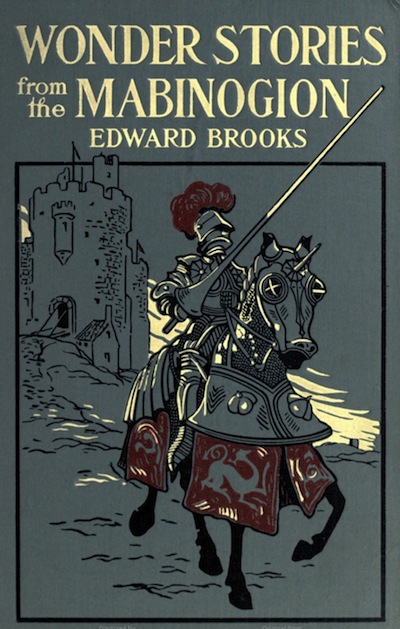
Wonder Stories from the Mabinogion by Edward Brooks (1908); the name of the illustrator is not given.
The book is available at Hathi Trust and at Internet Archive.
Here are the chapters:
The Lady and the Fountain
Kilwch and Olwen
Sir Gawaine and the Green Knight
Peredur, The Son of Evrawc
Geraint and Enid
The Story of Pwyll and Rhiannon
Branwen, The Daughter of Llyr
The Story of Manawyddan and the Mice
The Dream of Maxen Wledig
The Story of Lludd and Llevelys
Llew Llaw and his Wife
The Dream of Rhonabwy
The Story of Taliesen
And here is the Flickr Slideshow of the illustrations:
Wonder Stories from the Mabinogion by Edward Brooks (1908); the name of the illustrator is not given.
The book is available at Hathi Trust and at Internet Archive.
Here are the chapters:
The Lady and the Fountain
Kilwch and Olwen
Sir Gawaine and the Green Knight
Peredur, The Son of Evrawc
Geraint and Enid
The Story of Pwyll and Rhiannon
Branwen, The Daughter of Llyr
The Story of Manawyddan and the Mice
The Dream of Maxen Wledig
The Story of Lludd and Llevelys
Llew Llaw and his Wife
The Dream of Rhonabwy
The Story of Taliesen
And here is the Flickr Slideshow of the illustrations:
Future Planning: Beowulf
I am very happy with the version of Beowulf that I currently have in the UnTextbook, but Beowulf is important enough that I think it might be good to have a second Beowulf unit. That way people who want to read the story twice can do so, comparing two different versions.
The version I currently have is The Story of Beowulf by Strafford Riggs, with illustrations by Henry Pitz (1933).
The version I am thinking of adding is the version of Stories of Beowulf by Henrietta Elizabeth Marshall published in 1908 with pictures by J. R. Skelton. It has an audiobook version! The total length of the audio version is 2 hours (LibriVox - Internet Archive). The printed book is available to Hathi Trust, Google Books, and fully digitized at Baldwin Project.
I made a Flickr Album of the images by J. R. Skelton. My favorite image is the one of Beowulf being blasted by the fire-breathing dragon:

Here is the slideshow:
The version I currently have is The Story of Beowulf by Strafford Riggs, with illustrations by Henry Pitz (1933).
The version I am thinking of adding is the version of Stories of Beowulf by Henrietta Elizabeth Marshall published in 1908 with pictures by J. R. Skelton. It has an audiobook version! The total length of the audio version is 2 hours (LibriVox - Internet Archive). The printed book is available to Hathi Trust, Google Books, and fully digitized at Baldwin Project.
I made a Flickr Album of the images by J. R. Skelton. My favorite image is the one of Beowulf being blasted by the fire-breathing dragon:
Here is the slideshow:
Subscribe to:
Posts (Atom)