Showing posts with label Divinity. Show all posts

God of the Day: Susanoo

Today's god is another god of storms, but this time associated with the sea, not the sky: the Shinto god Susanoo. You can find out more about Susanoo and about the Shinto religion of Japan at Wikipedia.

Susanoo has a brother and a sister: his sister Amaterasu is the goddess of the Sun, and his brother Tsukuyomi is the god of the Moon. You can read the story of Susanoo's quarrel with his sister Amaterasu here, and also about his battle with the eight-headed dragon Orochi.

You will meet the god Susanoo in the Week 2 Myth-Folklore Anthology story: The Eight-Forked Serpent of Koshi.

This carved screen shows Susanoo battling the dragon:


God of the Day: Indra

I'll be focusing on the gods and goddesses who come up in the class readings, and one of the first gods who appears is in the Week 2 Anthology for the Myth-Folklore class: Indra, king of the gods (Devas) in the Vedic Indian tradition, who also appears as a god in Buddhism, under the name Shakra (Shakka). You can read more about Indra at Wikipedia.

Indra is a god of lightning and thunder and storms. He defeats the drought-demon known as Vritra, saving the world by bringing the rains. As his weapon, he wields the thunderbolt (vajra), and his vehicle (vahana) is the celestial elephant Airavata.

In the epics, Indra is the father of the monkey-king Vali in the Ramayana, and in the Mahabharata he is the father of the hero Arjuna, one of the five Pandava brothers.

Here is Indra and his consort Shachi riding on the elephant Airavata:


You will see a reference to Indra by the name Sakka (Shakka, Shakra) in the Myth-Folklore Anthology for Week 2: The Hare that Was not Afraid to Die.

Goddesses of the Day: Valkyries

Since I posted a lovely picture of the Valkyries from Twitter yesterday, I thought I would follow that up with some more information about these goddess. Our English use of the word "Valkyrie" comes from the Old Norse word valkyrja, which is a compound that means choosing (kyrja) those slain in battle (valr). The Valkyries bring their chosen warriors to dwell in Valhalla ("hall of the slain"), which is located in Asgard, the kingdom of the gods ruled over by Odin. You can find out more about the Valkyries at Wikipedia. The Wikipedia article contains excerpts from the Eddas and other ancient testimony about the Valkyries.

Here is a painting of a Valkyrie as imagined by the 19th-century Norwegian artist Peter Nicolai Arbo:


God of the Day: Manannan

Manannan is the Celtic "Son of the Sea" (Manannán mac Lir). He is the god of the dead who ferries souls into the otherworld, and he is also a shapeshifter and trickster. You can find out more at Wikipedia.

Manannan is known for his boat Scuabtuinne ("Wave Sweeper"), and he also travels in a chariot pulled by a horse named Enbarr who could travel over land and sea.

His sword is named Fragarach ("The Retaliator"),  and he also possesses one of the cloaks invisibility (féth fíada).

Some say that the Isle of Man was named after Manannan, or vice versa.

And for the strange story of the stolen statue of Manannan, here is a BBC article: The bizarre theft of a Celtic sea god.


God of the Day: Yama

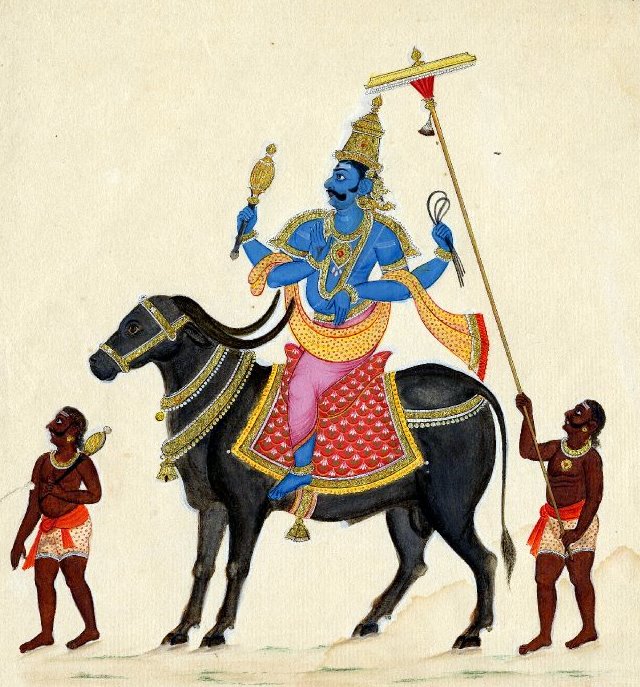
Today's god is Yama, the god of the dead in India. You can read more about Yama at Wikipedia. Yama is also sometimes regarded a god of justice, or Dharma. His abode is in the south, and he has a water-buffalo named Paundraka as his vahana, or vehicle. He is often shown carrying a pasha (a noose or lasso), and sometimes a danda (stick). Yama is assisted by a scribe known as Chitragupta.

In the Mahabharata, Yama (Dharma) is the father of the eldest of the Pandava brothers, Yudhishthira, who later becomes king.

In addition to his important role in Hindu traditions, Yama is also part of the Buddhist tradition; you can find out more about Yama in Buddhism in a separate Wikipedia article: Yama (Buddhism).


One of the comic books on Reserve in Bizzell contains a famous story from the ancient Upanishads about the god Yama and a wise and brave boy named Nachiketa: Nachiketa: A Collection Of Stories From The Upanishads. Bizzell Reserves call number: PN 6790 .I443 A437 v.702. Nachiketa is the son of a sage, and even as a young boy he is occupied with spiritual questions. When his pet deer dies, Nachiketa wants to know whether there is life after death. In a moment of anger, his father curses him to become a gift to Yama, the god of death. Nachiketa obediently marches to the abode of Yama, and Yama grants him three boons. Nachiketa asks for his father to be cheerful, then he asks for a sacrificial rite to alleviate hunger and thirst, and then he wants to know whether there is life after death. When Nachiketa insists on an answer, Yama enlightens him, and Nachiketa goes back home to his father. You can read more about the legend of Nachiketa at Wikipedia.

God and Goddess of the Day: Apollo and Artemis

After the twin gods Castor and Pollux, I thought I would move on to the most famous twins of the Greek pantheon: Apollo and Artemis (called Diana by the Romans), the twin children of Leto; their father was Zeus.

Apollo was known as the god of music, along with healing and with the sun, and also archery.. See Wikipedia for the many myths in which Apollo figured prominently, such as the story of Apollo and Daphne, Apollo and Hyacinth, and Apollo and the Python, to name just a few.

Like Apollo, Artemis was also a great archer, a virgin goddess of the hunt, and she was associated with the moon. You can find out more at Wikipedia, where there are also articles about Artemis stories such as Artemis and Orion, Artemis and Actaeon, Artemis and Callisto, and more.

(Apollo and Artemis, circa 500 BCE)


Gods of the Day: Castor and Pollux

After the Ashwins of India, I wanted to move on to the twin horsemen of Greece: Castor and Pollux, also known as the Dioscuri. You can find out more at Wikipedia.


Both Castor and Pollux are sons of the mortal woman Leda, but Pollux was the son of Zeus (who famously seduced Leda in the form of a swan), while Castor was the son of Leda's husband, Tyndareus, King of Sparta. Their sisters were Helen, wife of Menelaus (later known as Helen of Troy) and Clytemnestra, wife of Agamemnon.

The twins were worshipped in both Greece and Rome; these are the ruins of the Temple of Castor and Pollux in Rome:


Gods of the Day: Ashwins

After writing about the Celtic horse-goddess Epona, I wanted to be sure to include the Ashwins, the twin horsemen of Indian mythology. You can find out more about them at Wikipedia and at the Ancient History Encyclopedia.

Their name is from the same root as the word for horse, ashwa; you can see the same root in the word for the horse-sacrifice, ashwamedha. They are also called the Ashwini Kumaras, the "Ashwin Boys."

The Ashwins received their name because of their skill as horsemen and charioteers. As sons of Surya, the sun-god, they are associated with the sky-chariot that brings the sun at sunrise and leads the sun away at sunset. They are also associated with medicine and healing.

Ashwin is also the name of a month in the Hindu calendar, as well as being the name of a constellation.

The Ashwins are important characters in the Mahabharata because they are the divine fathers of the twin Pandava heroes, Nakula and Sahadeva. Nakula, in particular, has great skill with horses, and during the year of hiding, he disguises himself as a horse-trainer in the employ of King Virata. Because they are the sons of the Ashwins, Nakula and Sahadeva are sometimes called Ashvineya.


You will find two different legends about the Ashwins in this comic book on Reserve in Bizzell Library:  Ashwini Kumars: Tales of Devotion from the Vedas.

Goddess of the Day: Epona

Although the goddess Epona was originally a Celtic horse goddess, she later acquired a place in the Roman pantheon, being worshiped throughout the Roman empire (see the sculpture belong that comes from Macedonia, for example). You can find out more at Wikipedia.

Her name itself, which is from the Celtic language of the ancient Gauls, means "Great Mare." You can learn more about the blending of Gaulish (Celtic) and Roman religion at Wikipedia.

This sculpture of Epona is from Roman Macedonia, circa 400 C.E.


This sculpture of the goddess Epona comes from Germany, circa 200 C.E.


Goddess of the Day: Hestia

After writing about Agni, the fire-god of India, I wanted to move on to a fire-goddess, so I chose Hestia, the virgin hearth-goddess of Greek mythology. You can read more about Hestia at Wikipedia; her counterpart in Roman religion was Vesta.

Hestia was one of the Olympian gods and goddesses, being one of the children of Cronus and Rhea. Hestia was the first one that Cronus swallowed, and she was the last to come back out after Zeus compelled Cronus to vomit them back out again; this made Hestia both the oldest daughter (first born) and the youngest daughter (the last to be born again). Later on, though, Hestia was not always included in the list of the Twelve Olympians, having been displaced by the newcomer, Dionysus.

This depiction is from a sixth-century tapestry called the Hestia Tapestry:


God of the Day: Agni

After writing about Xiuhtecuhtli, the Aztec god of fire, I thought I would move on to Agni, the god of fire in India. Agni is one of the ancient gods, dating back to the Vedic period of Indian religion; you can find out more at Wikipedia. The name Agni is related to the Latin word for fire, ignis, which you can see at work in the English word "ignite" and "ignition."

Agni plays an important role in the Ramayana in the agnipariksha ("test by fire"), when Sita demonstrates her purity by entering into the fire. In the legend of the Maya Sita, the god Agni returns the true Sita to Rama in that moment.


In the Mahabharata, Agni has decided to burn the Khandava Forest, and asks for help from Arjuna and Krishna to keep the storm god, Indra, from putting out the fire before Agni has consumed the whole forest. Here's an amazing modern painting of that story by Parama Libralesso:


And here's a traditional depiction of Agni riding a ram (British Museum):


God of the Day: Xiuhtecuhtli

Today's god is the Aztec god of fire and of day, called Xiuhtecuhtli. He is also known as the Lord of Turquoise, based on a close association between turquoise and fire, and he was also the god of time and of the year. You can find out more at Wikipedia.

This mask of Xiuhtecuhtli is a turquoise mosaic, dating to around 1400 or 1500. There is an essay about this mask at the Ancient History Encyclopedia.