Showing posts with label Unit: Fables of La Fontaine. Show all posts

Myth-Folklore Unit: Fables of La Fontaine

Overview. While the fables of Aesop started out as oral folklore, over the centuries many poets have retold the fables in literary verse. And, without a doubt, the most famous "Aesopic poet" would be Jean de La Fontaine, a 17th-century French poet whose brilliant, witty verse fables are now known all over the world. In this unit, you will read some of La Fontaine's fables as rendered in English verse (from Fables in Rhyme for Little Folks by W. T. Larned and Fables of La Fontaine by Elizur Wright), and I hope you will have time to read at least some of the poems out loud to appreciate the rhymes and word play which the English translators have employed to capture the charms of La Fontaine's French. Another distinctive feature of La Fontaine's fables is that, in addition to the Greek and Roman stories, he also borrowed from the storytelling traditions of India. So, you will find stories here that go back to ancient Greece and Rome, along with tales from ancient India too!

Language. This unit consists of English verse translations of La Fontaine's poetry, closely imitating La Fontaine's wonderful rhyming style.

Story Length: Aesop's fables are quite short, so there are multiple stories on each page. Two different translators are included: Larned's poems are intended for children, so they tend to be shorter, while the Wright translation consists of longer poems.

Navigation. You will find the table of contents below, and you can also use this link to see the story posts displayed on two pages total: Fables of La Fontaine. Click "Older Posts" at the bottom of that page to see the second page.

Additional Resources. There is an Aesop Index page for all the fables in the various Aesop units in this course, and you can use this link to see the four different Aesop units listed on a single page. If you would like to see all 600 of the fables that are part of the Greek and Roman Aesop tradition, you can find a listing at Aesopica.net.


Free audiobook available:

READING A:
  1. Foolish Animals (Larned, with audio)
  2. More Foolish Animals (Larned, with audio)
  3. Foxes (Larned, with audio)
  4. Birds (Larned, with audio)
  5. Insects (Larned, with audio)
  6. Foolish People (Larned, with audio)
  7. Foxes and Wolves (Wright)
  8. Horses (Wright)
  9. Dogs (Wright)
  10. Cats (Wright)
READING B:
  1. Mice (Wright)
  2. More Mice (Wright)
  3. The Tortoise; The Bat (Wright)
  4. Frogs (Wright)
  5. The Swallow; The Eagle (Wright)
  6. Man and Beast (Wright)
  7. The Astrologer; The Dairywoman (Wright)
  8. The God Mercury; Hercules (Wright)
  9. Sun and Wind; Belly and Members (Wright)


La Fontaine: Foolish Animals (Larned)

These stories are part of the La Fontaine unit. Story source: Fables in Rhyme for Little Folks by W. T. Larned and illustrated by John Rae (1918).


The Hare and the Tortoise

LIBRIVOX AUDIO: The Hare And The Tortoise

Said the Tortoise one day to the Hare:
"I'll run you a race if you dare.
I'll bet you cannot
Arrive at that spot
As quickly as I can get there."

Quoth the Hare: "You are surely insane.
Pray, what has affected your brain?
You seem pretty sick.
Call a doctor in — quick,
And let him prescribe for your pain."

"Never mind," said the Tortoise. "Let's run!
Will you bet me?" "Why, certainly." "Done!"
While the slow Tortoise creeps
Mr. Hare makes four leaps,
And then loafs around in the sun.

It seemed such a one-sided race,
To win was almost a disgrace.
So he frolicked about
Then at last he set out--
Too late! Though he sped like a dart,

The Tortoise was first. She was smart:
"You can surely run fast,"
She remarked. "Yet you're last.
It is better to get a good start."


The Ass In The Lion's Skin

LIBRIVOX AUDIO: The Ass In The Lion's Skin

An Ass in The Lion's skin arrayed
Made everybody fear.
And this was queer,
Because he was himself afraid.

Yet everywhere he strayed
The people ran like deer.
Ah, ah! He is betrayed:
No lion has that long and hairy ear.

Old Martin spied the tip, and country folk,
Who are not in the secret of the joke,
With open mouths and eyes
Stare at old Martin's prize —
A Lion led to mill, with neck in yoke.


There was a little Frog
Whose home was in a bog,
And he worried 'cause he wasn't big enough.

He sees an ox and cries:
"That's just about my size,
If I stretch myself--Say Sister, see me puff!"
See me puff!

So he blew, blew, blew,
Saying: "Sister, will that do?"

But she shook her head. And then he lost his wits.
For he stretched and puffed again
Till he cracked beneath the strain,
And burst, and flew about in little bits.


(300 words)

La Fontaine: More Foolish Animals (Larned)

These stories are part of the La Fontaine unit. Story source: Fables in Rhyme for Little Folks by W. T. Larned and illustrated by John Rae (1918).


The Dog And His Image


A foolish Dog, who carried in his jaw
A juicy bone,
Looked down into a stream, and there he saw
Another one,

     Splash! In he plunged... The image disappeared —

The meat he had was gone.
Indeed, he nearly sank,
And barely reached the bank.


The City Mouse and the Country Mouse

LIBRIVOX AUDIO: The City Mouse And The Country Mouse

A City Mouse, with ways polite,
A Country Mouse invited
To sup with him and spend the night.
Said Country Mouse: "De—lighted!"

In truth it proved a royal treat,
With everything that's good to eat.

Alas! When they had just begun
To gobble their dinner,
A knock was heard that made them run.
The City Mouse seemed thinner.

And as they scampered and turned tail,
He saw the Country Mouse grow pale.

      A knock was heard.

The knocking ceased. A false alarm!
The City Mouse grew braver.
"Come back!" he cried. "No, no! The farm,
Where I'll not quake or quaver,
Suits me," replied the Country Mouse.
"You're welcome to your city house."


The Monkey and the Cat


Jocko the Monkey, Mouser — his chum, the Cat,
Had the same master. Both were sleek and fat,
And mischievous. If anything went wrong,
The neighbors where not blamed. Be sure of that.

Jocko, 'tis said was something of a thief;
Mouser, if truth be told, would just as lief
Much stolen cheese as chase the midnight mouse.
The praise bestowed on either must be brief.

One day these rogues, stretched flat before the fire,
Saw chestnuts roassting. "Ah! Could we conspire
To jerk them out," said Jocko, "from the coals,
We'd smash the shells and have our heart's desire.

"Come, Brother Mouser! This day 'tis your turn
To do some bold and desperate thing to earn
A reputation. You, who are so quick,
Snatch out the nuts before they start to burn.

"Alas! That I, a Monkey, was not made
To play with fire. But you are not afraid."
So Mouser — pleased, like many a cat or man,
With pretty words — sly Jocko's wish obeyed.

Into the fire he put a practiced paw:
Out came a chestnut clinging to his claw —
Another and another. As they dropped
Jocko devoured them, whether roast or raw.

      So Mouser — pleased — sly Joko's wish obeyed.

A servant enters. Off the robbers run.
Jocko, you may be sure, enjoyed the fun.
But Mouser's paw is sadly singed — for what?
Just to get nuts for Jocko. He got none.


(400 words)

La Fontaine: Foxes (Larned)

These stories are part of the La Fontaine unit. Story source: Fables in Rhyme for Little Folks by W. T. Larned and illustrated by John Rae (1918).

Rosy and ripe, and ready to box,
The grapes hang high o'er the hungry Fox. — 

      He pricks up his ears, and his eye he cocks.

Ripe and rosy, yet so high! — 
He gazes at them with a greedy eye,
And knows he must eat and drink — or die.

When the jump proves to be beyond his power — 
"Pooh!" says the Fox. "Let the pigs devour
Fruit of that sort. Those grapes are sour!"


The Fox and the Stork


Old Father Fox, who was known to be mean,
Invited Dame Stork in to dinner.
There was nothing but soup that could scarcely be seen: — 
Soup never was served any thinner.

And the worst of it was, as I'm bound to relate,
Father Fox dished it up on a flat china plate.

Dame Stork, as you know, has a very long beak:
Not a crumb or drop could she gather
Had she pecked at the plate every day in the week.
But as for the Fox — sly old Father:
With his tongue lapping soup at a scandalous rate,
He licked up the last bit and polished the plate.

Pretty soon Mistress Stork spread a feast of her own;
Father Fox was invited to share it.
He came, and he saw, and he gave a great groan:
The stork had known how to prepare it.

She had meant to get even, and now was her turn:
Father Fox was invited to eat from an urn.

The urn's mouth was small, and it had a long neck;
The food in it smelled most delightful.
Dame Stork, with her beak in, proceeded to peck;
But the Fox found that fasting is frightful.

Home he sneaked. On his way there he felt his ears burn
When he thought of the Stork and her tall, tricky urn.


The Cat and the Fox


The Cat and the Fox once took a walk together,
Sharpening their wits with talk about the weather
And as their walking sharpened appetite, too;
They also took some things they had no right to.

Cream, that is so delicious when it thickens,
Pleased the Cat best. The Fox liked little chickens.

With stomachs filled, they presently grew prouder,
And each began to try to talk the louder — 
Bragging about his skill, and strength, and cunning.
"Pooh!" said the Fox. "You ought to see me running.
Besides, I have a hundred tricks. You Cat, you!
What can you do when Mr. Dog comes at you?"

"To tell the truth," the Cat said, "though it grieve me
I've but one trick. Yet that's enough — believe me!"

There came a pack of fox-hounds — yelping, baying.
"Pardon me", said the Cat. "I can't be staying.
This is my trick." And up a tree he scurried,
Leaving the Fox below a trifle worried.

In vain he tried his hundred tricks and ruses
(The sort of thing that Mr. Dog confuses) — 
Doubling, and seeking one hole, then another — 
Smoked out of each until he thought he'd smother.

At last as he once more came out of cover,
Two nimble dogs pounced on him — all was over!


(500 words)

La Fontaine: Birds (Larned)

These stories are part of the La Fontaine unit. Story source: Fables in Rhyme for Little Folks by W. T. Larned and illustrated by John Rae (1918).


The Raven and the Fox


Mr. Raven was perched upon a limb,
And Reynard the Fox looked up at him;
For the Raven held in his great big beak
A morsel the Fox would go far to seek.

Said the Fox, in admiring tones: "My word!
Sir Raven, you are a handsome bird.
Such feathers! If you would only sing,
The birds of these woods would call you King."

The Raven, who did not see the joke,
Forgot that his voice was just a croak.

He opened his beak, in his foolish pride —
And down fell the morsel the Fox had spied.

"Ha-ha!" said the Fox. "And now you see
You should not listen to flattery.
Vanity, Sir is a horrid vice —
I'm sure the lesson is worth the price."


The Raven Who Would Rival The Eagle


An Eagle swooped from out the sky,
And carried off a sheep.
A Raven seeing him, said: "I
Could do that too if I should try.
His meal comes mighty cheap."

Of all that well-fed flock was one
As fat as fat could be.
The Raven rose, and lit upon
Her back. She seemed to weigh a ton —
So very fat was she.

And, oh! Her wool was wondrous thick:
It would have made a mat.
The Raven's claws are caught, and stick!
He's played himself a pretty trick —
To fly with one so fat.
The Raven's claws are caught, and stick.

"Ba, ba!" "Caw, caw!" cry bird and beast.
The shepherd comes at last:
Sir Raven who would find a feast
Is from the woolly one released,
And in a cage kept fast.


The Heron Who Was Hard To Please


A long-legged Heron, with long neck and beak,
Set out for a stroll by the bank of a creek.

So clear was the water that if you looked sharp
You could see the pike caper around with the carp.

The Heron might quickly have speared enough fish
To make for his dinner a capital dish.

But he was a very particular bird:
His food fixed "just so," at the hours he preferred.

And hence he decided 'twas better to wait,
Since his appetite grew when he supped rather late.

Pretty soon he was hungry, and stalked to the bank.
Where some pondfish were leaping — a fish of low rank.

"Bah, Bah!" said the Bird. "Sup on these? No — not I.
I'm known as a Heron: as such I live high."

Then some gudgeon swam past that were tempting to see,
But the Heron said haughtily: "No — not for me.
For those I'd not bother to open my beak,
If I had to hang 'round come next Friday a week."

Thus bragged the big Bird. But he's bound to confess
That he opened his elegant beak for much less.
Not another fish came. When he found all else fail,
He was happy to happen upon a fat snail.


(400 words)

La Fontaine: Insects (Larned)

These stories are part of the La Fontaine unit. Story source: Fables in Rhyme for Little Folks by W. T. Larned and illustrated by John Rae (1918).


The Grasshopper and the Ant

All summer long,
Now found winter stinging
And ceased in his song.
Not a morsel or crumb in his cupboard — 
So he shivered,and ceased in his song.

Miss Ant was his neighbor;
To her he went:
"O, you're rich from labor,
And I've not a cent.
Lend me food, and I vow I'll return it,
Though at present I have not a cent."

The Ant's not a lender,
I must confess.
Her heart's far from tender
To one in distress.

So she said: "Pray, how passed you the summer,
That in winter you come to distress?"
"I sang through the summer,"
Grasshopper said.
"But now I am glummer
Because I've no bread."

"So you sang!" sneered the Ant. "That relieves me.
Now it's winter — go dance for your bread!"


The Dove and the Ant


An Ant, who in a brook would drink,
Fell off the bank. He tried
To swim, and felt his courage sink — 
This ocean seemed so wide.
But for a dove who flew above
He would have drowned and died.

The friendly Dove within her beak
A bridge of grass-stem bore:
On this the Ant, though worn and weak,
Contrived to reach the shore.
Said he: "The tact of this kind act
I'll cherish evermore."

Behold! A barefoot wretch went by
With slingshot in his hand.
Said he: "You'll make a pigeon pie
That will be kind of grand."
He meant to murder the gentle bird — 
Who did not understand.

The Ant then stung him on the heel
(So quick to see the sling).
He turned his head and missed a meal:
The pigeon pie took wing.
And so the Dove lived on to love — 
Beloved by everything.


The Lion and the Gnat


The Lion once said to the Gnat: "You brat,
Clear out just as quick as you can, now — scat!
If you meddle with me
I will not guarantee
That you won't be slammed perfectly flat — 
D'ye see?"
Said the Gnat: 
"Because you're called King — you thing! — 
You fancy that you will make me take wing.
Why, an ox weighs much more,
Yet I drive him before
When I get good and ready to sting.
Now, roar!"

Then loudly his trumpet he blew.
And — whew!
How fiercely and fast at his foe he flew.
From the tail to the toes
He draws blood as he goes.
Then he starts in to sting and to chew
His nose.

Sir Lion was mad with the pain.
In vain
He roared and he foamed and he shook his mane.
All the beasts that were nigh
Fled in fear from his cry.
But the Gnat only stung him again — 
In the eye.

He looked and laughed as he saw
— Haw, Haw! — 
The Lion self-torn by his tooth and claw,
So His Majesty's hide
With his own blood was dyed.
Said the Gnat: "Shall I serve you up raw — 
Or fried?"

It's finished. The Lion's loud roar is o'er.
He's bitten and beaten, he's sick and sore.
But a spider's web spread
Trapped the Gnat as he sped
With the news... He will never fight more — 
He's dead!


(500 words)

La Fontaine: Foolish People (Larned)

These stories are part of the La Fontaine unit. Story source: Fables in Rhyme for Little Folks by W. T. Larned and illustrated by John Rae (1918).


The Hen With The Golden Eggs


To this lesson in greed,
Pray, little ones, heed:

Each day, we are told,
A most wonderful Hen
Laid an egg made of gold
For this meanest of men.

So greedy was he,
He was not satisfied.
"What is one egg to me?
I want all that' inside!"

He cut off her head,
And began to explore.
But the poor hen was dead.
And could lay eggs no more.


The Acorn and the Pumpkin


Once there was a country bumpkin
Who observed a great big pumpkin
To a slender stem attached;
While upon an oak tree nourished,
Little acorns grew and flourished.
"Bah!" said he. "That's badly matched."

"If, despite my humble station,
I'd a hand in this Creation,
Pumpkins on the oaks would be;
And the acorn, light and little,
On this pumpkin stem so brittle
Would be placed by clever Me."

Then, fatigued with so much thought, he
Rest beneath the oak tree sought. He
Soon in slumber found repose
But, alas! An acorn, falling
On the spot where he lay sprawling,
Hit him — plump! — upon the nose.

Up he jumped — a wiser bumpkin.
"Gosh!" he said. "Suppose a pumpkin
Came a-fallin' on my face!
After all, if I had made things,
I'll allow that I'm afraid things
Might be some what out of place."


The Miller, His Son and the Ass


A Miller and Son once set out for the fair,
To sell a fine ass they had brought up with care;
And the way that they started made everyone stare.
To keep the Ass fresh, so the beast would sell dear
On a pole they slung him. It surely seemed queer:
He looked, with heels up, like some huge chandelier.

One person who passed them cried out in great glee.
"Was there anything ever so silly?" said he.
"Can you guess who the greatest Ass is of those three?"
The Miller at once put the brute on the ground;
And the Ass, who had liked to ride t'other way round,
Complained in language of curious sound.

No matter. The Miller now made his Son ride,
While he followed after or walked alongside.
Then up came three merchants. The eldest one cried;
"Get down there, young fellow! I never did see
Such manners: — a gray-beard walks where you should be.
He should ride, you should follow. Just take that from me!"

"Dear Sirs," quoth the Miller, "I'd see you content."
He climbed to the saddle; on foot the boy went...
Three girls passed. Said one: "Do you see that old Gent?
There he sits, like a bishop. I say it's a shame,
While that boy trudging after seems more than half lame."
"Little girl," said the Miller, "go back whence you came."

Yet this young creature so worked on his mind
That he wanted no woman to call him unkind:
And he said to his Son: "Seat yourself here — behind."
With the Ass bearing double they jogged on again,
And once more met a critic, who said: "It is plain
Only dunces would give their poor donkey such pain.

He will die with their weight: it's a shame and a sin.
For their faithful servant they care not a pin.
They'll have nothing to sell at the fair but his skin."
"Dear me!" said the Miller, "what am I to do?
Must I suit the whole world and the world's father, too?
Yet it must end some time — so I'll see the thing through."

Both Father and Son now decided to walk,
While the Ass marched in front with a strut and a stalk;
Yet the people who passed them continued to talk.
Said one to another: "Look there, if you please,
How they wear out their shoes, while their Ass takes his ease.
Were there ever, d'ye think, three such asses as these?"

Said the Miller: "You're right. I'm an Ass! It is true.
Too long have I listened to people like you.
But now I am done with the whole kit and crew.
"Let them blame me or praise me, keep silent or yell,
My goings and comings they cannot compel.
I will do as I please!"...So he did — and did well.


(600 words)

La Fontaine: Foxes and Wolves (Wright)

These stories are part of the La Fontaine unit. Story source: The Fables of La Fontaine translated by Elizur Wright (1882).

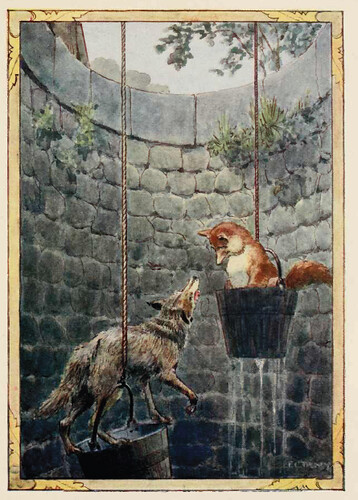
The Wolf and the Fox

Why Aesop gave the palm of cunning
Over flying animals and running
To Renard Fox, I cannot tell,
Though I have searched the subject well.

Has not Sir Wolf an equal skill
In tricks and artifices shown,
When he would do some life an ill,
Or from his foes defend his own?

I think he has, and, void of disrespect,
I might, perhaps, my master contradict:
Yet here's a case, in which the burrow-lodger
Was palpably, I own, the brightest dodger.

One night he spied within a well,
Wherein the fullest moonlight fell,
What seemed to him an ample cheese.

Two balanced buckets took their turns
When drawers thence would fill their urns.

Our fox went down in one of these,
By hunger greatly pressed to sup,
And drew the other empty up.

Convinced at once of his mistake,
And anxious for his safety's sake,
He saw his death was near and sure,
Unless some other wretch in need
The same moon's image should allure
To take a bucket and succeed
To his predicament, indeed.

Two days passed by, and none approached the well;
Unhalting Time, as is his wont,
Was scooping from the moon's full front,
And, as he scooped, Sir Renard's courage fell.

His crony wolf, of clamorous maw,
Poor fox at last above him saw,
And cried, "My comrade, look you here!
See what abundance of good cheer!
A cheese of most delicious zest!
Which Faunus must himself have pressed,
Of milk by heifer Io given.
If Jupiter were sick in heaven,
The taste would bring his appetite.
I have taken, as you see, a bite;
But still for both there is a plenty.
Pray take the bucket that I have sent you;
Come down, and get your share."

Although, to make the story fair,
The fox had used his utmost care,
The wolf (a fool to give him credit)
Went down because his stomach bid it —
And by his weight pulled up
Sir Renard to the top.

We need not mock this simpleton,
For we ourselves such deeds have done:
Our faith is prone to lend its ear
To anything which we desire or fear.


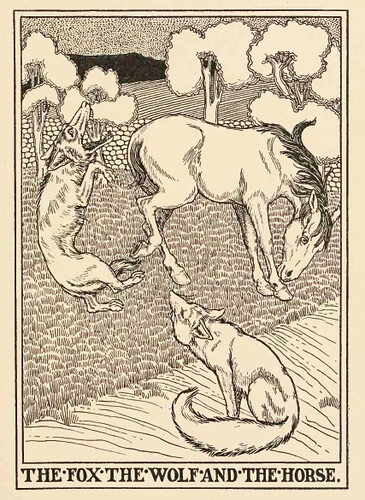
The Fox, the Wolf, and the Horse 

A fox, though young, by no means raw,
Had seen a horse, the first he ever saw!

"Ho! neighbour wolf," said he to one quite green,
"A creature in our meadow I have seen —
Sleek, grand! I seem to see him yet —
The finest beast I ever met."

"Is he a stouter one than we?"
The wolf demanded, eagerly;
"Some picture of him let me see."

"If I could paint," said fox, "I should delight
T" anticipate your pleasure at the sight;
But come; who knows? Perhaps it is a prey
By fortune offered in our way."

They went. The horse, turned loose to graze,
Not liking much their looks or ways,
Was just about to gallop off.

"Sir," said the fox, "your humble servants, we
Make bold to ask you what your name may be."

The horse, an animal with brains enough,
Replied, "Sirs, you yourselves may read my name;
My shoer round my heel has writ the same."

The fox excused himself for want of knowledge:
"Me, sir, my parents did not educate —
So poor, a hole was their entire estate.
My friend, the wolf, however, taught at college,
Could read it were it even Greek."

The wolf, to flattery weak,
Approached to verify the boast;
For which four teeth he lost:
The high raised hoof came down with such a blow,
As laid him bleeding on the ground full low.

"My brother," said the fox, "this shows how just
What once was taught me by a fox of wit —
Which on your jaws this animal has writ:
All unknown things the wise mistrust."

(600 words)

La Fontaine: Horses (Wright)

These stories are part of the La Fontaine unit. Story source: The Fables of La Fontaine translated by Elizur Wright (1882).


The Horse Wishing To Be Revenged On The Stag 

The horses have not always been
The humble slaves of men.

When, in the far-off past,
The fare of gentlemen was mast,
And even hats were never felt,
Horse, ass, and mule in forests dwelt,
Nor saw one then, as in these ages,
So many saddles, housings, pillions —
Such splendid equipages,
With golden-lace postilions —
Such harnesses for cattle,
To be consumed in battle,
As one saw not so many feasts,
And people married by the priests.

The horse fell out, within that space,
With the antlered stag, so fleetly made;
He could not catch him in a race,
And so he came to man for aid.

Man first his suppliant bitted;
Then, on his back well seated,
Gave chase with spear, and rested not
Till to the ground the foe he brought.

This done, the honest horse, quite blindly,
Thus thanked his benefactor kindly:
"Dear sir, I'm much obliged to you;
I'll back to savage life. Adieu!"

"O, no," the man replied;
"You'd better here abide;
I know too well your use.
Here, free from all abuse,
Remain a liege to me,
And large your provender shall be."

Alas! good housing or good cheer,
That costs one's liberty, is dear.

The horse his folly now perceived,
But quite too late he grieved:
No grief his fate could alter;
His stall was built, and there he lived,
And died there in his halter.

Ah! wise had he one small offence forgot:
Revenge, however sweet, is dearly bought
By that one good, which gone, all else is nothing.


The Horse and the Wolf 

A wolf, what time the thawing breeze
Renews the life of plants and trees,
And beasts go forth from winter lair
To seek abroad their various fare —
A wolf, I say, about those days,
In sharp look-out for means and ways,
Espied a horse turned out to graze;
His joy the reader may opine.

"Once got," said he, "this game were fine;
But if a sheep, it were sooner mine.
I can't proceed my usual way;
Some trick must now be put in play."

This said,
He came with measured tread,
As if a healer of disease —
Some pupil of Hippocrates —
And told the horse, with learned verbs,
He knew the power of roots and herbs —
Whatever grew about those borders —
And not at all to flatter
Himself in such a matter,
Could cure of all disorders.

If he, Sir Horse, would not conceal
The symptoms of his case,
He, Doctor Wolf, would gratis heal;
For that to feed in such a place,
And run about untied,
Was proof itself of some disease,
As all the books decide.

"I have, good doctor, if you please,"
Replied the horse, "as I presume,
Beneath my foot, an aposthume."

"My son," replied the learned leech,
"That part, as all our authors teach,
Is strikingly susceptible
Of ills which make acceptable
What you may also have from me —
The aid of skilful surgery;
Which noble art, the fact is,
For horses of the blood I practise."

The fellow, with this talk sublime,
Watched for a snap the fitting time.

Meanwhile, suspicious of some trick,
The wary patient nearer draws
And gives his doctor such a kick,
As makes a chowder of his jaws.

Exclaimed the wolf, in sorry plight,
"I own those heels have served me right:
I erred to quit my trade,
As I will not in future;
Me nature surely made
For nothing but a butcher."


(500 words)

La Fontaine: Dogs (Wright)

These stories are part of the La Fontaine unit. Story source: The Fables of La Fontaine translated by Elizur Wright (1882).


The Wolf and the Dog 

A prowling wolf, whose shaggy skin
(So strict the watch of dogs had been)
Hid little but his bones,
Once met a mastiff dog astray;
A prouder, fatter, sleeker Tray
No human mortal owns.

Sir Wolf in famished plight,
Would fain have made a ration
On his fat relation,
But then he first must fight,
And well the dog seemed able
To save from wolfish table
His carcass snug and tight.

So, then, in civil conversation
The wolf expressed his admiration
Of Tray's fine case.

                           Said Tray, politely,
"Yourself, good sir, may be as sightly;
Quit but the woods, advised by me,
For all your fellows here, I see,
Are shabby wretches, lean and gaunt,
Belike to die of haggard want.
With such a pack, of course it follows,
One fights for every bit he swallows.
Come, then, with me, and share
On equal terms our princely fare."

"But what with you
Has one to do?"
Inquires the wolf.

                   "Light work indeed,"
Replies the dog; "you only need
To bark a little now and then,
To chase off duns and beggar men,
To fawn on friends that come or go forth,
Your master please, and so forth,
For which you have to eat
All sorts of well-cooked meat —
Cold pullets, pigeons, savoury messes —
Besides unnumbered fond caresses."

The wolf, by force of appetite,
Accepts the terms outright,
Tears glistening in his eyes.

But faring on, he spies
A galled spot on the mastiff's neck.
"What's that?" he cries.

             "O, nothing but a speck."

"A speck?"

                      "Ay, ay; It's not enough to pain me;
Perhaps the collar's mark by which they chain me."

"Chain! chain you! What! run you not, then,
Just where you please, and when?"

"Not always, sir; but what of that?"

"Enough for me, to spoil your fat!
It ought to be a precious price
Which could to servile chains entice;
For me, I'll shun them while I have wit."

So ran Sir Wolf, and runs yet.


The Ass and the Dog 

Dame Nature, our respected mother,
Ordains that we should aid each other;
The ass this ordinance neglected,
Though not a creature ill-affected.

Along the road a dog and he
One master followed silently;
Their master slept — meanwhile, the ass
Applied his nippers to the grass,
Much pleased in such a place to stop,
Though there no thistle he could crop.

He would not be too delicate,
Nor spoil a dinner for a plate,
Which, but for that, his favourite dish,
Were all that any ass could wish.

"My dear companion," Towser said,
"It's as a starving dog I ask it —
Pray lower down your loaded basket,
And let me get a piece of bread."

No answer — not a word! — indeed,
The truth was our Arcadian steed
Feared lest, for every moment's flight,
His nimble teeth should lose a bite.

At last, "I counsel you," said he, "to wait
Till master is himself awake,
Who then, unless I much mistake,
Will give his dog the usual bait."

Meanwhile, there issued from the wood
A creature of the wolfish brood,
Himself by famine sorely pinched.

At sight of him the donkey flinched,
And begged the dog to give him aid.

The dog budged not, but answer made:
"I counsel you, my friend, to run,
Till master's nap is fairly done;
There can, indeed, be no mistake,
That he will very soon awake:
Till then, scud off with all your might,
And should he snap you in your flight,
This ugly wolf —why, let him feel
The greeting of your well-shod heel.
I do not doubt, at all, but that
Will be enough to lay him flat."

But before he ceased it was too late;
The ass had met his cruel fate.


(500 words)

La Fontaine: Cats (Wright)

These stories are part of the La Fontaine unit. Story source: The Fables of La Fontaine translated by Elizur Wright (1882).


The Cat Metamorphosed Into A Woman 

A bachelor caressed his cat,
A darling, fair, and delicate;
So deep in love, he thought her mew
The sweetest voice he ever knew.

By prayers, and tears, and magic art,
The man got Fate to take his part;
And, lo! one morning at his side
His cat, transformed, became his bride.

In wedded state our man was seen
The fool in courtship he had been;
No lover ever was so bewitched
By any maiden's charms
As was this husband, so enriched
By hers within his arms.

He praised her beauties, this and that,
And saw there nothing of the cat;
In short, by passion's aid, he
Thought her a perfect lady.

It was night: some carpet-gnawing mice
Disturbed the nuptial joys.

Excited by the noise,
The bride sprang at them in a trice;
The mice were scared and fled.

The bride, scarce in her bed,
The gnawing heard, and sprang again —
And this time not in vain,
For, in this novel form arrayed,
Of her the mice were less afraid.

Through life she loved this mousing course,
So great is stubborn nature's force:
In mockery of change, the old
Will keep their youthful bent;
When once the cloth has got its fold,
The smelling-pot its scent,
In vain your efforts and your care
To make them other than they are —
To work reform, do what you will,
Old habit will be habit still.

Nor fork nor strap can mend its manners,
Nor cudgel-blows beat down its banners;
Secure the doors against the renter,
And through the windows it will enter.


The Eagle, the Wild Sow, and the Cat 

A certain hollow tree
Was tenanted by three:
An eagle held a lofty bough,
The hollow root a wild wood sow,
A female cat between the two.

All busy with maternal labours,
They lived awhile obliging neighbours;
At last the cat's deceitful tongue
Broke up the peace of old and young.

Up climbing to the eagle's nest,
She said, with whiskered lips compressed,
"Our death, or, what as much we mothers fear,
That of our helpless offspring dear,
Is surely drawing near:
Beneath our feet, see you not how
Destruction's plotted by the sow?
Her constant digging, soon or late,
Our proud old castle will uproot,
And then — O, sad and shocking fate! —
She'll eat our young ones, as the fruit!
Were there but hope of saving one,
'Twould soothe somewhat my bitter moan."

Thus leaving apprehensions hideous,
Down went the puss perfidious
To where the sow, no longer digging,
Was in the very act of pigging.

"Good friend and neighbour," whispered she,
"I warn you on your guard to be:
Your pigs should you but leave a minute,
This eagle here will seize them in it;
Speak not of this, I beg, at all,
Lest on my head her wrath should fall."

Another breast with fear inspired,
With fiendish joy the cat retired:
The eagle ventured no egress
To feed her young, the sow still less.

Fools they, to think that any curse
Than ghastly famine could be worse!

Both staid at home, resolved and obstinate,
To save their young ones from impending fate —
The royal bird for fear of mine,
For fear of royal claws the swine.

All died, at length, with hunger,
The older and the younger;
There staid, of eagle race or boar,
Not one this side of death's dread door —
A sad misfortune which
The wicked cats made rich.

O, what is there of hellish plot
The treacherous tongue dares not!
Of all the ills Pandora's box outpoured,
Deceit, I think, is most to be abhorred.


(500 words)

La Fontaine: Mice (Wright)

These stories are part of the La Fontaine unit. Story source: The Fables of La Fontaine translated by Elizur Wright (1882).


The Cockerel, the Cat, and the Young Mouse 

A youthful mouse, not up to trap,
Had almost met a sad mishap;
The story hear him thus relate,
With great importance, to his mother:

"I passed the mountain bounds of this estate,
And off was trotting on another,
Like some young rat with nothing to do
But see things wonderful and new,
When two strange creatures came in view:
The one was mild, benign, and gracious;
The other, turbulent, rapacious,
With voice terrific, shrill, and rough,
And on his head a bit of stuff
That looked like raw and bloody meat,
Raised up a sort of arms, and beat
The air, as if he meant to fly,
And bore his plumy tail on high."

A cock, that just began to crow,
As if some nondescript,
From far New Holland shipped,
Was what our mousling pictured so.

"He beat his arms," said he, "and raised his voice,
And made so terrible a noise,
That I, who, thanks to Heaven, may justly boast
Myself as bold as any mouse,
Scud off (his voice would even scare a ghost!)
And cursed himself and all his house,
For, but for him, I should have staid,
And doubtless an acquaintance made
With her who seemed so mild and good:
Like us, in velvet cloak and hood,
She wears a tail that's full of grace,
A very sweet and humble face —
No mouse more kindness could desire —
And yet her eye is full of fire;
I do believe the lovely creature
A friend of rats and mice by nature.
Her ears, though, like herself, they're bigger,
Are just like ours in form and figure.
To her I was approaching, when,
Aloft on what appeared his den,
The other screamed — and off I fled."

"My son," his cautious mother said,
"That sweet one was the cat,
The mortal foe of mouse and rat,
Who seeks by smooth deceit,
Her appetite to treat;
So far the other is from that,
We yet may eat
His dainty meat,
Whereas the cruel cat,
Whenever she can, devours
No other meat than ours."

Remember while you live,
It is by looks that men deceive.


The Mouse Metamorphosed Into A Maid 

A mouse once from an owl's beak fell;
I had not have picked it up, I wis;
A Brahmin did it: very well —
Each country has its prejudice.

The mouse, indeed, was sadly bruised,
Although, as neighbours, we are used
To be more kind to many others,
The Brahmins treat the mice as brothers;
The notion haunts their heads that when
The soul goes forth from dying men,
It enters worm, or bird, or beast,
As Providence or Fate is pleased,
And on this mystery rests their law,
Which from Pythagoras they're said to draw,
And hence the Brahmin kindly prayed
To one who knew the wizard's trade,
To give the creature, wounded sore,
The form in which it lodged before:
Forthwith the mouse became a maid,
Of years about fifteen,
A lovelier was never seen;
She would have waked, I believe,
In Priam's son, a fiercer flame
Than did the beauteous Grecian dame.

Surprised at such a novelty,
The Brahmin to the damsel cried,
"Your choice is free;
For every he
Will seek you for his bride."

Said she, "Am I to have a voice?
The strongest, then, shall be my choice."

"O sun!" the Brahmin cried, "this maid is thine,
And you shall be a son-in-law of mine."

"No," said the sun, "this murky cloud, it seems,
In strength exceeds me, since he hides my beams;
And him I counsel you to take."

Again the reverend Brahmin spake —
"O cloud, on-flying with your stores of water,
Pray wast you born to wed my daughter?"

"Ah, no, alas! For, you may see,
The wind is far too strong for me;
My claims with Boreas' to compare,
I must confess, I do not dare."

"O wind," then cried the Brahmin, vexed,
And wondering what would hinder next —
"Approach, and, with your sweetest air,
Embrace — possess — the fairest fair."

The wind, enraptured, there blew —
A mountain stopped him as he flew,
To him now passed the tennis-ball,
And from him to a creature small.

Said he, "I had wed the maid, but that
I have had a quarrel with the rat;
A fool were I to take the bride
From one so sure to pierce my side."

The rat! It thrilled the damsel's ear;
To name at once seemed sweet and dear.
The rat! It was one of Cupid's blows;
The like full many a maiden knows,
But all of this beneath the rose:
One smacks ever of the place
Where first he showed the world his face.

Thus far the fable's clear as light;
But, if we take a nearer sight,
There lurks within its drapery
Somewhat of graceless sophistry:
For who, that worships even the glorious sun,
Would not prefer to wed some cooler one?
And does a flea's exceed a giant's might,
Because the former can the latter bite?
And, by the rule of strength, the rat
Had sent his bride to wed the cat,
From cat to dog, and onward still
To wolf or tiger, if you will:
Indeed, the fabulist might run
A circle backward to the sun.

But to the change the tale supposes —
In learned phrase, metempsychosis.

The very thing the wizard did
Its falsity exposes —
If that indeed were ever hid.

According to the Brahmin's plan,
The proud aspiring soul of man
And souls that dwell in humbler forms
Of rats and mice, and even worms,
All issue from a common source,
And, hence, they are the same of course:
Unequal but by accident
Of organ and of tenement,
They use one pair of legs, or two,
Or even with none contrive to do,
As tyrant matter binds them to.

Why, then, could not so fine a frame
Constrain its heavenly guest
To wed the solar flame?

A rat her love possessed.
In all respects, compared and weighed,
The souls of men and souls of mice
Quite different are made —
Unlike in sort as well as size:
Each fits and fills its destined part
As Heaven does well provide,
Nor witch, nor fiend, nor magic art,
Can set their laws aside.


(900 words)

La Fontaine: More Mice (Wright)

These stories are part of the La Fontaine unit. Story source: The Fables of La Fontaine translated by Elizur Wright (1882).

The Council Held By The Rats 

Old Rodilard, a certain cat,
Such havoc of the rats had made,
It was difficult to find a rat
With nature's debt unpaid;
The few that did remain,
To leave their holes afraid,
From usual food abstain,
Not eating half their fill:
And wonder no one will
That one who made of rats his revel,
With rats passed not for cat, but devil.

Now, on a day, this dread rat-eater,
Who had a wife, went out to meet her,
And while he held his caterwauling,
The unkilled rats, their chapter calling,
Discussed the point, in grave debate,
How they might shun impending fate.

Their dean, a prudent rat,
Thought best, and better soon than late,
To bell the fatal cat;
That, when he took his hunting round,
The rats, well cautioned by the sound,
Might hide in safety under ground;
Indeed he knew no other means.

And all the rest
At once confessed
Their minds were with the dean's;
No better plan, they all believed,
Could possibly have been conceived,
No doubt the thing would work right well,
If any one would hang the bell.

But, one by one, said every rat,
"I'm not so big a fool as that."

The plan, knocked up in this respect,
The council closed without effect:
And many a council I have seen,
Or reverend chapter with its dean,
That, thus resolving wisely,
Fell through like this precisely.

To argue or refute
Wise counsellors abound;
The man to execute
Is harder to be found.

The Cat and the Old Rat 


A story-writer of our sort
Historifies, in short,
Of one that may be reckoned
A Rodilard the Second —
The Alexander of the cats,
The Attila, the scourge of rats,
Whose fierce and whiskered head
Among the latter spread,
A league around, its dread;
Who seemed, indeed, determined
The world should be unvermined:
The planks with props more false than slim,
The tempting heaps of poisoned meal,
The traps of wire and traps of steel,
Were only play compared with him!

At length, so sadly were they scared,
The rats and mice no longer dared
To show their thievish faces
Outside their hiding-places,
Thus shunning all pursuit; whereat
Our crafty General Cat
Contrived to hang himself, as dead,
Beside the wall with downward head,
Resisting gravitation's laws
By clinging with his hinder claws
To some small bit of string.

The rats esteemed the thing
A judgment for some naughty deed,
Some thievish snatch,
Or ugly scratch,
And thought their foe had got his meed
By being hung indeed.

With hope elated all
Of laughing at his funeral,
They thrust their noses out in air;
And now to show their heads they dare;
Now dodging back, now venturing more;
At last on the larder's store
They fall to filching, as of yore.

A scanty feast enjoyed these shallows:
Down dropped the hung one from his gallows,
And of the hindmost caught.

"Some other tricks to me are known,"
Said he, while tearing bone from bone,
"By long experience taught;
The point is settled, free from doubt,
That from your holes you shall come out."

His threat as good as prophecy
Was proved by Mr. Mildandsly;
For, putting on a mealy robe,
He squatted in an open tub,
And held his purring and his breath —
Out came the vermin to their death.

On this occasion, one old stager,
A rat as grey as any badger,
Who had in battle lost his tail,
Abstained from smelling at the meal,
And cried, far off, "Ah! General Cat,
I much suspect a heap like that;
Your meal is not the thing, perhaps,
For one who knows somewhat of traps;
Should you a sack of meal become,
I had let you be, and stay at home."

Well said, I think, and prudently,
By one who knew distrust to be
The parent of security.

(500 words)